Armenia Says Construction of TRIPP Corridor to Begin in Late 2026
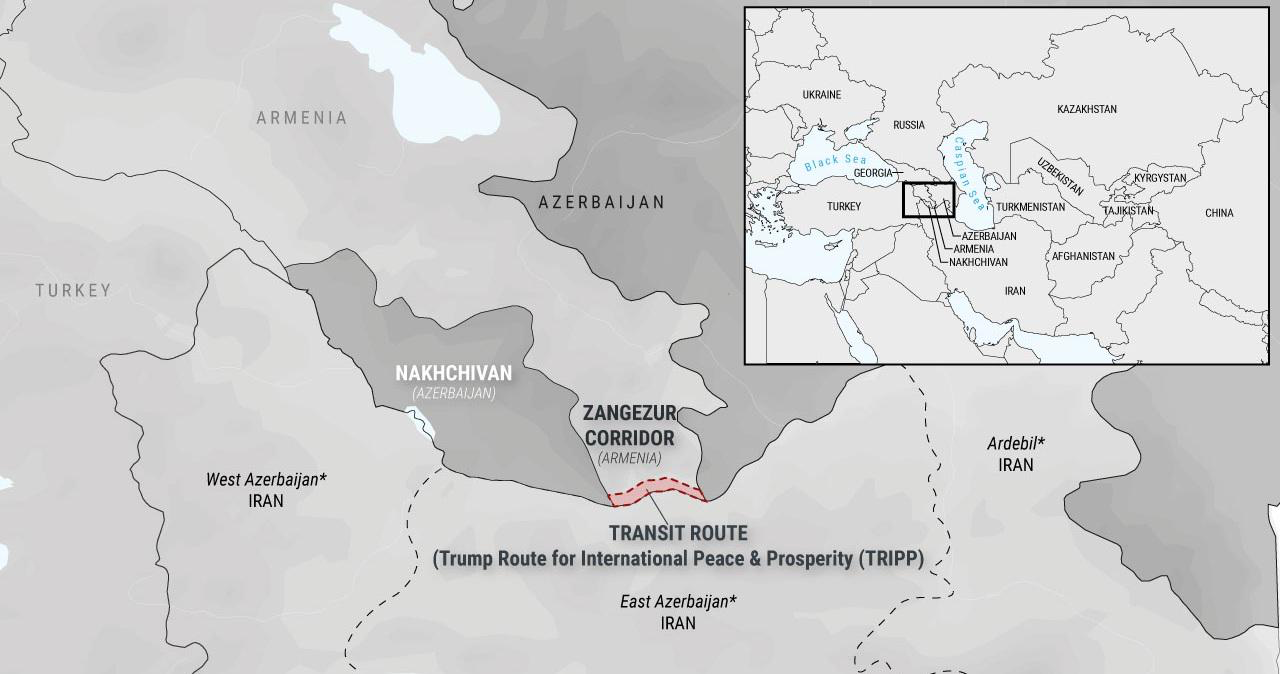
“In the first half of 2026, the parties must agree on all of this, and in the second half, begin construction work,” Pashinyan said during a government session in parliament on Wednesday. He said that while this timeline was the goal, delays could occur but further added that “we will do everything to ensure that this schedule works precisely.”
According to the prime minister, the railway would follow the former Soviet route because building it elsewhere was unrealistic.
In September, a high-level United States delegation led by Deputy Assistant Secretary for European and Eurasian Affairs Brendan Hanrahan visited Armenia to discuss TRIPP. Following the talks, Armenia’s Economy Minister Gevorg Papoyan announced that preparations had shifted from planning to active implementation.
Transport links between Azerbaijan and Armenia had been frozen since the early 1990s, after Armenia’s aggression and the subsequent occupation of Azerbaijani territories. For decades, major regional transport routes, including the Baku–Tbilisi–Kars railway, were built to bypass Armenia despite the possibility of a shorter route through its territory.
Following Azerbaijan’s victory in the 2020 war and the liberation of its occupied lands, discussions began on restoring regional transport connections. Article 9 of the trilateral statement that ended the 2020 war called for the unblocking of all economic and transport links. Under that arrangement, Armenia agreed to ensure safe passage between Azerbaijan’s mainland and its Nakhchivan exclave, a route known as the Zangezur Corridor.
In August, a peace agreement was initialed by the foreign ministers of Azerbaijan and Armenia during a trilateral meeting involving President Ilham Aliyev, Prime Minister Nikol Pashinyan, and United States President Donald Trump in Washington.
The document, titled the “Agreement on the Establishment of Peace and Inter-State Relations between the Republic of Azerbaijan and the Republic of Armenia,” signaled a mutually accepted rapprochement between the two countries, also resolving the long-standing issue of transport connectivity.
Under the trilateral joint declaration, the United States was granted exclusive rights to develop the 42-kilometer TRIPP through Armenian territory. This route forms the Armenian section of the Zangezur Corridor, which is currently under construction in Azerbaijan. The Azerbaijani section of the corridor, the Horadiz–Aghband railway, will connect to TRIPP at the Armenia–Azerbaijan border. Together, the two lines will complete the Zangezur Corridor linking mainland Azerbaijan and its Nakhchivan exclave, with a further extension planned toward the Turkish rail network.
President Aliyev recently said the Zangezur Corridor could open by the end of 2028, while Azerbaijan aims to finish construction of the Horadiz–Aghband railroad by the end of 2026.