What censoring Palestine reveals about French academic 'freedom'
Hèla Yousfi 21 Nov, 2025
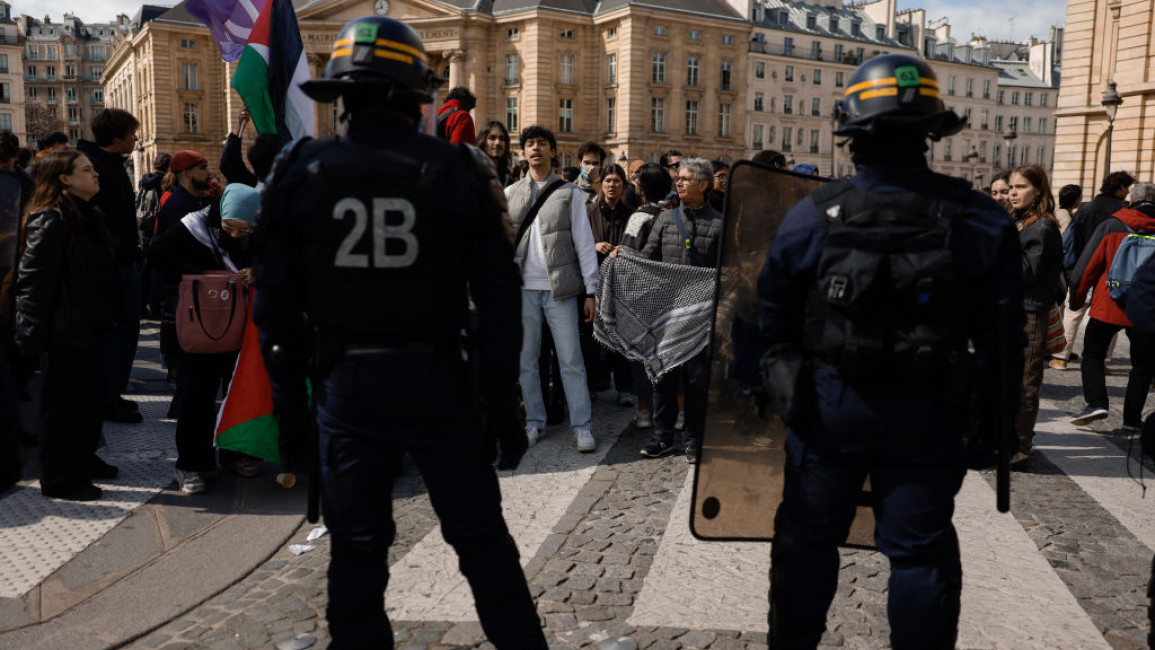
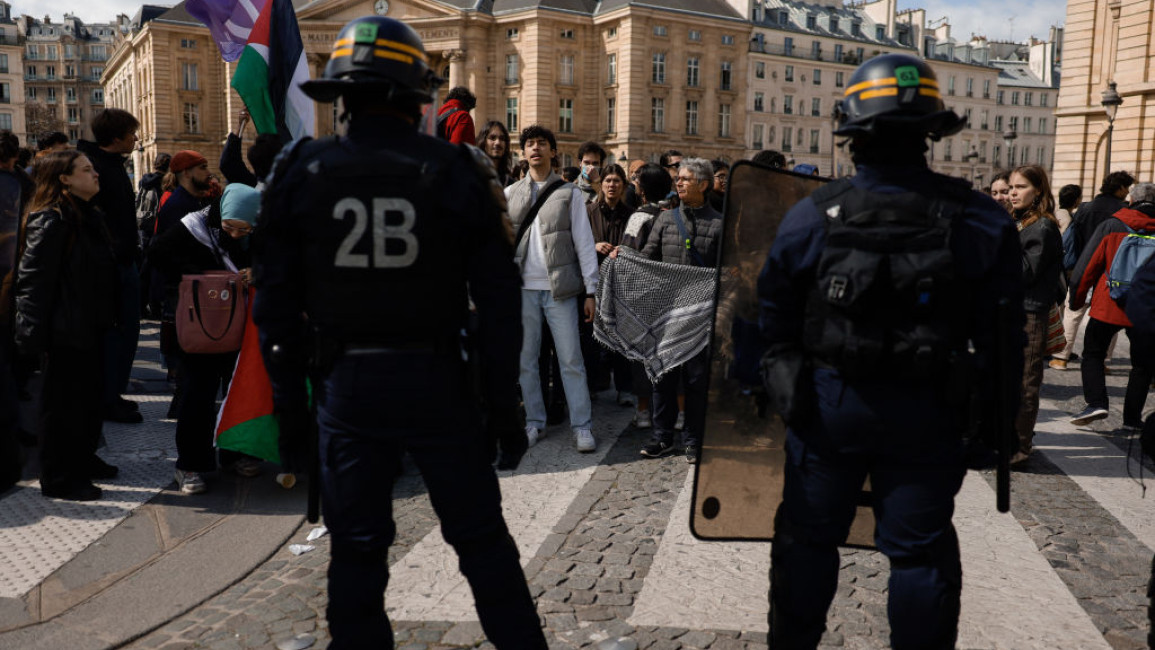
Assaults on free speech and academic freedom, especially when it comes to Palestine, continue to mount, in France as elsewhere. Last week, they escalated again, when an international symposium entitled ‘Palestine and Europe: the weight of the past and contemporary dynamics’ that was to be held at the Collège de France (CdF), was cancelled by Thomas Römer, the CdF’s administrator.
The event, co-organised by historian Henry Laurens and the Arab Centre for Research and Policy Studies in Paris (CAREP), sought to bring together internationally recognised, leading experts on the subject – including academics, the UN special rapporteur Francesca Albanese, and former French Foreign Affairs Minister Dominique de Villepin.
The targeted campaign against the conference was initiated by the right-wing newspaper Le Point and the pro-Israel International League Against Racism and Antisemitism (LICRA), then amplified by social networks close to the far right. Its detractors claimed – without any evidence – that the conference was not, in fact, a coming together of academic experts on the subject, but a ‘pro-Hamas’, ‘partisan’, and ‘activist’ gathering.
The newspaper Blast has also revealed the existence of an organised network of academics called the Research Network on Racism and Antisemitism (RRA), which aims to influence academic institutions and put pressure on their leadership. The RAA, described as ideologically close to the far right, worked behind the scenes to secure the cancellation of the conference planned at the CdF.
The Minister of Higher Education, Philippe Baptiste, amplified this campaign’s unfounded and defamatory accusations and directly exerted pressure on the CdF.
The ministry justified its political intervention under the guise of ‘guaranteeing scientific rigour’ – in direct contravention of its primary mission: to protect academic freedom. Conservative rhetoric invoking neutrality, balance, or security, has – ironically – been used repeatedly to justify far-right silencing campaigns, and the support they receive both in the media and the government.
In response to what they described as ‘a deliberate attempt to prevent academic research on Israel-Palestine when it contravenes the intellectual frameworks promoted by supporters of Israeli policy’, more than 2,500 researchers, teachers and students have since signed a petition calling for Baptiste’s resignation.
Intensifying censorship
Several professors from the Collège de France also denounced this ‘capitulation’ in an opinion piece published in Le Monde, writing that it ‘sets an extremely serious precedent’ because ‘it undermines the very possibility of scientific and intellectual debate on societal issues, as soon as they become the subject of political, partisan, or media interventions, aimed at banning or preventing them’.
Far from being an isolated event, this political episode is part of a broader context of censorship and repression of academic work on Palestine, which has intensified since 7 October 2023. Academic events have been cancelled, the free conduct of academic research challenged, and serious accusations of ‘anti-Semitism’ or ‘apology for terrorism’ have been levelled against Middle East Studies experts.
This assault on those who question the French state's unconditional support for the Israeli government reflects a wider tendency of limits imposed on academic freedom and the silencing of critical voices in France. This is not a new phenomenon, nor is it limited to Palestine. In 2016, for example, the then Minister of Higher Education, Jean Michel Blanquer, launched a similar attack on researchers for their supposed ‘Islamo-leftism’ – implicitly equating ‘critical thinking’, ‘terrorism’, and ‘Islam’.
In an open letter in support of the targeted researchers, the signatories used the term ‘academic authoritarianism’ to describe the government’s assault on academic freedom. A concept that remains sharply relevant today.
Indeed, as the cancelation of the conference at the CdF demonstrates, it has become increasingly normalised for certain areas of research in the social sciences and the humanities, including gender and race studies, as well as postcolonial and decolonial studies, to be discredited by the political establishment and for their practitioners to be directly targeted. ‘Cancel culture’, ‘Woke-ism’, and ‘indigenist drift’, are all expressions used by those in power to censor any questioning of the hegemonic social and political order and to frame anti-racist and decolonial work as divisive or anti-republican.
Such assaults on academic freedom demonstrate a desire to exercise greater control over knowledge production and research in France, as well as an increasingly authoritarian political context. While these attacks on academic freedom occur within an international context marked by the ascendance of authoritarianism, it is also true that they manifest differently depending on the national context.
The state shaping academic freedom
Academic freedom – the right of scholars and academics to express themselves without fear of censorship or institutional retaliation – is not an absolute, fundamental right or a sacred privilege. It is often the outcome of negotiations, historical legacies, and the power relations that structure the academic field, both nationally and internationally.
Beyond the current political and ideological tensions in France, it is the institutional arrangements resulting from the encounter between the various neoliberal reforms of the educational sector, on the one hand, and the authoritarian turn of the state, on the other, that have reshaped the working environment for academic staff and weakened academic freedoms in the country.
In contrast with the US, where academic freedom is understood as a corollary of ‘freedom of _expression_’, in France academic freedom is not understood as a fundamental right. It is a professional privilege reserved for academics, as members of the academic community. It is formally defined as a constitutionally protected principle, guaranteeing independence in teaching and research.
Historically, this protection was extended within a highly centralised university system in which professors, appointed for life as elite civil servants, enjoyed a status-based right to autonomy. Yet this model has always contained a central contradiction: academic freedom is ‘protected’ by the state but also limited by the conditions that the state itself imposes. Therefore, the same framework that shields scholars from external interference also gives political authorities substantial power to shape research agendas, regulate careers, and intervene when academic work diverges from state priorities.
Since the 1990s, neoliberal reforms have transformed the relationship between these two – structurally contradictory – aspects. Laws such as the 2007 Law on the Autonomy of Universities (LRU) and the 2020 Programming and Research Law (LPR), while claiming to extend university ‘autonomy’, have, in practice, consolidated managerial control, weakened collegial governance, increased precarity, and tied research to competitive performance criteria.
These reforms have enabled the French government to not only steer institutional governance, but also to intervene directly in the content of academic output — by censoring certain fields, restricting funding, and pressuring administrators. Rather than a sacred liberty, academic freedom in France is more akin to a conditional privilege, distributed – or withheld – according to political acceptability, institutional power, and broader social hierarchies.
Palestine and the limits of academic dissent
The contemporary resurgence of fascism in the West cannot be understood without acknowledging its deep entanglement with imperialism and colonial violence. Yet, while calls for vigilance against fascism remain commonplace within mainstream discourse, the repression of pro-Palestinian activism reveals the limits of these liberal warnings.
Since October 2023, repression of pro-Palestinian scholarship and activism has intensified sharply across French universities. Conferences have been cancelled, student mobilisations suppressed, academics accused of antisemitism, ‘Islamo-leftism, or ‘apology for terrorism’, and university presidents pressured by the government to maintain strict control over campus dissent.
Arrests, pre-emptive bans, and surveillance practices have targeted students and staffwho express solidarity with Palestinians or who produce critical scholarship on Israel’s policies.
The issue is not merely geopolitical: it reveals how deeply academic freedom is shaped by colonial legacies and racial hierarchies. Racialised populations, particularly Arabs and Muslims, are framed as internal enemies, and critical discourse on Israel’s genocidal war – always coded as a Muslim or Arab concern – is framed as a threat to public order or national unity.
Universities that promote open debate frequently abandon this commitment when the subject is Palestine, demonstrating that academic freedom is contingent and politically regulated.
The state claims to defend universities from ideological threats, yet it is the primary actor reshaping and restricting academic freedom—especially in relation to Palestine. What appears as neutrality often masks political repression. What is framed as protection of the public order frequently serves to silence dissent.
The Palestine question thus reveals the deeper structure of academic governance under authoritarian neoliberalism: academic freedom is selectively invoked to preserve dominant narratives while marginalising critical scholarship. Defending academic freedom, therefore, requires more than appealing to an abstract principle—it requires confronting the political, economic, and colonial forces that determine who may speak, what may be researched, and which lives and struggles are recognised within the university.
Hèla Yousfi is Associate Professor at PSL-Dauphine university. She has conducted research and published on the topic of political culture and organizational practices in Arab countries. Her other areas of interest include institutional change and economic development, decolonial studies of management and social movements. She is the author of: Trade unions and Arab revolutions: The Tunisian case of UGTT , Routledge Research in Employment relations (2017).
Have questions or comments? Email us at: editorial-english@newarab.com
Opinions expressed in this article remain those of the author and do not necessarily represent those of The New Arab, its editorial board or staff.