‘Do Not Awaken the Tiger’: Petro Responds to US Threats against Colombia
Petro warned Washington to stop threatening his country after Trump claimed Colombia could be attacked over drug production.
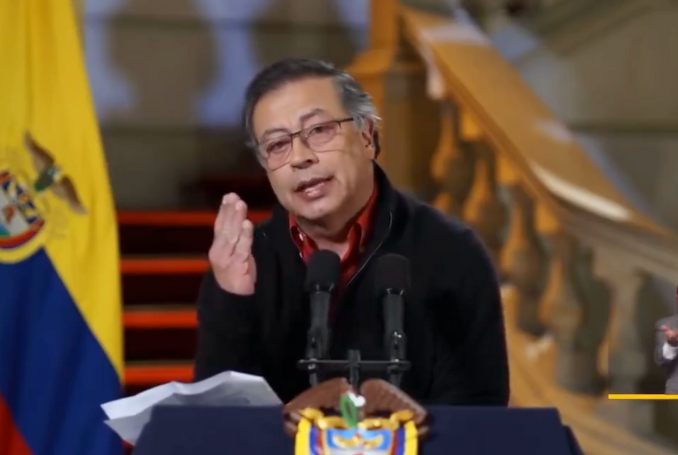
Colombian President Gustavo Petro. (Photo: video grab)Colombian President Gustavo Petro on Tuesday warned Washington to stop threatening his country after US President Donald Trump declared that nations producing cocaine and exporting it to the United States were “vulnerable to attack”.
Speaking on X, Petro responded sharply: “Do not threaten our sovereignty, because you will awaken the tiger. Attacking our sovereignty is tantamount to a declaration of war, so do not destroy two centuries of diplomatic relations.”
Trump claimed during a press conference earlier on Tuesday that Colombia “manufactures cocaine … and sells us cocaine, which we greatly appreciate,” before adding that any country doing so “will be subject to attack (…) not only in Venezuela.”
His comments came as the US military continues a wide-ranging campaign in the Caribbean and Pacific, bombing boats it claims are carrying drugs—raids that have killed more than 80 people since September.
Petro rejected the accusation outright, saying that “if there is one country that has helped stop the consumption of thousands of tons of cocaine in North America, it is Colombia.”
Washington, meanwhile, has escalated its pressure campaign. In an interview with Fox News, US Secretary of State Marco Rubio accused the Nicolás Maduro government of enabling cocaine smuggling through Venezuelan territory and providing a foothold for Iran, the Iranian Revolutionary Guard, and Hezbollah.
Trump has also imposed sanctions on Petro and his relatives, revoked his US visa, and removed Colombia from Washington’s list of allied countries in the fight against drug trafficking.
For Petro, these actions constitute a direct attack on his government and an attempt to influence Colombia’s 2026 elections. He has accused Trump of “interfering in (Colombia’s) internal politics” to ensure the left is removed from power.
Yet, as legal expert and human rights lawyer Daniel Kovalik explained in an exclusive FloodGate interview with Ramzy Baroud, the dispute cannot be separated from Colombia’s break with Israel and its outspoken position on the genocide in Gaza.
Kovalik, who serves as Petro’s attorney in the United States, stressed that the Colombian president’s stance on Palestine is grounded in principle, not political calculation. Petro, he said, “is acting in a more moral, altruistic way. His support for the Palestinians is based on nothing but morality. He gets nothing out of this… nothing but sanctions, threats, war — but he’s doing it anyway.”
The timing of the US sanctions confirms this political motive. They were announced shortly after Petro’s speech at the UN General Assembly, in which he demanded the creation of an international military force to protect Palestinians in Gaza.
“It made it very clear that that speech got him into very hot water with the Trump administration,” Kovalik noted. Targeting Petro’s wife and son, he argued, was a calculated move “to try to quiet him and isolate him on the issue of Palestine.”
Washington’s aggressive posture toward both Colombia and Venezuela, Kovalik said, reflects a broader effort “to finish off what was known as the Pink Tide,” the wave of left-wing governments that challenged US dominance in Latin America. “The US still sees the region as theirs. They think they have the exclusive right to control Latin America.”
This geopolitical context also explains the repeated threats against Venezuela. But, as Kovalik cautioned, a military adventure would be disastrous: “If the US invaded Venezuela, it would be another Vietnam. Eight million Venezuelans have joined militias to defend the country. The US doesn’t have anything close to that.”
Petro’s break with Israel further complicates the picture. Before the current government, Colombia and Israel enjoyed close military cooperation. Kovalik recalled that Israeli advisers played a key role in supporting the country’s most violent paramilitary structures.
Petro’s decision to cut ties with Tel Aviv, Kovalik said, was a “huge and dangerous step”—and the retaliation was swift.
Petro’s attorney said the Colombian president “is a revolutionary himself. He supports revolutionaries. He supports the right to self-determination like those amongst the Palestinians.” And this, more than anything, is what has placed him in Washington’s crosshairs, according to Kovalik.
(The Palestine Chronicle)