“When a mountain falls.”
Stories from Ramla Prison Clinic.
Listen, world, to what I want to tell you. By God, the pain and suffering carried by the sick prisoners in Ramla Prison Clinic: If you placed it on a mountain, that mountain would collapse. It would not withstand it.
—Prisoner, Ramla Clinic
■
7 DECEMBER—I’m pleased to publish here the last of a three-part series based on my encounter in the West Bank a year ago with Rateb al–Hribat. Arrested in 2002 during the Al–Aqsa Intifada for his ostensible involvement with Fatah’s military arm, the Al–Aqsa Martyrs’ Brigades, Rateb spent 22 years in numerous of Israel’s prisons—a “network of torture camps,” to quote from the title of a report published in August 2024 by the human rights organization B’Tselem. He was released in July 2024 at the age of forty-five.
During our conversation, in the fall of 2024 in his home town of Dura, in the governorate of Ramallah, I learned that Rateb had written two books while volunteering at Ramla Prison Hospital, a facility notorious for its medical neglect and abuse. The first of these, Why Can’t I See White, was recently translated into English.
In Part 2 of this series I published the introduction and preface to Rateb’s first book. What follows are three stories from it about various of the prisoners Rateb helped during his volunteer work at Ramla Clinic, as the hospital is also known. Taken together, they sketch a brutal picture of the Ramla facility and the sadism of Israeli doctors and prison officials.
When reading these stories, it must be remembered that Israel’s occupation of Palestine is illegal under international law, making the entire prison system likewise illegal. Under the same statutes, Palestinians have a legally recognized right to armed resistance. It is precisely this legal framework that places each story and, indeed, each life in its proper perspective. Within the claustrophobic environment of Ramla Prison Hospital, where nearly every moment is one of physical or psychological cruelty and suffering, the devotion and care Rateb and other prisoners show for each other are acts of mercy and grace—and, in the end, acts of determination and resistance.
The first and second parts of this series can be read here and here.
I invite you to read these accounts in the spirit of witnessing and as an _expression_ of respect and solidarity.
Thank you.
— C. M.
Rateb al–Hribat.
In the Beginning.
At the beginning of 2015, I was transferred from Ramon to Ramla Prison Clinic to volunteer in serving sick and wounded Palestinian prisoners held in a special section designated for so-called security detainees. At any given time their number ranged between twenty and twenty-four prisoners. This is where my story begins. It is where my journey through pain and suffering started.
I had previously visited this section for medical tests. At the time, I had a simple curiosity to learn about the general conditions there, particularly regarding chronic and long-term illnesses among prisoners who had been suffering for years. Before I started volunteering at Ramla Clinic, my knowledge was very limited. I assumed the men were simply sick prisoners, just ordinary patients. But the harsh reality was completely different.
Two common Arabic sayings come close to describing the hidden reality at Ramla: “The people of Mecca know its paths best.” And, “What you see is not the same as what you hear.”
To an outsider, or to those who visit the facility for medical tests, the sick prisoners appear normal. You might see them smiling, playing, or joking with one another—just like the rest of the detainees. At first glance, the general atmosphere seems ordinary. But the truth, as I discovered, was something else entirely.
■
The Young Lions: Omar al–Rimawi and Ayham al–Sabbah.
Omar and Ayham were two young boys who had not yet reached the age of fifteen. They embodied the love of Palestine in every sense of the word. They were among the young lions who arrived at the Ramla Clinic around May 2016 after carrying out a stabbing operation at a supermarket near a settlement in the West Bank. During that attack one Israeli soldier was killed and another was injured. The two Israelis were from the Golani Brigade, which was formed in 1948 and has since been notorious for its brutality.
Ayham al–Sabbah arrived at the unit two weeks before Omar al–Rimawi. He, Ayham, embodied the purity of innocence and simplicity of childhood. He cried constantly from the pain caused by severed tendons and nerves in his right arm and hand—wounds from expanding bullets.
He called out to me every day, asking, “Where is my friend Omar?” I reassured him, saying, “He will come soon, don’t worry about him. Omar is a strong man, and he will come. There is no other place for prisoners injured in the Al–Aqsa Intifada except this bleak prison.”
Ayham was very intelligent and sharp-minded, far beyond his years. Even though he was young he often said, “I am from al–Qassam Brigades.” He loved the Hamas movement and was obsessed with al–Qassam [the armed wing of Hamas]. Despite our efforts to distract him from his injury, he remained constantly in tears, crying and screaming from the intensity of the pain.
Omar arrived about two weeks later. Their reunion was filled with emotion. They had been classmates in school and now they were reunited in the dark and racist prison clinic.
Omar Rimawi entered the prison ward as a young boy of only fourteen years, but he displayed the maturity and character of a man in his twenties. He was patient in enduring the pain of his own severe wounds.
Omar had serious injuries to his chest and spine. Initially, he couldn’t move at all. Not even to turn from side to side. Despite these injuries and his excruciating suffering, Omar endured his ordeal in silence. He never cried or showed anyone that he was in pain.
Omar’s injuries were so severe the doctor told me he would never be able to stand or walk and would likely be paralyzed for life.
Omar al–Rimawi, this young lion, was a lovable, lighthearted young man. He remained in a pitiable state for about a month, unable to move, enduring his suffering with a spirit of resistance. Omar possessed a strong will, as solid as the stones of Palestine adorned with green trees and red soil. This is a temperament that infuriates the occupiers.
He would say to me, “I want to get off this bed, no matter what it takes!” And indeed, he made remarkable progress every day because of his strong determination. When Omar started physical therapy, he began to refuse painkillers. This reveals the true strength of his character and the depth of his resilience.
Omar said, “I want to walk. I want to return to my normal state despite my injuries.” And he did.
Moreover, he was considerate. He didn’t like to impose upon the other prisoners, those of us who were helping him. Instead, he insisted on doing all of his personal tasks himself, despite his critical condition.
One day I was outside the cell in the canteen purchasing supplies for the prisoners. Meanwhile, Omar needed to go to the bathroom. Can you imagine? He went to the bathroom all alone! He fell on the floor in the bathroom and didn’t call for help. He managed on his own. Omar was a young man of will and determination, and a model of good manners and respect.
Omar loved the Fatah movement [the dominant party in the Palestinian Authority]. One day he said to me, “Do you know why I love the Fatah movement?” I said, “No, I don’t know. Why?” Omar replied, “I came to love the Fatah movement after meeting you.”
Later, when the intelligence officers asked him which movement he belonged to. Omar said, “I belong to the movement of Rateb al–Hribat Abu Jameel.”
After about three months of physical therapy, Omar began to rely more and more on himself for eating, dressing, and moving on his own without assistance. He even started doing simple exercises. This was a reflection of his strong will and deep faith. Omar set a goal for his recovery and worked diligently toward it.
As he was increasingly able to move, Omar continued helping everyone in the cell, especially the other sick prisoners.
Omar was one of those young lions, possessing generosity and kindness, who truly gave to others. He was distinguished by his dignity, courage, and true manhood. Among all young men in the unit he specifically helped others who needed assistance.
The Israeli soldier that Omar killed was three times his size. But by comparison, and despite his small stature, Omar possessed a brave heart and a readiness to sacrifice far beyond that of the occupying soldiers who had invaded our land and desecrated its peace.
Omar was convinced of the justness of his actions. His attack was not a random act but had a clear meaning and purpose. Omar understood what he was doing and why, and he accepted his fate. It was clear to me, from our conversations, that Omar believed Palestine and Jerusalem were worth every sacrifice. This conviction, I believe, is what made Omar so patient and steadfast.
Omar was the top of his class and came from an educated and respected family with a strong social standing. He lacked nothing. But the call of Palestine is heard even by the deaf. How could it not be heard by heroes such as Omar?
Omar’s First Visit.
When Omar visited his family for the first time, they had no idea that he could stand. They thought he was confined to a wheelchair, unable to move or walk. This was all the family knew about their son.
You can imagine the surprise and happiness when they saw Omar standing. His parents were shocked. Suddenly their wishes were mixed with reality, their dreams with the truth. Is this really Omar? The visit was filled with many emotions—relief, sorrow, and tears. Surprisingly, it was Omar who comforted his family and lifted their spirits. It was as if he were a grown man, although at this time he was only fifteen years old.
Omar still remembers the kindness of everyone who helped him and stood by him during his injury, especially the prisoners who assisted him in the Ramla Prison Hospital. He remains in constant contact with them and asks about their families.
This is the young lion and hero, Omar al–Rimawi, a new legend added to the legends of the prisons, the heroes of the resistance operations.
Despite his young age, Omar was sentenced to thirty years in prison and a fine of one million shekels [roughly US$300,000].
The wounded prisoner Ayman al–Kurd and the ‘Nahshon’ forces.
Ayman al–Kurd was born on 14 May 1996 in the city of Jerusalem, in the northernmost Palestinian Arab neighborhood of Kafr ‘Aqab. He carried out a heroic operation in Jerusalem during the Al–Aqsa and Jerusalem uprising on 19 September 2016.
Ayman was brought to the prison section of Al–Ramla Hospital in the evening at around 9:30. He was lying on a stretcher, unable to move, crying out and repeating in a loud voice: “Allahu Akbar. La ilaha illa Allah, Allahu Akbar.” He was placed in Room No. 1, in the ward designated for sick and injured prisoners.
Ayman was injured after carrying out a stabbing operation at the Damascus Gate in the old city of Jerusalem, targeting two soldiers who were guarding the Al–Aqsa Mosque. He was struck by more than ten bullets and had shrapnel spread throughout his body. Among the bullets that hit him were dumdums. These are designed to expand and break apart in the body, causing maximum damage. The majority of these hit his spine, leaving him paralyzed.
This wounded young man cried more than he laughed. For more than six consecutive months, he spent most of his time crying and screaming from the intensity of his pain. May Allah help him and the rest of us. How could anyone not cry or feel pain in such a bleak place?
The shrapnel from the bullets was clearly visible on his foot, back, and chest. We worked carefully to remove some of the fragments in stages over the course of several days.
One day I was in the clinic assisting Ayman with dressing his wounds. I asked the Israeli doctor to sedate him before attempting any further removal procedures. The doctor agreed, and a surgical procedure began that day. Ayman remained under anesthesia until the fragments were fully extracted.
One of the bullets was removed from his hand, and it was a difficult sight. The bullet was of the explosive dumdum type, and removing it was not easy. I took it discreetly and handed it to Ayman to keep as a reminder. Anyone who saw the bullet was shocked by its size and shape, and how it had settled in his body.
More than once, we had to remove shrapnel from various parts of Ayman’s body. He remained extremely agitated and screamed constantly. The pain was unbearable and sometimes caused him to act in an uncharacteristically irresponsible manner. We tried to understand and tolerate it because his suffering was immense, and the darkness overwhelming.
At times, Ayman would lose control of himself. I, who was his brother and friend, would encourage him to be patient and to persevere. My colleagues and I would often accompany him in the yard early in the morning, at noon, and in the evening to ease his suffering, even if just a little. But he would find relief only after taking strong painkillers that helped him sleep or gave him temporary rest.
The usual painkillers helped him cope with the pain only for a few hours. Once their effect wore off, the cycle of screaming and crying would begin again in an almost daily sequence.
When it came to his trips to the Israeli court, Ayman faced many difficulties. The worst of these came from the Nahshon forces, a special operations unit within the Israeli Prison Service responsible for transporting prisoners to the court. They treated him with hatred, racism, and a complete lack of decency. Even though Ayman was confined to a wheelchair, they would pull him out of it and drag him on the ground to further humiliate him.
These terrorist forces showed no trace of humanity or mercy. Their racist reactions were inflicted upon the body of this wounded, paralyzed man. When they heard the details of his case—especially the charges against him—the violence intensified.
Ayman tried to defend himself during these repeated attacks, but he had no power or strength. What could a paralyzed person do when confronted by heavily armed, brutal occupying forces? They do not have a shred of mercy for their enemy, even if he is weak or disabled.
Ayman returned to us in the section at eight in the evening, even though he left for the Israeli court at six in the morning. He spent fourteen hours in total traveling and sitting in a wheelchair in court.
We spoke to the official in charge of the clinic about this matter, but no one listened. They didn’t care about Ayman or what happened to him in court or on the way there. They didn’t care about the constant harassment and humiliation he endured at the hands of the Nahshon forces.
Once again my eyes could not see the color white. I could not see white in the doctors’ uniforms, stained as they were by deliberate neglect, nor in their hearts, which are mostly filled with the venom of scorpions and a desire for revenge.
We filed many complaints to all the responsible authorities about what was happening to Ayman. But this blatant abuse was deliberate and intentional. It was normal procedure for the Israeli intelligence and the Shin Bet.
Despite his suffering and dependence upon a wheelchair, Ayman was known for his generosity and love for the other prisoners. He loved serving others and getting to know them. These qualities made him stand out.
What always pained Ayman, as I observed, was his recollection of the past, and the comparison between what he once was and what he had become—what he used to be and how he was today. This had a profoundly negative psychological effect and sometimes caused him to act without awareness or understanding.
Ayman was sentenced to thirty-five years and was transferred from Ramla prison hospital to Gilboa prison.
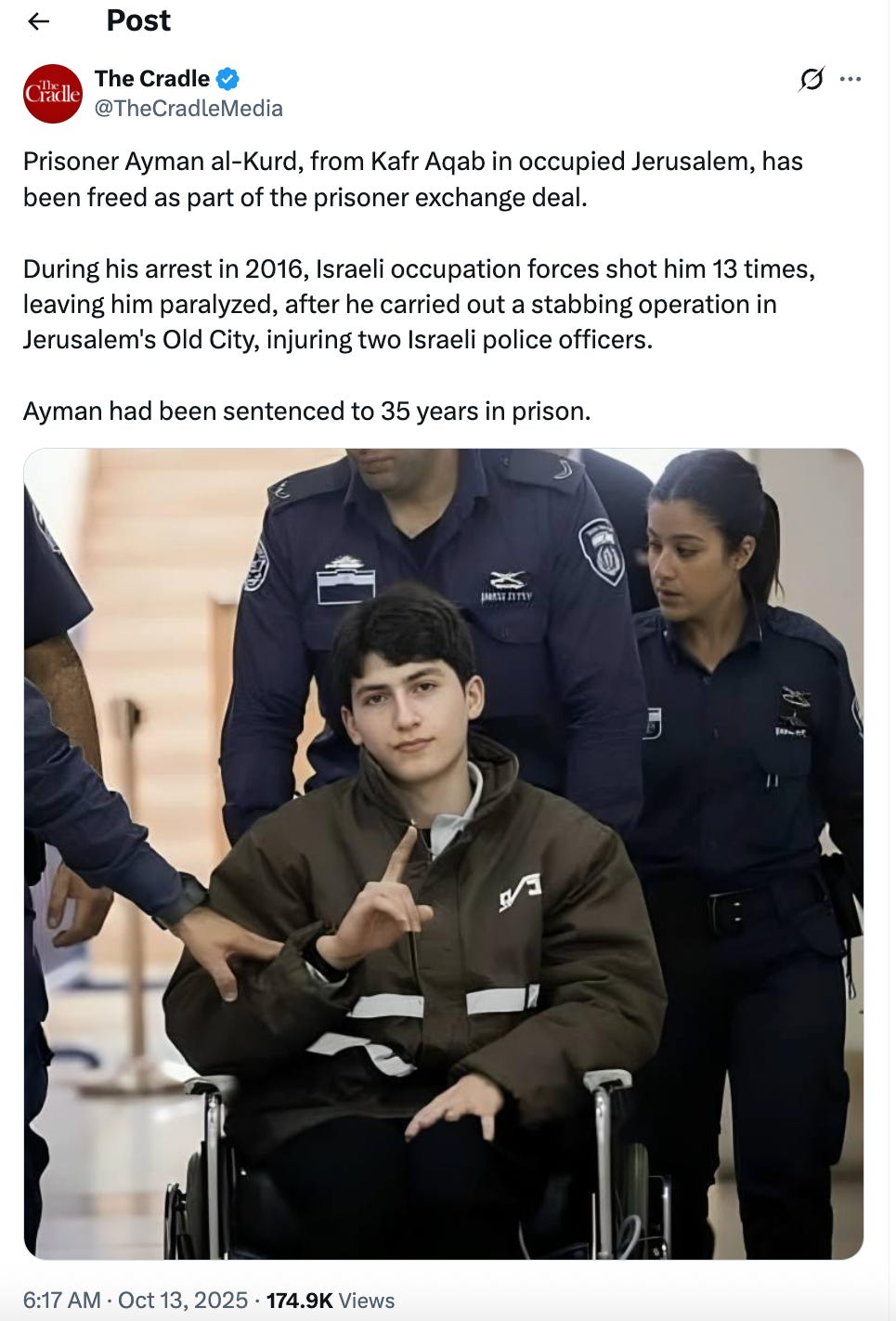
Ayman al–Kurd was released from Ofer Prison on 13 October as part of a prisoner exchange deal. The photo in the “X” post below was taken at his sentencing in 2020. He was fourteen when he was shot and arrested in 2016. Israel waited four years to sentence Ayman so that he would be older, no longer a child, and they could justify a longer term.
Mamdouh Amr and ‘Kheekh!’
Brother Mamdouh was originally a native of the village of Al Majd, which lies west of Dura in the Hebron Governorate. After the war of 1967, Al Majd was occupied and his family was forced to relocate to Dura. Mamdouh was a teacher of mathematics.
He left his beautiful village for the settlement of Gush Etzion, which connects the cities of Hebron and Bethlehem. Gush Etzion has been the location of numerous stabbing and vehicular ramming attacks, all of which are considered heroic acts of resistance.
Mamdouh went to this settlement—built illegally on Palestinian land—with the intention of carrying out a stabbing attack. But as soon as he reached Gush Etzion, where Occupation soldiers were stationed, they opened fire on him in a torrent of hatred, leaving him with bullets in his leg, chest, hand, and other parts of his body.
His condition was extremely critical, and he stayed in intensive care for a long time. But Allah’s almighty will was above all and Mamdouh survived.
Mamdouh was brought into the clinic of the Ramla prison, where we begin this story about him. The moment I greeted him, by asking for his name, I was struck by a surprise—and oh, how many repulsive surprises there are in these prisons. Mamdouh couldn’t speak because of the severity of his injuries.
I asked Mamdouh if he could write so that we could learn his name and how he was doing. He nodded in agreement, so I brought him a notebook and a pen. I asked him to write his name and where he was from. That was when I learned he was from the Dura—my own home town.
The day after he arrived at the ward, the doctor, who doesn’t know the color white, came to examine him. Mamdouh’s condition was so critical that it was difficult to manage without a doctor.
The doctor informed me bluntly that his condition was very unusual, given the fact he had just been moved out of intensive care. Mamdouh was suffering from shortness of breath because part of his lungs had been removed. He couldn’t breathe normally and the doctor noted that he wasn’t allowed to eat solid food: He was on a special liquid diet that had to be mixed with a specific substance—even water had to be mixed with that substance.
Even though his condition was critical, for Mamdouh, the most important thing was food. Despite all his pain, his biggest concern and top priority was food. He was a true “foodie” with an insatiable appetite.
Because of his excessive love for food he nearly lost his life. Mamdouh couldn’t regulate his eating habits. For two months he refused to eat anything the doctor prescribed. Every day, he would ask for real food and sometimes I had to give him some just so he would eat.
One day, he became so exhausted that he was unable to breathe. I asked for a doctor to come to the section immediately. Fortunately, this time a doctor showed up. After the examination, he was transferred to an external hospital because of the dangerous and urgent nature of his condition.
Less than two hours later, the prison doctor asked me for a telephone number for Mamdouh’s family. When I asked, “What for?” the doctor replied, “Mamdouh’s situation is very critical and he might die.” But then the will of Allah—He who revives the bones from their dust—manifested again. And indeed, Mamdouh’s condition started improving little by little. He spent almost a month in intensive care, and then he came back to us.
When Mamdouh returned to the section, I set up a special diet for him following the doctor’s instructions. And I did my best to ensure he adhered to it.
Sometime later, Mamdouh was finally able to speak, which made us all very happy. But his first word was very strange: kheekh. It wasn’t even Arabic. And no one understood what it meant. It took us more than an hour finally to understand that Mamdouh meant to say “cake.” Out of playfulness and affection we started calling him “Kheekh.”
Mamdouh’s health slowly started to improve. But the pieces of surgical metal that were still embedded in his leg continued to torment him. After nearly eight months of enduring constant pain, the doctor finally decided it was time to remove the metal. I accompanied Mamdouh on his visit to the orthopedic doctor. There I witnessed something that still leaves me in shock, wondering how I was able to endure what I saw.
The metal in Mamdouh’s foot was removed by a doctor who used tools that resembled those used for cars. He asked for a No. 12 wrench, locking pliers, and a flathead screwdriver. “My God,” I thought, “what is this?” These were a mechanic’s tools!
The doctor struggled to unscrew the bolts in Mamdouh’s leg to the point that he, Mamdouh, vomited and lost consciousness. We stood there stunned, witnessing the horrific sight. The process of unscrewing the bolts resembled what a tire shop mechanic does when removing a tire from a car.
Mamdouh was screaming at the top of his lungs and his loud cries and wails echoed for everyone to hear. The doctor carried out the entire procedure without administering anesthesia—not even a local anesthesia.
When we returned to the ward, Mamdouh took some very strong painkillers and fell asleep immediately, waking up only the next day.
A week later, by the will of Allah Almighty and his own strong will, Mamdouh was finally able to walk using a walker.
Over time we learned more details about Mamdouh. He used to work abroad as a math teacher and was known for his witty personality, always eliciting a smile from others.
As the best of creation, our Prophet Muhammad, peace be upon him, has told us: A smile is a form of charity and so is a kind word. Imagine the generosity of someone who shares a smile in a place like Ramla Prison.
Because of the demand for space at the Ramla Clinic, Mamdouh was transferred to another prison before finishing his physical therapy.
■
The most prominent central prisons and detention centers in the Zionist occupation state are: Beersheba Central Prison, Ashkelon Central Prison, Ramla Prison, Kfar Yona Prison “Beit Lid,” Al-Maskobiya Interrogation Center in Jerusalem, the Negev Desert Prison (Ansar 3) (in Hebrew: Ktzi’ot), Ofer Prison, Telmond Prison, Nafha Prison, Damon Prison, Gilboa Prison in Beit She’an, and Shatta Prison.
The number of Palestinians held hostage in Israeli prisons increased dramatically following the events of 7 October 2023. They are subjected to torture, rape and other forms of sexual abuse, starvation, regular beatings, acts of humiliation, and even execution. According to Addammer, a Palestinian prisoner-support and human-rights association, there are currently more than 9,250 political prisoners held by the Zionist entity.
This series was previously published at Winter Wheat.
Everything I write is freely available. If you appreciate what you read, please consider supporting my work, including my trips to Occupied Palestine. I rely entirely upon reader support. You can become a paid subscriber by clicking on the button below. You can “buy me a coffee.” You can send a one-time, monthly, or yearly donation via PayPal. Or you can support me on Patreon. You can also share this article. Thank you.