Erasure of Compatible Values: Trump's New National Security Strategy Recasts Europe as Strategic Liability
The US has released a new National Security Strategy which re-envisions the Monroe Doctrine for a new century. Bernhard at MoA covered it in full here for those interested in the thorough details. I’ll instead look at the bigger picture, as well as one specific, fascinating aspect of this major rethink of US foreign policy.
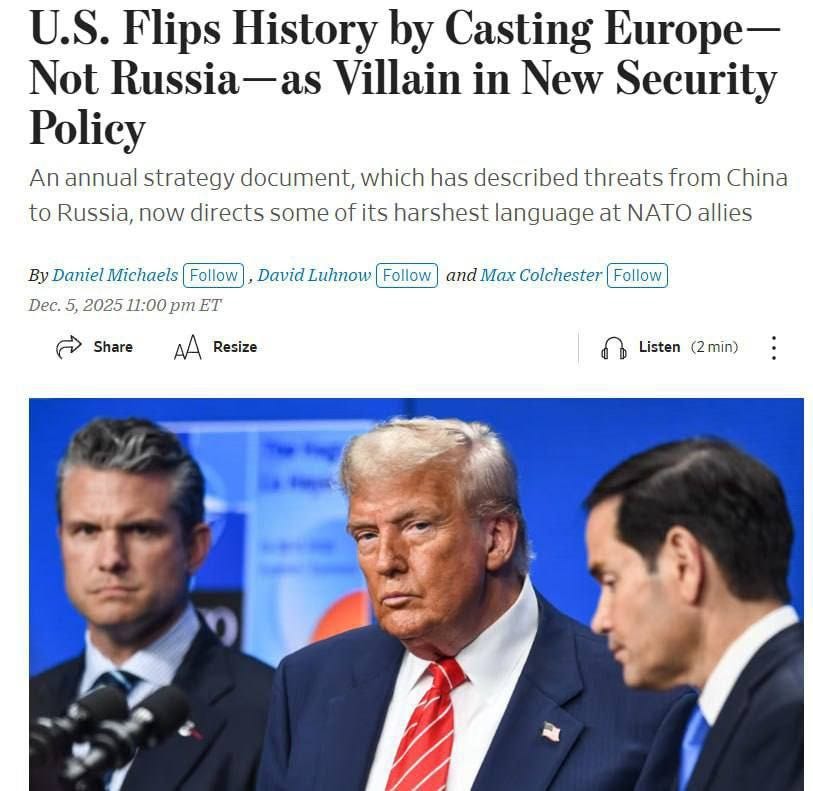
NYT’s subheading reframes the new vision as a hatred for Europe:
A new White House policy document formalizes President Trump’s long-held contempt for Europe’s leaders. It made clear that the continent now stands at a strategic crossroads.
Well, why wouldn’t Trump hate the new Europe? It’s a continent that has turned its back on civil liberties, the principles for which America itself was supposed to stand first and foremost.
It accused the European Union of stifling “political liberty,” warned that some NATO members risked becoming “majority non-European,” and said the U.S. should align with “patriotic European parties” — code for Europe’s far-right movements.
Most interesting in the above is the mention of one particular aspect of Trump’s new document, which essentially reframes US’s waning support for Europe as a backlash against Europe’s continued policy of erasure of its own peoples and cultures.
A different NYT article focused entirely on this:
The Trump administration said on Friday that Europe was facing the “stark prospect of civilizational erasure” and pledged that the United States would support like-minded “patriotic” parties across the continent to prevent a future in which “certain NATO members will become majority non-European.”
Others covered this most intriguing of angles directly as well, here the National Pulse:
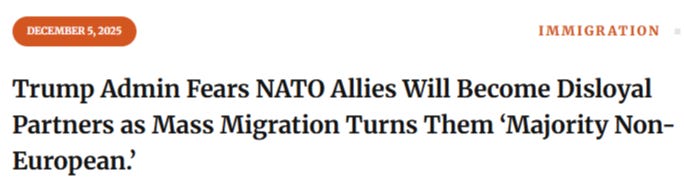
And why wouldn’t that be a legitimate security concern for the US? When the demographics of your chief allies completely revert to a people with understandably questionable loyalties to the very security architectures which underpin your key alliance—well, that becomes quite a tangible problem.
Here are the exact relevant passages from the new Trump NSS—read the bolded carefully:
Page 25: “The larger issues facing Europe include activities of the European Union and other transnational bodies that undermine political liberty and sovereignty, migration policies that are transforming the continent and creating strife, censorship of free speech and suppression of political opposition, cratering birthrates, and loss of national identities and self-confidence. Should present trends continue, the continent will be unrecognizable in 20 years or less. As such, it is far from obvious whether certain European countries will have economies and militaries strong enough to remain reliable allies.”
Page 27: “Over the long term, it is more than plausible that within a few decades at the latest, certain NATO members will become majority non-European. As such, it is an open question whether they will view their place in the world, or their alliance with the United States, in the same way as those who signed the NATO charter.”
The point is so significant, let’s run it again: “As such, it is far from obvious whether certain European countries will have economies and militaries strong enough to remain reliable allies…As such, it is an open question whether they will view their place in the world, or their alliance with the United States, in the same way as those who signed the NATO charter.”
To repeat: Isn’t that a genuine concern? When your very own allies have shifted their core demographic to the point that you must worry about the civic, social, and cultural underpinning of the agreements with those very allies, it’s time to rethink relevant strategic alliances you have with them.
This has long been a growing concern in the West, ever since the globalist migration social engineering wave had begun peaking and reshaping the social fabric of Western nations.
In the US in particular, this was highlighted in the early 2000s in a kind of cult-essay written by Stephen Steinlight, called “The Jewish Stake in America’s Changing Demography”.
In the essay, Jewish writer Steinlight makes a similar argument, but from the perspective of Jewish influence in the US. His argument is that the mass migration sweeping through the US will eventually alter the demographics of the nation to such an extent that it will pose a serious threat to Jewish-American ‘special interests’, given that the predominantly Latin-American and Muslim immigrants will lack the same inculcated sense of respect for Jewish values and guilt for the Holocaust that native-born Americans possess.

From his section, Posing the Sphinx Questions:
The big one for starters: is the emerging new multicultural American nation good for the Jews? Will a country in which enormous demographic and cultural change, fueled by unceasing large-scale non-European immigration, remain one in which Jewish life will continue to flourish as nowhere else in the history of the Diaspora? In an America in which people of color form the plurality, as has already happened in California, most with little or no historical experience with or knowledge of Jews, will Jewish sensitivities continue to enjoy extraordinarily high levels of deference and will Jewish interests continue to receive special protection?
Does it matter that the majority non-European immigrants have no historical experience of the Holocaust or knowledge of the persecution of Jews over the ages and see Jews only as the most privileged and powerful of white Americans? Is it important that Latinos, who know us almost entirely as employers for the menial low-wage cash services they perform for us (such a blowing the leaves from our lawns in Beverly Hills or doing our laundry in Short Hills), will soon form one quarter of the nation’s population? Does it matter that most Latino immigrants have encountered Jews in their formative years principally or only as Christ killers in the context of a religious education in which the changed teachings of Vatican II penetrated barely or not at all? Does it matter that the politics of ethnic succession — colorblind, I recognize — has already resulted in the loss of key Jewish legislators (the brilliant Stephen Solarz of Brooklyn was one of the first of these) and that once Jewish “safe seats” in Congress now are held by Latino representatives?
Far more potentially perilous, does it matter to Jews — and for American support for Israel when the Jewish State arguably faces existential peril — that Islam is the fastest growing religion in the United States? That undoubtedly at some point in the next 20 years Muslims will outnumber Jews, and that Muslims with an “Islamic agenda” are growing active politically through a widespread network of national organizations? That this is occurring at a time when the religion of Islam is being supplanted in many of the Islamic immigrant sending countries by the totalitarian ideology of Islamism of which vehement anti-Semitism and anti-Zionism form central tenets? Will our status suffer when the Judeo-Christian cultural construct yields, first, to a Judeo-Christian-Muslim one, and then to an even more expansive sense of national religious identity?
It all culminates with Steinlight’s urgent concern that Jewish political power in the country will face a swift erosion. By the way, the prophetic essay was written in 2001, and we can now clearly see Steinlight’s vision coming to pass, as a new generation of Americans, heavily influenced by migrant causes and values, have effectively begun to turn on both Israel and what is perceived as Jewish ‘special privileges’—what with the rise of figures like Nick Fuentes, and affiliated movements.
As can be seen, the question of mass migration altering the very nature of power structures and alliances in Western nations has long been an existential topic of debate. Trump’s new National Security Strategy therefore appears a thoroughly positive step in sending a message to European globalists that America will not abide their turning their countries into security threats which undermine the US’s own strategic interests in the region.
As B noted in his piece, this appears to mark the end of the infamous Wolfowitz Doctrine, though of course we’ve yet to see how far the Trump administration’s ‘breakthrough’ policies will actually make it in practice, given that—based on the current track—there’s increasing chance for Democrats to eventually seize back power and reverse virtually all of Trump’s initiatives.
That all being said, it is quite instructive to watch the US set out its own new strategy and renewal of the Monroe Doctrine, self-assuredly announcing that no adversaries will be allowed to stake a claim anywhere within the US’s own hemisphere, let alone even proximately approaching the US’s continental border. Think of the hypocrisy inherent to that: Russia was crucified for demanding its own sphere of influence merely at its border, and that Ukraine should not become a land base and springboard for NATO’s adversarial attacks against Russia. But somehow, the US is allowed to stake its claim to the entire Western Hemisphere, while Russia is roundly excoriated and sanctioned to hell for daring to seek a small buffer of security at its own borders, toward which NATO has openly and consistently advanced.
If the US can have an entire hemisphere to itself, where it enjoys a lawless and ruleless ability to carry out whatever military operations it sees fit—like those happening now against Venezuela—in order to ‘protect its national security interests’, then surely Russia can be afforded the right to do the same anywhere along its borders. After all, if the global ‘Rules Based Order’ is truly an impartial one, it should unquestioningly allow the reciprocal distribution of said ‘rules’ amongst co-equal Great Power centers.
Interestingly enough, Russia did actually release its own similar national security strategy just recently.
From the official Kremlin site:
In its own similar way, the new strategy outlines Russia’s approach toward 2036 of securing and bolstering its neighboring regions, particularly the newly-annexed Ukrainian territories, with a sense of civic pride and integration into the Russian cultural sphere:
Putin’s new national policy strategy targets ‘foreign meddling’ and aims to have 95 percent of citizens share a ‘Russian civic identity’
More:
The document separately underscores the need to strengthen “the unifying role of the Russian people as the state-forming nation.” It proposes doing this through educational and public-outreach projects, support for folk-art ensembles, and efforts to maintain the interest of foreign nationals living in Russia in Russian culture.
It likewise heavily focuses on ‘foreign meddling’ and attempts to stoke inter-ethnic conflicts within Russia’s border zones.
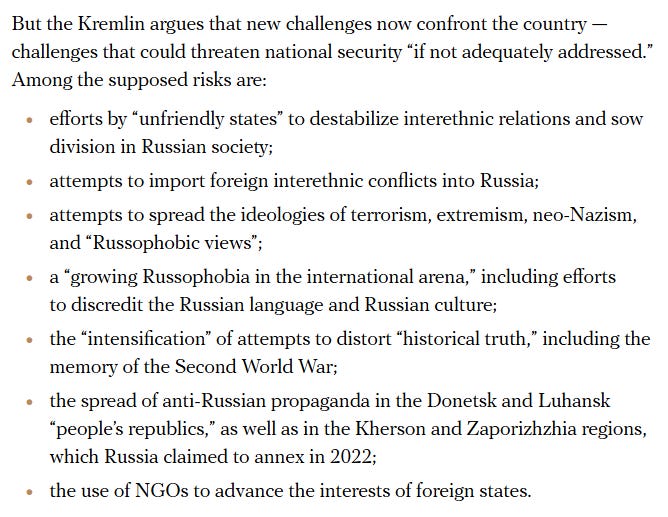
Putin’s decree warns that insufficient action on these fronts could harm national security. It lays out a series of priorities in response:
protecting and developing the Russian language and promoting it as a lingua franca among Russia’s many ethnic groups. This includes encouraging young people to use standard literary Russian and countering “excessive” use of foreign loanwords;
cultivating civic consciousness among children and young people. The document suggests doing this by ensuring “the presence of the state symbols of the Russian Federation in all spheres of public life,” expanding instruction in local and national history, and holding public celebrations that “foster a sense of community and belonging to the country’s history and achievements”;
safeguarding “historical truth” and historical memory, as well as “traditional Russian spiritual, moral, and cultural-historical values,” including the ideals of “patriotism and service to the Fatherland,” and increasing public interest in the study of Russian history.
It’s clear that with these dual national security strategies, the world is entering an era of Great Powers consolidating their spheres of influence amidst a historic breakdown of geopolitical blocs and the ushering in of multipolarity.
The powers of the world have sensed the dissolution and deterioration of previously long-standing systems and orders, and have begun taking it upon themselves to institutionalize those things considered to be national and civilizational entitlements and birthrights. In many ways, it signals another final death knell for globalism, though not necessarily—in the case of the US—neocon-ism.
Your support is invaluable. If you enjoyed the read, I would greatly appreciate if you subscribed to a monthly/yearly pledge to support my work, so that I may continue providing you with detailed, incisive reports like this one.
Alternatively, you can tip here: buymeacoffee.com/Simplicius