DNA, social media and family history: What US authorities could demand you hand over at the border
Exclusive: US Customs and Border Protection could soon demand your DNA as part of an Esta application
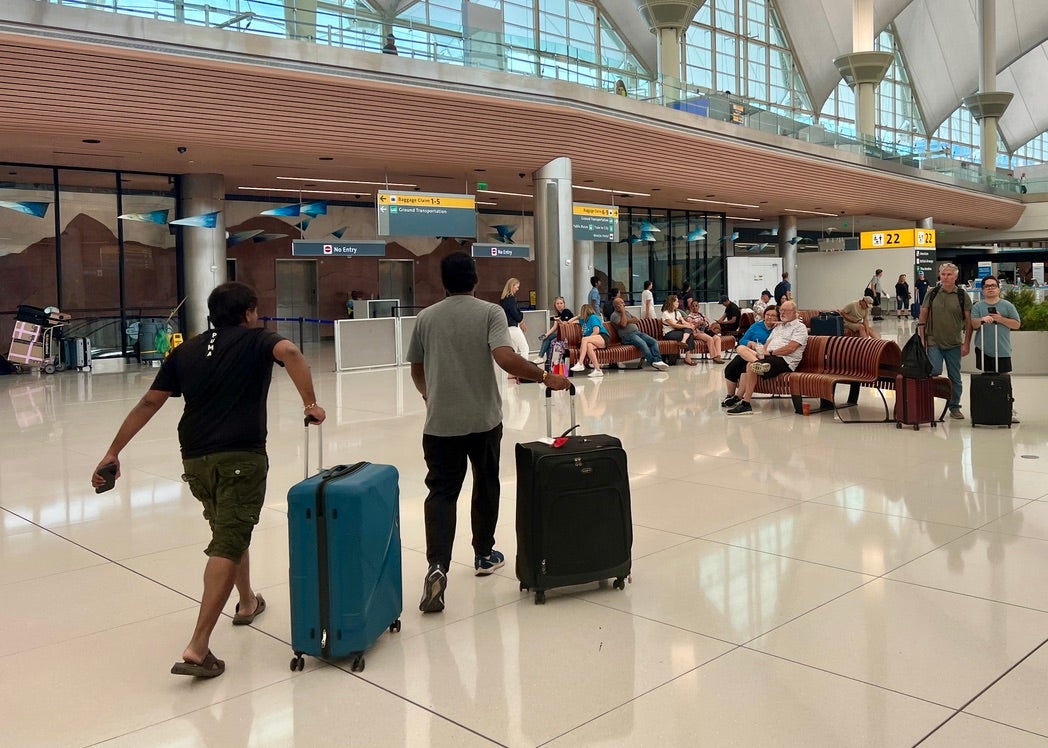
Welcome to America? Passengers at Denver International Airport, Colorado (Simon Calder )
Passport? Tickets? Social media history? The US authorities plan to demand access to five years of your activity on Instagram, Facebook or X (formerly Twitter) and other social media platforms before issuing a permit to enter America.
Whether you are a football fan off to the 2026 World Cup, a family heading for Florida or a business traveller to New York or Chicago, US Customs and Border Protection (CBP) wants to examine details of your social media activity going back five years.
The proposals are in response to an Executive Order by Donald Trump for foreign visitors to be “vetted and screened to the maximum degree possible”.
What red tape do travellers to the US face at the moment?
The vast majority of British visitors enter on an “Esta” – the Electronic System for Travel Authorization. The permit costs $40 (£30) and allows stays of up to 90 days within two years. It’s even required for transit passengers transferring between international flights at a US airport.
You apply online through the website (taking care to avoid scam sites) or app. For most visitors it’s a straightforward if slightly tedious formality, with the permit for travel to the US usually granted within a few hours.
If for any reason the application is rejected – and that can happen if your name and personal details are a close match with someone on a “watchlist” – then you might have to apply for a US visa instead, which is expensive and time-consuming.
Do US border officials currently take any interest in social media?
Yes. Nine years ago an optional question was added to Esta application process inviting prospective visitors to reveal their social media accounts. You could say, “here’s my Facebook details, Instagram profile and username on X”. But the vast majority of applicants don’t. When you arrive in the US, border officials may ask to see your phone to examine the contents and question you about your social media activity.
Some tourists have been turned away – allegedly for holding political views at odds with the current administration.
What is changing – and why?
US Customs and Border Protection “is adding social media as a mandatory data element for an Esta application”. Esta applicants will be asked “to provide their social media from the last five years”. The aim is to investigate the background of foreign arrivals “to the maximum degree possible”.
Officials could scrutinise the applicant’s views and comments, and use the information to help decide whether or not to issue an Esta.
The CBP says: “Social media may be used to support or corroborate a traveler’s application information, which will help facilitate legitimate travel by providing an additional means to adjudicate issues related to relevant questions about identity, occupation, previous travel, and other factors. It may also be used to identify potential deception or fraud.” In addition, “social media may help distinguish individuals of additional concern”.
Anyone who already has a valid Esta will not be asked for any additional information in advance of travelling to the US. They may, though, be questioned about their social media activity on arrival.
How soon could this come about?
The proposals have been published in the Federal Register, which carries government announcements. Officials say they are seeking comments from organisations and individuals on the plan. But it seems likely to be put into practice within a few months to comply with Mr Trump’s Executive Order. For now, though, there is a window of opportunity in which you can apply for an Esta – valid two years – without having to surrender your social media details.
What’s the reaction in the UK?
Overwhelming negative. In a poll I conducted on, yes, social media, with more than 5,000 self-selecting responses:
- 17 per cent said the change did not bother them.
- 16 per cent said they would comply, reluctantly.
- 28 per cent said they weren’t going to the US anyway.
- 40 per cent said they despised the idea and won’t visit.
Julia Lo Bue-Said, chief executive of the Advantage Travel Partnership, said: “These barriers will hit UK travel to the US hard. History shows us that when a destination becomes harder to reach, British holidaymakers simply go elsewhere.
“Right now, US bookings are up 20 per cent across our membership, driven by events like the football World Cup, but new obstacles could quickly reverse that trend.”
I predict that this move will deter younger travellers rather than older visitors, because the young tend to have more prominent social media profiles that might include expressions of opinion or associations with causes that are potential red flags for US border officials.
Do other countries make such demands?
Not for for mere holidaymakers. Anyone heading for North Korea can assume that their visa application will have been carefully scrutinised in Pyongyang, with officials checking out social media activity before deciding whether to issue permission to visit.
For people hoping to move permanently to another country, immigration authorities will sometimes compare what the applicant has posted online with the information they provided. If, for example, there are lots of pictures of an apparent partner who is not the same individual as the claimed spouse, that could generate some questioning.
Foreign Office warnings about social media activity are sparse. The FCDO warns that “expressing support for Ukraine on social media” could get you into trouble in Russia, but almost nobody is travelling there. In China, Facebook and X are permanently blocked.
Any other get-tough proposals in the pipeline?
Yes. On a timeframe that the CBP currently calls “when feasible”, applicants will have to give far more information, including:
- Names plus dates and places of birth of close family members – parents, spouse, siblings and children.
- Telephone numbers used in the last five years by the applicant and their family,
- Email addresses used by the applicant in the last 10 years.
There is even provision for demanding DNA from applicants, although there is no indication how this could be provided. The Independent has asked US Customs and Border Protection how it proposes to obtain the genetic material.
The CBP also plans to allow applications only via the official app. At present prospective visitors can apply on the Esta website – but many get diverted to scam sites. US Customs and Border Protection says requiring all applicants to use the app would “enhance security and improve efficiency”.
There is also a technological fix to the problem of travellers whose departure has not been properly recorded. For example, anyone leaving San Diego in California for Tijuana in Mexico simply walks through a gate, with no exit check.
The organisation says: “CBP will use geolocation services to confirm that the traveler reporting their departure is outside the United States, as well as, run ‘liveness detection’ software to determine that the selfie photo is a live photo.”