2025 End of Year Wrap-Up and Battlefield Projections for 2026
As we reach the end of 2025, let us look forward to 2026 with a projection for where the battlefield will take us in the next year.
But first, let us cover the current battlefield updates in order to understand where things currently stand to contextualize the situation before we begin prognosticating the future.
We’ll jump straight into it.
The first and biggest update that many are likely already aware of, is that both Mirnograd and Gulyaipole have been entirely captured.
Below is a Russian MOD-released video showing large groups of prisoners being taken in Mirnograd during the final sweeps:
Some have asked what happened to the alleged 1,000+ AFU that were surrounded in Mirnograd? No one knows for certain but it’s likely that some large portion of them were forever entombed by the mass-Russian FAB raids on the apartment blocks the AFU were hiding in: there are ‘stories’ about hundreds of AFU bodies, if not more, being buried under the rubble still. And we can assume at the minimum several hundred were captured, as well.
Most likely though, many more escaped than we’d like to admit, given that the total “encirclement” of this cauldron was not as complete as it looked on maps. Our war maps have no satisfactory way of truly indicating or expressing the modern sparsely-populated battlefield, with its many gray zones. Up to nearly the last days, Ukrainian forces were still likely able to sneak out small groups of men at a time, at night and in foggy conditions, etc., and this trickle likely enabled them to reduce the so-called 1,000+ entrapped forces by at least a few hundred, if not more. We learned in the Kupyansk debacle that Russian areas of “control” as shown on pro-Russian maps are not always as iron-clad as we’d like to believe, often being more a series of sparsely-defended gray zones than truly consolidated territories.
The map now looks like so, with Pokrovsk, Mirnograd, and even Rodynske to the north captured:
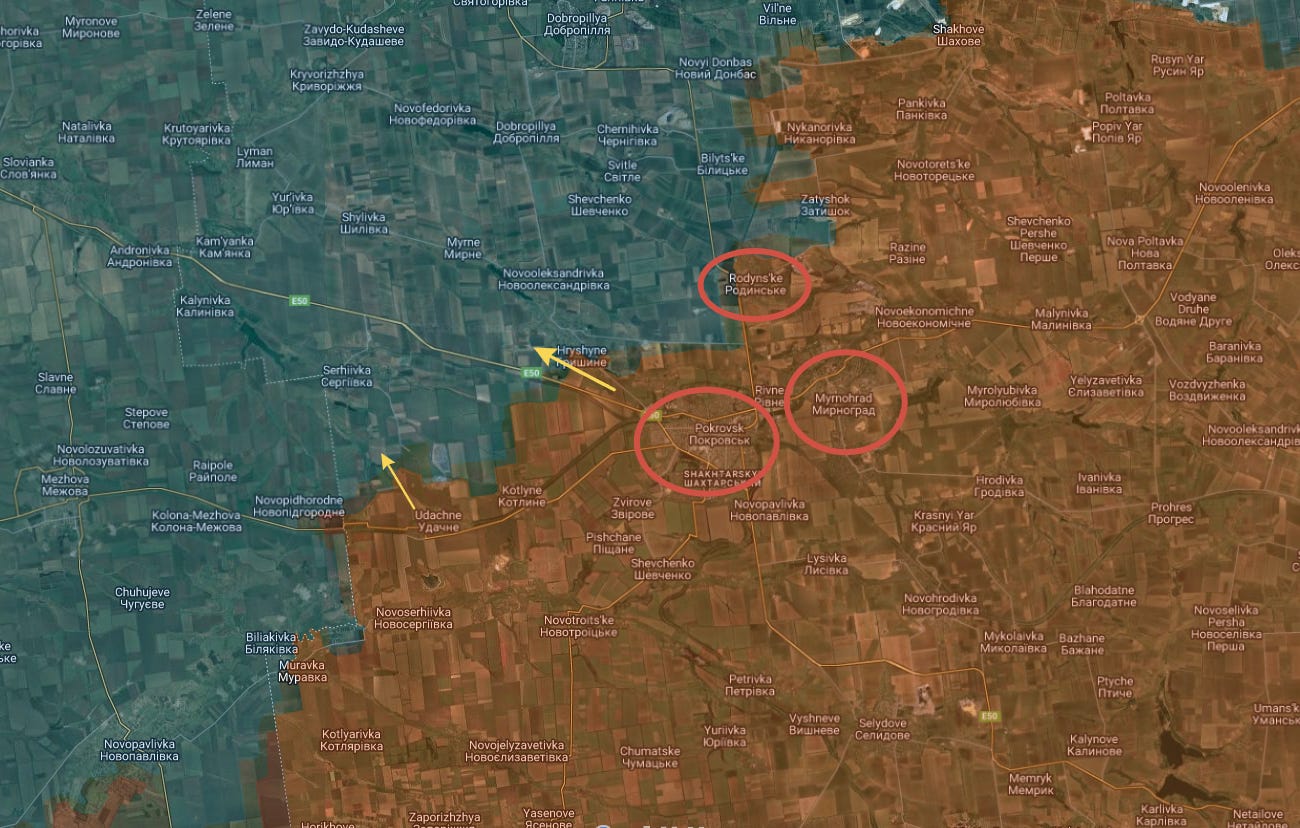
The next logical move is Gryshino (Hryshyne on the map), where Russian forces are already infiltrating. And Dobropillya in the north will have to be the medium-term target, as it is the only sizable logistics node in the region, which helps supply and acts as gateway to Kramatorsk to its northeast.
In a new interview from the “front line”, Syrsky ridicules the idea that AFU in Pokrovsk should have ‘retreated’, stating that there is no where to retreat to other than either open fields or having to find other towns to hide in much farther back which would just as easily be turned to dust by Russian bombs:
He appears to say that using a large agglomeration like Pokrovsk-Mirnograd made more strategic sense to hole up in and soak up Russian firepower, claiming that 50% of all Russian FAB bombs dropped across the entire front were done so on Pokrovsk.
The Commander-in-Chief of the Armed Forces of Ukraine, Syrsky, stated that Ukrainian soldiers have nowhere to retreat from Pokrovsk
He commented on the calls for the need to leave the city to save the lives of Ukrainian soldiers:
But the question arises: where to? Go out into an open field - and what next? Continue to retreat, look for the next city or settlement, which will also be razed to the ground," said Syrsky.
Where, where? Only back, surrendering cities and bringing Russia's victory close
Now let’s talk about the most important areas of advancement currently taking root.
First, the surprising west Zaporozhye sector. Russian forces have continued north of Stepnogorsk (circled in white), which itself is roughly 80-90% captured:
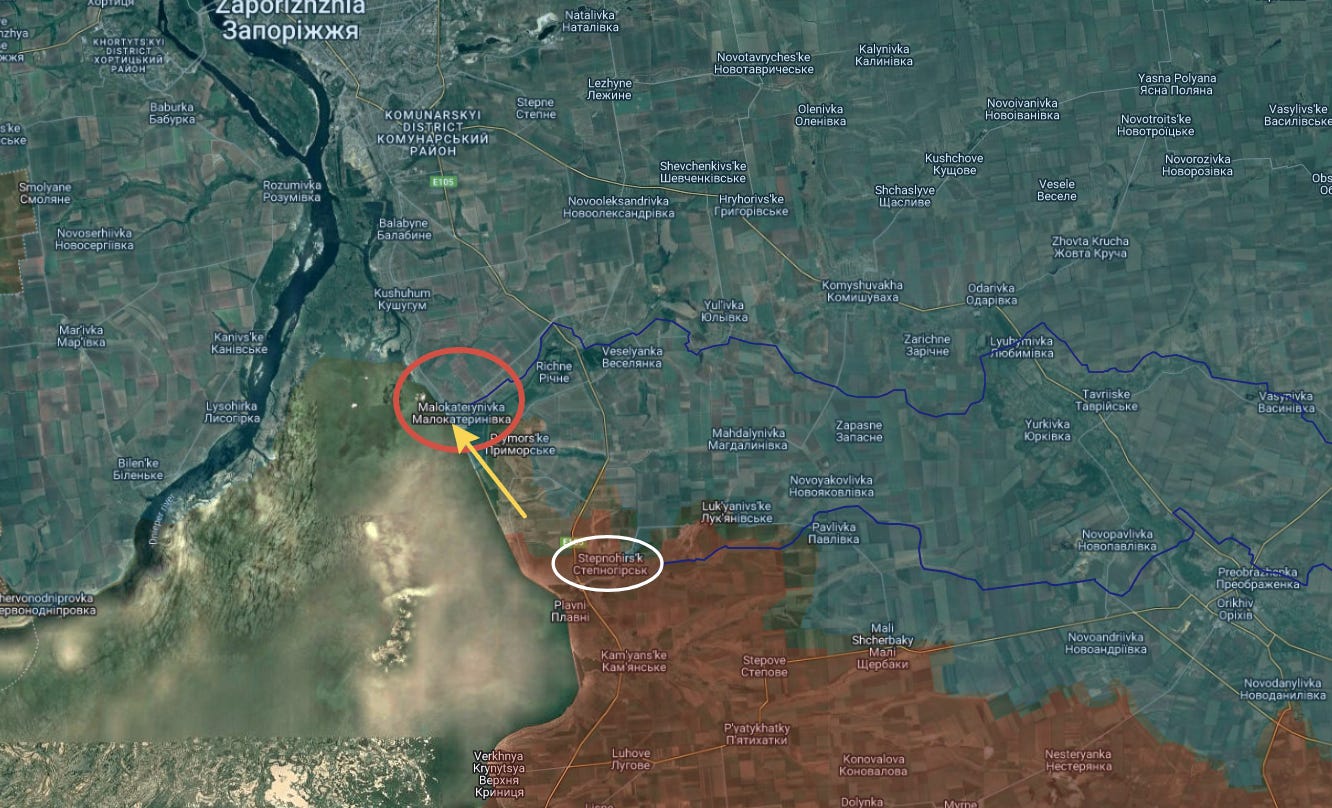
They have nearly reached Malokaterinovka (circled in red), and are progressing along ‘Center Street’ in the furthest north portion of Primorske.
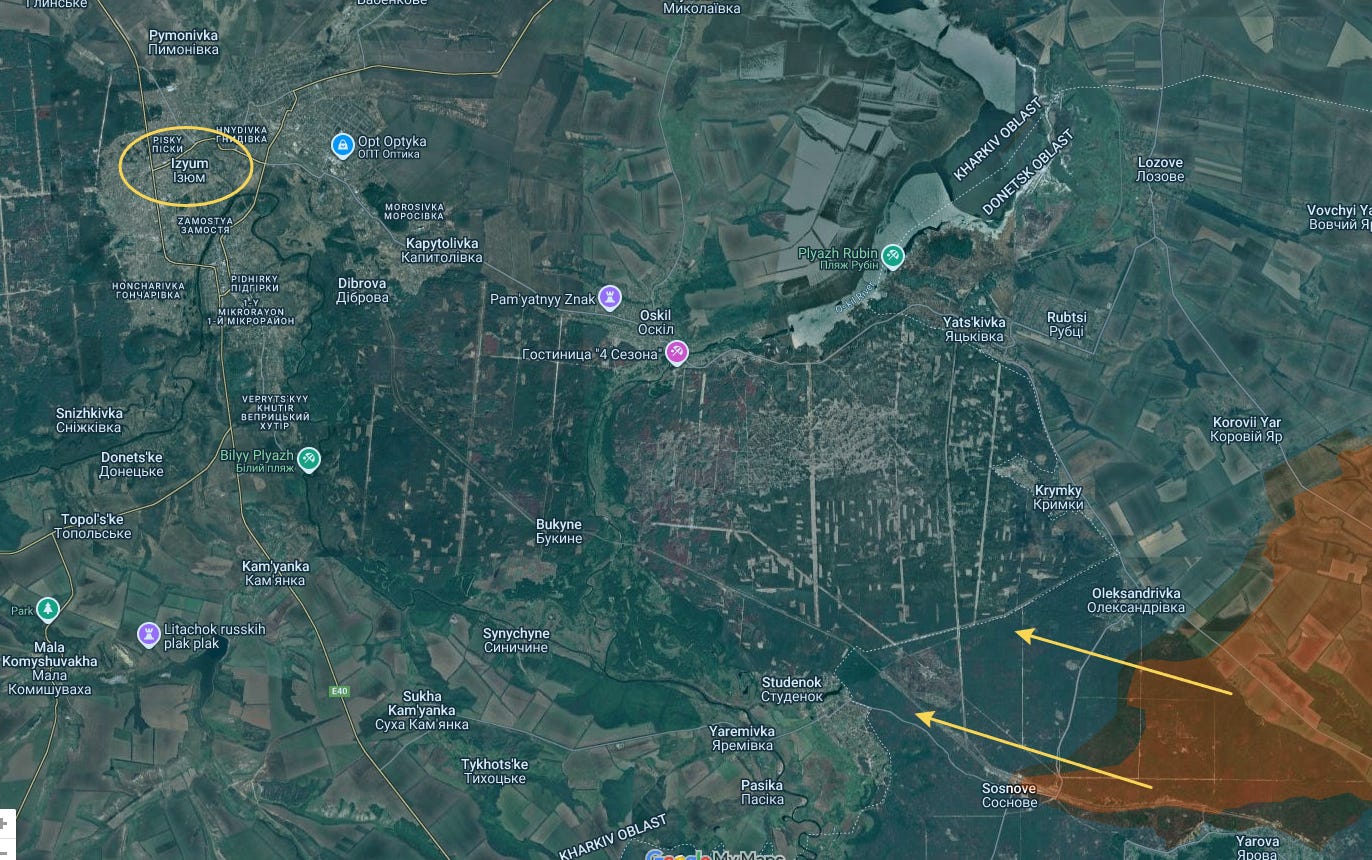
But much greater than that has been Russia’s sudden breakthrough on the Lyman sector. Here Russian forces advanced into Sosnove, capturing a large portion of it, creeping along the Siversky Donets river toward Izyum:
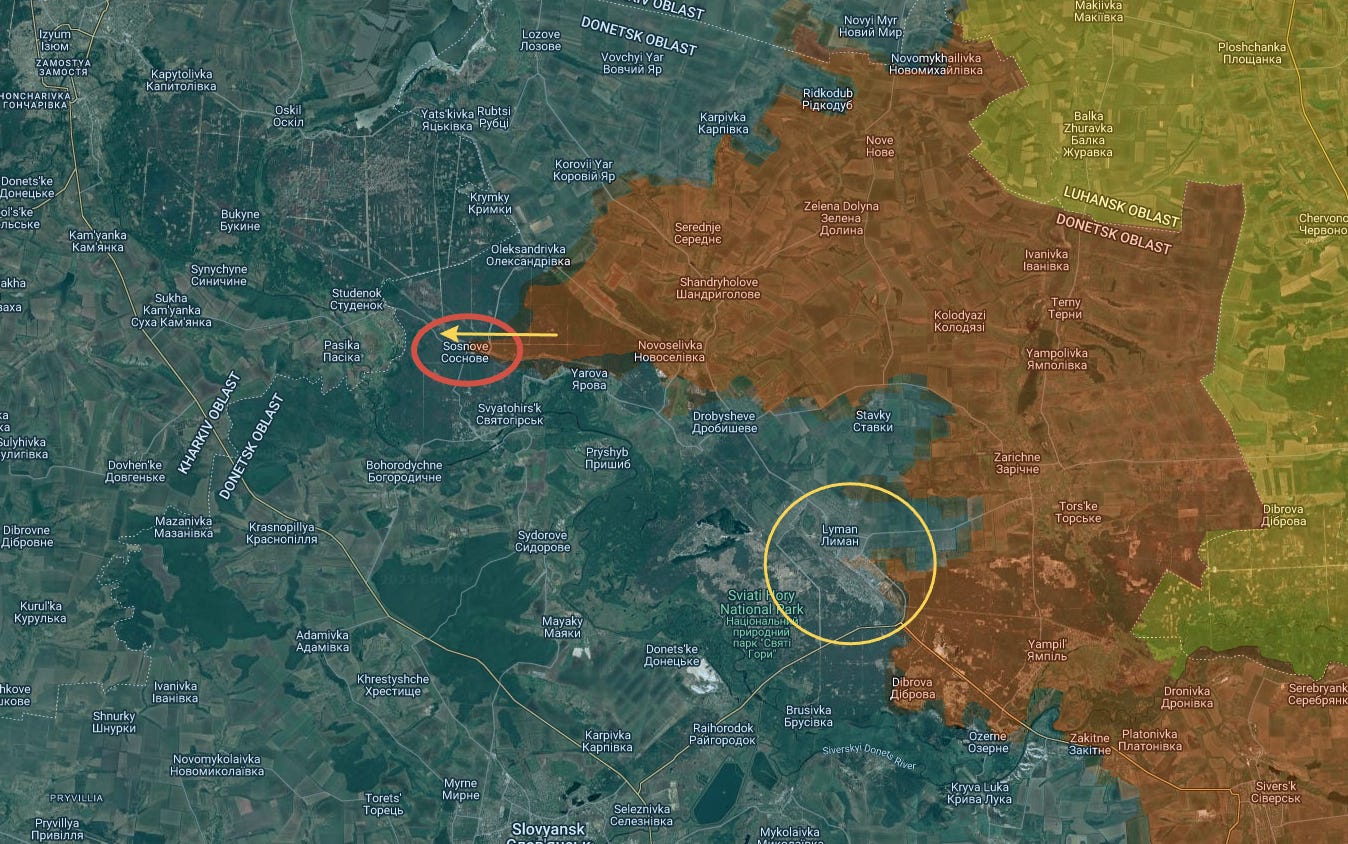
As can be seen, Izyum is now within FPV and artillery range of about 20km. A close up for effect:
And Krasny Lyman itself has had advancement. Not only consolidation of positions inside the town itself, but the new salient from the east—in the direction of Zarichne—which is now taking Lyman’s flank:
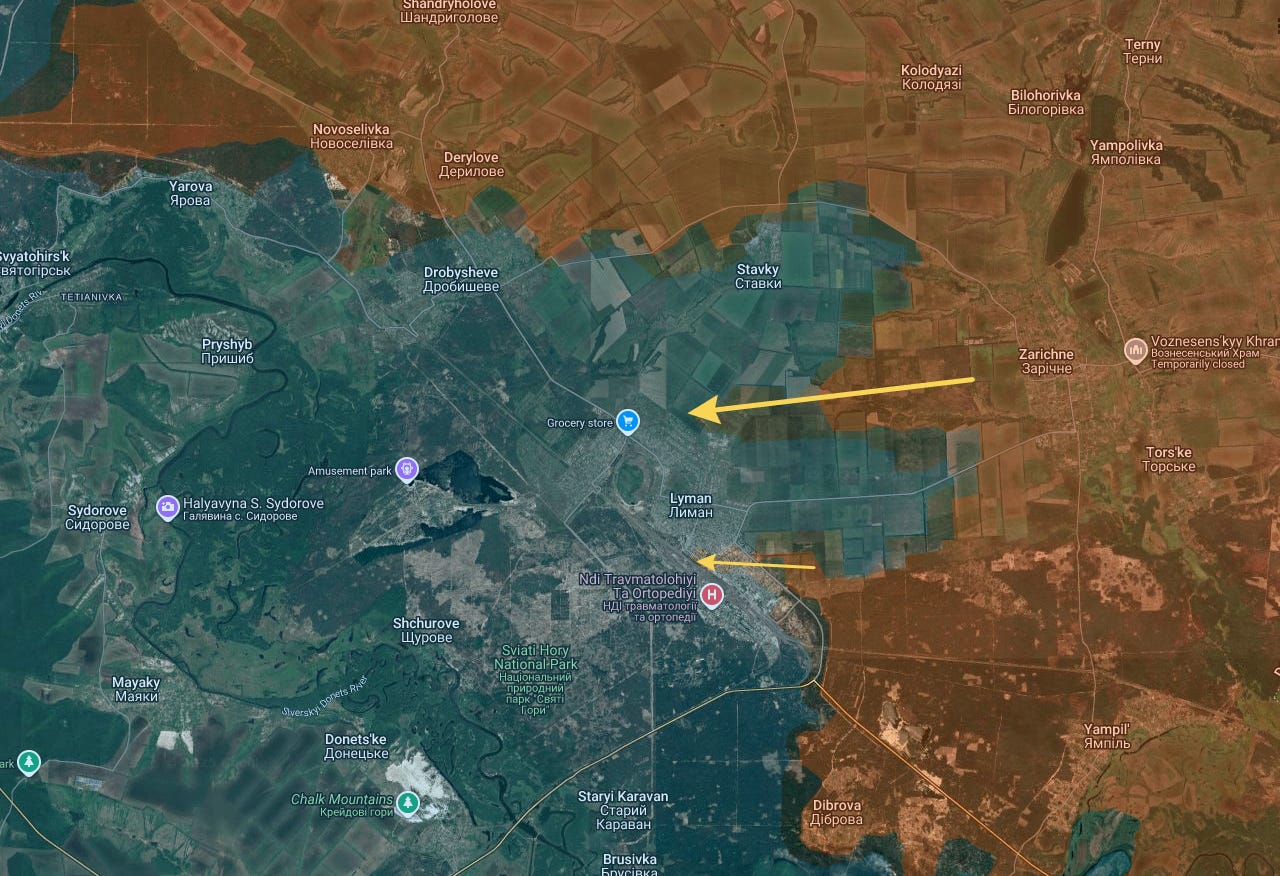
With the surprise advance to Sosnove, what we are seeing is the encirclement of Lyman, which appears set to be the next town to fall in the not-too-distant future.
As for the nearby Kupyansk direction, there are signs of a turnaround there with Russian forces now having been geolocated in the below ‘Moskovka’ area, which would confirm that Ukraine has not retaken remotely as much territory as previously thought:
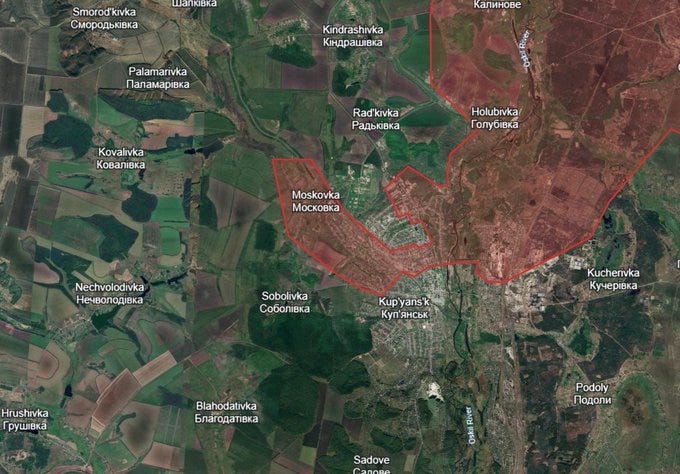
During his latest meeting with high command, Putin ordered the elimination of Ukrainian units there, with the somewhat humbled (or disgraced, depending on your view) Kupyansk sector commander Colonel-General Sergei Kuzovlev again reporting that his units were cleansing Kupyansk of AFU infiltrators.
But note this interesting exchange. First, for context is the video of Kuzovlev announcing the total capture of Kupyansk on December 12th, to which even a skeptical Putin double checks with, “So, it’s completely cleared?”
Now, note how Putin gives Kuzovlev a direct but subtly reproving glare as he tells him Kupyansk must be fully cleared, and decisively so, in the latest meeting—a clear reference to Kuzovlev’s previous “not-so-decisive” mistake:
Compare Kuzovlev’s body language in the second video—clearly more ‘hangdog’ and penitently bowed next to the proud demeanor of the first.
What’s more is that Kuzovlev reportedly told Putin he expects the full destruction of the AFU grouping in Kupyansk around January or February:
⚡️Putin ordered to decisively stop attempts by the Armed Forces of Ukraine to break through to Kupiansk. The enemy group under the city will be destroyed in January - February, the commander of the “West” group reported to the president.
The Supreme Commander-in-Chief noted the prospects for the complete liberation of the Donbass territory.
The Russian Armed Forces need to continue ensuring the security of Russia’s border regions next year, Putin stressed.
What’s even more interesting is the appearance of Putin micro-managing the battles of this sector—as is his right as Supreme Commander-in-Chief—seen in the following video:
Note at the 1:24 mark how Putin points to the map and declares the importance of liquidating the particular group of AFU on the north bank, presumably, of the Seversky Donets river just south of Krasny Lyman. I could be wrong, but I do not recall Putin ever giving such direct battlefield management orders to his generals in such a way.
Usually, he appears to simply accept their reports, giving the impression of a passive Commander-in-Chief who lets his generals make all the decisions with little oversight. But here we get a fascinating window into the potential reality of the situation behind the scenes, where Putin himself may be much more involved in each battlefield decision and strategic stroke than we’ve previously assumed.
Lastly, Belousov and Gerasimov report that everything is “going according to plan”—and even ahead of schedule, as per Belousov—and that December saw Russia’s fastest rate of advance of the entire year:
2026 Predictions
We covered the Gulyaipole front in the last paid report, and not much has changed since then. Here is an animation showing Russia’s captures on this sector just in the past two months alone, which segues us into the next section:
Let us start on this sector. I have already written at length about my prediction here specifically. As can be seen by the rate of advance above, Russia is capturing one defensive block between major rivers every two or three months. The next block will take them to the Orekhov-Novomykolaivka line (circled in yellow below), and should take another 2-3 months at most, and possibly faster.
Suriyak had the same idea so I’ll use his map and analysis (follow along on his map here)—the area shaded in brighter red is the next area Russia will capture in the next couple months as it barrels toward Zaporozhye city:
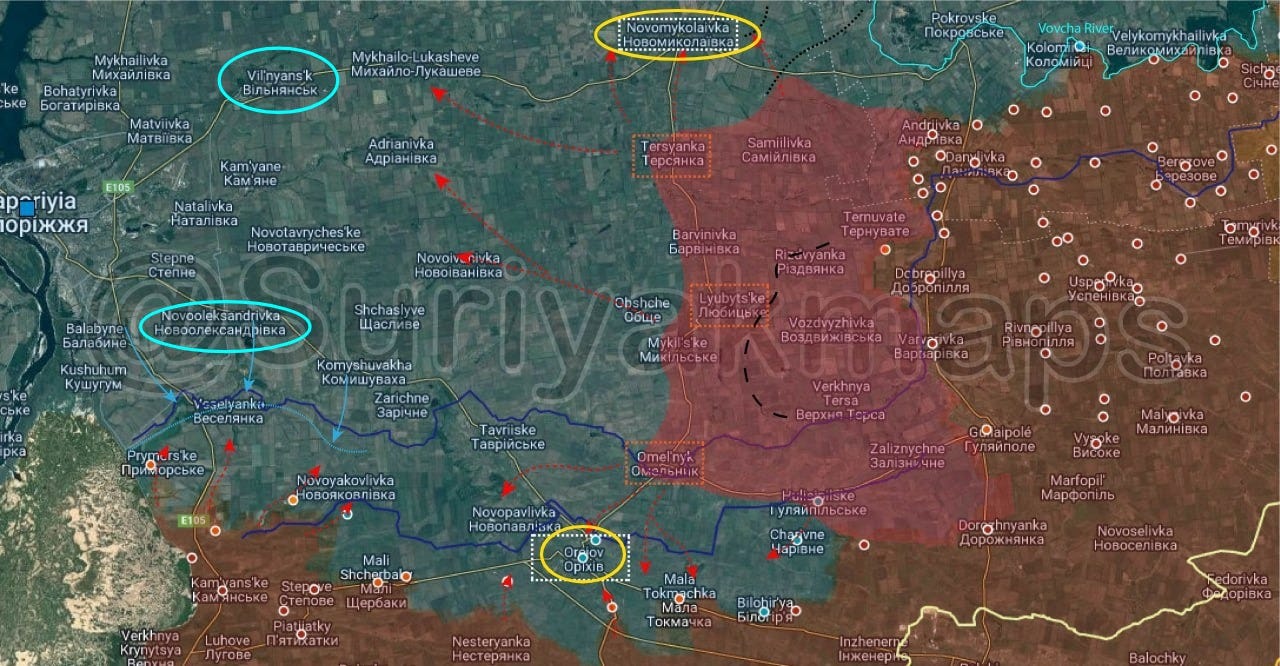
In spring, Russian forces will begin the battle for Orikhiv and possibly Novomykolaivka. The former will involve an intensification of the southern axes with the aim of cutting off the route to Zaporizhia from the north. However, it is also necessary to mention the Vasylivka front, as the Russian army will continue to have problems advancing due to its proximity to the oblast capital and the large number of drones, which has meant that ‘advances’ have been carried out by small units tasked with destroying enemy positions and attracting Ukrainian reinforcements while the other fronts develop.
In the second town, while the battle is brewing, the Russians will advance westward through the high ground towards the last line of defence, Vilnyansk-Novooleksandrivka, which could be reached in the summer.
Circled in blue above is the final line of defense around Vilnyansk-Novooleksandrovka, which Suriyak believes will be reached by summer. According to my stated timetable of 2-3 months per each “block” between defensive lines, this is correct. That means around summertime, at current paces, Russia will essentially be reaching the outskirts of Zaporozhye city itself; though, I will hedge by saying it could go to autumn by the latest in case of some problems or slowdowns.
Keep this in mind for later, as it will play into the much larger overall analysis.
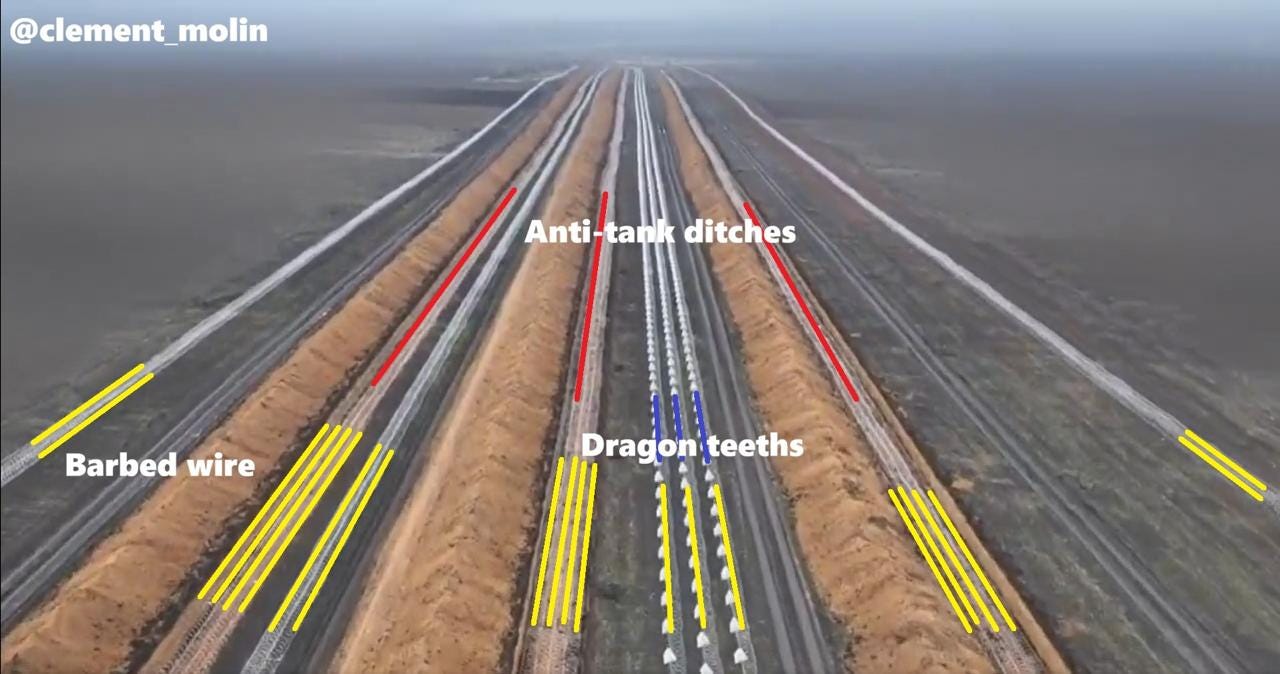
A reminder of the defensive line Ukraine has planned for Russia precisely in this sector—good thread on it here:
As a brief interlude, here’s a video showcasing Russia’s latest HIMARS-killer, the guided MLRS Tornado-S system, which, according to the report below, was instrumental in the clearing out of Gulyaipole on this sector in particular:
The report says the satellite-guided rockets for this system are finally being delivered in quantity to Russian forces.
Note some important translation errors in the above video: SAA = SMO. At 1:45, “trap” is meant to be “REB” which is EW (electronic jamming). The operator is stating that the 9M542 guided rocket has a capability to evade electronic warfare systems by detecting them and automatically swerving around to hit the target from another angle.
The other key sector to watch for 2026 of course will be the Slavyansk-Kramatorsk region, or the “heart of the Donbass”. This is where the entire war essentially started, with the first rebellion inside Slavyansk—so these two major cities are the symbolic heart of the entire conflict.
The jaws are slowly shutting on this agglomerate as of late 2025, but the cities are still no where near in danger of being assaulted any time soon:
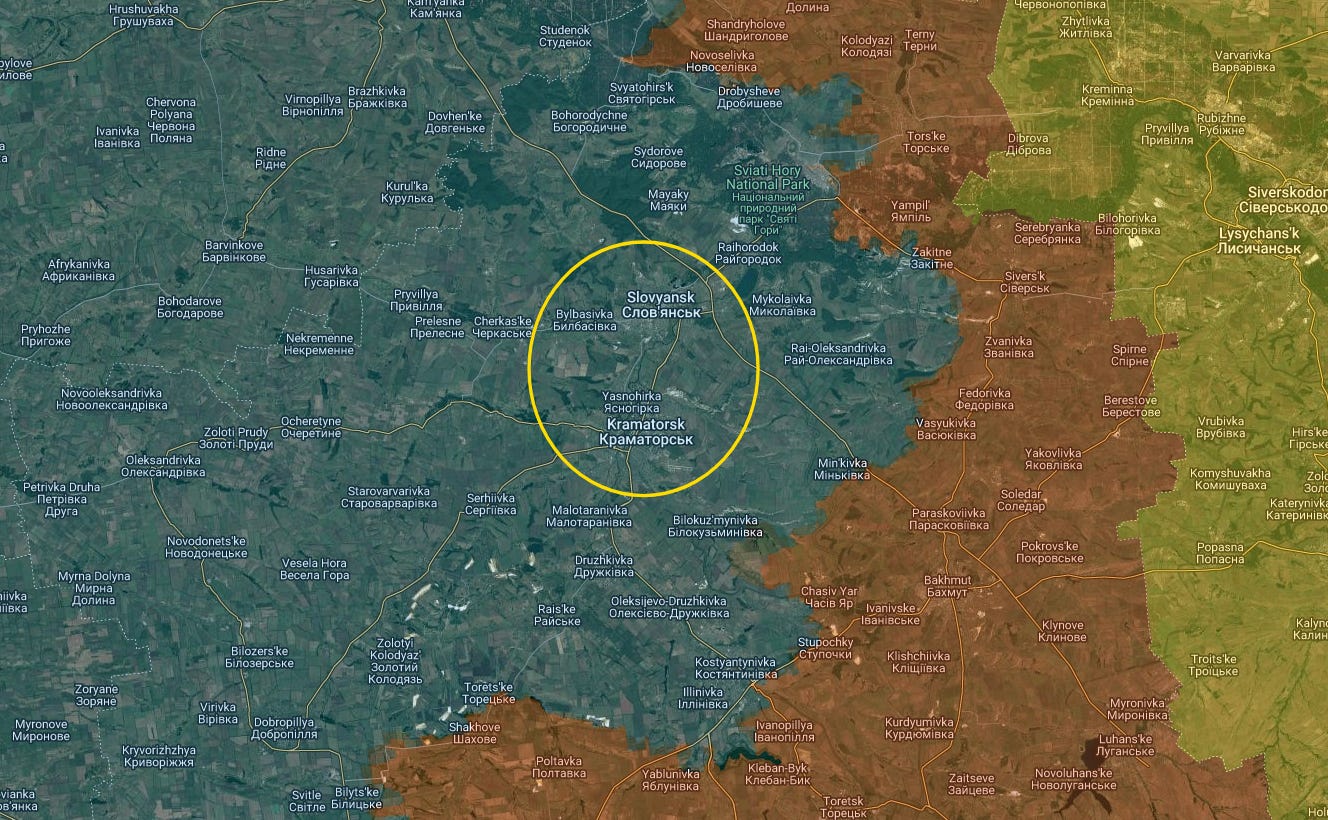
You can see to the north is Russia’s new salient where Sosnove was captured. That along with the coming capture of Krasny Lyman represents the northern pincer toward Slavyansk:
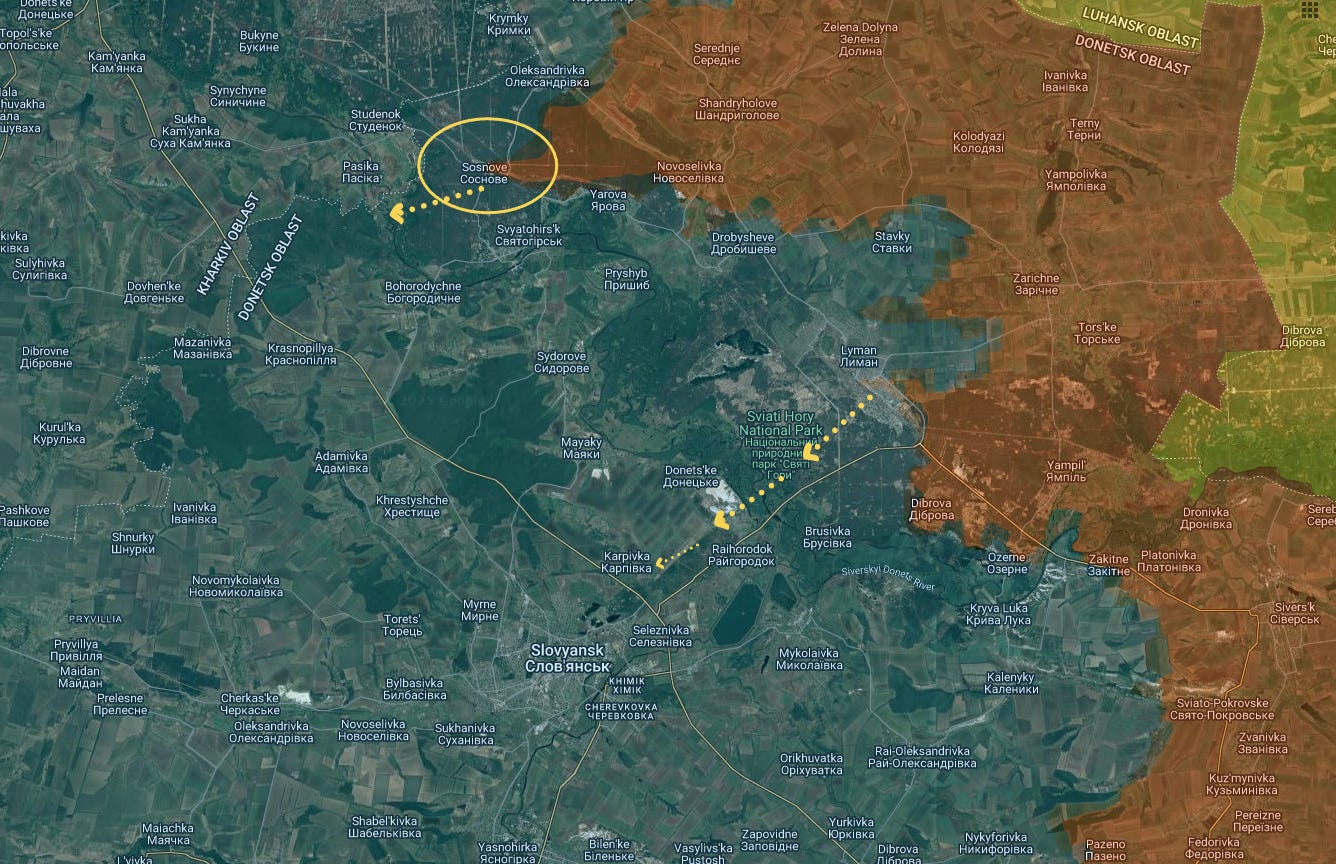
The question is, how much progress can Russia make here in 2026? Historically, Russia had major issues approaching Slavyansk through the infamous ‘Sherwood forest’ southeast of Izyum. Likewise, Russia had never truly successfully even managed to cross the Siversky Donets river here, which forms a natural barrier just north of Slavyansk and running all the way to Izyum.
This presumably will again be a huge hurdle and creates a lot of uncertainty for Russia’s progression on this axis. The direction stemming from Seversk will likely fare better, with Russian forces possibly able to approach Slavyansk from the east and just south of the Seversky Donets.
Given that the Seversk front had been frozen for a very long time and only recently had a spurt of movement, it’s hard to make predictions as to that grouping’s combat potential for large-scale future advancement. This is particularly the case because the terrain in this entire region has always given Russia major problems, not only due to the bisection with the major river, but the fact the area is covered in dense forests which the Ukrainians have classically entrenched themselves well in.
There could be some major ‘surprise’ breakthroughs here, though. For instance, it’s reported by some sources that Syrsky utilized precious reserves from this Lyman area (as well as others) to launch the wasteful ‘counter-offensive’ in Kupyansk, which is now attriting these reserves. Some believe this is the main reason for Russia’s sudden breakthroughs near Lyman, in Sosnove, etc., as critical defense units and reserves were removed toward Kupyansk.
If this continues, this area could face more surprising ‘collapses’ just as the Zaporozhye region did when vital units were removed from there toward other areas, like the defense of Pokrovsk and counter-attacks thereof.
Here’s a map showing roughly Russia’s peak control of this area in July 2022 before the major collapse-retreat began:
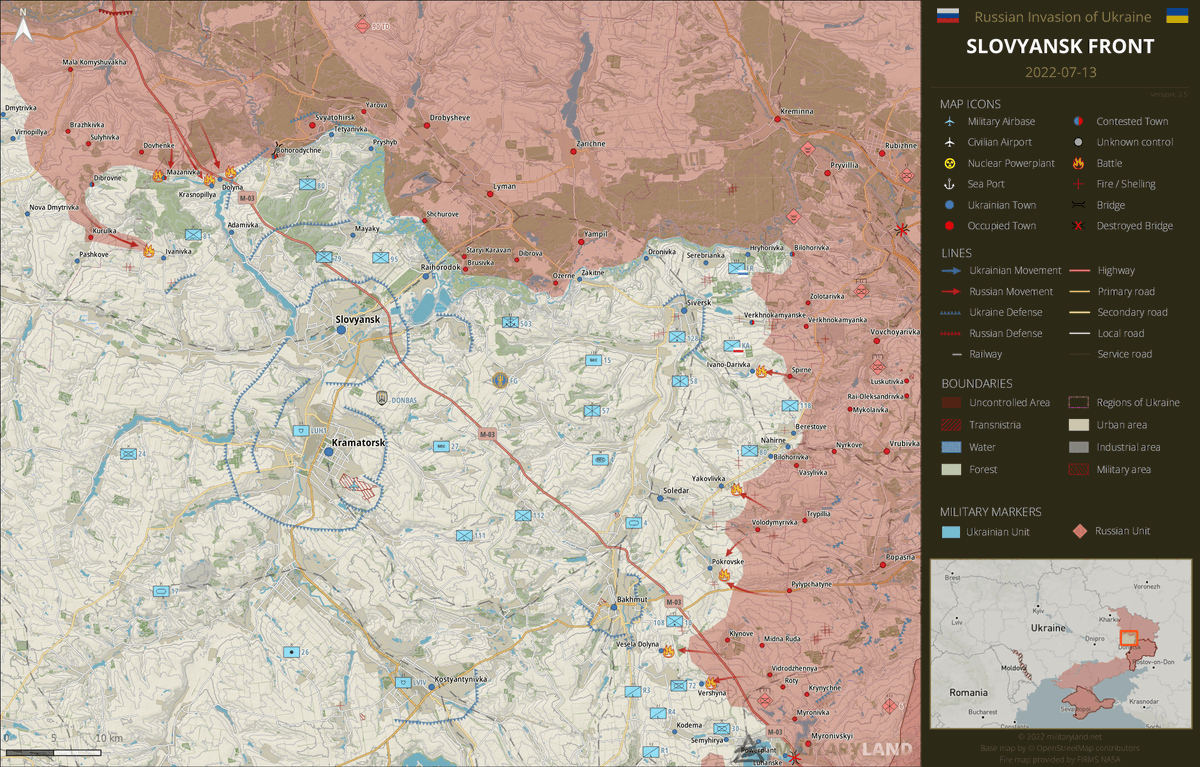
We can see the Seversky Donets river acted as barrier for the entire northern and northeastern front, with Russian troops only really crossing it to the northwest in the direction of Izyum.
For 2026, it’s clear that Lyman will soon be captured and Russian troops will likely continue westward: the only question is, will they again simply line the river, or will they somehow attempt to cross it this time, around Raihorodok?
This area is particularly treacherous because the Seversky Donets actually has a confluence with the Oskol river, creating even more natural barriers and difficult terrain. The yellow circle is the Oskol coming down from the Kupyansk direction, with the blue line following it toward where it meets the Seversky Donets:
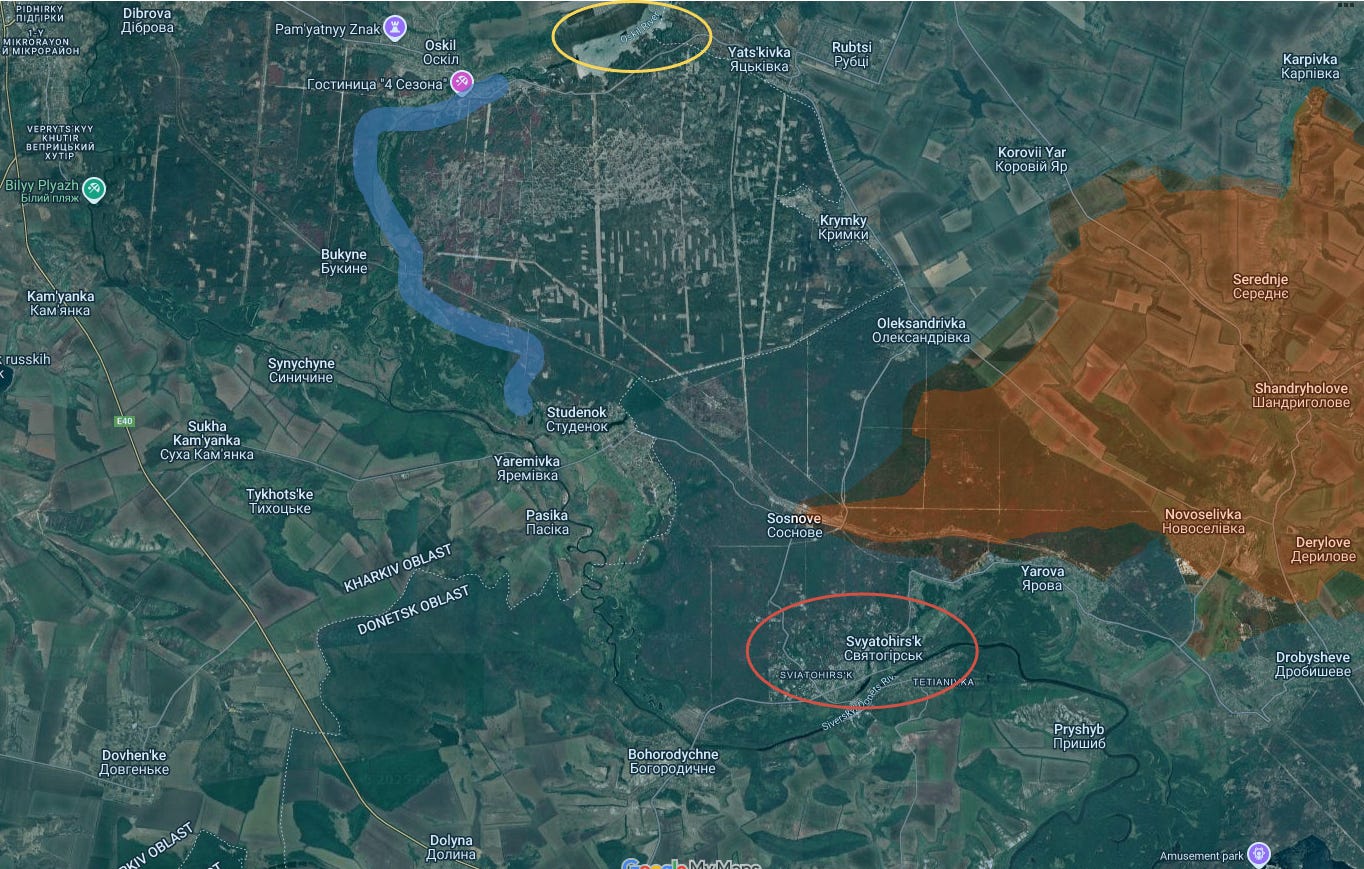
You can see the current location of Russian troops in Sosnove as already reaching this critical barrier that could be very difficult to bypass. At the minimum, Russian forces will likely seize the key town of Svyatogorsk (circled in red) and perhaps attempt to cross there, though that’s unlikely.
The blue shaded area below shows the natural limit of what Russians can capture on the way toward Izyum, before reaching the Oskol barrier:
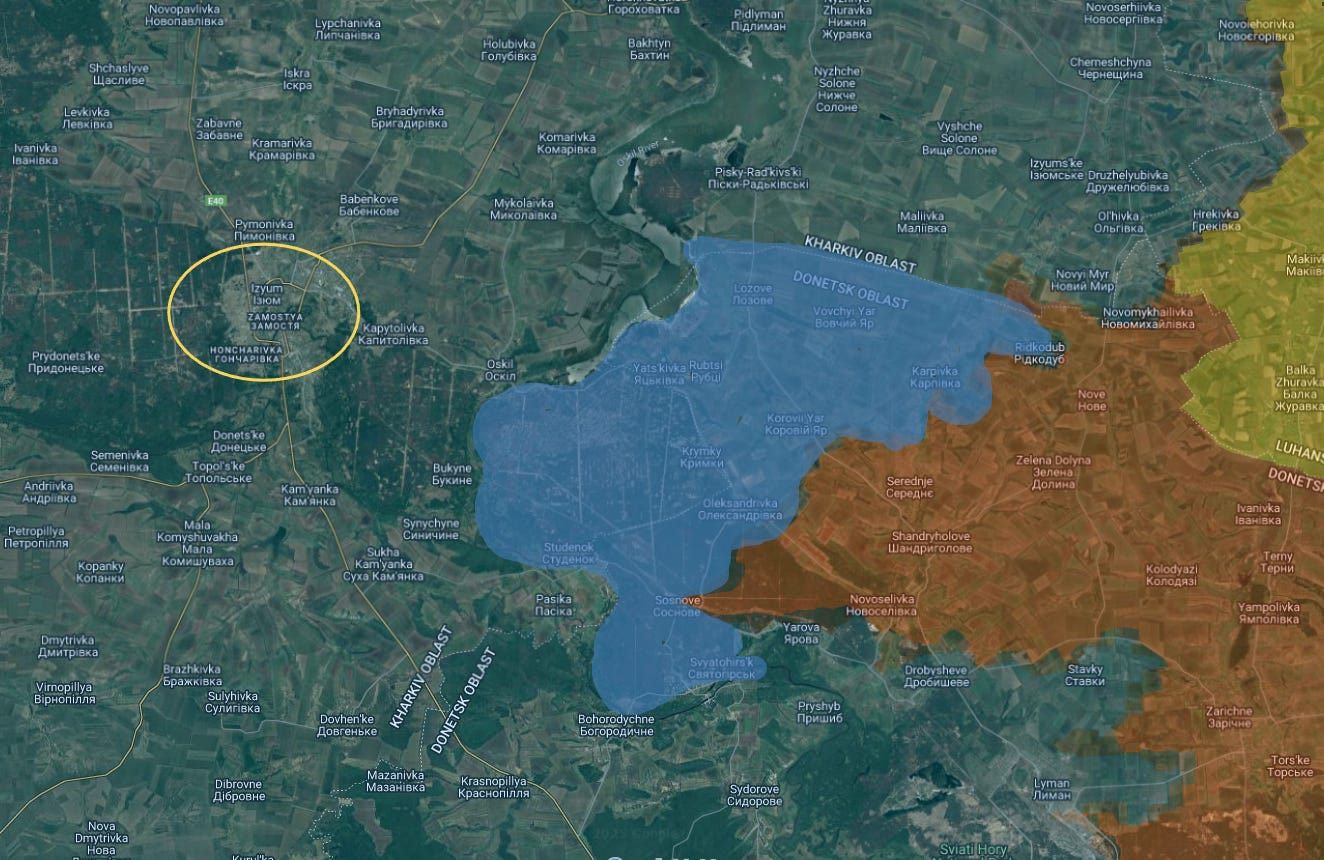
Sure, they did cross the Oskol north of Kupyansk, but that was aided by supply lines running directly from Russia over the border. Here it would be much trickier, but given the current rapid advancement here it will be very interesting to see what happens.
As such, I can only rate this entire area as having low potential for 2026, though there are always possibilities for big ‘surprises’ given what we said before. More likely will be Russian forces taking everything east of the Oskol in 2026, but I’m not sure how much past it they can go in this zone. Further up north in the Kharkov region is where they will likely continue down on the western bank of the river.
The more likely scenario would be Russian forces continuing up toward the Kramatorsk agglomerate from the Kontantinovka direction, given that large city captures have become much more Russia’s forte compared to the crossing of treacherous natural terrain like rivers, swamps, and forests.
Movement has stalled a bit here of late, but the natural objective of Druzhkovka will have to be the main pursuit throughout the first half of 2026:
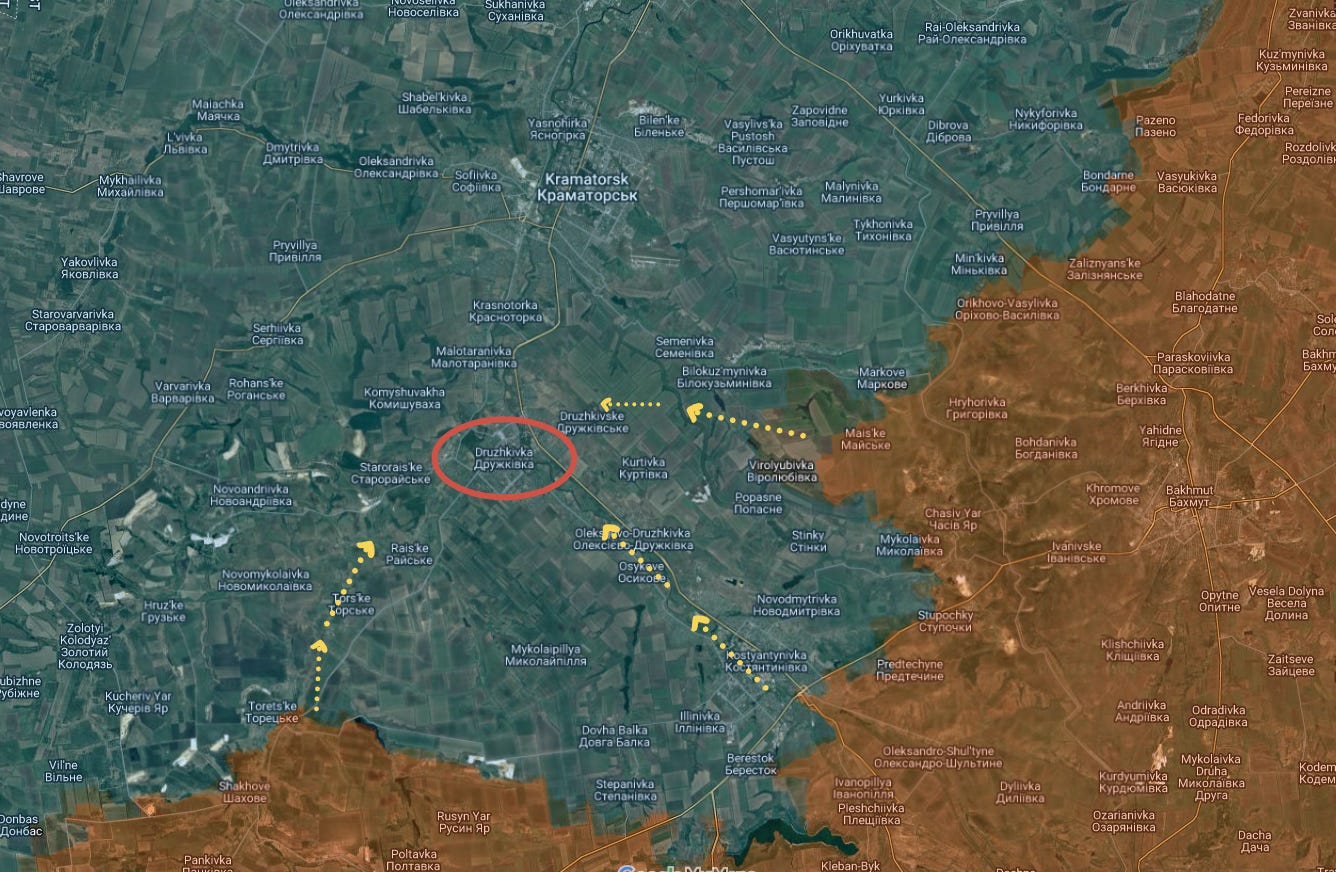
We can guess that somewhere in the second half or late 2026, Russia will begin ‘knocking at the southern gates’ of Kramatorsk. The advance westward from Seversk should come more easily, terrain-wise, so I could foresee Russian reaching the gates of Slavyansk on both sides of the Seversky river sometime in the middle of 2026, while the Konstantinovka grouping approaches Kramatorsk from the south:
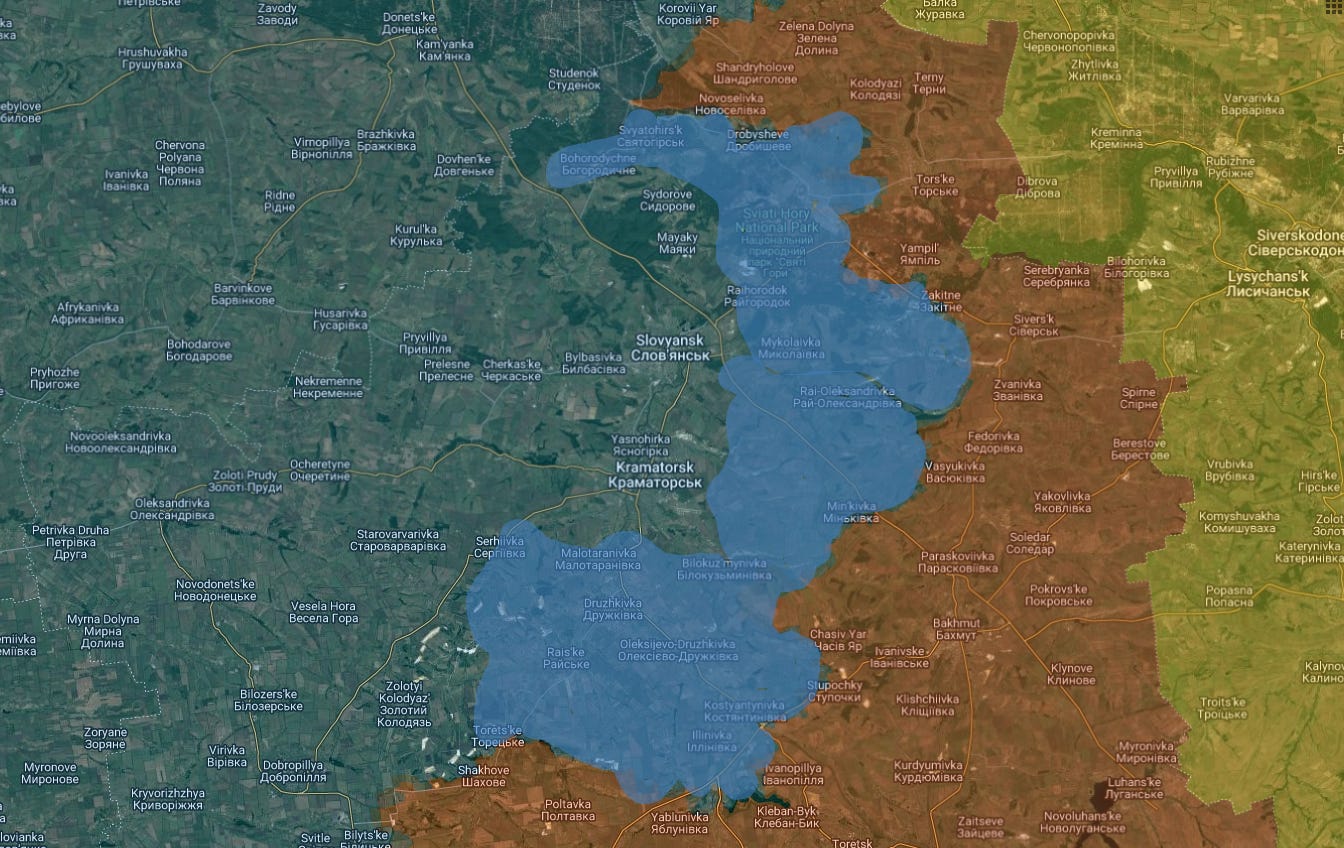
A situation like the above (shaded in blue) could be what the map roughly looks like sometime in Q3 or Q4 of 2026, though it could potentially happen even sooner if the AFU’s collapse in manpower accelerates.
The actual battles for and capture of the Kramatorsk-Slavyansk agglomerate could be the “big battle” of winter 2026, just as Bakhmut was the battle of winter 2022 into 2023, and Avdeevka the battle of winter 2023 into 2024.
As can be seen, the two main headline culminations for the next year will be Russia’s besiegement of Zaporozhye and that of the Kramatorsk-Slavyansk agglomerate. This will provide a huge climax for late 2026, encircling two regions with a population total of over 1.2 million pre-war. That is Zaporozhye’s ~700k plus the entire Kramatorsk agglomerate, which includes Slavyansk, Konstantinovka, Druzhkovka, etc., which totals somewhere near ~500k.
In fact, Putin stated precisely this in his latest general staff address:
Of course, some will zoom out the map and complain, stating: “So, you’re telling me all throughout 2026, Russia will only liberate this shaded blue area below? How does that get any closer to winning the war, as it’s such a tiny portion of Ukraine as a whole?”
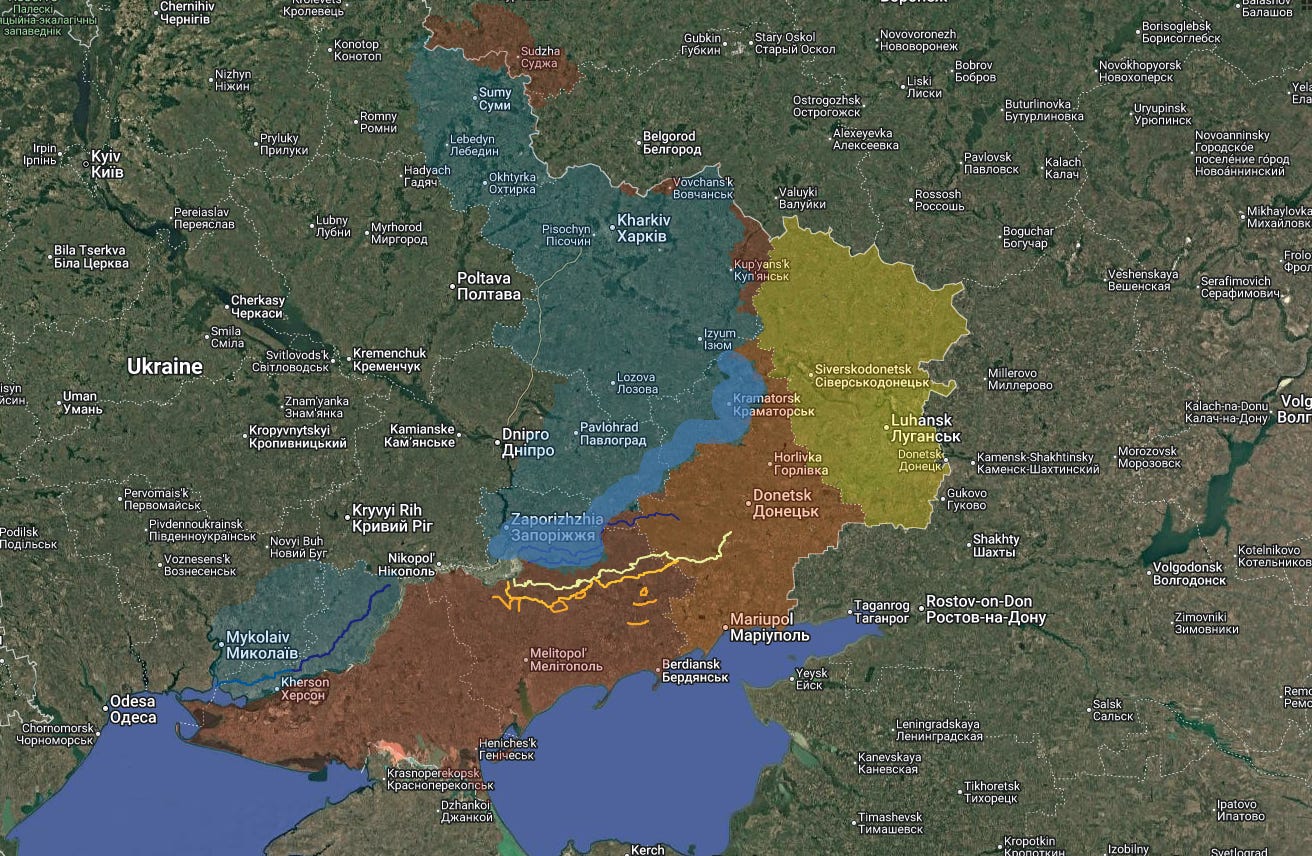
Recall that war is waged across many different domains. This is discussing strictly the territorial captures, and not even mentioning the attrition war that is arguably far more important. How much will Ukraine’s manpower holdup at current loss rates throughout 2026?
On one hand, Ukraine has not had to even launch any truly end-stage mobilizations of the 18-24 cohort yet, so we can assume Ukraine still has much more fodder to spare for the long haul. On the other hand, we clearly see major breaches along the front pointing to obvious manpower shortages, as well as reports from official Ukrainian sources of record levels of desertions.
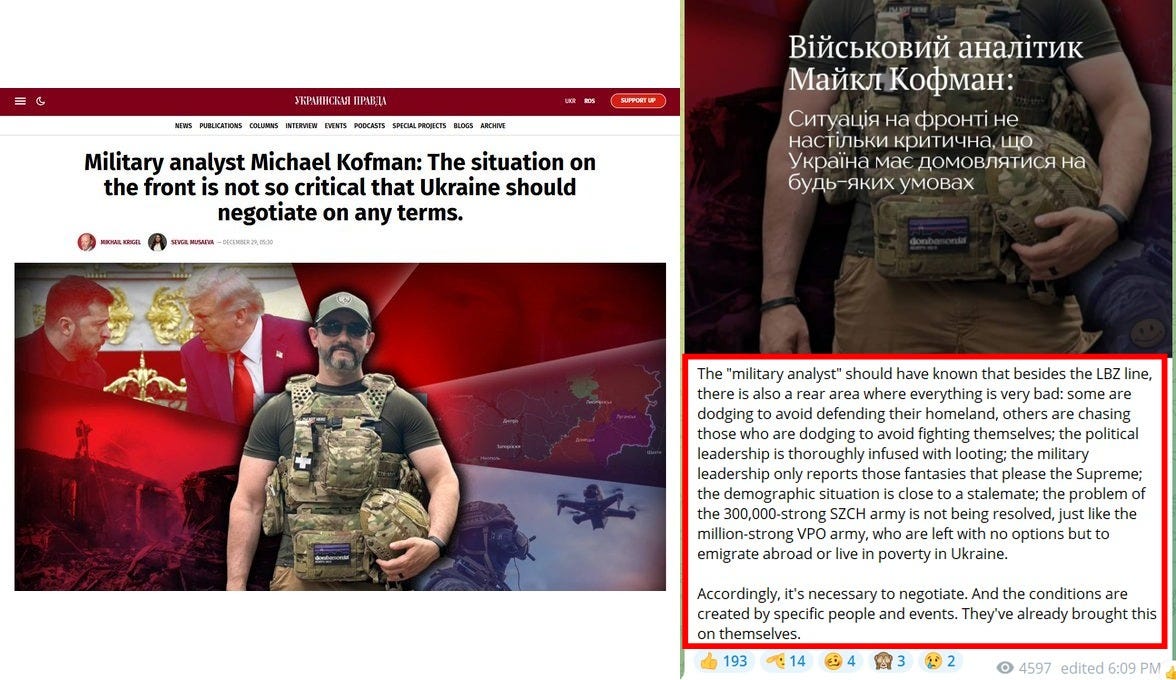
For instance, here a Ukrainian military member lambastes famed ‘analyst’ Michael Kofman for his overly-rosy depiction of the AFU’s condition:
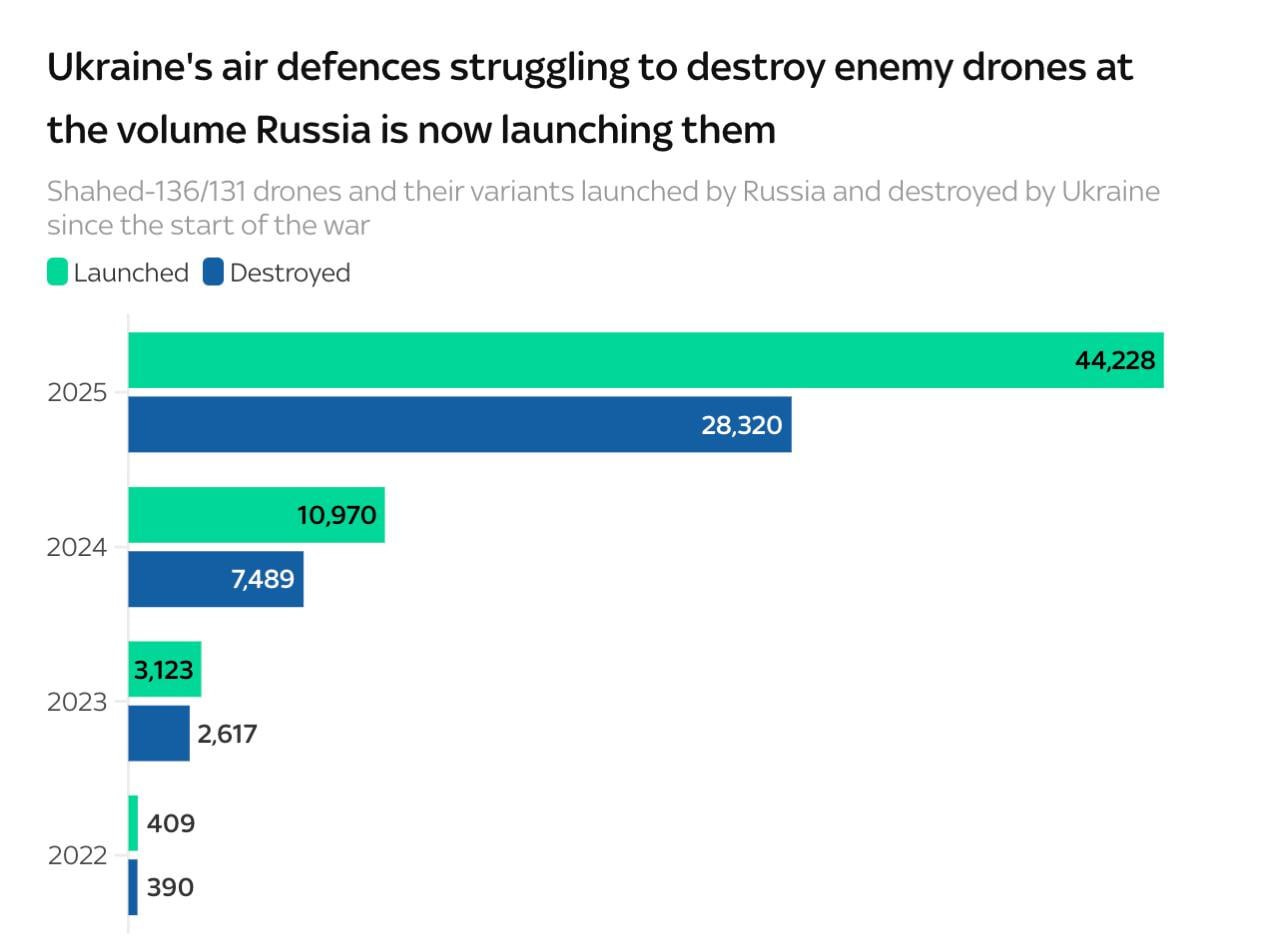
Then there is the infrastructure aspect. Ukraine’s energy grid, industrial, and economic infrastructure is being targeted by Russia like never before: from railways, ports, factories, power plants, etc. This will likewise continue to worsen to unseen levels and add to the questions of how much longer Ukraine can hold out amidst worsening conditions from all of the mentioned fields.
Then there is the political aspect. This past year has brought major political pressure, from the corruption scandals slowly tightening the noose over Zelensky himself, to major figures being forced out, from Podolyak, Yermak, and many others. How much longer can Zelensky’s regime bear this pressure and societal exhaustion, particularly with the pressures of elections growing more intense as well?
So the real question is not how much territory Russia seizes, per se. That’s just one of the many elements of Russia’s overall hybrid war which will add intense pressure to the teetering structure of Ukraine as a whole.
Imagine, for a moment if Ukraine makes it to the end of 2026, politically speaking, and the AFU manages to hang on as well. The situation will likely be terminally dismal, and nearing a breaking point. Now imagine precisely at this time of greatest despair—with energy infrastructure totally destroyed, complete political and societal exhaustion, economic collapse or near-terminal hardship, etc.—and right at this moment, Russian troops capture Zaporozhye and Kramatorsk-Slavyansk. The blow from these liberations could reverberate so loudly as to finish off any remaining morale in the nation, or at least send it veering into the final death spiral.
As some top pro-Ukrainian analysts have noted of Zaporozhye in particular:
[T]he city of Zaporizhzhia is far, far more important for Ukraine militarily and politically than anything left in Donetsk Oblast. It’s a large industrial city and the Russian capture of it would be truly catastrophic for Ukraine.
Of course, some have claimed that Russia does not have the manpower to capture such “major cities” as Zaporozhye, given that to assault a city of nearly 1 million people, one needs an army of hundreds of thousands of troops. That may be the case if the defending army likewise has such a garrison there proportionate to the city size. But what will the AFU garrison in Zaporozhye look like by the time Russian troops arrive?
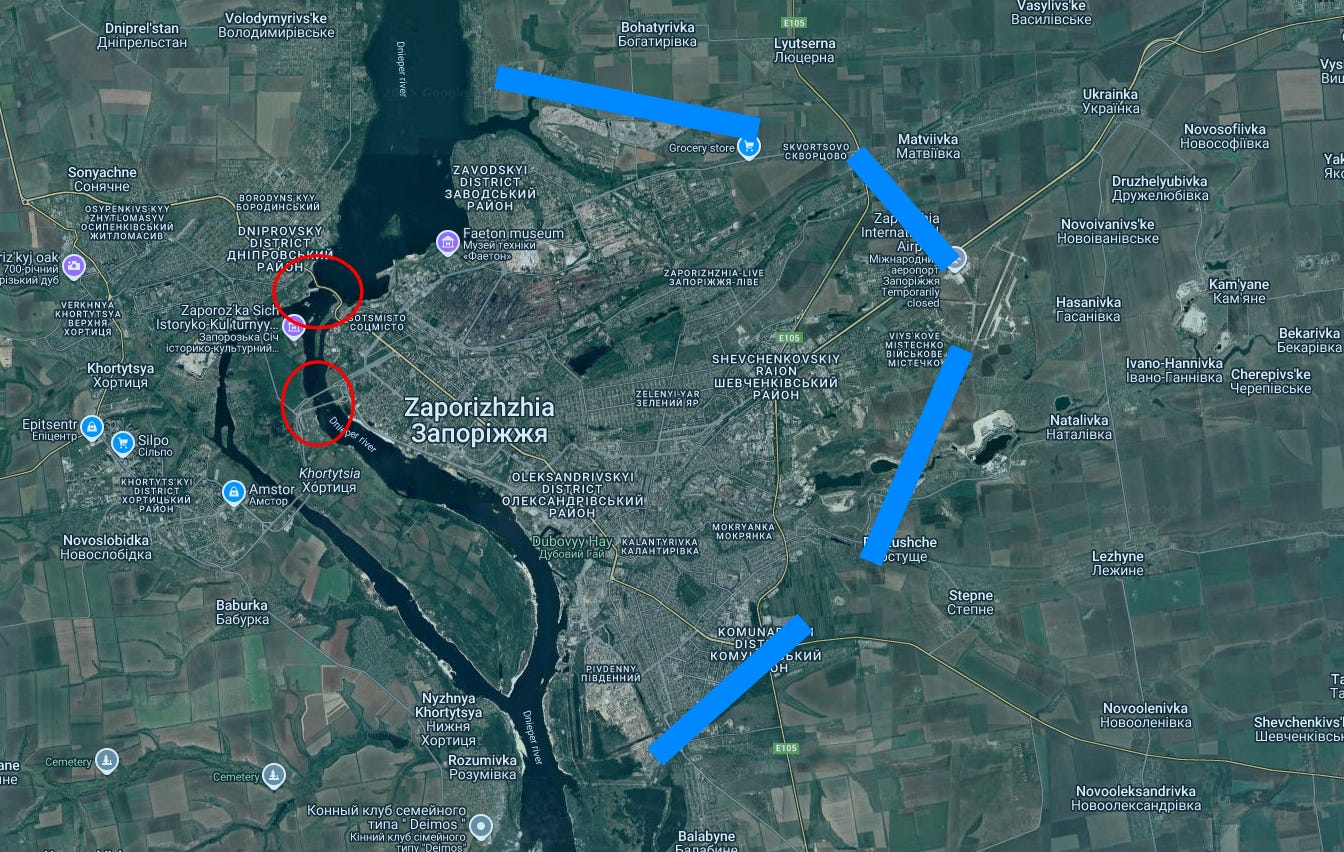
In fact, I propose that Zaporozhye could be one of the easiest cities for Russian troops to capture, despite its mythical size. That is because the city has its back entirely to the water like Mariupol, which means once Russian troops surround it on merely three sides, it is essentially game over, as all logistics routes will be cut off.
Once Russian troops (blue lines) have surrounded it and the bridges westward are under drone fire control (red circles), it’s pretty much game over and will likely culminate in another Azovstal-like “final holdout” and siege in some downtown industrial sector:
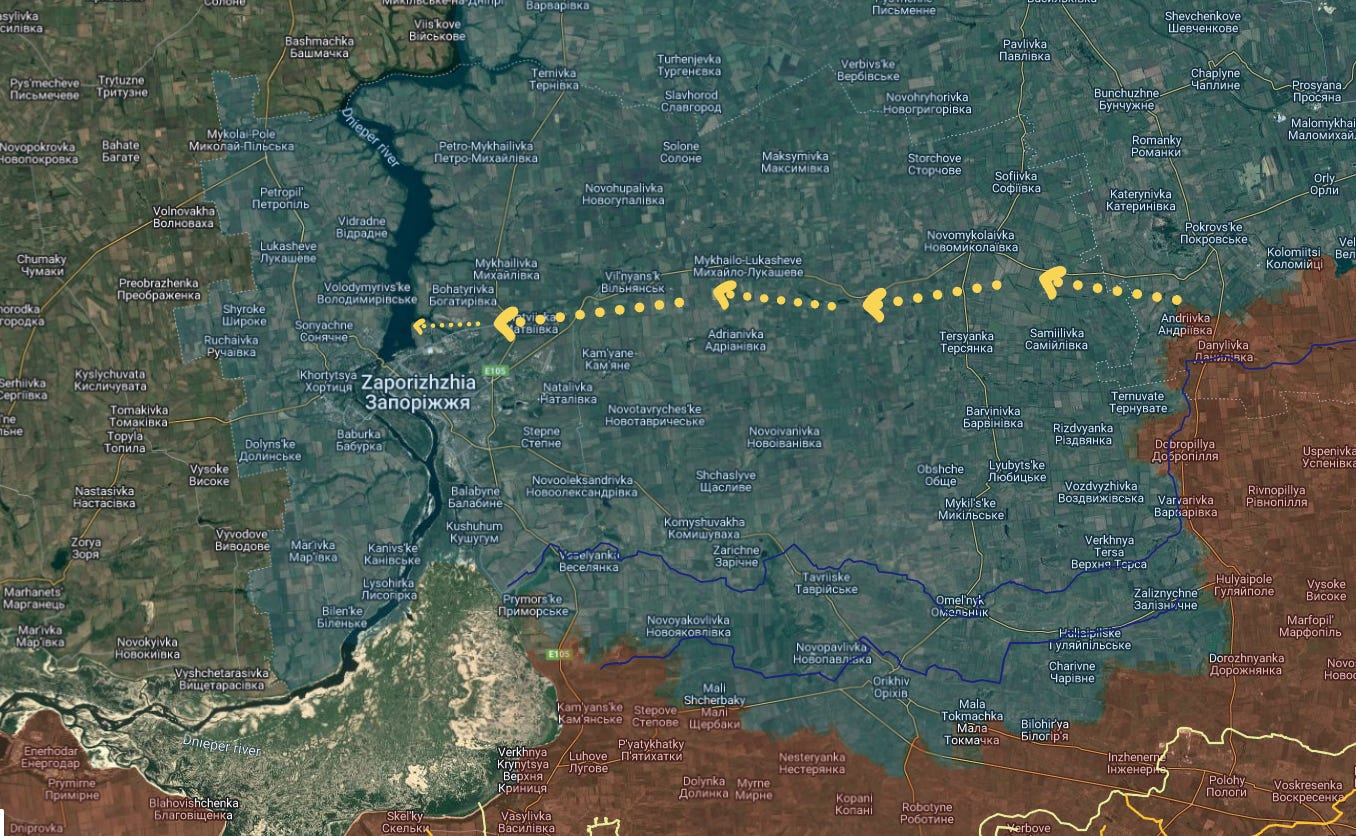
And given that Russian troops are proceeding precisely along the main road leading to the north of Zaporozhye, one can easily see how they will encircle the city and cut it off from the north once they arrive:
After that, we can probably see them proceeding toward Pavlograd and Dnipro for 2027 and beyond, should the war last that long.
None of these projections have mentioned the northern front, which has been stirring recently. And there are potentials for Russia to continue expanding the so-called ‘buffer zone’ in both Kharkov and Sumy regions.
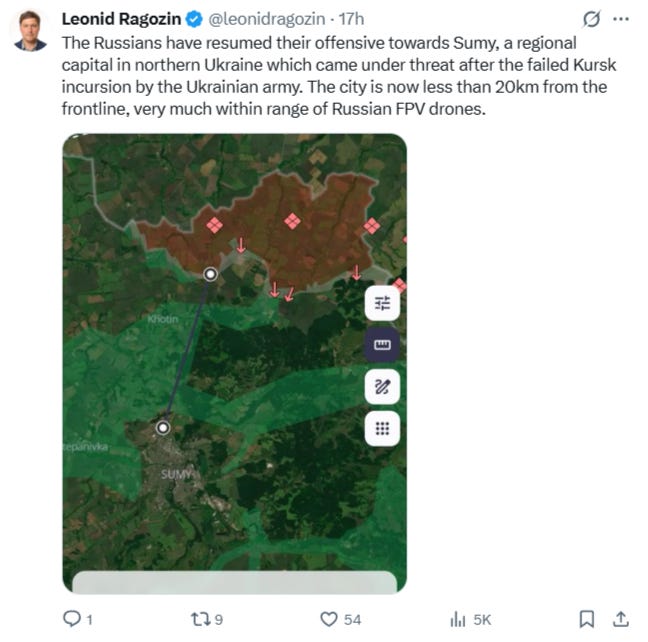
It doesn’t appear Russia has the manpower for full-fledged offensives there but that could always change should the AFU continue suffering major manpower collapses of its own.
For instance, there were reports today that many settlements in the Chernigov region were issuing mandatory evacuations for some unknown reason:
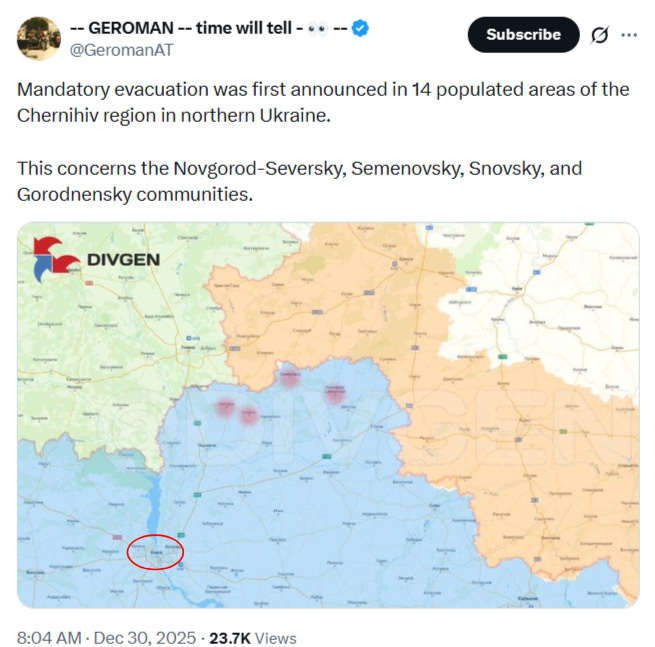
For context, that’s Kiev circled in red.
Another map:
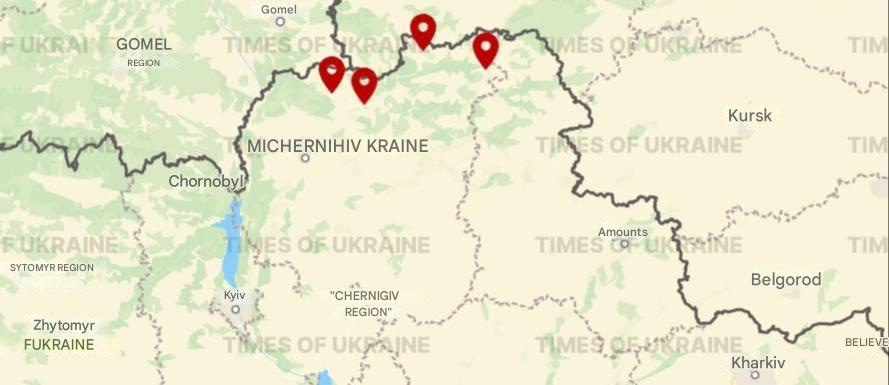
This was confirmed by Ukrainian Pravda here. It appears they expect an assault from over the border here for the enlarging of the border buffer zone. This would make sense given the recent new cross-border advances Russia has made in the past couple weeks in the Sumy region near Grabovske. And in fact, just as of this writing, Gerasimov landed in this region to inspect the North grouping, which means it’s probably going to heat up soon.
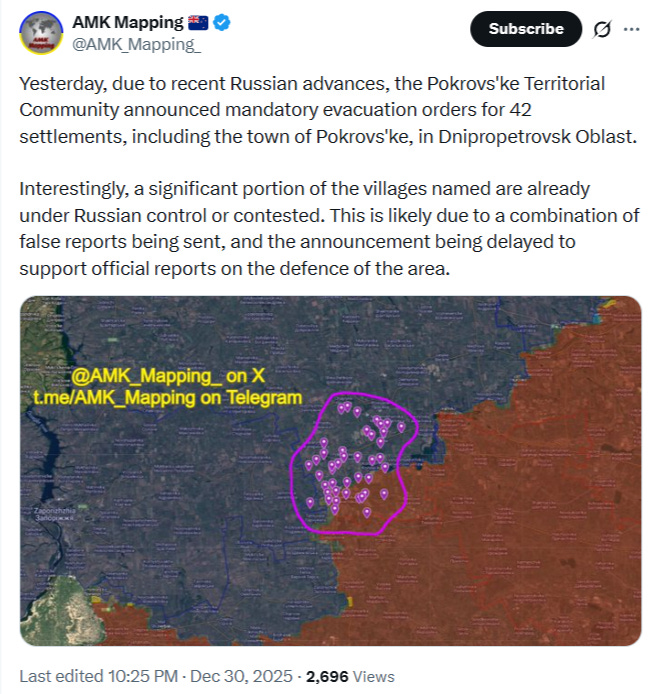
Meanwhile, evacuations were ordered for the region directly northwest of Russia’s main ‘Eastern Express’ advance line:
We will see how accurate these predictions are through 2026, but they represent the logical culminations of the current battlefield dynamics.
Lastly, a final New Year’s address by Defense Minister Andrey Belousov, wherein he calls the Russian Armed Forces the most ‘combat-ready’ in the world:
‘In 2025, we continued to improve the combat capabilities of our Armed Forces. Today, we can surely say that the Russian army is the most combat–ready in the world. We prove in practice that we are able to ensure the sovereignty of the country and defend our national interests. During the special military operation, Russian soldiers and officers demonstrate true professionalism, dedication and bravery, and heroically fight for the country,’ Andrei Belousov said in his congratulatory message.
If we don’t see each other again until then, I wish you all Happy New Year! May 2026 bring the world—and us all—better tidings.
How accurate are our battlefield projections for 2026?
It will happen roughly like so
Russia will advance far more
Russia will slow down, advance less
591 VOTES · 2 DAYS REMAINING
How long do you expect the war to continue to last?
631 VOTES · 2 DAYS REMAINING
Your support is invaluable. If you enjoyed the read, I would greatly appreciate if you subscribed to a monthly/yearly pledge to support my work, so that I may continue providing you with detailed, incisive reports like this one.
Alternatively, you can tip here: buymeacoffee.com/Simplicius