Ukraine's Power Grid Woes Worsen, + New Oreshnik BDA
Today’s news brings us more grim updates about the state of Ukraine’s energy grid. The lights have still been out in much of Kiev and many other large cities after a long cold snap, and things do not seem to be improving much.

Kiev’s CHPP-5 (combined heat and power plant) and CHPP-6 failed to be fully restored following a ballistic missile strike last week, according to Sergey Nahornyak, a member of the Verkhovna Rada Committee on Energy.
Defensive structures failed to protect the facilities, he noted.
After urging Kiev residents to “temporarily flee” Kiev if they’re able to, Klitschko showed some of the damage to the water and heating systems—the video being geolocatedto Thermal Power Plant 6 in Kiev:
One of the most noteworthy aspects of the last strike on Kiev was the notable absence of any major air defense action. Video footage of only one “Patriot” missile launching and self-destructing in the sky soon after emerged, but beyond this Ukrainian defenses over Kiev appeared dismal compared to previous strikes, signifying a likely exhaustion of resources.
At the same time, we should be wary of the fact that it’s in the pro-Ukrainian sphere’s interest to play up and exaggerate the damage in order to garner sympathy from the West, so we shouldn’t expect Kiev to ‘collapse’ and the AFU to suddenly surrender. The fight grinds on, as always despite these hardships.
UK’s Defense Secretary Healey demonstrates this pity-grandstanding in Kiev:

Even as of this writing, a new massive series of strikes is ongoing against targets in Kiev, Zaporozhye, and Kharkov with a claimed 20+ Iskander ballistic missiles involved, which could be a new record.

—
Let’s move on to a post-battle damage assessment of the Oreshnik strike, now that we’ve gotten some new information.
The Russian MOD has updated us with the info that the target which was hit was notthe big gas plant everyone had assumed, but rather the Lvov Aviation Plant. The full statement from the Russian MOD:
According to information confirmed by several independent sources, a strike launched by the Armed Forces of the Russian Federation on the night of 9 January using the Oreshnik mobile ground-based missile system disabled the Lvov State Aviation Repair Plant.
▫️ At the plant, aircraft of the Armed Forces of Ukraine, including F-16 and MiG-29 aircraft supplied by the Western countries, were repaired and maintained. The plant also produced long-range and medium-range attack UAVs used to hit Russian civilian facilities in the depth of Russian territory.
▫️ The Oreshnik system engaged production workshops, warehouses with products (UAVs), as well as the infrastructure of the factory airfield.
▫️ In addition, as part of this massive attack with the use of the Iskander missile system and the Kalibr sea-based cruise missiles, the production facilities of two enterprises in Kiev involved in assembling strike UAVs for attacks against the territory of Russia, as well as energy infrastructure facilities that support the work of the Ukrainian defence industry, were hit.
The interesting part about this is that Ukrainian officials did admit that some kind of “secondary” effects from the explosion caused gas outages in the region, which were reported by other official Ukrainian news outlets. For instance, here a news outlet confirms that there were reports—seen on videos posted by Ukrainians on social media—of stoves not being operable, to which the Lvov City Council member implies that this was caused by secondary damage from the blast wave:
So, we do know for definite that gas infrastructure was damaged somehow by the blast, and there were rumors and unsubstantiated reports about underground gas pipes being affected by the seismic pressures. Thus the “glow” seen after the Oreshnik strikes could still have represented some burning gas, but the target itself was not the Stryi gas field as we had supposed.
Ukrainian dissident journalist Anatoly Shariy allegedly published the following—of which I was only able to verify the text, but not the photos which seem to be deleted from his post, so take it with great skepticism. He claims the gas strike was essentially a coverup, as the actual site that was hit was far more sensitive, and even claims to have received photos of the destruction:
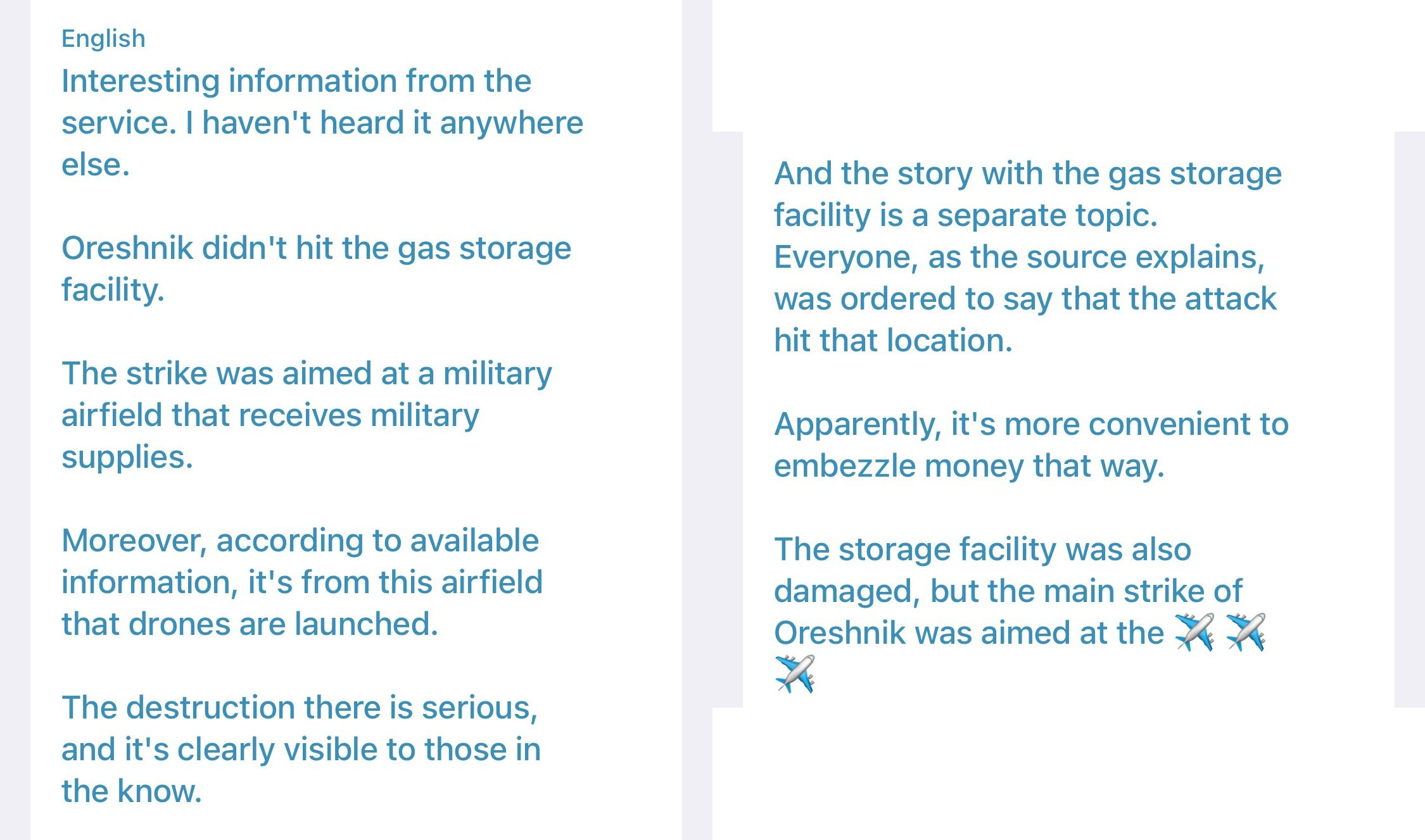

The problem is, some have geolocated the above photos to the actual Stryi gas site, rather than any airfield, so take it for what it’s worth.
The mayor of Lvov Andriy Sadovyi further elaborated, stating that the attack caused “horrific” damage to the site, but that it was still no where close to the damage it could have caused if the Oreshnik actually had ‘warheads’ rather than empty kinetic ‘vehicles’—below both the AI dub and subtitled versions:
So, at the minimum we have multiple Ukrainian authorities admitting that the Oreshnik did considerable damage to whatever it was targeting. This means we can only assume that Oreshnik’s accuracy is adequate enough to hit the targets it is aiming for.
Which brings us to the next point. CNN made a lot of hubbub with their new video showcasing the recovered parts of the 2024 Oreshnik system, just as new photos emerged of identical-looking parts from the recent strike:
The problem is, these parts are from the main delivery bus which carries the MIRV or MaRV warheads before they are released. The left-most photo below shows the newly recovered Oreshnik piece that matches the one in the center, recovered in 2024 after the strike on Yuzhmash enterprise.
The red-circled area is likely the thrusting engine of the bus, which positions it before releasing the MIRV warheads toward their targets.
There is now a lot of chatter about the “ancient technology” in this bus, such as vacuum tubes and “Yuri Gagarin’s old gyroscope”. The vacuum tubes were already identified by even pro-UA weapons experts as being standard for ICBM missile tech because they happen to be immune or at least provide adequate shielding to EMP explosions, whereas normal circuitry would be fried.
One such pro-UA expert writes:
Nuclear missiles have to be radiation hardened because of nuclear interceptors and the chance they are being launched through a nuclear cloud. Vacuum tubes, by nature, are radiation hardened. Vacuum tubes, to this day, have niche uses.
This is a defense mechanism for ICBMs against nuclear interceptors which would attempt to intercept them in outer space. Some people don’t know that the missile defense systems of the Cold War era which were the last line of defense against nuclear ICBMs were themselves armed with nuclear-tipped warheads, like Russia’s A-135 and US’s Sprint missiles. That’s because when you don’t want to leave things to chance, you hit the nuke with your own nuke in the atmosphere.
As for the gyroscope, it is said this is a crude and primitive guidance system, as “used by Yuri Gagarin”. But here’s the interesting part no analyst has yet brought up. No one yet truly knows precisely what the Oreshnik is, whether it’s a MIRV missile system, which means kinetic vehicles which are targeted, or rather aimed, by the delivery bus but which themselves have no other independent steering or thrusting ability, or a MaRV (Maneuverable Re-entry Vehicle) system, wherein the warheads actually have their own thrust and can steer and guide themselves to the target even long after being released from the delivery bus.
The difference is crucial. Most people assume Oreshnik utilizes MIRVs which means the delivery bus has to have an extremely advanced and sophisticated guidance system in order to precisely pinpoint the MIRVs to their targets—because once they’re released, they have no further way of correcting their trajectory, and they are released in the atmosphere.
Cold War-era MIRV systems had a CEP accuracy of many kilometers because it didn’t matter if the nuclear warhead landed a few miles “off target” as it would still obliterate the target, particularly given the Cold War-era’s much higher warhead yield sizes. Thus, in that era such ancient “gyroscopes” could be used wherein the guidance was “good enough” to place the MIRV warheads plus or minus a few thousand meters.


But here’s the problem: we now have confirmation from Ukrainian officials that the Oreshnik struck its target precisely and caused “horrific damage” to the “sensitive facility”. So, how could an ancient guidance system known for +-1,000s of meters CEP accuracy be able to do this?
We can logically conclude only one of two possibilities exists:
The Oreshnik bus has far more sophisticated guidance components than merely “Gagarin’s gyroscope” which allows it to aim the MIRV’d warheads precisely onto the target from hundreds of miles away, given that the bus releases them in the atmosphere and the warheads “drift” to target with no further propulsion ability at all, or…
The Oreshnik is actually a MaRV system, wherein the bus itself uses ancient tech, but the Maneuverable Re-entry Vehicles have sophisticated self-guidance and propulsion mechanisms that allow them to reach the target on their own.
If the case is really #2 above, that means the “recovered” components from the bus are useless given that the delivery bus is the least sophisticated part of the overall system, and is really only there to separate the warheads from the main booster stage of the rocket.
But if the case is really #1, that means it’s physically impossible for the delivery bus to have low-grade and obsolete tech while still being able to aim its MIRV vehicles to targets hundreds of miles below with pinpoint accuracy. Either “ancient” Soviet tech is actually remarkably advanced even by today’s standards, or there is more sophisticated stuff which they did not recover, or simply are incapable of understanding.
Since most data points to the warheads being MIRVs, we can assume that the “ancient gyroscope” is just a redundancy system and far more sophisticated guidance exists which the Ukrainians either did not recover, or simply did not want to show.
Also, let’s not forget the tech level of US nuclear missile forces:

Sometimes the old stuff simply works better and is more reliable.
—
As a last interesting note, reliable Ukrainian EW expert Serhiy ‘Flash’ Beskrestnov claims to have had insider info about the Oreshnik strike:
I can’t comment on anything before official sources, but Oreshnikov’s strike on Lviv wasn’t intended to cause global damage. I believe it was a message addressed to Europe about Russia’s capabilities and determination. That’s why a western city of Ukraine was chosen for the strike.
To give you an idea of the destructive power of the strike’s elements: it penetrated two ceiling slabs and burned down the entire collection of Lenin’s works in the building (the archive was in the basement). I’m not joking.
All these stories from Russian channels about penetrating deep into the ground for tens of meters don’t correspond to reality.
After the above message, he clarified with a second one:
Friends, many have read my post and decided that Oreshnik is some kind of nonsense.
No! MBR/BRSD Oreshnik is a very dangerous and effective weapon in its nuclear version. That’s why the missile was created. It has 6 separate, essentially autonomous nuclear submunitions.
It’s just that when firing 36 “shells”, this weapon is not effective and is purely a demonstration of its capabilities.
In essence he’s saying that the penetrative capabilities of the empty warheads is not as fearsome as claimed, and that it was only able to pierce two concrete floors of a building to reach the building’s basement level.
There is obviously now a huge ongoing scientific debate of the true explosive characteristics of kinetic objects going at Mach 10. The problem is, no one knows how fast the objects are actually going at terminal speed, given that the Mach 10+ number was recorded by Western radars in the atmosphere at the missile’s likely burnout phase (before the boosters even separate with the delivery bus), where it would be going its fastest. And secondly, no one remotely knows what the actual MIRV ‘vehicles’ or submunitions of the Oreshnik even look like: there are various theories of them being anything from tungsten flechettes to regular but “empty” conical warheads. That means estimating true kinetic force is next to impossible and is just an empty exercise in futility.
—
As a last noteworthy update, another bit of confirmative news today from NYT which further corroborated theories about how Venezuela’s air defenses were essentially non-existent during Trump’s “masterstroke” raid on Maduro:

A big face-palm from the very first sentence of the article:

"Venezuela’s advanced, Russian-made air defense systems were not even hooked up to radar when U.S. helicopters swooped in to snatch President Nicolás Maduro, American officials say, rendering Venezuelan airspace surprisingly unprotected long before the Pentagon launched its attack."
It goes on to state the remainder of VZ’s air defense was “in storage”, while Russia’s vaunted S-300 allegedly suffered from Venezuela’s decay:
The vaunted, Russian-made S-300 and Buk-M2 air defense systems were supposed to be a potent symbol of the close ties between Venezuela and Russia…
But Venezuela was unable to maintain and operate the S-300 — one of the world’s most advanced antiaircraft systems — as well as the Buk defense systems, leaving its airspace vulnerable when the Pentagon launched Operation Absolute Resolve to capture Mr. Maduro, four current and former American officials said.
But don’t worry, this does not take away any glory from America’s deadly and “invisible” special forces, who heroically liberated the stolen freedom-oil by slaughtering Maduro’s personal household staff before hightailing it out of country in Hollywood fashion.