and Seward’s icebox...
The maps of some people are puzzling. Why, for example, did Hitler not understand the strategic role of the Mediterranean in the minds of his enemies? It’s easy to say that, because he was a provincial Austrian, his eye went back and forth from left to right and never from top to bottom. Maybe so.
It’s also hard to explain some (or many) Americans’ (as in North Americans’) vision of their ‘own’ hemisphere. It is vast. Yet they persist in describing Paraguay or Chile as a part of their ‘backyard’ when a good part of Europe is closer to them, geographically, politically, economically, and perhaps also culturally.
Today this backyard has acquired the qualities of a giant fortress with a big moat on either side, and someday, maybe, on top. Moats may once have served a defining and defensive purpose. But large bodies of water, namely oceans, do the opposite. This is geopolitics 101.
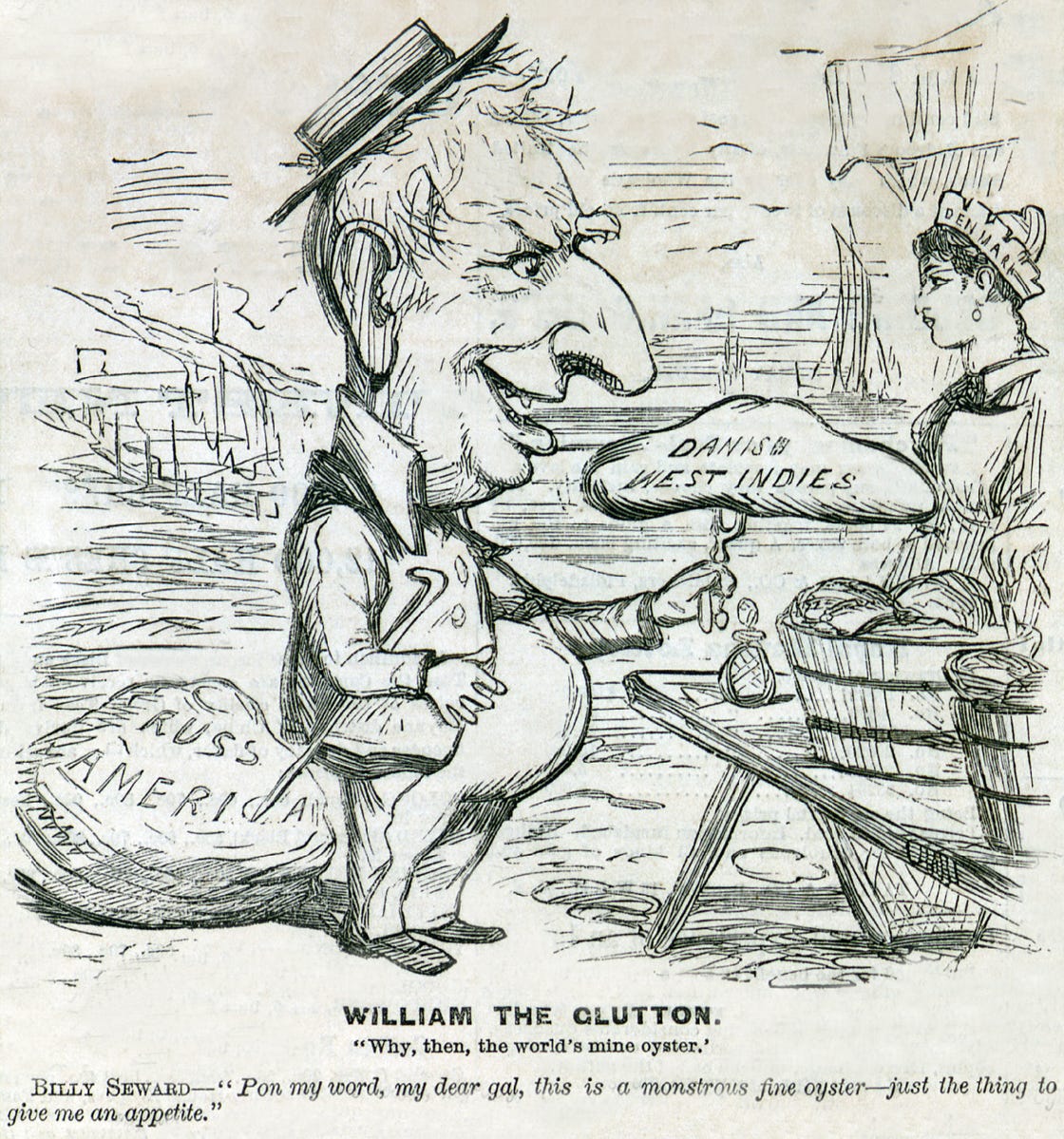
William Henry Seward, a nineteenth century visionary, understood that. His determination was to acquire Alaska, pursued with the same passion and mockery as the current obsession with Greenland. Mr Seward was sublime but his aim was not. It was, too, the opposite. Acquiring Alaska was not meant to seal off the Pacific or the Arctic or any other region for America’s sole possession. It was part of expanding into the Pacific realm, and into Asia, so as to better compete for access to the great China market.
Today’s ‘strategy of denial’ most resembles a classic sphere-of-influence attempt which, in the previous century, took the form of regional autarky. But the USA already has, and has long had, a ‘co-prosperity sphere’ in the Western Hemisphere, and in other regions. It won’t strengthen itself by forcing them down and others out. And it won’t gain if others are encouraged to do the same in their ‘backyards’. An Asia for the Chinese, a Eurasia for the Russians, and a Middle East for the Israelis (and/or Saudis) will mean one world war after another. Or, at the very least, penury for anyone who tries it.
If you don’t believe this, ask the Russians. Viz:
‘Now, Mr. Molotov’, Mr Bevin demanded, ‘what is it that you want?...’
‘I want a unified Germany’, said Molotov.
‘Why do you want that? Do you really believe that a unified Germany would go Communist? They might pretend to. They would say all the right things and repeat all the correct formulas. But in their hearts they would be longing for the day when they could revenge their defeat at Stalingrad. You know that as well as I do.’
‘Yes’, said Molotov. ‘I know that. But I want a unified Germany.’
—Harold Nicolson
‘We were fortunate in our opponent.’
—Dean Acheson