Has Russia Finally Begun Disconnecting Ukraine's Nuclear Plants?
Today again we start off with a major Russian strike that occurred as promised. In the last article two days ago we said Russia was readying a new strike, and it delivered. But what is most notable about this one is that it also fulfilled the ‘rumors’ we were hearing from Ukraine’s experts—like that of Serhiy ‘Flash’—that Russia could soon start disconnecting the “final” source of Ukrainian power, which is the nuclear power plants.
All this time, Russia has focused on hitting the TPPs, or thermal power plants, and various other gas and hydro-stations near dams, etc. Hitting nuclear plants is obviously quite a sticky subject because of not only the optics it creates, but obviously the dangers involved. Last time I had posted photos of the ‘substations’ which down-convert nuclear energy to be sent over the major 750 kV lines. These substations are usually located in close proximity to the nuclear plants themselves, as seen below:
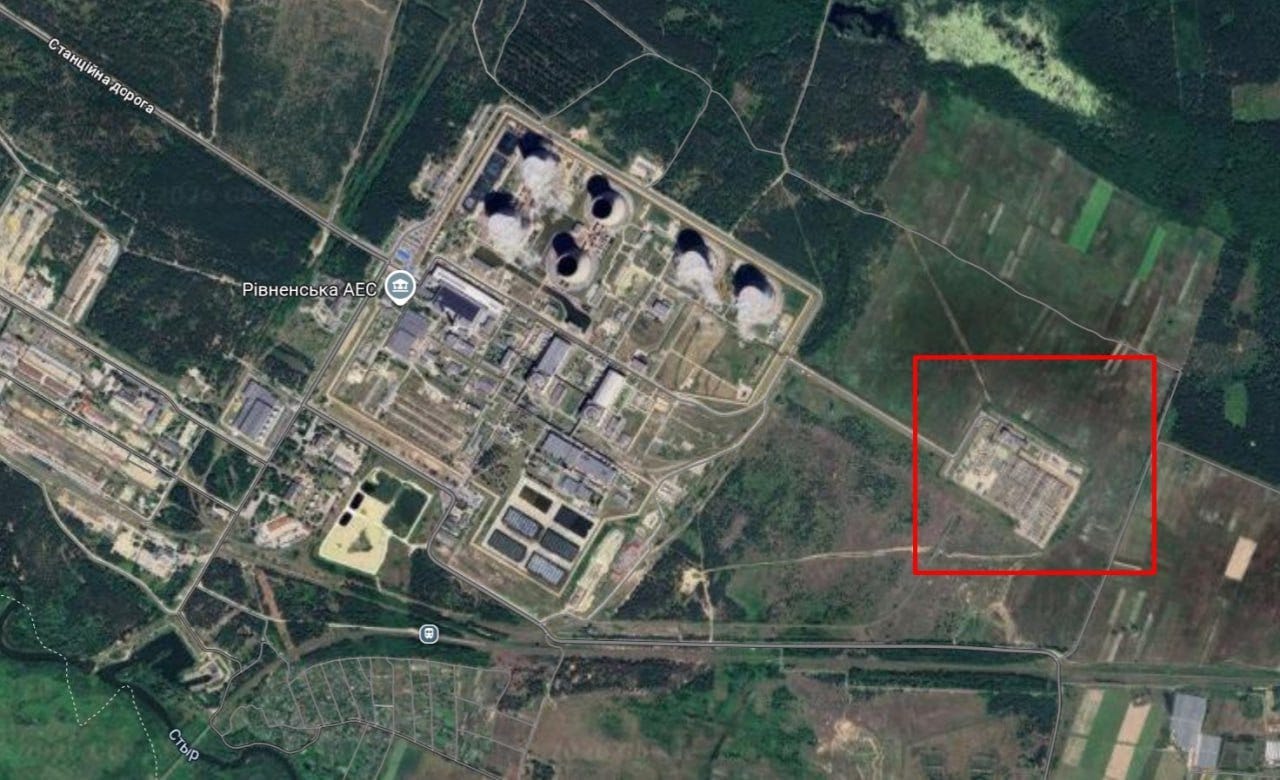
Hitting them can cut the plant off from the grid, but carries major risks: an errant missile could miss or get shot down over the nuke plant itself, causing a radioactive event; and the second and much more likely risk is that hitting the substations cuts the plant itself off from power which can take out its cooling systems, leaving the plant unable to cool itself and thus risking a melt down.
This is because nuclear plants get their power for auxiliary systems like cooling, etc., from the wider national grid which is sent to the plant via these substations. Granted, there are other onsite backup generators which can take over in perfect circumstances, allowing the main reactors to power down into safe mode, wherein control rods are inserted into the cores, but without further redundancies things can get dicey. This is because—as I understand it—even in ‘cold shutdown’ mode decay heat is still generated by the fissile material to an extent, and thus some cooling remains necessary. And if you don’t have power for that cooling, the reactors can still eventually melt down.
So, Russia has for a long time avoided striking these nuclear substations. But it seems it may have been part of a long term strategy to first degrade or entirely wipe out Ukraine’s conventional energy grid generating capabilities and leave the nuclear power stations to the very end, particularly because there are not very many of them.
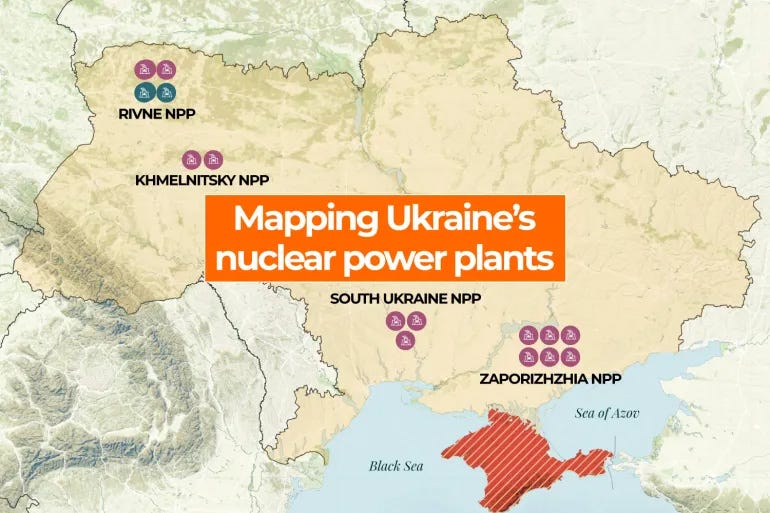
Ukraine has several dozen thermal power plants, which have now all been struck and either destroyed or degraded to some extent—but it has only three total nuclear plants (not counting Zaporozhye NPP, which most MSM still claims is under Ukrainian control)—Rivne, Khmelnitsky, and South Ukraine:
A brief history just to contextualize things because, if the situation develops the way it’s looking, the nuclear power vector will become one of the main narratives of the Ukrainian saga over the next few weeks.
Just going off of very basic Wiki info, we get the following:
At its peak before losing Zaporozhye plant—the largest in Europe—Ukraine ranked 7th in the world for nuclear generation capacity, which is punching quite above its weight. Only US, France, China, Russia, South Korea, and Canada were ahead of it. In 2021, nuclear power supplied over 55-70% of Ukraine’s total electricity (depending on source), which was the second-highest share in the world behind only France. In fact, Ukraine’s total power sector “is the 12th largest in the world in terms of installed capacity, with 54 gigawatts”, which explains things somewhat.

This is all to contextualize the importance of these remaining plants to Ukraine’s overall grid vitality. Recall several weeks ago Ukrainian officials had stated that virtually all Ukraine’s remaining power is generated by the nuclear plants. If there’s actual truth to that—i.e. if the statements weren’t just exaggerated fear-mongering to frighten the West into sending more aid—then the simple disabling of the substations powering these three plants should send Ukraine into its final power grid death spiral.
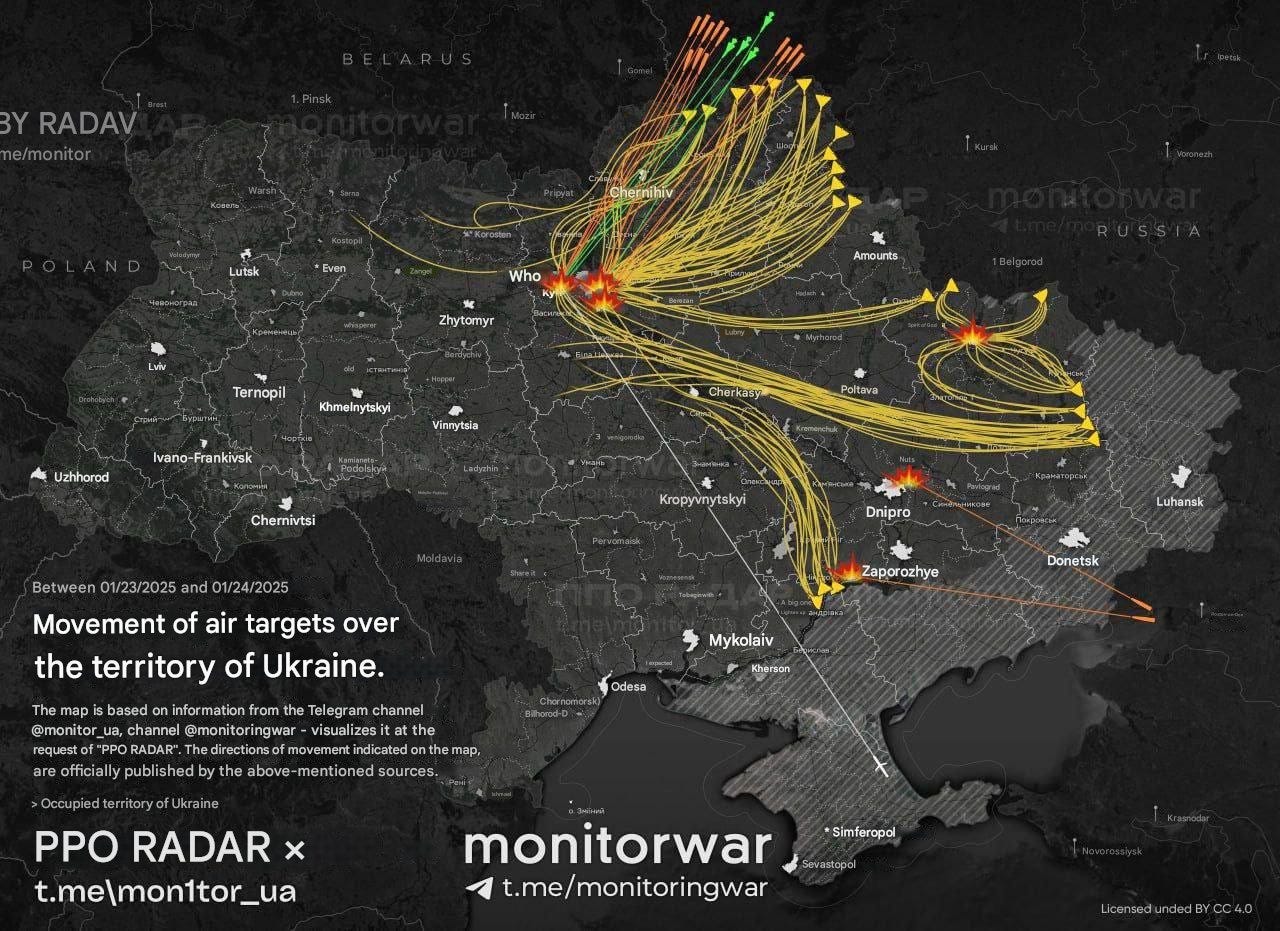
Now that we’re caught up, let’s take a look at what allegedly happened last night. Russian hypersonic Zirkon, Iskander, and other missiles allegedly hit the major 750 kV substation linking the Rivne NPP to Kiev according to several unverified reports—this one from AMK:
The main targets for this strike was Ukrainian energy infrastructure in Kyiv Oblast. The following was targeted:
CHP-6 Combined Heat and Power Plant, Kyiv Oblast (50.53188, 30.66309) by ~2 Iskander-Ms.
CHP-5 Power & Heat and Power Plant, Kyiv Oblast (50.39403, 30.56928) by ~2 Iskander-Ms.
“Kyiv” 750 kV electrical substation, Kyiv Oblast (50.49441, 29.69235) by ~5 Iskander-Ms, ~4 Kh-22/32s, and ~2 Zircons
Unknown target north of Radomyshl, Zhytomyr Oblast by ~2 Kh-22/32s and ~2 Kinzhals.
Unknown target near Pryluky, Chernihiv Oblast by ~2 Iskander-Ks
Unknown target near Samar, Dnipropetrovsk Oblast by ~1 Iskander-M.
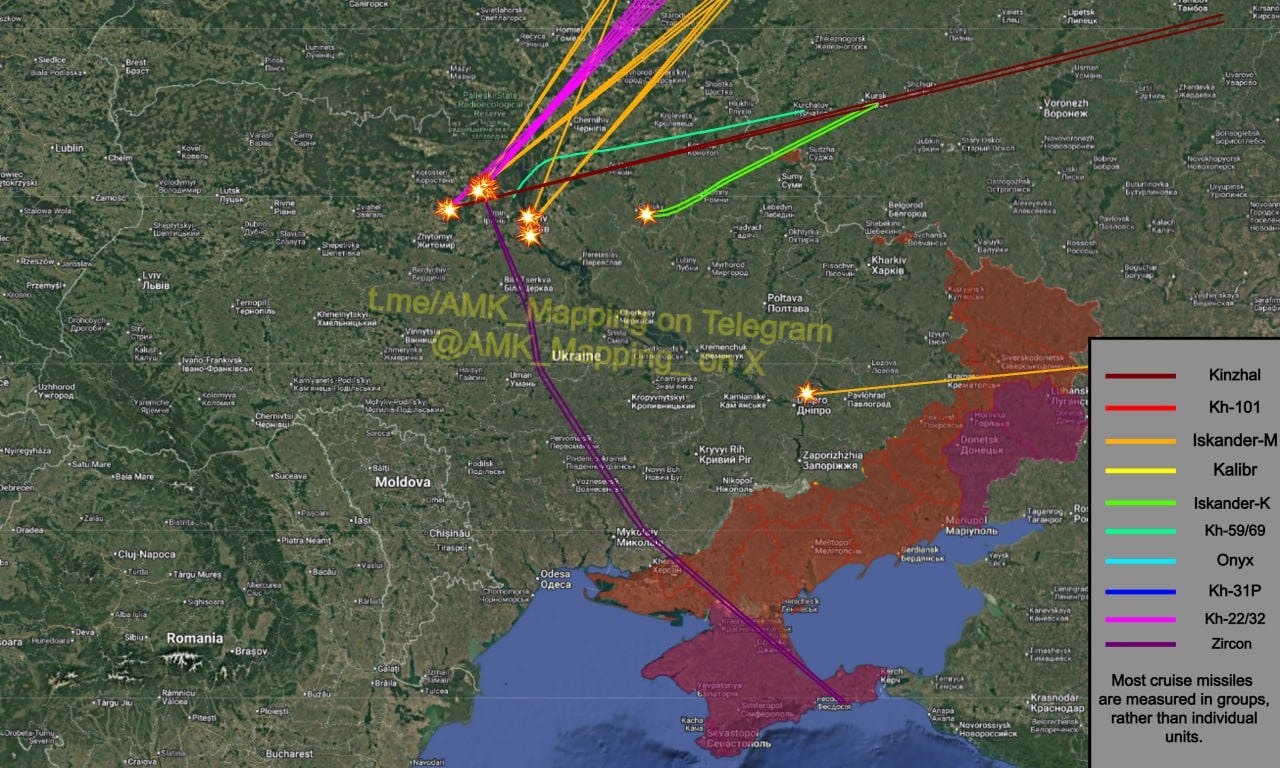
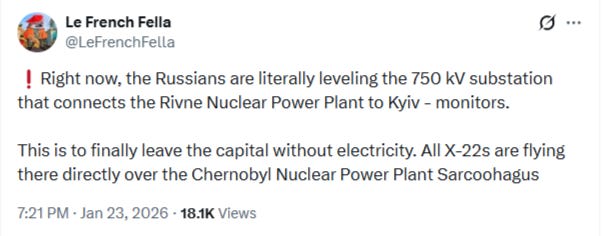
To understand: The nuclear power plants (NPPs) have their own major “step-up” 750 kV stations near them as explained earlier to up-convert the power for long distance transmission. But there are also other receiving-end 750 kV terminals closer to the destination—in this case Kiev—which consolidate power and interlink it from other plants, like the Khmelnitsky NPP, while also down-converting it for local use. In this case, it appears Russia has hit this receiving-end station near Kiev, rather than the Rivne NPP’s adjacent 750 kV terminal. This appears to be the ‘safer’ choice for now so as not to damage the nuclear plant itself directly.
This substation is very important in the western Ukraine transmission grid as it connects the 750 kV Rivne and Khmelnytskyi NPPs with the two main 330 kV lines of the Kyiv urban agglomeration. However, the grid is resilient and there is another route via the substation close to Ternopil (Zahidne) then other 330kV lines. Finally, the Nalyvaikivka 750 kV substation is hundreds of km from any nuclear plant, so be careful of reports indicating Russia is targeting nuclear facilities, this is not the case, despite the fact such strikes are of course intended at isolating NPP from the main transmission grid and the impact on Kiev’s population is terrible.
Conventional thermal plants in Kiev were again hit as well:
A missile strike on the energy infrastructure in Kiev, on the night of January 24, 2026.
As a result of the attack on TPP-6, the roof of the machine room was breached.
Geolocation: 50.53272, 30.66238
And other substations all over the country were targeted. For instance:
Footage showing 5 recent Russian Geran-2 drone strikes on the Dnipro-Donbas 330 kV electrical substation in Zaporizhzhia City.
This video is compilation footage, with the strikes having seemingly been carried out from between 6:45am and 10:49am on January 19, and between 12:52pm and 6:25pm on January 20th
Coordinates: 47.85645, 35.21813
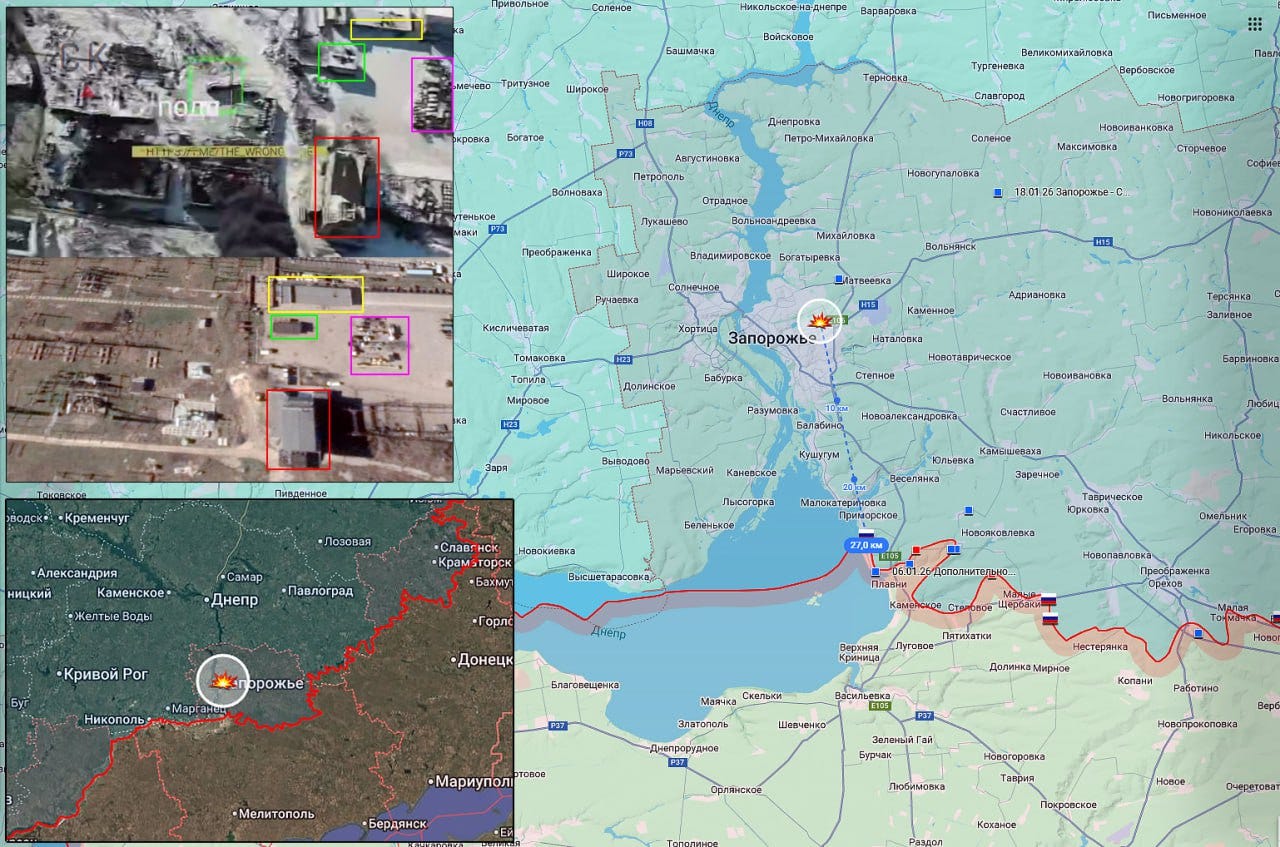
Another report lists a series of 330 kV and 110 kV stations which were attacked by drones:
Due to last night’s Geran-2 drone attacks, almost all of Chernihiv City, along with multiple other cities, were left without power.
Strikes were carried out on:
- “Slavutich” 330 kV electrical substation in the city of Slavutych (part of Kyiv Oblast, but primarily used for Chernihiv Oblast). 51.52364, 30.70781.
- “Nizhinska” 330 kV electrical substation in the city of Nizhyn. 51.0308, 31.95607.
- Either the “Bakhmach-2” or the “Bakhmach tranzytna” 110 kV electrical substations in the city of Bakhmach. 51.17942, 32.85552 and 51.18858, 32.85417 respectively.
- Other energy targets.
And another report of a previous strike days ago claims that the 750 kV stations near Vinnitsya were targeted:

And the mysterious target of the 2 Zircon strikes a few days ago southeast of Vinnytsia appears to be the 750 kV substation SS “Vinnytska,” located southeast of Vinnytsia city
49°09’54.0”N 28°43’23.2”E
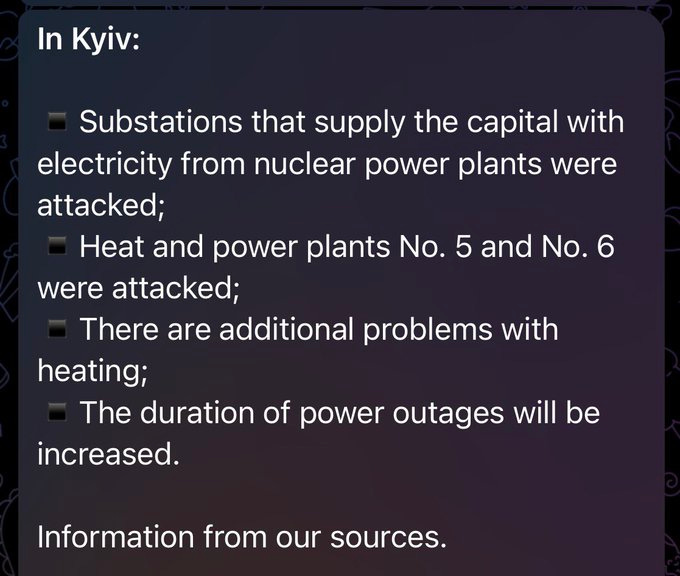
Now, we can see the tone of Western media’s coverage really change into something bordering on panic. We had just written in the last report about how Zelensky was begging for a new energy ceasefire because Russia hit back way harder than Ukraine’s pitiful tanker strikes, or the woefully diminished strikes on Russian oil refineries. Now Reuters confirms what readers here had already known for a week:
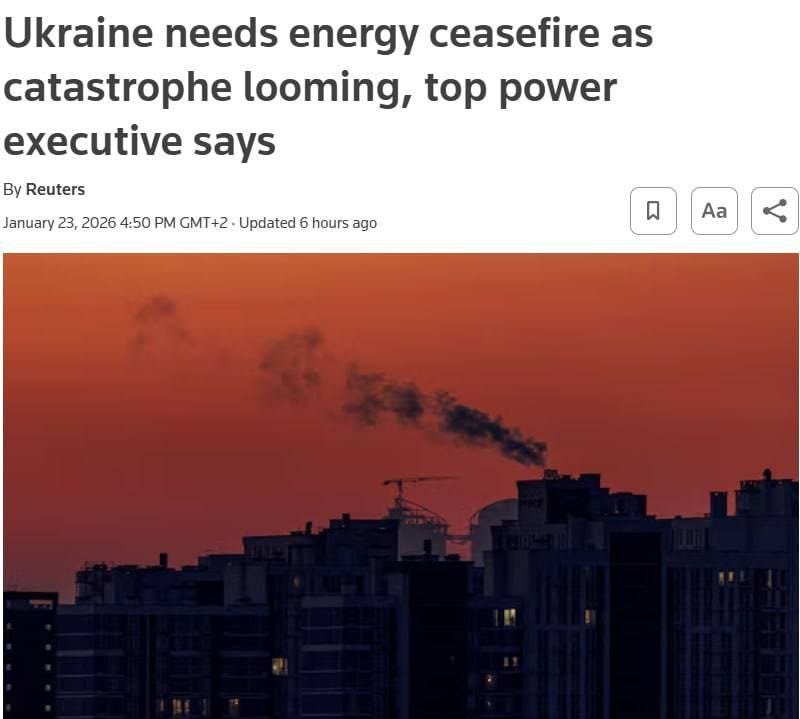
In the latest piece, head of Ukraine’s largest energy company DTEK says that up to 70% of total capacity is lost and Ukraine’s entire grid would have to be rebuilt from the ground up, rather than simply repaired, such is the totality of its destruction:
“We are close to a humanitarian catastrophe,” Timchenko said. “People get power for 3-4 hours, then a 10- to 15-hour break. We have apartment blocks without heat for weeks already.”
DTEK has lost 60–70% of its generating capacity and suffered damage worth hundreds of millions of dollars, he said.
Timchenko said rebuilding the energy sector would cost $65–70 billion, citing World Bank estimates, and in many cases would require entirely new assets.
“We are talking rather about building a new energy system in Ukraine rather than just reconstruction,” he said.
A Ukrainian source generated this map showing Kiev’s current outage, with red representing outage areas:

Ukraine won’t be able to negotiate an energy truce with Russia, says MP Getmantsev.
Let’s be objective – they have the stronger position. Our shelling of their oil refineries isn’t as painful for them as the situation in Kiev and other cities is for us.
Zelensky’s ex-press secretary Iulia Mendel admitted something else we’ve mentioned here many times—Ukraine’s so-called “deep strikes” on Russia have been nothing compared to Russia’s ‘retaliatory’ strikes on Ukraine’s own power grid, elaborating as to why:
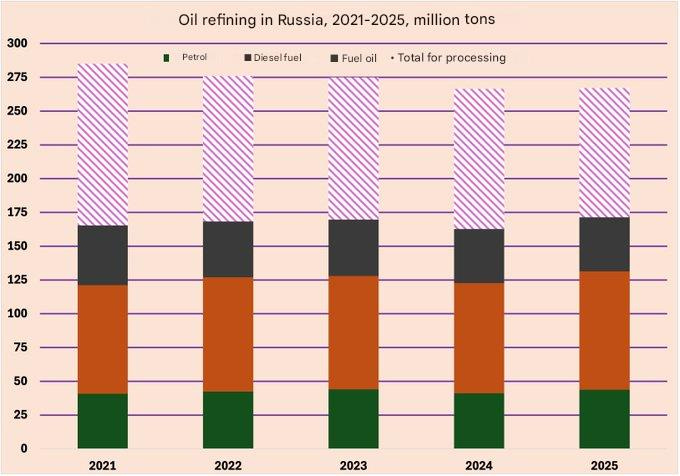
The economic impact of Ukraine’s deep strikes inside Russia doesn’t even come close to the devastating damage Russia inflicts on Ukrainians every day. Russia’s oil refining sector is heavily subsidized — these refineries mainly serve the domestic market and contribute nothing to the federal budget. On top of that, they are repaired after each attack. Meanwhile, Russia’s own export ban on certain petroleum products actually led to a reported increase in production in 2025.
At the same time, millions of Ukrainians are left without electricity or heating in temperatures dropping to -20°C.
The United States is now urging both Ukraine and Russia to stop targeting each other’s energy infrastructure. For Ukraine, agreeing to this could be a real lifeline.
Another graph was shared on the increasing intensity of Russian strikes on Ukraine’s grid:
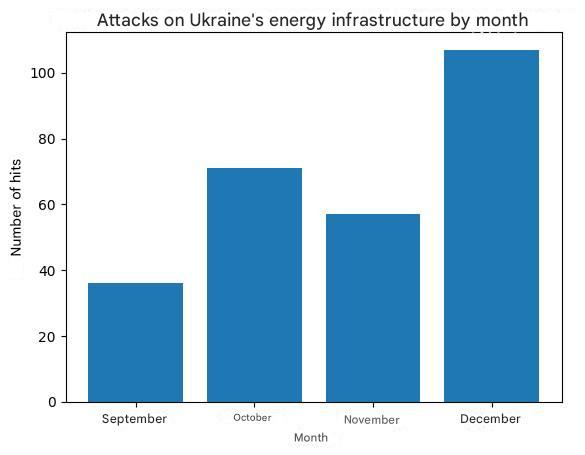
Since the fall, Russia has launched a series of attacks on Ukraine’s energy system, - analysts
▪️Ukrainian analysts publish statistics on the attacks.
▪️During the period from September to December, the Russian Armed Forces carried out 271 attacks on substations, thermal power stations, heat and power plants, etc.:
➖September - 36;
➖October - 71;
➖November - 57;
➖December - 107.
▪️”In fact, Russia managed to divide Ukraine into two parts: where the northern, eastern, southern, and central parts have no electricity, while the western part had no power outages until mid-January,” - complain the enemy’s resources.
So, to answer the opening title question: we do not yet know for certain if Russia has truly committed to a doctrinal and systematic disconnection of Ukraine’s NPPs from the grid. We do not yet even have full incontrovertible verification that the 750 kV substations were truly hit, though most likely it is the case, given the preponderance of reports from both Ukrainian and Russia sources.
We must always somewhat temper our “excitement” and expectations, given how long it’s been that we were continually promised by various authorities from both sides that Ukraine’s grid was “finally on the verge” of total collapse. For instance, here’s a video I posted myself in 2024 of Arestovich claiming that Ukraine’s grid was only 2-3 more Russian strikes away from total collapse. Note specifically what he says about the nuclear plants:
"Arestovich recorded a video in which he announced the complete collapse of the Ukrainian energy system for 2-3 Russian missile strikes. Now Ukraine still has a nuclear power plant and an energy bridge with Europe. But Russia can destroy all this with two or three missile strikes, literally throwing the whole country back to the 17th century in a couple of days.
Only the village will survive, the lighting will be from splinters. Winter will drive hundreds of thousands of people out of the cities and the whole country will be engaged in survival, not war. Russia, according to him, simply feels sorry for ordinary farmers."
Granted, maybe Russia had the capability to finish these NPPs off in 2024 but chose not to—we don’t know for certain. One thing Arestovich did prophecy correctly in this particular instance is the flood of Ukrainian citizens away from the cities, which we are apparently witnessing now in Kiev.
The point being that we should be sensible and cautious in believing everything will be completely shut down. But at the same time, it’s clear that something has changed, even in the empirically quantifiable measures of sheer attack volume. It certainly does appear possible that Russia has chosen to finally unplug the last strongholds of Ukraine’s power grid—I am simply cautious in jumping to conclusions too early based on past expectations.
One last important thing that needs repeating though is the fact that 750 kV equipment is said to be much more difficult and expensive to source and replace, compared to 110/330 kV substation transformers, etc. I am not an expert on this particular matter, so those with specific knowledge can chime in in the comments, but as I understand it the 750 kV standard is a Soviet-specific legacy high-voltage transmission standard which is not compatible with most European countries, which run 300-500 kV max. On the contrary, 330 kV appears to be a standard voltage range that can be easily sourced and replaced from a variety of Western countries.
Theoretically, this means a destroyed 750 kV facility is essentially gone for good. At the same time, it’s hard to “completely” destroy such facilities as it would take many systematic strikes. You’ve seen the earlier photos, they are vast substation fields with dozens or hundreds of transformers. Even several missiles would only take out a small portion of such a transformer field—take a look one more time:

You would need dozens of missiles and potentially hundreds of drones to permanently disable all of that. That doesn’t mean a few won’t take most of it offline for some time, but it will subsequently be repairable in a reasonable amount of time.
Let’s see if Russia continues the systematic campaign.