The Ever-Tightening Russia/China Strategic Partnership
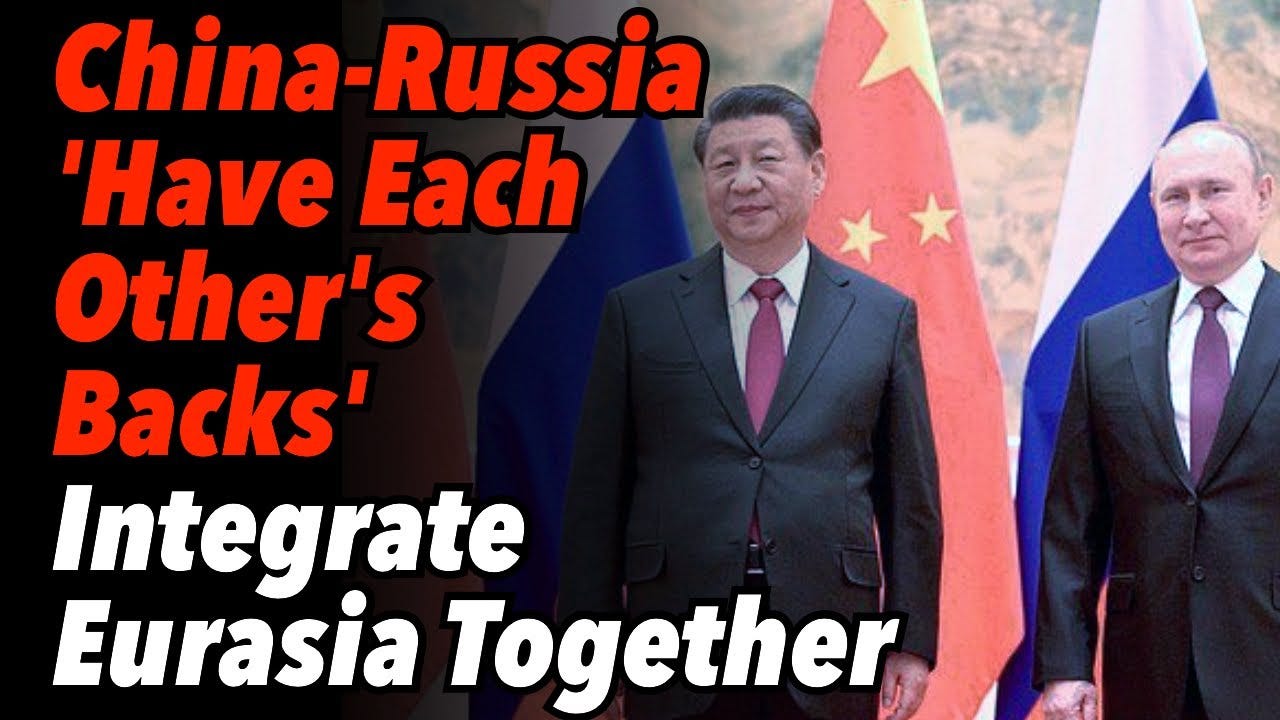
Beginning in 1997 with the initiation of BRICS via the Russia/China Joint Declaration of a Multipolar World I revisited ten days ago, Russia and China have gone from establishing a Friendship Treaty in 2001 that continues to be reindorsed every five years to declaring their relationship a strategic partnership. In 2001, Russia and China and several Central Asian states formed the Shanghai Cooperation Organization that at the outset focused on anti-terrorism given Outlaw US Empire presence in Afghanistan and its backing of international terrorism. In 2004, the very longstanding border issues were solved and their first joint military exercise, known as Peace Mission, followed the next year. This source provides more history:
China and Russia continued to strengthen ties throughout the 2010s. In 2011, the two sides marked the 10th anniversary of the signing of the Treaty of Good-Neighborliness and Friendly Cooperation by upgrading China-Russia relations to a “comprehensive strategic partnership of cooperation.” In 2019, the countries once again upgraded their relations to a “comprehensive strategic partnership of cooperation for a new era.” During a state visit to Moscow to mark the 2019 upgrading of relations, Chinese President Xi Jinping stated “the China-Russia relationship is seeing a continuous, steady and sound development at a high level, and is at its best in history.”
The Strategic Partnership levels were continually upgraded, and the joint declarations issued on each occasion became bolder, deeper and broader. Win-Win Cooperation is now the cornerstone of their relations. In 2007, what was called the Eastern Gas Program was approved that would eventually become the Power of Siberia gas pipeline system. Construction began in 2012 then in May 2014 Russia and China agreed to a 30-year gas deal worth $400 billion, and the first gas was delivered in 2019. Geopolitics contributed 100% to the agreement to construct Power of Siberia Two that was finally consummated in an agreement between Russia, China and Mongolia in September 2025. Pipeline gas isn’t the only form as China imports ever increasing amounts of LNG which increased close to 30% in 2025 over 2024. China’s thirst is seen by its shipyards constructing ice-class LNG carriers at an astounding rate using the Northern Sea Route to go directly to the Yamal export points which Russia continues to expand. Russian oil exports to China reached more than 108 million tons, an increase of about 30% since 2022. Electricity is also sent to China, close to 500 million KwH in 2025. And China continues to import coal, about 90 million tons in 2025, an amount that’s declining as China weans itself from coal use with its massive buildout of renewables. Once Power of Siberia Two gas begins arriving, coal imports will drop even further, which IMO doesn’t bother Russia. Yes, the energy trade is dominant between the two, but military goods is second, although those too are declining thanks to China’s own progress in that area. Total trade for 2025 is said to be $234 Billion. Finding balance of payments information to see what the proportions are is very hard to find since almost all articles focus on the transactions now taking place in rubles and yuan almost 100% bypassing the US-controlled SWIFT system. The last data I found was from 2023 and showed a roughly equal balance between them.
The trade relationship of course is very important but so is the bilateral and geopolitical relationships which often merge. Their Joint Statements issued after Summits have always illustrated their joint strategy in both realms. IMO, the best point of reference in that regard remains the Joint Statement of the Russian Federation and the People’s Republic of China on the International Relations Entering a New Era and the Global Sustainable Development that was issued on 4 February 2022 on the eve of the Beijing Winter Olympics. It’s very tempting to cite long portions of that document which is in English at the link. However, I will limit myself to just a few paragraphs, while highly suggesting time be taken to read the entire document:
Today, the world is going through momentous changes, and humanity is entering a new era of rapid development and profound transformation. It sees the development of such processes and phenomena as multipolarity, economic globalization, the advent of information society, cultural diversity, transformation of the global governance architecture and world order; there is increasing interrelation and interdependence between the States; a trend has emerged towards redistribution of power in the world; and the international community is showing a growing demand for the leadership aiming at peaceful and gradual development … Some actors representing but the minority on the international scale continue to advocate unilateral approaches to addressing international issues and resort to force; they interfere in the internal affairs of other states, infringing their legitimate rights and interests, and incite contradictions, differences and confrontation, thus hampering the development and progress of mankind, against the opposition from the international community….
The sides note that Russia and China as world powers with rich cultural and historical heritage have long-standing traditions of democracy, which rely on thousand-years of experience of development, broad popular support and consideration of the needs and interests of citizens. Russia and China guarantee their people the right to take part through various means and in various forms in the administration of the State and public life in accordance with the law. The people of both countries are certain of the way they have chosen and respect the democratic systems and traditions of other States.
The sides note that democratic principles are implemented at the global level, as well as in administration of State. Certain States’ attempts to impose their own ”democratic standards“ on other countries, to monopolize the right to assess the level of compliance with democratic criteria, to draw dividing lines based on the grounds of ideology, including by establishing exclusive blocs and alliances of convenience, prove to be nothing but flouting of democracy and go against the spirit and true values of democracy. Such attempts at hegemony pose serious threats to global and regional peace and stability and undermine the stability of the world order.
The sides believe that the advocacy of democracy and human rights must not be used to put pressure on other countries. They oppose the abuse of democratic values and interference in the internal affairs of sovereign states under the pretext of protecting democracy and human rights, and any attempts to incite divisions and confrontation in the world. The sides call on the international community to respect cultural and civilizational diversity and the rights of peoples of different countries to self-determination. They stand ready to work together with all the interested partners to promote genuine democracy.
A little more than two years later during the Summit at Harbin, Presidents Xi and Putin signed another joint statement “on deepening the comprehensive strategic partnership of coordination for a new era.” The document is written in a rather informal manner that suggests the greater degree of comfort the two sides enjoy in their relations. These two paragraphs from the introduction illustrate that:
Both sides pointed out that current China-Russia relations transcend the military-political alliance model of the Cold War era, characterized by non-alignment, non-confrontation, and non-targeting of third countries. Facing a turbulent and changing world order, China-Russia relations have withstood the test of international vicissitudes, demonstrating stability and resilience, and are now at their best level in history. Both sides emphasized that developing a comprehensive strategic partnership of coordination for the new era between China and Russia serves the fundamental interests of both countries and their peoples. This partnership is not a temporary measure, is not influenced by external factors, and has strong intrinsic motivation and independent value. Both sides firmly defend their legitimate rights and interests, oppose any attempts to obstruct the normal development of China-Russia relations, interfere in the internal affairs of both countries, or restrict the economic, technological, and international space of the two countries.
Both sides reaffirmed that China and Russia always regard each other as priority partners, consistently uphold mutual respect, treat each other as equals, and pursue mutually beneficial cooperation. They always adhere to the United Nations Charter, international law, and the basic principles of international relations, making their relationship a model of major countries and neighboring states in today’s world. Both sides are willing to further deepen comprehensive strategic coordination, firmly support each other on issues concerning their core interests such as sovereignty, territorial integrity, security, and development, effectively leverage their respective advantages, focus on safeguarding their national security and stability, and promote development and revitalization. Both sides will follow the principles set out in the Treaty of Good-Neighborliness and Friendly Cooperation signed on July 16, 2001, as well as other bilateral documents and statements, to conduct high-quality, high-level mutually beneficial cooperation in various fields.
Although they don’t specifically cite Russia in their texts, the aims of China’s handful of Global Initiatives are shared by Russia, particularly the Global Security and Global Governance Initiatives. China also favors and promotes the Russian and Belarusian proposal for a Greater Eurasian Partnership and its twin Russia’s proposed Eurasian Security Structure. And then there’s BRICS whose greatest champions are Russia and China. The merging of Russia and China into one geopolitical entity is the greatest nightmare of all for those wanting to preserve Western Hegemony who looked on with glee when Mao split with Khruschev after his so-called secret speech that denounced Stalin, although Stalin wasn’t all that keen on the formation of Chinese Communism. What’s perhaps the most important features between the two nations are the goals set by their leaders upon gaining power after their Civil Wars, how they rebounded from WW2, and how they handled the Cold War, all of which set the stage for what has transpired since the Soviet Union’s dissolution and China’s industrial rise. A cursory examination of all that would fill a large book. I’ll end by noting both the Chinese and Russian Social Democratic parties that eventually became the two respective Communist Parties began at roughly the same time—China’s in 1911 and Russia’s in 1898 as the Russian Social Democratic Labour Party which evolved into the Mensheviks and Bolsheviks. The struggles they endured and roads travelled were similar yet quite different. In many respects, geography made the main difference since China was well removed from the West and showed the Outlaw US Empire in the war it calls The War to Resist America and Aid Korea that it wouldn’t be intimidated, so it was mostly left alone while Soviet Russia wasn’t. That situation remains very similar today, but the qualitative differences of both Russia and China are vastly different today—both are on the rise while the Collective West is sinking.