Nine Killed After Iranian Missile Hits Synagogue Bomb Shelter in Central Israel
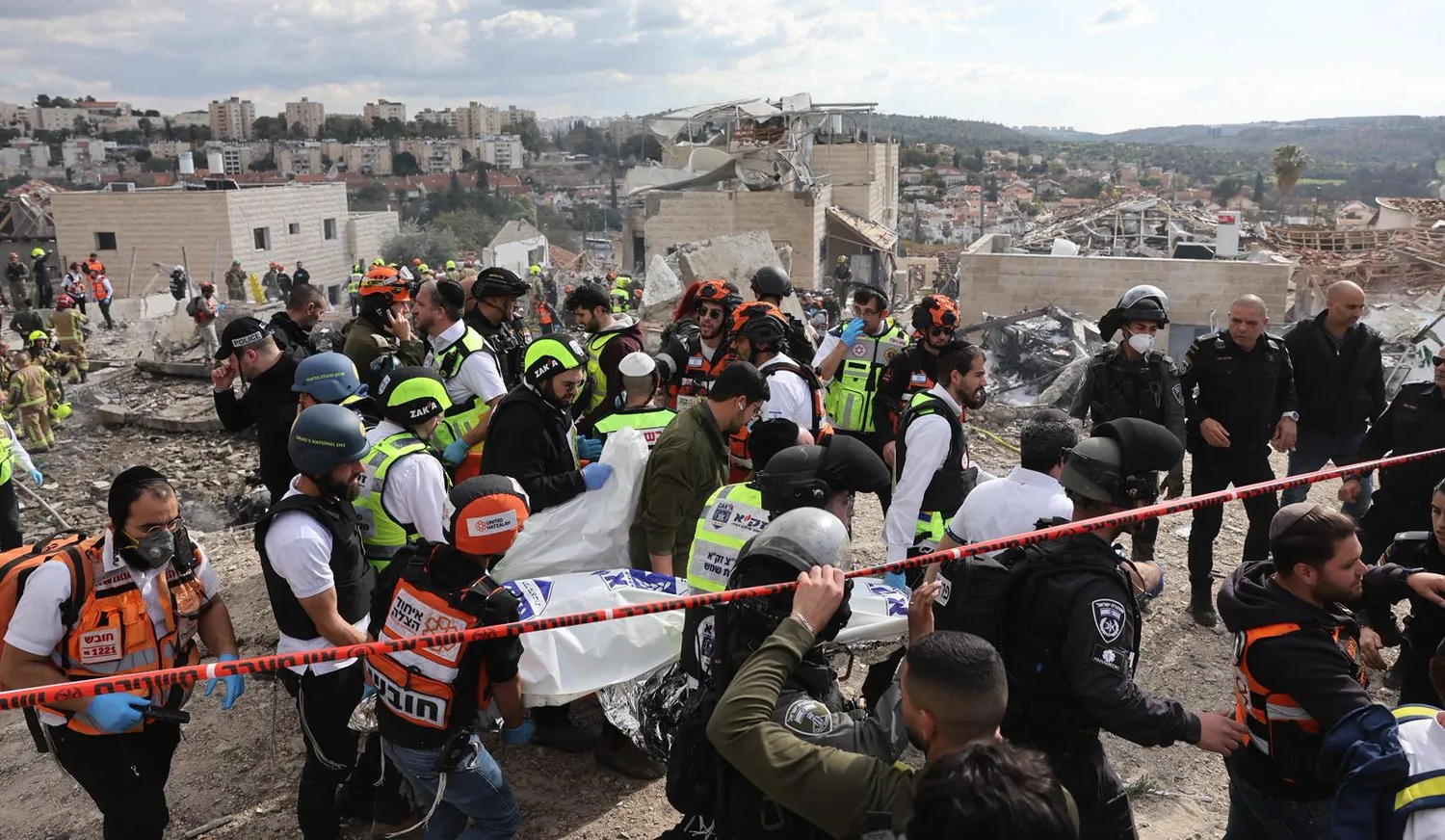
Some of the victims were apparently inside a bomb shelter when they were killed, the Jerusalem police chief said, and the IDF is investigating whether the shelter was functioning properly. Sixty people were wounded, including children and a pregnant woman
Nine people were killed on Sunday after an Iranian missile hit a public bomb shelter at a synagogue in the central Israeli city of Beit Shemesh.
The commander of Israel Police's Jerusalem District said that some of the victims were apparently inside the bomb shelter when they were killed, while others were in nearby buildings when the missile hit. The IDF's Home Front Command is checking whether the shelter was functioning properly.
Sixty people were injured in the strike. Two of them are in serious condition, including a young girl. Five were moderately injured, including two children, one of them four years old. The rest, among them children, sustained light injuries. A pregnant woman was among the wounded, according to the Hadassah Medical Center. Fire and rescue services said they rescued over 70 residents from the scene of the strike.
Police Commissioner Danny Levy said that the authorities are working to rescue a woman trapped at the scene. In addition to the house that was struck, dozens of nearby homes were also damaged.
The IDF said that a review determined that the missile siren system was activated as required before the missile hit. However, a resident who was at the scene told Haaretz that the explosion occurred during the siren, while another resident said it was heard before the siren.
The head of the IDF's Home Front Command said that "a direct hit [on the shelter] penetrated the protective structure." The police's Jerusalem District chief said that bomb shelters and reinforced safe rooms have so far been unable to withstand a direct missile hit. However, he noted that these spaces do protect against non-direct missile hits and shrapnel or interceptor fragments.
The police chief reiterated at the scene in Beit Shemesh that reinforced safe rooms and bomb shelters are the safest places to be during missile fire.
Efforts are currently underway to dig deep underground at the missile hit site to rule out the possibility that people may be trapped, the deputy chief of the Beit Shemesh fire station said.
"We arrived at the scene and initially began rescuing anyone we could see and who could be rescued with light rescue equipment," he said. "We are now working on digging deeper and further down, so that we can reach the very bottom to make sure we have ruled out anyone being trapped."
The fire station deputy chief said that the station itself was also damaged by the blast's shockwave. "We have blast damage maybe 100 meters [330 feet] further ahead, so we are currently checking everything."
One woman who was lightly injured in the missile strike told Shaare Zedek Medical Center that the explosion occurred after IDF phone notifications were received instructing people to stay near a bomb shelter, but before a siren sounded.
"The noise was insane and we didn't have time to think – the missile hit immediately," she said. "I looked outside and all the shutters flew off. I didn't have time to go to the shelter ... There were many [phone] alerts, but there wasn't a siren," she continued. "Everything is destroyed, everything is a mess."
Another 76-year-old woman whose home was destroyed in the strike said that after the siren, she heard a loud explosion. "I took my phone and my glasses and said to Tomer [her son], 'Tomer, run.' We went out to the street because inside there was smoke, a lot of smoke, and I didn't want to inhale it." According to her, she immediately understood that the impact was very close.
Another resident told Haaretz that "the place is in ruins." A paramedic also described widespread destruction in the area. "We saw destroyed homes, flames and smoke rising from residential buildings, smashed cars, and a great deal of commotion," he said.
The Beit Shemesh municipality opened a reception center for families of missing residents at a local community center. "The center is intended to provide assistance to residents who are missing or out of contact with their loved ones, and to enable the rapid, organized, and centralized transfer of information for the purpose of locating and assisting them," the municipality said in a statement.
At another scene in central Israel, a man in his 50s was injured in his hand by shrapnel.
The municipality of the southern Israeli city of Ashkelon reported that two interceptor fragments were found inside the city, with no damage or injuries reported.