https://www.nytimes.com/2026/03/03/us/trump-immigration-ice-raids-safe-houses.html
Inside the Underground Safe Houses Sheltering Immigrants From ICE
In Springfield, Ohio, some Americans have converted their basements and spare bedrooms into shelters for immigrant families who could be targeted in raids.
March 3, 2026
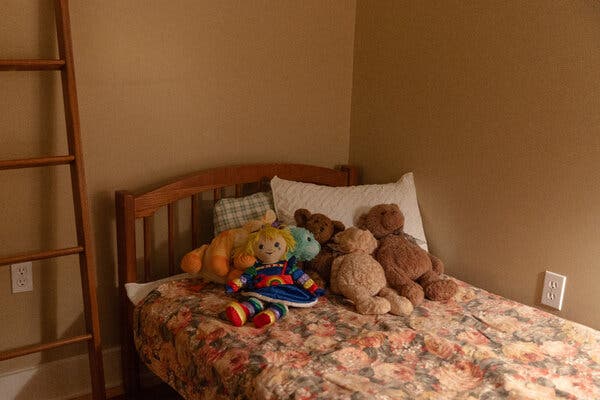
A spare bedroom in a Springfield, Ohio, house prepared for Haitians, in case the immigrants didn’t feel safe in their own homes.
A spare bedroom in a Springfield, Ohio, house prepared for Haitians, in case the immigrants didn’t feel safe in their own homes.
Photographs by Maddie McGarvey
Miriam Jordan has been reporting on the fate of Haitian immigrants who transformed Springfield, Ohio, since the summer of 2024.
The upstairs room was ready.
Three teddy bears and a smiling cloth doll were propped on a neatly made bed. A bassinet was nearby. On the dresser was a sanctuary of care: baby shampoo, lotion and talcum powder.
Night was falling in Springfield, Ohio, when the Haitian mother and her 1-month-old baby arrived. Lee, in her 70s, had never met the woman on her doorstep. Still, they embraced. After cooing over the infant, Lee led her guests on a tour of the house, ending with the bedroom that would serve as their redoubt from a feared immigration sweep.
Across Springfield that evening, anxiety was mounting. Haitians and their American supporters were awaiting a federal court ruling, expected by midnight Feb. 2, about the fate of Temporary Protected Status, or T.P.S., for Haiti, the program that has allowed beneficiaries to live and work legally in the United States.
The Trump administration had moved to terminate the status effective Feb. 3. Without court intervention, thousands of Haitians in Springfield would have become deportable overnight, and federal agents could descend on the city the very next day.
And even after the court blocked the termination, that prospect remains.
The government has asked an appeals court to overrule that lower court decision, and in a lawsuit about Syrians, the government asked the Supreme Court last week to take emergency action that could give the administration far more power to limit or end T.P.S. across the board.
More than 10,000 Haitians now call Springfield, a city of 58,000 between Dayton and Columbus, home. While some are U.S. citizens, most have T.P.S., and in the months ahead of the court ruling, many Americans had mobilized to help the growing Haitian community.
In churches and community centers, they organized prayer services, marches and petition drives. Volunteers ran practice drills. Others agreed to serve as legal guardians for children whose Haitian parents feared they could be detained.
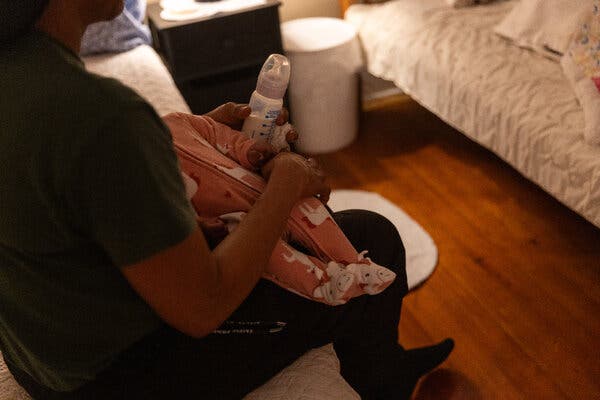
A Haitian mother and her infant found refuge in the home of an American before a court ruling about Temporary Protected Status. Without it, many Haitians would be immediately deportable.
The Haitian mother thanked her American host who sheltered her.
A Haitian immigrant wept when she arrived at an American home, where she and her baby remained for six days.
Some did something more risky: They discreetly converted spare bedrooms and finished basements into places of refuge.
In the days before the Feb. 3 expiration of T.P.S., many Haitian families began withdrawing from daily life.
“Teachers, employers, pastors, schools — we all witnessed the disappearance of members of our community,” said Anna Poteet, 39, who teaches English to immigrants each Sunday at a local center.
On Feb. 1, only five students came to her class, down from the usual 15. That same weekend, she visited a Haitian church that typically attracts about 100 worshipers. Just 20 were in the pews. On Monday, her 8-year-old son came home asking why so many of his friends were absent from school.
The small, secret network that began sheltering Haitian families echoes an earlier chapter in the city’s history.
Springfield was once a stop on the Underground Railroad, the network of abolitionists who helped enslaved people flee to free states or to Canada. U.S. Route 68 passes near the former home of George and Sarah Gammon, who had themselves been enslaved and whose house, now a museum, was a way station for those fleeing bondage.
“In the 1850s, people here were taking in enslaved people seeking freedom,” said Marie, a local activist who has been vetting people who volunteered to host.
“Today, there are people offering safe harbor to Haitians who just want to live in peace and safety,” she said.
Because of the secrecy surrounding the initiative, which has not been previously made public, The New York Times agreed to identify people involved by only their middle names.
“I’m really mad at the way our government is treating newcomers,” said Lee, a retiree, as she cradled the infant.
“We are a country of immigrants,” she said. “My family came here from Ireland.”
Federal law makes it a crime to “conceal, harbor, or shield from detection” an unauthorized immigrant. The offense is a felony that can carry up to five years in prison. In the past, prosecutions have targeted smugglers, and sometimes employers, but not ordinary citizens.
Houses of worship have a long tradition of offering sanctuary to undocumented immigrants. Their status as religious institutions has typically afforded them protection from immigration enforcement. And some congregations have pledged to continue providing refuge even after the Trump administration last year lifted restrictions on enforcement actions in churches and other “sensitive” locations, such as schools and hospitals.
Organizing by ordinary people to shelter immigrants in private homes represents an emerging, invisible front of resistance.
These are not seasoned activists. They are neighbors, like Jean.
A woman in her 40s with no political or religious affiliations, Jean said she had felt compelled to step up after an unsettling incident at work. An immigrant employee at the company, which is not in Springfield, was detained by immigration agents. Jean began thinking about the Haitian families in her own community.
While local groups were organizing food deliveries and neighborhood watch patrols in the event that federal agents showed up, Jean worried about a more fundamental risk, knowing that the Homeland Security Department has the addresses of all Haitians who have T.P.S.
Many Haitians in Springfield withdrew from daily life ahead of a court decision, fearing immigration agents might descend on the city to detain them.
In Springfield, the Gammon house, now a museum, was a stop on the Underground Railroad in the 1850s. The city was a strategic way station for enslaved people escaping north or to Canada.
A rally in support of immigrants at the St. John Missionary Baptist Church in Springfield last month.
“I began asking, ‘Where do people flee to?’” Jean said. “We need emergency housing.”
She contacted her friend, Marie, who has contacts in the Haitian community.
Coincidentally, Marie was already receiving encrypted messages from local Americans, some from church, others total strangers, offering their homes.
Around that time, clashes had intensified in Minnesota, where the mass deployment of federal agents had resulted in the arrests of many immigrants, including refugees who were in the country legally.
“Minnesota was blowing up, and people thought it could be Springfield’s turn next,” recalled Marie. “They wanted to protect our Haitians.”
Marie and Jean realized they could help, but they had to vet would-be hosts scrupulously. Some were longtime acquaintances. Others came recommended but still had to be vouched for by at least two people the friends trusted.
If someone didn’t rub them the right way, Marie declined the offer politely. “You live too far from the kids’ schools,” she would write back, for instance.
Once hosts were cleared, it came down to practical considerations. Do you have a bedroom with actual beds? Is the space suitable for children?
For security reasons, there was no spreadsheet or cloud-based list. Jean kept the names and contact information of approved hosts handwritten in a small red booklet, its cover engraved with a gold bird perched on a stack of books.
The potential legal jeopardy she might face was not lost on her.
“Almost everything is in a gray area,” Jean said. “This needs to be happening, even if there are risks.”
In response to a request for comment about Americans sheltering immigrants who feared being detained and deported, a spokeswoman for the Homeland Security Department said that people stripped of T.P.S. should use the government’s self-deportation process “to receive a free one-way plane ticket and $2,600 financial assistance to help them resettle elsewhere.”
The Haitians seeking shelter had come to Springfield to work and had helped revive the city, Jean pointed out, and she felt a duty to them, a sentiment expressed by others involved in the effort.
City leaders unveiled an ambitious plan in 2014 to revive the industrial hub, attracting new businesses that invested millions of dollars in the area. Yet as factories and warehouses opened, employers struggled to find enough workers.
Haitian migrants began trickling in, and their numbers soared rapidly, particularly in 2020, during the first months of the Covid-19 pandemic, as word spread that jobs were abundant and housing in Springfield was affordable.
Last year, the Trump administration lifted restrictions on enforcement actions in “sensitive” locations, such as churches, schools and hospitals.
Haitian workers have filled jobs in manufacturing, health care and other sectors that had faced a labor shortage in Springfield and surrounding areas.
The basement of a Springfield home that accommodated a Haitian family last month.
After the 2021 assassination of Haiti’s president, Jovenel Moïse, and the violence that ensued, the Biden administration expanded Temporary Protected Status for Haitians.
Tensions surfaced as housing costs rose and public services, such as clinics, were strained by the rapid pace of the influx.
Haitian residents tried to keep a low profile. They worked, attended church and built their lives. They knew that returning to Haiti was impossible, at least in the near term, and that their status, while not permanent, allowed them to remain in the United States lawfully.
President Trump and Vice President JD Vance shattered their sense of stability in 2024 by repeatedly amplifying a baseless claim that Haitians in Springfield were stealing and eating their neighbors’ pets, thrusting the city into the fraught immigration debate.
Hours after his inauguration, Mr. Trump directed the Homeland Security Department to review all temporary protection programs.
A month later, the Homeland Security secretary, Kristi Noem, rescinded the Biden administration’s extension of T.P.S. for Haiti. She asserted that the Trump administration was “returning T.P.S. to its original status: temporary.” Ultimately, she set an end date of Feb. 3, affecting about 350,000 Haitians nationwide.
Lawyers representing five Haitians, including a nurse in Springfield, sued to block the termination, arguing it was unlawful and discriminatory.
As the court deadline approached, fear tightened its grip on Springfield. Many Haitian families limited outings to work and school. Others stocked up on food or temporarily left the city. One family with young children called an American friend during a freeze to report that their furnace had stopped working. They were too frightened to trust a stranger to come repair it.
Americans like Lee began volunteering to host Haitians.
The list of safe houses in the red booklet grew.
In a text message to an American woman on Jan. 30, a Haitian said, “My wife is so scared.” They were considering renting an Airbnb in a nearby town, he said, because it would be a big imposition to ask someone to take in a family of four.
She advised against that because he would be providing his name.
“We need a safe place to stay wherever you think will work,” he texted back.
More than 10,000 Haitians now call Springfield home.
Some volunteers have been collecting and delivering diapers and formula to Haitian families who are afraid to leave their homes.
A Haitian family received help obtaining passports at St. Vincent de Paul center in Springfield in January.
On the evening of Feb. 2, the Haitian couple with two children, 6 and 11, and another on the way, unloaded supplies — enough for 30 days — into the basement of the American woman and her partner.
The Haitian couple told the children they were going on vacation. They would skip school and could spend time on their new PlayStation 5; Mom and Dad would not be going to work.
At around 7 p.m. that night, a federal judge in Washington issued an order blocking the termination from taking effect, keeping T.P.S. in place for Haitians while the lawsuit proceeds.
The host learned of the court decision and told her guests, who were relieved but decided to stay at least one night, anyway.
“I don’t know how to thank you, because a thank you is not enough for your generosity by opening your house for our family,” he said.
The mother and baby who spent that night at Lee’s house returned to their own home six days later.
All told, about two dozen immigrant families found sanctuary through the network, according to Jean. Some other Haitian families managed to find refuge that night with American friends outside the network, Marie said.
Lee, like other local Americans, said that she would accommodate as many people as she could, should the need arise.
“I’ll put sleeping bags on the ground if I have to,” said Lee.
Yet while the immigrants and their supporters in Springfield have exhaled since the court decision, they know it may be only a reprieve.
“Even though they have been given temporary relief,” said Ms. Poteet, the English teacher, “they still live day to day not knowing if tomorrow another decision will upend their lives.”
The prepared rooms and the names in the red booklet remain intact.
“Whatever happens, we are ready,” Marie said.
Miriam Jordan reports from a grass roots perspective on immigrants and their impact on the demographics, society and economy of the United States.