Iran War Shifts to Cynical Plan 'B' After US Fails to Fracture 'Regime'
The entire discussion around the Iran war has now turned to Iran’s “diminishing” scale of strikes, with pro-Western commentators claiming that this means Iran is losing and will eventually succumb to the US-Israeli juggernaut.
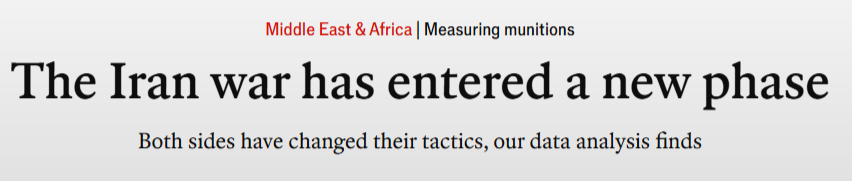
The Economist broke down the current tempo of the war in a new piece.
Other popular graphs being circulated with “IDF spokesperson” as the source:
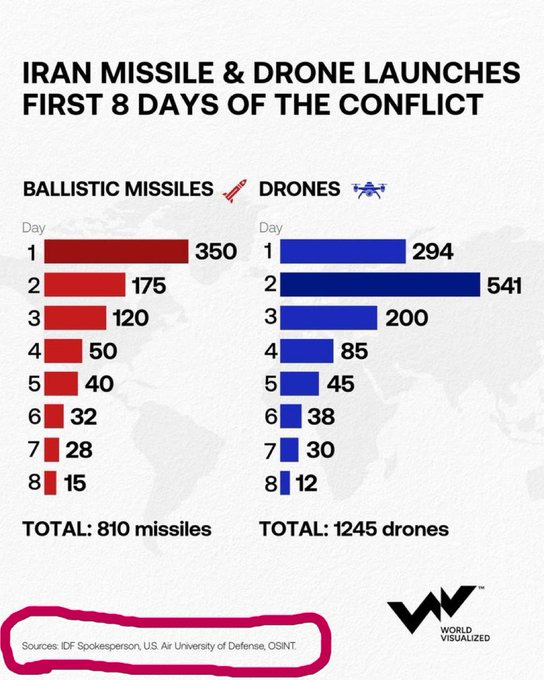
I wrote on X why the decline in Iran’s missile salvos is not what it’s being made out to be:
Wrong.
This uses the false assumption that Iran's opening salvo represents some kind of "normal" daily usage which is then sophistically straw-manned to assert that subsequent days are falling "below average". In reality, the opening salvos are always meant as an anomalously high barrage that is not ever meant to be sustainable.
Iran is merely switching to normal sustainable long term salvo volumes.
One of the ways we can determine this is by considering that in the last exchange, Iranian missile capabilities were said to be heavily attrited (with various 70-90% figures being given) which was supposed to explain the low salvo counts.
Yet if Iran's total ballistic capabilities were really that attrited, there's no way it would have been able to rebuild them just in the past year alone to the point of being able to fire the same massive opening salvos as in the first war.
This leads us to conclude that the opening salvo count merely represents a doctrinal opening barrage, with an attendant 'regression to the mean' of regular sustainable salvo volumes.
In short, Iran is merely operating within its normal doctrinal strike procedures. The lower salvo counts should actually scare you, because it represents the base volume that Iran can sustain indefinitely while regenerating stocks 1:1.
They may scoff at this now, but wait 8 months down the line when Iran is still comfortably sending a couple dozen non-interceptable hypersonics with cluster munitions per day like clockwork and you'll see what kind of systematic attrition that brings to the region.
That's not to even mention that this relates only to ballistic missiles and doesn't even address the fact that drone launches have increased, which now strike with increased effectiveness due to the regional AD attrition. It won't be a laughing matter 8 months down the line when a 1-2 dozen ballistics and 100+ drones are launched daily at exhausted "allied" bases.
As stated, the statistics being presented about Iran’s missile launches are from hasbara sources, particularly the IDF. For instance, Iran’s missile and drone salvos were said to have dropped to almost nothing in the past two days as in the earlier graph, yet UAE has independently reported that the number of attacks it has defended against Iran just today alone is vastly higher than the stated counts:
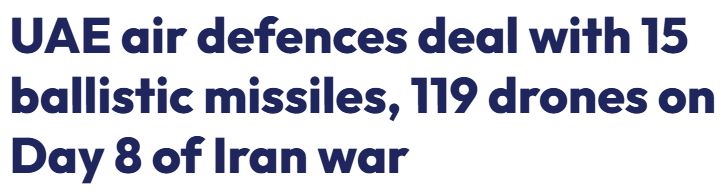
As can be seen, UAE alone reports 15 ballistics and nearly 120 drones launched just at them today, whereas some “official” statistics are showing roughly that amount as total fired by Iran into every direction. If the disparity is true, we’re looking at several orders of magnitude of potential discrepancies between “official” statistics and real launches.
Keep in mind, US’s strikes have likewise fallen off from nearly 1,000 on the first day to an estimated 200-300 per day or less since then—and many if not most of those strikes are hitting superficial targets to “fluff up the score”, like a plane boneyard which surely added a couple dozen “points” to the “impressive” strike list:

But the most revealing aspect of the hasbara comes with new reports today that roughly 50-70% of Iran’s ballistic missile launchers have been “destroyed” or “buried”.
From Israeli Kann news:
The Iranians’ launch capability has dropped by about 70%: On the eve of the war, the Iranians had about 420 launchers, only about 120 remain operational | @ItayBlumental with the details
According to them, Iran had over 400 launchers, and 150 of them were directly “destroyed” while another 150 were temporarily “buried” underground, wherein presumably the tunnel entrances of their storage bases were hit.
We must first note that launchers specifically refers to the missile truck platforms, not the missiles themselves. Iran may have thousands of missiles, and Israel is bragging about destroying the launchers which are just trucks which can easily be rebuilt; that’s not to mention Iran has many missiles said to launch directly from the ground, without launcher vehicles.
Secondly, the problem with the above stories is that they are virtually identical to the reports given to us during the previous 12 Day War in June 2025. Here’s a Jerusalem Post article dating June 16, 2025:
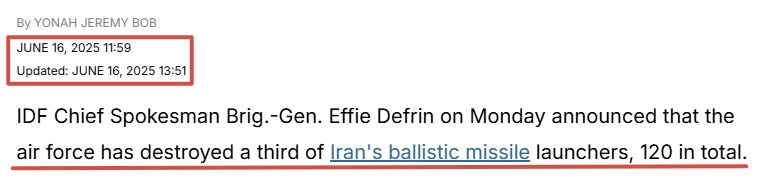
So, back then they likewise “destroyed” 120 launchers—an oddly similar number—and this represented “one third” of Iran’s launchers, which would be about 360. Keep in mind this is from the first few days of the 12 Day War—by the end of it, Israel had claimed that “two thirds” of Iranian launchers were destroyed, or around ~250, according to this Times of Israel article dated June 24, 2025:
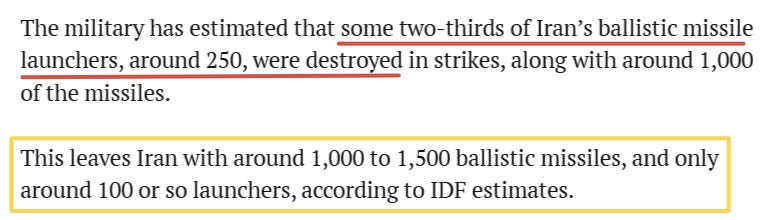
We are then to believe that since that time in 2025, Iran rebuilt its entire stockpile of launchers to over 400 once more. It would seem—according to these numbers—that Iran is able to build about 40 launchers per month in order to have rebuilt ~300 or so of them in the 7-8 months that have transpired since then. Western figures claim Iran also builds 100+ ballistic missiles per month, though it’s likely that number is much higher because we know Russia builds 60+ in Iskanders alone, and Iran has dozens of different ballistic types.
Just to humor the Israeli propaganda: even if they did destroy these numbers of Iranian launchers, why would that be considered catastrophic in any way when Iran was able to verifiably rebuild its entire stockpile from even far worse attrition last time? That’s without even saying that Iran now has a higher total (420+ claimed) than its previous total during the 2025 war (~350 claimed).
Also, recall that just like how Russia began to supercharge its defense industry after the true threat of NATO’s Ukraine war became understood, reaching figures of 5x production in many industries, wouldn’t it be plausible that Iran too may have increased its production after the 12 Day War, seeing the likely future danger it now was in?
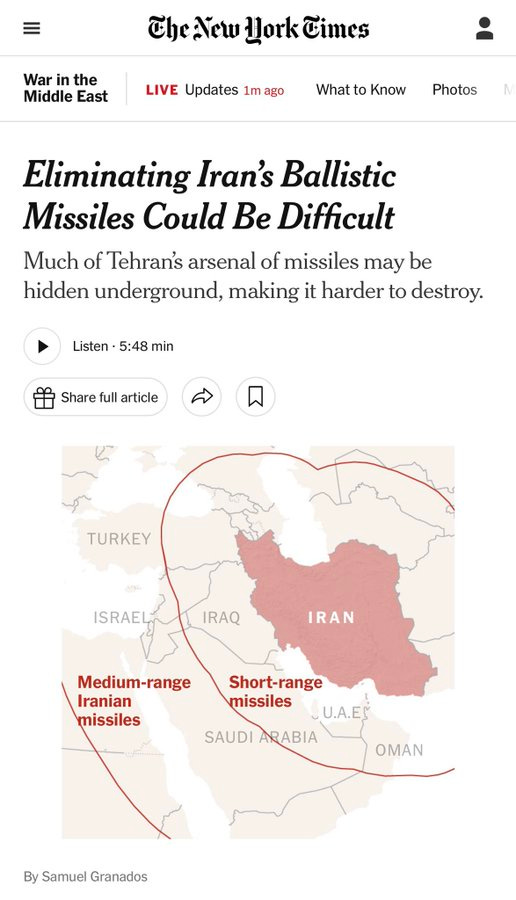
NYT is not so confident about the prospects of taking out Iran’s ballistics:
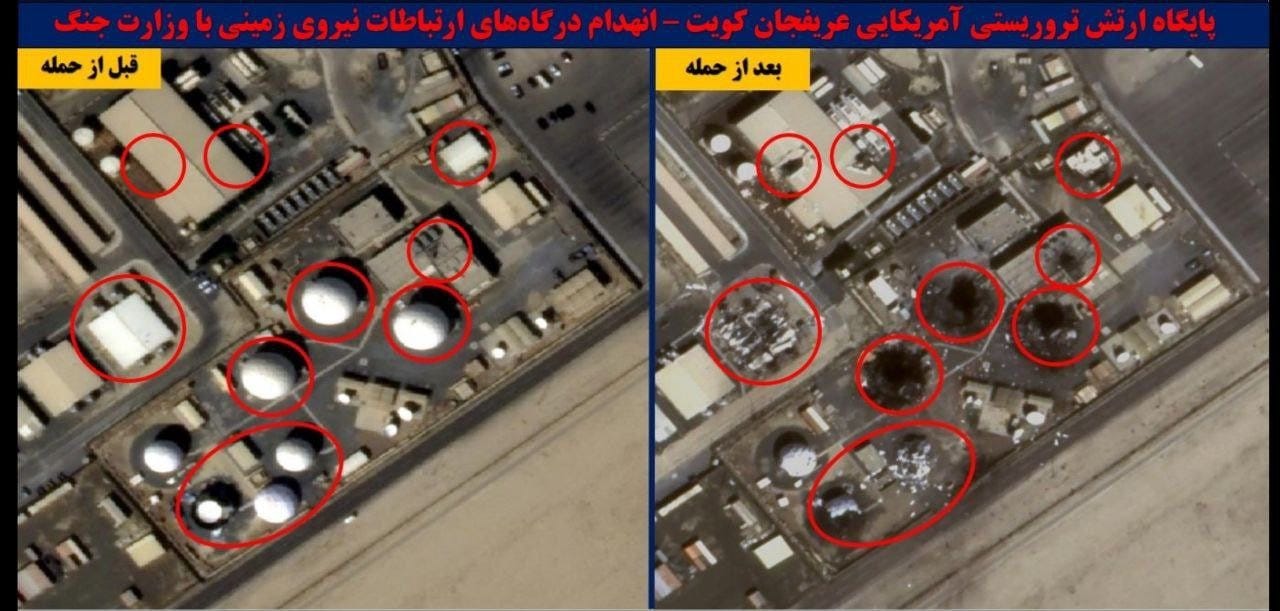
Now the war has begun to shift into strikes on energy infrastructure with the US-Israeli axis hitting the major Tondgouyan oil refinery in southern Tehran, while Iran reportedly blew up a refinery in Haifa, Israel and oil storage sites in Kuwait.
New satellite photos of Iranian strikes against Camp Arifjan in Kuwait from the past few days:
It signals a new US axis strategy to destroy Iran economically, now that Trump has realized that Iran will not surrender or collapse politically or militarily.
This is why now there’s talk of the US seizing Kharg Island which reportedly houses Iran’s largest oil export seaport terminal. But Iran has now “de facto” closed the Strait of Hormuz—I say de facto because both Trump and Iran itself, via Larijani, have stated Iran is not actively enforcing a blockade there, but simply that ships are refusing to pass on their own. In reality, several ships appear to have been hit and Iran may be playing a kind of plausible deniability game, closing the straits via intimidation rather than direct policy.
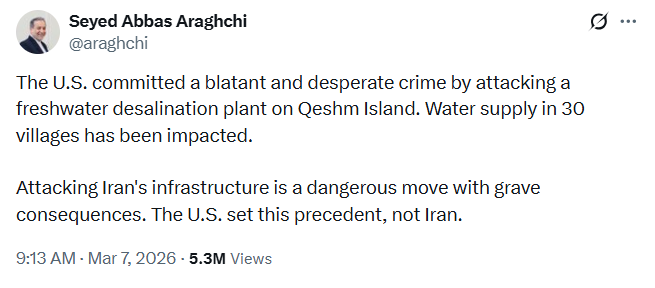
One of the new vectors in “bringing Iran to its knees” economically and socio-politically appears to be hitting its desalination plants, which US did today:
When asked about this attack, Trump launched into a seemingly racist and deranged rant against Iranians, calling them the most evil people on earth who cut babies’ heads off and “chop women in half”:
Many are now pointing to Iran’s escalation dominance in being able to hit the region’s desalination plants, particularly the critical ones in Israel which provide the country with virtually all potable water. Recall that Iran still maintains other major trump cards, like the Dimona nuclear plant which Iran has not yet even thought about hitting, barring the odd rumor—and of course the aforementioned Strait of Hormuz that Iran has not “officially” attempted to close yet.
Today, an IRGC-affiliated news agency account posted a veiled threat toward Bahrain’s desalination facilities:
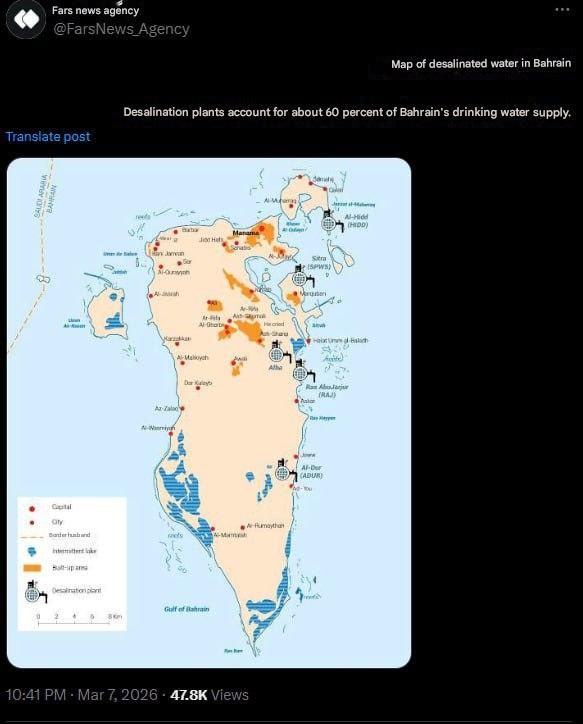
It brings us to the final point: that despite this war seeming like an “all out” existential effort, Iran has in fact continued to show restraint and appears to be holding something back in the tank in order to have escalatory options later down the line. Dimona is one example of this, but so are other major energy facilities throughout the Middle East, particularly Saudi Arabia’s largest fossil fuel complexes.
The other biggest elephant in the room in regard to this is US’s aircraft carriers. No one knows for certain whether Iran has actually attempted to hit one but is not able to, or whether Iran is saving this as the final escalatory option. On one hand, you would think the killing of the Supreme Leader represents the end-all-be-all escalatory step from the US, which should theoretically have triggered “all options” from Iran. But we know this is not the case because even today, president Pezeshkian essentially “apologized” for hitting Arab neighbors and promised to stop doing so, despite the fact the IRGC appeared to defy him soon after, hitting Kuwait and other states—once more illustrating the new independent “mosaic strategy” Iran’s military is currently functioning under.
I created a poll to gauge what people think about this question of the carriers:
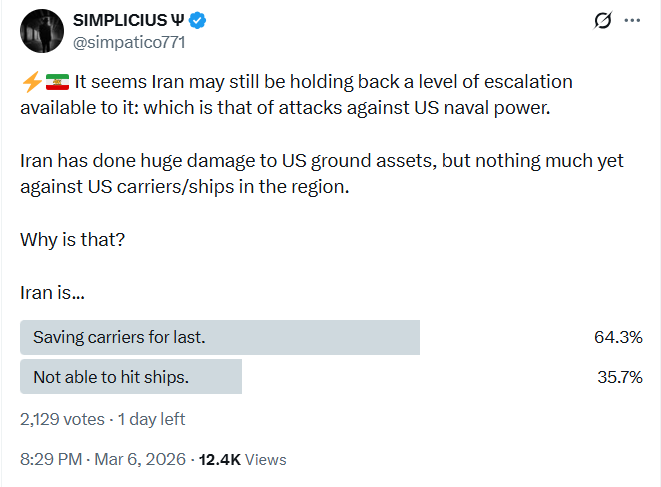
Many people responded with the belief that Iran knows if it sinks a US carrier, it would be such a prestige hit for the US that Trump may have no option but to nuke Iran. As crazy as it sounds, this is not an altogether implausible assertion, and it’s not out of the realm of possibility that Iran is operating under such a belief.
The other possibility is simply that Iran has not had a good chance yet or is simply waiting for the second carrier to arrive to set an ambush. Latest satellite intel has shown the USS Lincoln’s current position, about 300-400km from Iranian shores, and nearly 700km from the Strait of Hormuz. Which means it is keeping a doctrinal max-distance from Iran’s shores which balances safety from Iran’s missiles while still allowing the carrier’s assets to perform missions.
The second carrier, the USS Gerald R Ford, is said to have been seen transiting the Red Sea after passing the Suez Canal, and so is well out of range of any realistic Iranian strike.
Recall that Russia has been pounding Ukraine’s infrastructure for a long time, and has not brought the country—a fraction of the size and population of Iran—to its knees. US and Israel’s strikes against civilian infrastructure can continue for a very long time until the political blowback begins doing more damage to the US than the strikes do to Iran. For his part, Trump believes Iran is already totally “devastated”—do you believe him?
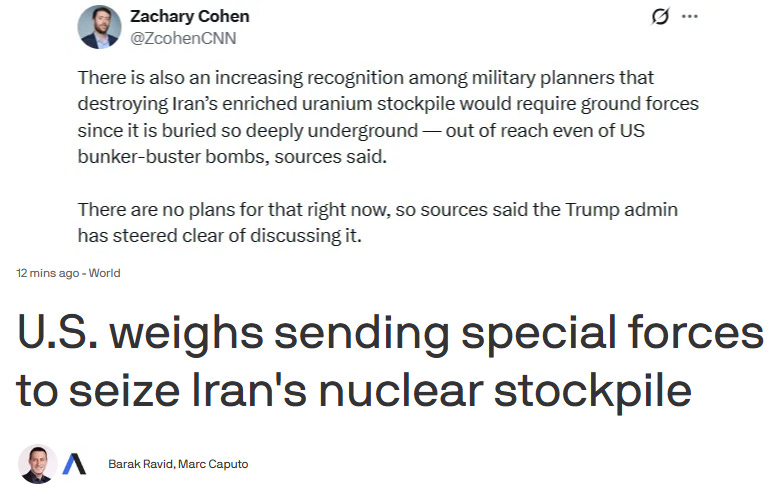
CNN now reports that Iran’s nuclear enrichment stockpile is actually impervious to strikes, and would require boots-on-ground to completely take out—what a shocker:
And in an even bigger shock, a White House deputy explained that the US plans to take over Iran’s oil:
By the way, the largest US military hospital abroad has announced a total cessation of its “labor and delivery” duties in order to focus on casualties from the Iranian conflict:

The largest U.S. Department of Defense hospital abroad is pausing its labor and delivery services until further notice to focus on the needs of the conflict across the Middle East.
They’re obviously being vague, but it’s understood that the US may be experiencing far more casualties—whether wounded, dead, or both—than is being reported and the influx is beginning to overburden the system. US casualties are seemingly being swept under the rug in “creative” fashion, like this new one from earlier:

Iranian ballistic missiles inflicting “medical episodes” is a new one in the empire’s infinitely florid propaganda lexicon.
Well, as per usual, when the warmongers can’t achieve their military objectives, it’s the civilians who suffer. Al Jazeera reports that over 1,300 Iranian civilians—30% of them children—have already been killed by the US-Israeli strikes:
One week into the US-Israel war on Iran, more than 1,300 Iranians have been killed, with children accounting for 30% of the dead.
US–Israeli strikes hit civilian sites, including at least 20 schools and 10 hospitals, according to UNICEF. Al Jazeera's Fintan Monaghan reports.
Trump, for his part, says the Minab elementary school massacre was carried out by Iran, despite overwhelming evidence it was a double and perhaps even triple-tap strike by the savage “coalition”.
It only goes to underscore the ‘gentlemanly’ fashion with which Russia has prosecuted its own Ukrainian war. In over four years of conflict, 15,000 total civilians are said to have been killed, while US-Israel killed ~1,300 Iranian civilians in just a matter of days. At this pace, they will have reached the four-year-long Ukraine war’s count in a couple months or so.
But then, according to Hegseth in the video above, “the only side who targets civilians in the war is Iran.”
Your support is invaluable. If you enjoyed the read, I would greatly appreciate if you subscribed to a monthly/yearly pledge to support my work, so that I may continue providing you with detailed, incisive reports like this one.
Alternatively, you can tip here: buymeacoffee.com/Simplicius