Ah, That’s What Diplomacy Was For
The Path Not Taken
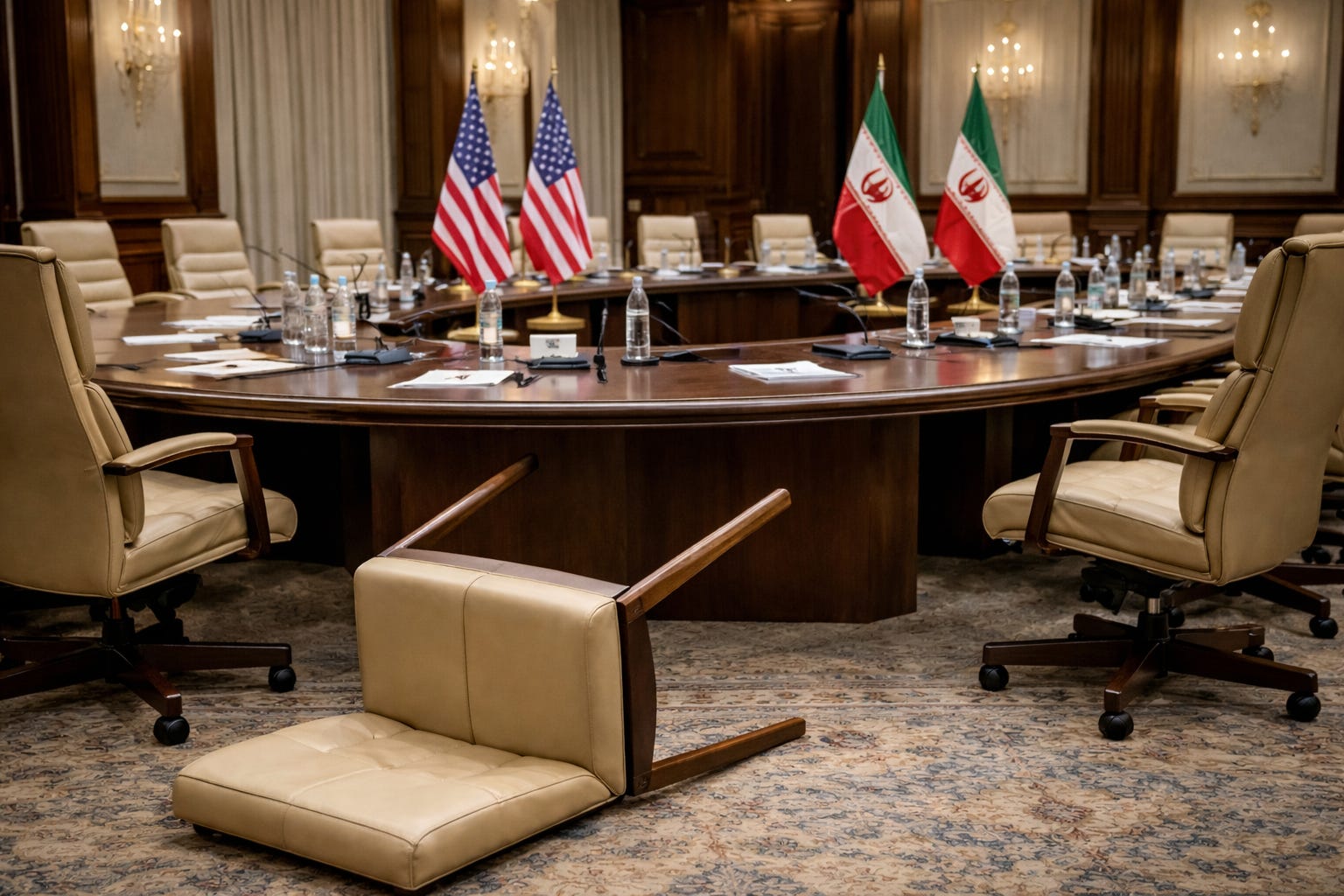
Diplomacy often seems like a pesky procedural palaver when you really want a satisfying result quickly, but you really miss the less sexy result when things go sideways. The prosecution of war against Iran, so far, has provided a solid example.
I’ve written in earlier posts about the risks of this war before it started, and about its unnerving early days. What I want to address here is what the conflict has already cost us in diplomatic terms, and why that loss matters more than it might appear.
Less than a week in, analysts covering the current regional war broadly agree that the prospects for a quick collapse of the Iranian regime, let alone a smooth transition to something more benign and participatory, are slim. If such an outcome were likely, the signals would be clear by now: senior regime defections, more and larger uprisings, cracks in the leadership. None of that has materialized visibly, though it’s always possible that something fundamental has been misdiagnosed and is lurking beneath the surface, waiting to announce itself on its own timeline.
This is largely Iran’s war to win, if winning simply means surviving. The Islamic Republic has the luxury of time, which the United States, running on the clock of public opinion, does not. American and Israeli interceptor stocks are finite and suspected to be dwindling rapidly; Iran has successfully destroyed or damaged several billion-dollar radar systems, further degrading the capacity to intercept incoming strikes. And if Washington were willing enough to commit ground troops, the costs and risks would be potentially so severe that the Iranian regime inflicts revenge either way.
What diplomacy offered, properly effected, was an alternative to this quandary, as well a shot at some of the things the 2015 nuclear deal (JCPOA) failed or only partially delivered on, e.g., a permanent reduction in enriched fuel levels and quantities, and stricter international oversight. Trump’s own unpredictability was potentially a huge asset — and the opposite, to the degree that the regime may have felt it had cracked his code.
As it was, the JCPOA had value, but decisively only when accompanied by firm and consistent pushback on Iran’s so-called ‘extracurricular activities’: its aggressive support for proxies and clients across the region, from Hezbollah in Lebanon to the Houthis in Yemen, Shi’a militias in Iraq, and Hamas in Gaza. Instead, a long policy of excessive American restraint towards Iran (and Israel), and the hope that 10-15 years of engagement would coax Iran toward a new, kinder disposition, proved extremely and predictably negligent, a policy pursued explicitly in the name of preventing a war between Israel and Iran that it ultimately made more likely.
It is far from certain that diplomacy would have created a better outcome. Trump claims the Iranian regime was an inconsistent, and unstable negotiator, going back on offers made the day before. This is very likely true. But closing that door ended what might have been, and created what we have.
***
Paradoxically, the first Trump administration pulled together an agreement, the 2020 Abraham Accords, that held out the prospect of a second line of defense against (and an incentive to) Iran: a series of mutual support agreements between Israel and the Arab states that would reduce the chance of war by creating interlocking water, trade, and climate commitments whose benefits would be too obvious to their populations to abandon.
Trump also issued the order that killed Qassim Suleimani, the architect of most of Iran’s proxy wars, on January 3, 2020, a signal of intent that the Accords framework both reflected and depended upon. The main obstacle to implementation, and the condition that required sustained American pressure to advance, was the signatories’ commitment to rapid progress on a Palestinian state. The consequences of this elision are clear.
While the Iranian government’s positions just before the U.S.-Israel strikes must be taken with a large dose of skepticism, that’s what diplomacy is for, to get to positions that become essentially impossible once you’ve killed the leader of another country, however unpleasant.
Which leaves us with two possibilities, neither of them good: a damaged but vengeful regime, or outright chaos. I outlined both of those in detail last week, and the early trajectory of the war has done nothing to improve the odds on either. A weakened Iran will be brutally controlling of its own population and incentivized to fight back asymmetrically for years. Chaos, as the post-Arab Spring landscape has shown repeatedly, feeds on itself, and is qualitatively more dangerous today than two decades ago, given what cheap technology now allows rogue elements to do — and as the Houthis demonstrated when they effectively blockaded the Bab Al Mandeb straits in 2024 with a few drones. Saudi Arabia, as Bernard Haykel notes in a recent Bloomberg interview, has an extremely low tolerance for this kind of systemic risk, which is precisely why Riyadh has been so determined to dampen conflicts in Yemen and Sudan, and to ease tensions between Eritrea and Ethiopia.
Washington is not the only party that may have miscalculated catastrophically. Iran’s support for Hamas was presumably intended as a ‘simple’ but effective fork in the wheel of the Saudi-Israel rapprochement; it may have gotten its wish, but at a hugely disproportionate cost to itself, and everyone else. In the longer term, Israel may well be the biggest loser of all, having found itself far too effective at killing and destroying things for its own good. Destroying your neighborhood generates the kind of lasting enmity that doesn’t fade with the next election cycle. At some point, neighbors who hate you don’t just hate you; they bypass you. That isn’t just bad for Israel; it is potentially catastrophic for the regional architecture that made the 2020 Abraham Accords possible.
The Accords, over which Trump presided and to which Israel was a party, derived their power from a top-down logic of stability: leaders could deliver normalization if the benefits were clear and the costs manageable. They were, in their way, a belated gesture toward exactly the kind of regional interdependence that should have accompanied the nuclear negotiations a decade earlier. With each week of the current war, the prospect of returning to that framework diminishes, not linearly, but exponentially.
Subscribe to Middle East-Told Slant
The Middle East-Told Slant offers a non-partisan, practitioner’s perspective on Middle East politics, conflict, and culture. Written by a former US diplomat with 25+ years of regional experience, author of “Benghazi: A New History“ (Hachette, 2022) and Exit the Colonel (Public Affairs, 2008), and Translating Libya (Darf, 2015). Each week, I share analysis on current events, historical context, and cultural insights from the region, drawing on my experience in government, business, and academia across the Middle East.