The cost of waging war
Burning billions for bombs instead of building bridges
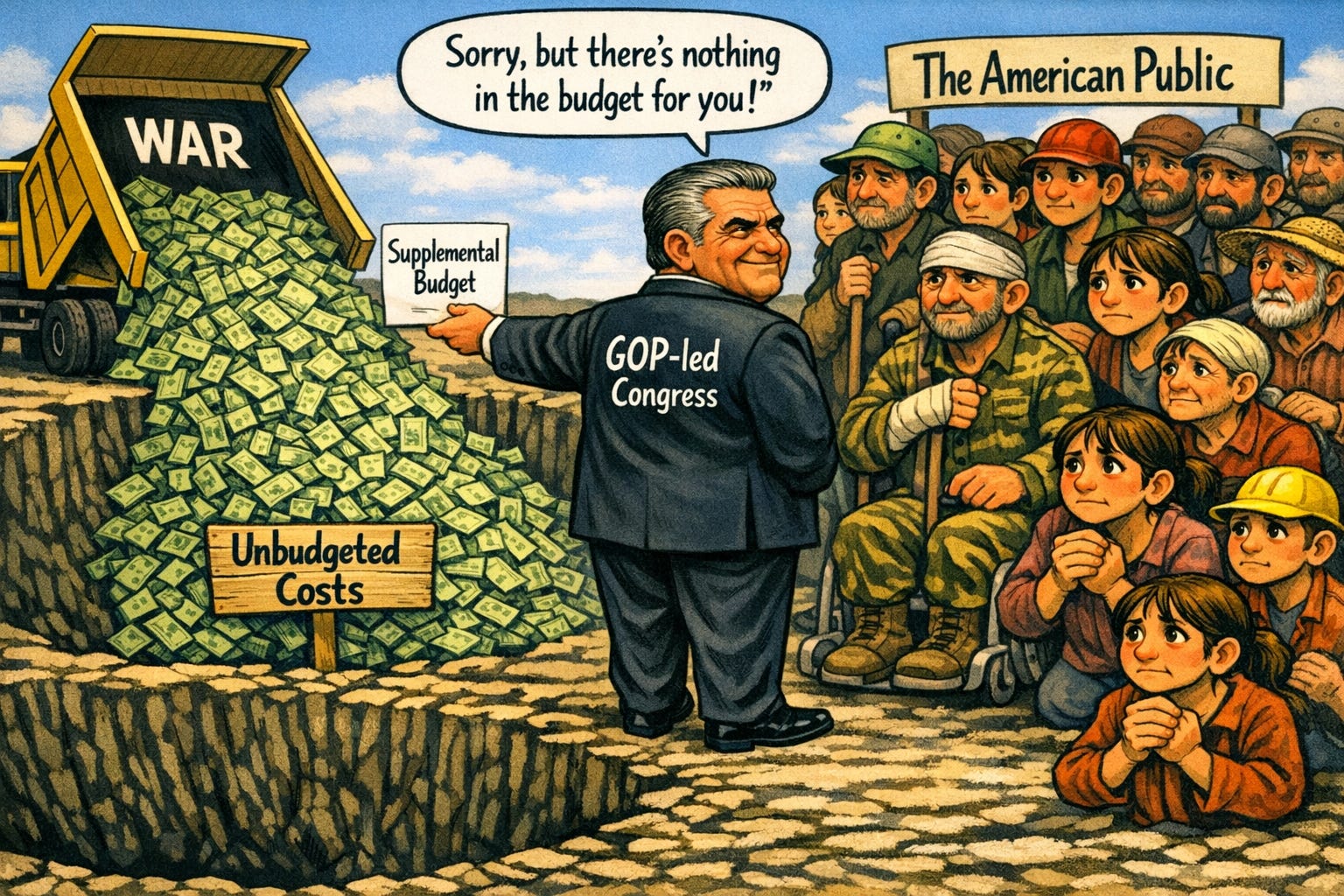
There are a lot of things to consider when a nation goes to war, chief among them the human cost on all sides of the conflict. The US is currently involved in military operations on multiple fronts. Because the human toll is mostly being borne by those who are the target of these operations—hundreds of ‘suspected drug dealers’ in the Caribbean and Latin America, and over a thousand Iranians in Operation Epic Fury—some Americans are cheering the display of American power and military might. That we would find joy in so much death is disturbing in itself, but that this would distract us from the price we’re paying in monetary terms is almost as disturbing.
Americans need to be reminded that wars are not cheap. The money spent on blowing up small boats or destroying schools could be better spent on repairing our deteriorating road networks or upgrading some of our schools. But, I won’t preach. Instead, I’ll ‘run the numbers’ and let readers make up their own minds.
Let’s start with a small conflict, the so-called narco-terrorist interdiction mission in the Caribbean, Operation Southern Spear. Publicly billed as an operation to work with allies and partners to counter threats from transnational criminal organizations, it is actually aimed at containing and reversing the increase of Chinese presence and influence in Latin America and the Caribbean.
With approximately 20 percent of the US Navy’s power massed in the Caribbean, what is it costing the American taxpayer? Operation Southern Spear’s daily cost is an estimated $20 million, with the USS Gerald R. Ford carrier strike group alone costing about $11.4 million per day. Since it began on November 13, 2025, it has cost over $234 million.
The Caribbean operations, as expensive and controversial as they might be, are penny-ante compared to the massive air campaign being conducted in coordination with Israel against Iran, Operation Epic Fury. The estimated cost of the first 100 hours of the operation was $3.7 billion, or about $891.4 million per day.
Some of the costs of each conflict are already budgeted. After all, it’s expensive to maintain a large standing force such as ours. But in the case of Epic Fury, for example, $3.5 billion is not included in the current budget. That sum covers munitions used, combat losses, and infrastructure damage. I say, without fear of contradiction, that the GOP-led Congress is sure to pass a supplemental budget to cover the ‘added’ costs.
The same cannot be said, however, for the needs of the American people. In addition to their tax dollars funding wars that no one has bothered to explain fully or justify to them, they’re bearing many other costs. The national average cost of a gallon of regular gasoline has jumped 14 percent since Epic Fury began, to $3.41 per gallon. The cost the week before the war started was under $3, but with a barrel of crude oil now over $100, prices of all fuels are rising. Rising diesel costs, which went over $4 per gallon on March 5 for the first time in two years. With diesel inventories already tight because of the high demand for heating and power generation during the harsh winter of 2025-2026, and the shortage of refining capacity, it’s not just the ability to fill a car’s gas tank that consumers have to worry about. Everything that moves by truck, from the produce at your local market to your Amazon packages, commercial airliners, and even maritime shipping, will become more expensive. Oil powers the machines that grow our food and make our products, and it’s a component in many of the things we commonly use, so if this war (or these wars) continue, consumers are likely to take a hit across the board.
One other cost that we’ve yet to face—and I pray we don’t—is the emotional toll when more young American men and women start coming home in body bags. If Epic Fury moves from an air campaign to a ground phase, which is essential if regime change is really the goal, more friendly casualties are a given. Except for those who have opposed these military (mis)adventures from the beginning, I sense that too few Americans have given this much thought.
Maybe it’s time we all started thinking.