China and Russia discuss strengthening Arctic and other transport links after conflict in the Middle East
Harici.com.tr 17.03.2026 19:04Author
China and Russia are discussing strengthening transport links as conflicts in the Middle East disrupt maritime transport. The increasing use of the Arctic sea route was among the topics discussed at the China-Russia Logistics Business Forum.
As the growing conflict in the Middle East disrupted global maritime transport, China and Russia began to consider a deeper cooperation in the field of logistics to secure a more resilient supply chain – including the use of the Arctic sea route.
At the inaugural China-Russia Logistics Business Forum in Moscow on Monday, officials and business leaders discussed strengthening transport and infrastructure ties, stating that such cooperation is vital at a time when geopolitical tensions are shaping global supply chains.
Dmitry Birichevsky, Director of the Economic Cooperation Department of the Russian Ministry of Foreign Affairs, emphasized in his speech at the forum that global instability should be taken into account in the development of bilateral relations.
“We have to take this whole into account,” he said, adding: “That's why the independent payment mechanisms and logistics between our countries, especially the Eurasian Economic Union (EAB) and the Commonwealth of Independent States (CIS) transit routes through friendly countries, are a perfect example of how this can work.”
Birichevsky stated that the situation in the Middle East reveals how vulnerable the global economy and logistics networks are to the unilateral actions of those who fuel wars.
This region, which is already full of conflicts, experienced a significant escalation after the US and Israel carried out airstrikes on Iran in late February.
The AEB is a customs union consisting of five countries consisting of Armenia, Belarus, Kazakhstan, Kyrgyzstan and Russia, while the CIS is a broader regional organization covering the nine former Soviet Republics.
“Today, we need to build new logistics routes that will increase our capacity and give China the opportunity to increase its transit potential,” said Gennady Bessonov, Chairman of the Executive Committee of the CIS Coordinator Transport Conference. "Reaching the ports of Europe and North and South America by providing access not only to the CIS countries, but also to Arkhangelsk and Murmansk," he added.
Arkhangelsk and Murmansk, two important ports of the Arctic sea route, have signed partnership agreements with the Chinese carrier New Shipping, which launched a regular Arctic line service in 2023.
New New Shipping plans to make its first voyage to the port of Murmansk this summer and is discussing to build a transfer terminal for Belarusian cargo in the port, according to the governor of the Murmansk region, Andrey Chibis, earlier this month.
The Chinese company is also discussing a plan to build a deep water cut in the port of Arkhangelsk with the port operator.
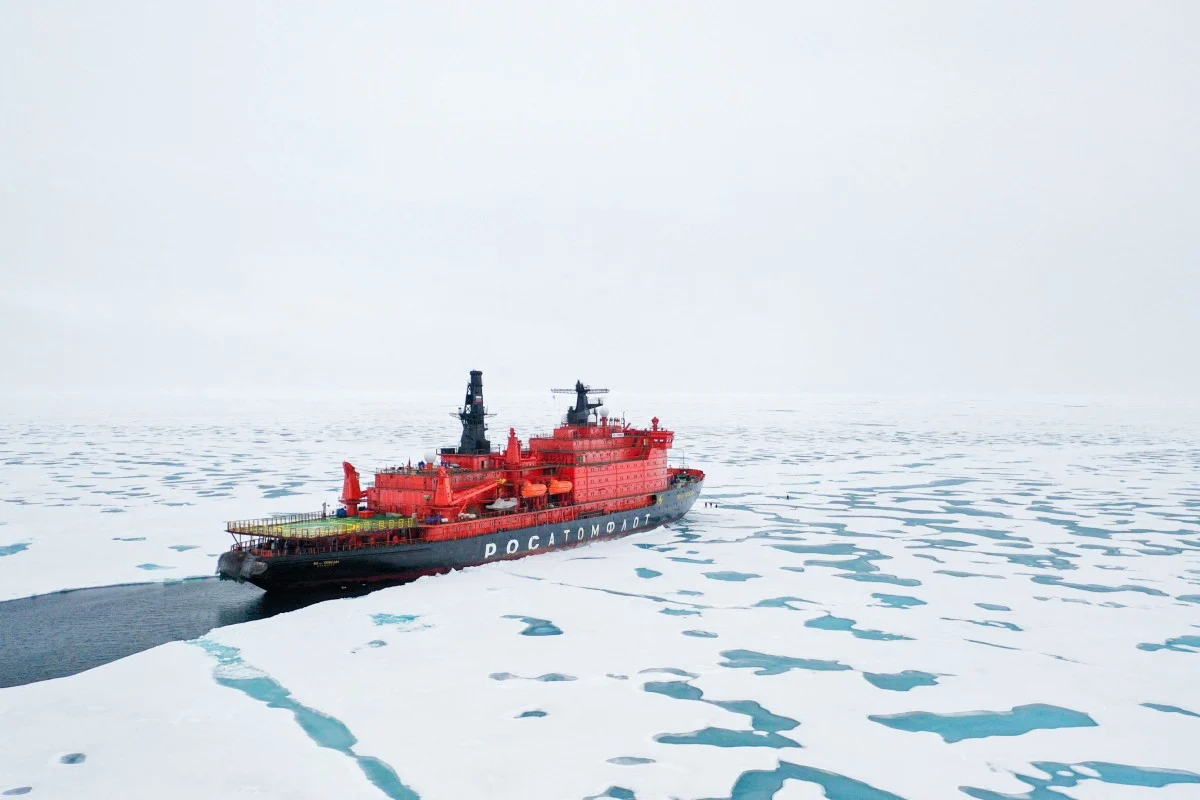
New New Shipping, which has played a leading role among Chinese carriers using the Arctic route, has partnered with Russian nuclear energy giant Rosatom in 2024. This partnership aims to build container ships with high ice class in order to establish regular container transport services in the Arctic Ocean.
On Thursday, Rosatom announced that it had approved the design of an Arctic-class ship specifically designed for this type of collaboration. This ship will have a capacity of more than 4,800 twenty-foot equivalent units and will be able to independently pass through 1.7 meters (five feet and seven inches) thick ice.
Russia is actively promoting the Arctic route, which could shorten transit times between Asia and Europe by up to 40%, and China is increasing its efforts to take more part in this route as an alternative to traditional corridors becoming increasingly sensitive to geopolitical instability.