From Gaza to Tehran, Palestinians and Iranians compare life under the bombs
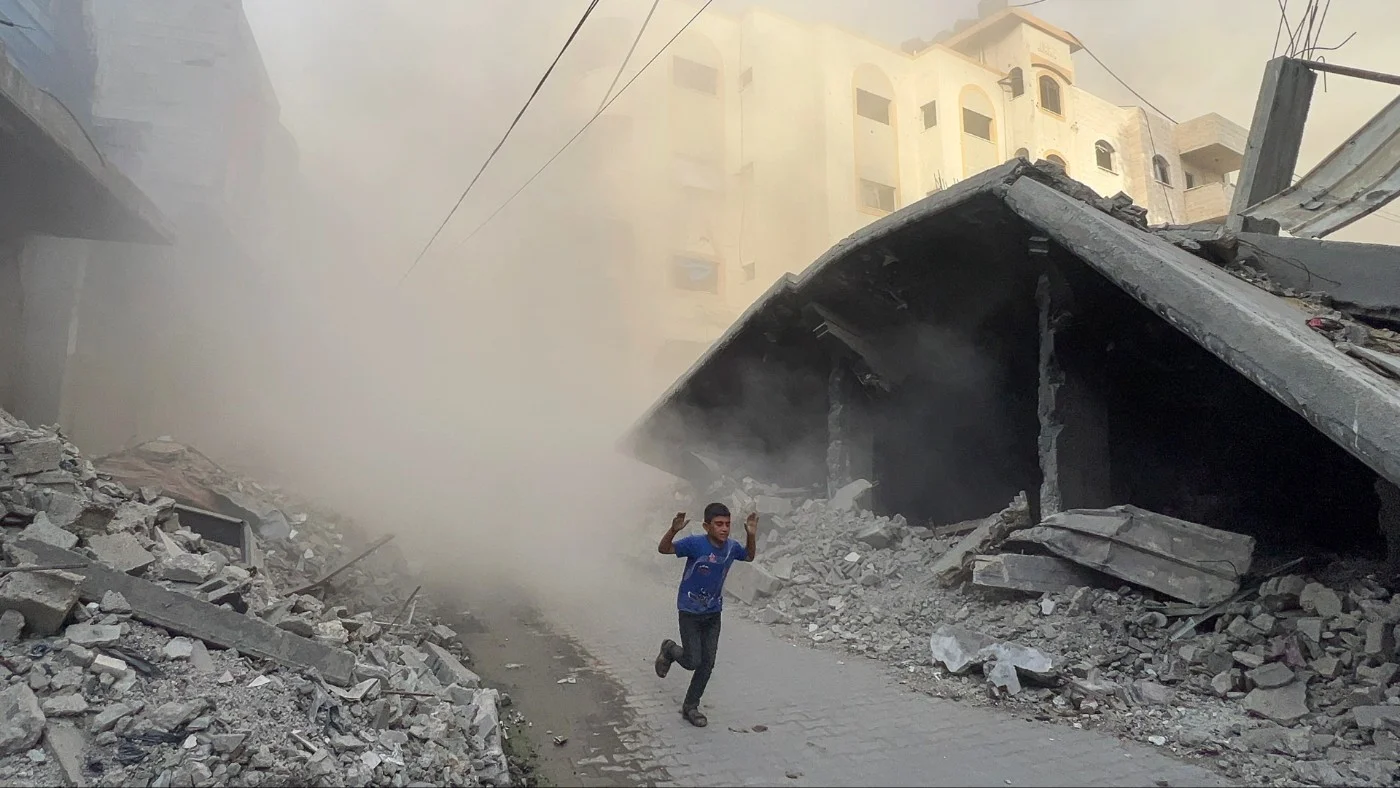
Civilians covered in dust. Blood-stained school bags. Hospitals turned into military targets.
These stark scenes from the war on Iran mirror, many Iranians now say, those in Gaza they once watched on their screens.
For Palestinians, the images from Iran are hauntingly familiar. Successive air strikes on civilian infrastructure. Scores of deaths. Scenes that force them to relive more than two years of genocide.
“If this war continues for a few more days, nothing will remain of Tehran,” says Hamed, 31, speaking to Middle East Eye in the Iranian capital.
“The scenes I see with my own eyes remind me of the films and photos that used to come out of Gaza. Back then, we never thought we might end up with a fate similar to theirs.”
In Gaza, Palestinians say they saw this pattern long before it appeared in other parts of the world.
“The genocide itself was a warning. Seeing Israel get away with crimes we never thought would be met with nothing more than timid condemnations suggested that the war would not stop here,” Muhammed al-Khaldi, a 32-year-old teacher from Gaza, told MEE.
“Gaza was the testing ground where Israel pushed the limits of what it could do. Unfortunately, the world allowed it to act without restraint. Now, they [Israel] know they can commit similar crimes elsewhere.”
School attacks in Iran and Gaza
On 28 February, the first day of the war on Iran, a double-tap strike on the Shajareh Tayyebeh school in Minab, southern Iran, killed at least 168 people, including two first responders and survivors who had been sheltering after the initial US strike.
Around five days later, two schools in the town of Parand, southwest of Tehran, were struck by missiles, sustaining heavy structural damage, according to Iranian state media.
“The school in our alley has been attacked several times. Thank God the schools have been closed. But why should a school be attacked?” Shirin, a 46-year-old resident of Tehran, told MEE.
“When the war ends tomorrow, where are these children supposed to go to class? Is all our infrastructure supposed to be destroyed completely?"
Shirin says she can hardly believe that Iranians are now enduring attacks similar to those suffered by Palestinians in Gaza.
“I was fooled into thinking that the US and Israeli strikes would really be precise, targeted attacks. Every day many residential homes are destroyed,” she said. “At night I cannot sleep because of the sound of the bombing. I wish this nightmare would end soon.”
In a similar attack in Gaza on 10 August 2024, the Israeli military bombed al-Tabaeen school in eastern Gaza City, where thousands of Palestinians were seeking shelter.
Around 100 Palestinians, including women and children, were killed on a Saturday in at least three waves of bombing as they performed dawn prayers.
“Schools were not just bombed during the war, they were part of the main targets. Every couple of days there was a new attack on another school,” Areej Muhammed, a 34-year-old mother from Gaza told MEE.
“Today, even after the ceasefire, I still cannot enrol my daughter in school. She has been out of school for the third consecutive year now. The attacks on schools aimed exactly at this, destroying the education system in Gaza.”
Over 97 percent of Gaza’s schools have been destroyed or damaged, and 92 percent of all education facilities in the coastal enclave require full reconstruction or major rehabilitation to become functional again, according to Unicef.
Since 7 October 2023, around 18,911 school-age children and 794 school teachers have been killed in Israel’s Gaza genocide.
Attacks on medical infrastructure
Attacks on schools are just one grim similarity between the wars on Iran and Gaza.
In Iran, hospitals have also been targeted, with at least 18 attacks on healthcare facilities, including 13 hospitals, revealing a devastating pattern that recalls the repeated strikes on medical infrastructure in Gaza.
On the second day of the Iran war, Tehran’s Gandhi Hospital was hit by a strike that destroyed its in-vitro fertilisation (IVF) department.
Iranians trying to conceive told MEE of the agony of not knowing what had happened to sperm and egg samples held in the fertility centre.
In Gaza, al-Basma IVF Centre, the Strip’s largest fertility clinic, was destroyed in an Israeli air strike in December 2023, wiping out nearly 4,000 frozen embryos and about 1,000 samples kept at the facility.
Today, the entire healthcare system in Gaza faces near total collapse following the targeting and damage of at least 94 percent of medical facilities. According to the World Health Organisation (WHO), Gaza no longer has any fully functional hospitals.
“I was besieged with my sick child at al-Shifa Hospital in November 2023. The hospital was bombed several times while we were still inside,” Manar al-Batrikhi, a 29-year-old resident of Gaza City, told MEE.
“We were forced to evacuate, but we remained in Gaza City, where we could not find proper treatment anywhere.”
In September 2025, after the Israeli military issued mass evacuation orders to residents of Gaza City, Batrikhi decided to evacuate her displacement camp in Gaza and move southward.
“I decided to move south in the hope of finding a hospital if my child needed care. But even there, we could not find proper treatment for his severe malnutrition. They have destroyed the medical system as a whole.”
Israel has meted out similar destruction in its latest offensive in Lebanon, where more than 800 people have been killed and health services targeted. In the last fortnight, Israel has killed 31 medical staff in Lebanon.
In Iran, since the war began, at least four medical workers have been killed and another 25 injured in several US-Israeli strikes on healthcare facilities.
“The hospital near our home has been bombed several times,” said Sara, 34, from Mashhad, northeast Iran.
“[Some] media outlets affiliated with Israel have been shaping the narrative during this time. First, they create the narrative, many people believe it, and in the end, it becomes like what happened in Gaza’s hospitals, those same false claims,” she said.
At least 1,444 civilians have been killed so far in two weeks of attacks on Iran, and an unknown number of security forces personnel. In the same two-week period at the beginning of the war on Gaza, more than 4,100 Palestinians were killed.
Sara reflected on the conclusion many in the region are drawing. “Now, little by little, everyone is realising that, for Israel, Iran, Lebanon, Syria and Gaza are all the same.”