Ukrainians Sound Alarm Over Coming Russian Spring Offensive
The Iran war has pushed itself to the forefront of news coverage for the past few weeks, which happened to coincide with a relative dead period in Ukraine which somewhat excuses the lack of reporting on that conflict.
However, it’s time we take a brief look at Ukraine again, particularly since some new developments are beginning to sprout with the spring thaws.
First to deal with the elephant in the room. Pro-Western Ukraine reporting has recently revolved entirely around some ‘mega-successes’ of the Ukrainian army, wherein they have reportedly caused major collapses of Russian defenses and have taken back the most territory since 2023. This in conjunction with Russia’s own lackluster advances of late has merged into a kind of critical-mass info campaign meant to characterize Russia’s military efforts as deteriorative and exhausted.
In particular, it has been augmented by new PR drone strikes on Moscow, which too have been deftly weaved into an overriding narrative of “Putin’s regime on its last legs”, with scuttlebutt about various coup plots and an atmosphere of tension in Russia fabricated out of whole cloth.
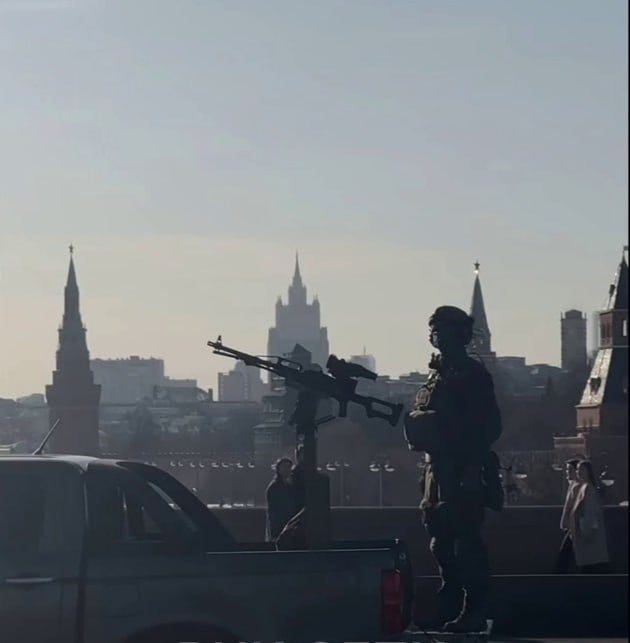
It’s true that Ukraine launched a series of large-scale drone attacks on Moscow precisely to energize these recent information campaigns. It’s true internet has been squelched in parts of Moscow during the attacks in order to neutralize the various networks Ukrainian drones have used for communications. And it’s true that given the large scale of the attacks, the ‘optics’ created by Russian anti-drone gunners placed around the Kremlin—a fashionable but empty PR target for Zelensky—have strengthened the tenor of this ongoing narrative.
Furthermore, it is true that over the past month or two, Ukraine had been launching a series of hard-fought counter-attacks on the Zaporozhye access in order to staunch Russia’s advances there. The popular animation being shared amongst pro-Western networks shows the scale of the advances on the northern edge of the Russian bulge:
This corresponds to the area seen here on Suriyak’s map:
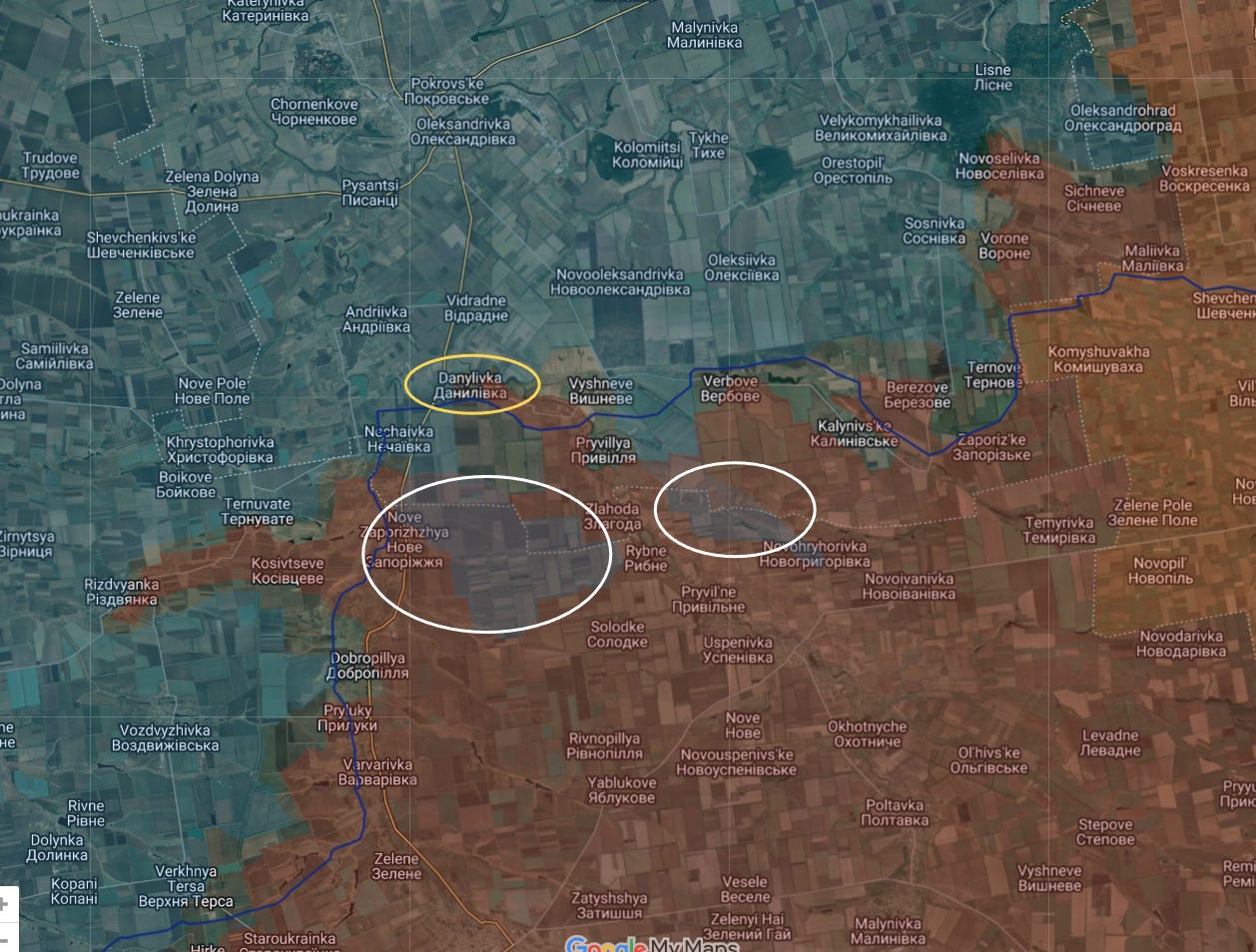
The problem with this “offensive” is two-fold. Firstly, as you can see in the above, the white circled areas depict alleged Ukrainian ‘breakthroughs’, but most competent mappers are leaving them shaded ‘gray’ because they represent areas where small groups of soldiers—in some cases single two or three-man teams—were spotted, but they were subsequently eliminated and the area simply fell into a no man’s land surrounded by sparsely distributed Russian defenses.
Note Danilovka circled in yellow above. Here a top Ukrainian account admits there is no way Ukrainian forces can push into or past Danilovka, as it essentially represents the end of their capability:

The second much bigger problem regarding this widely-hailed offensive is that the maps of the offensive are deliberately cut off just at the southern portion to prevent showing that the ongoing Russian advances westward have again accelerated irrespective to Ukraine’s temporary flare up to the north.
From Suriyak:
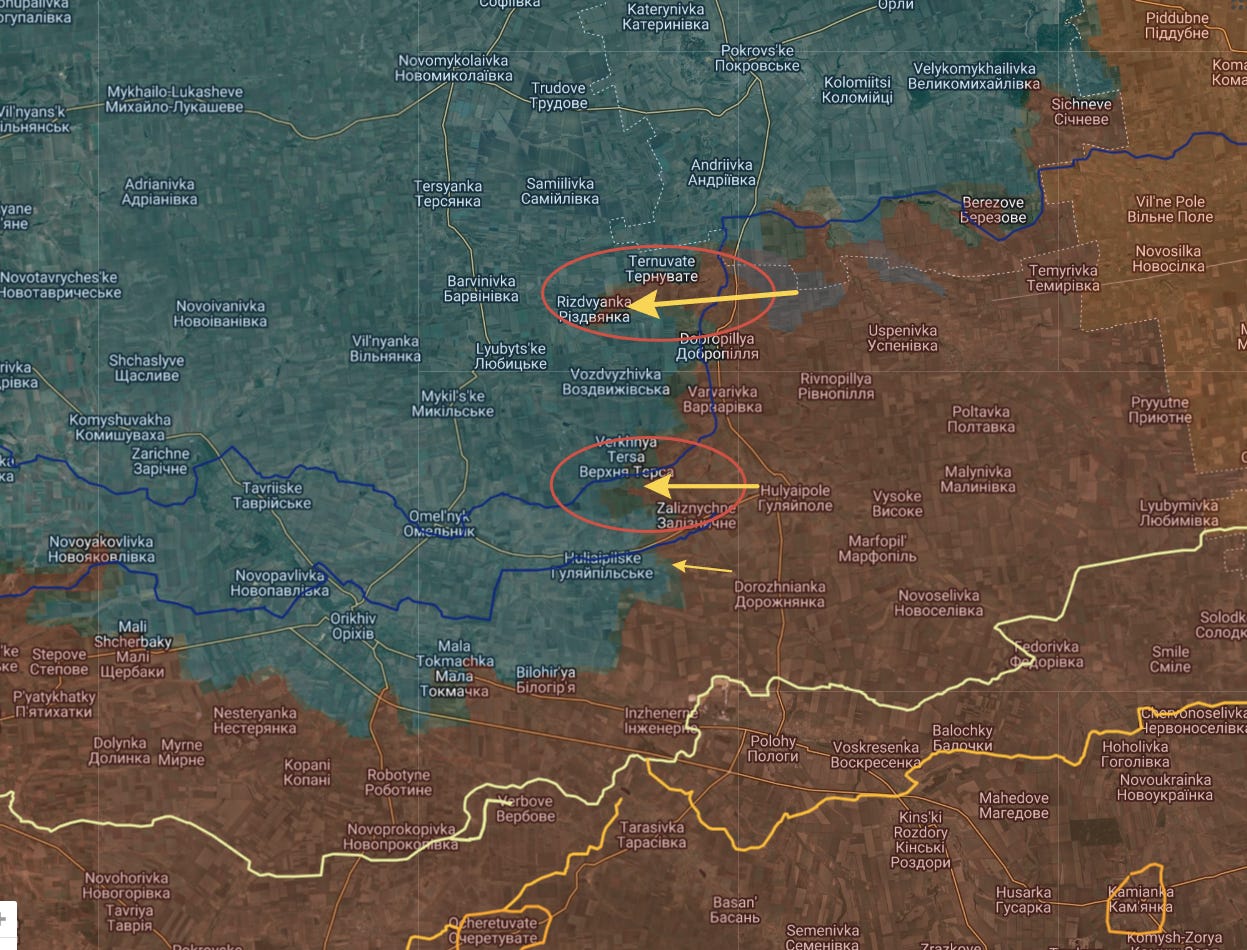
You can see the two pronged salients bursting through Ukrainian defenses towards and even past the center—on the northern prong—of the rectangular operations zone that lies between opposing defensive lines. Particularly note the northern prong at Rizdvyanka, though some other cartographers have this area more gray-zoned with the explanation being that only Russian “DRGs” activity has been present there; but to me, Suriyak has been the most consistently accurate gold standard thus far, so I go with his interpretation.
On the western side of the Zaporozhye region, Russian forces have likewise broken out into a deeper salient out of the Stepnogorsk area:
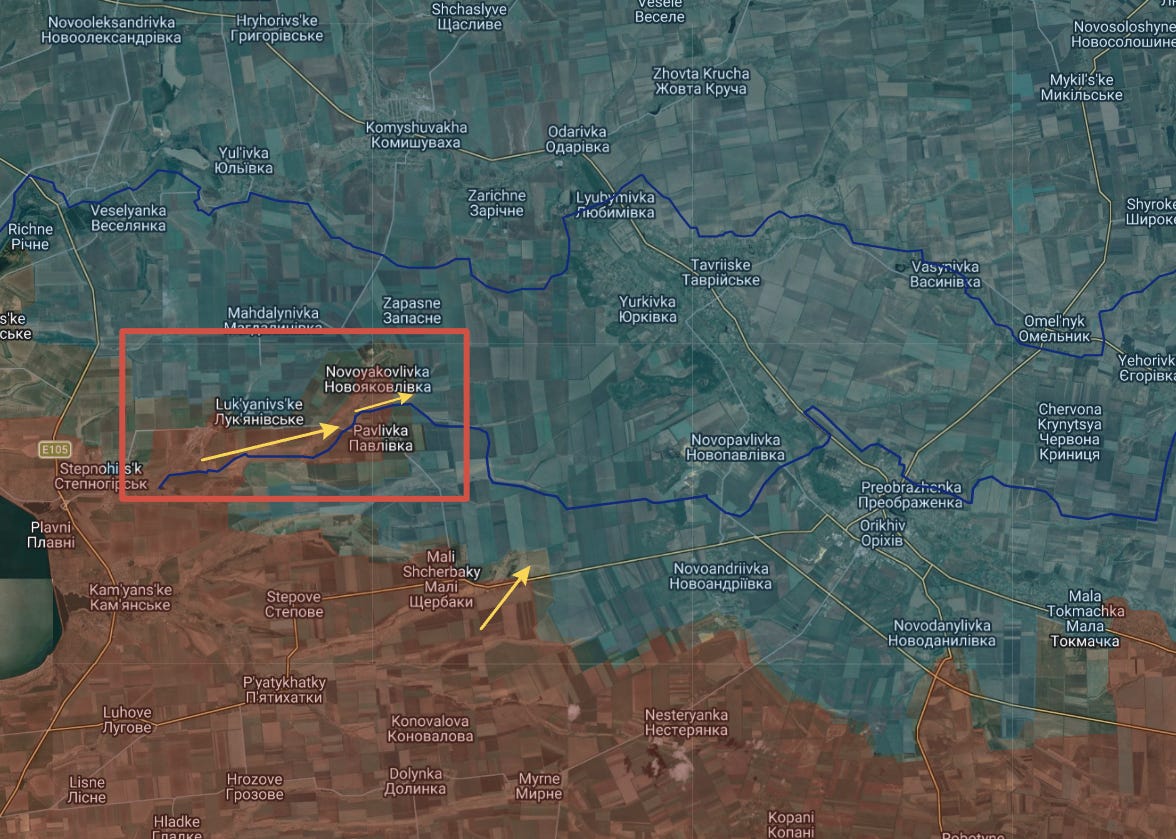
What you can see is that this is creating a massive ‘bowl’ of entrapment that will play a major role in the coming offensives, as per Ukrainian analysts, which we will get to a little later.
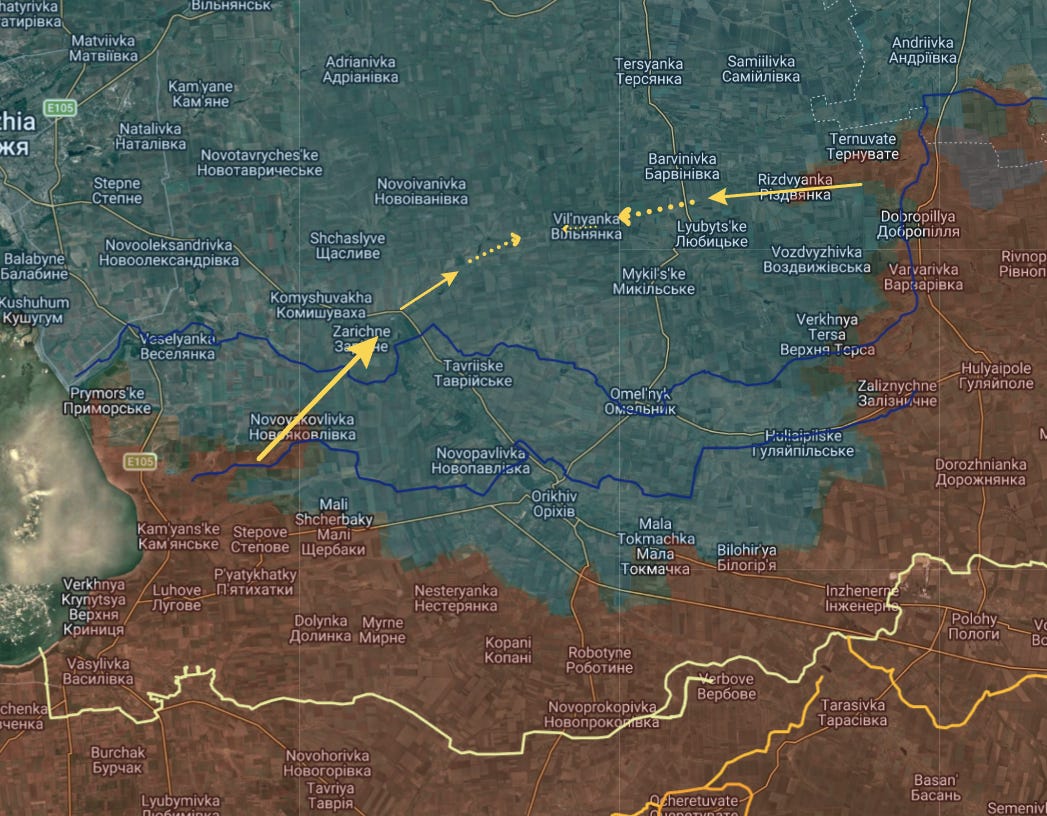
Like I said, keep that in mind for later, as we will return to this.
Elsewhere, Russian forces have likewise begun to pick up a bit of movement. Today Russian mappers reported the capture of Kaleniki on the Seversk-Slavyansk axis:
The Russian army liberated Kaleniki, advancing towards Slavyansk, - Ministry of Defense
▪️Units of the “Southern” group of troops, as a result of active actions, liberated the populated area of Kaleniki on the Slavyansk direction in the Donetsk People’s Republic.
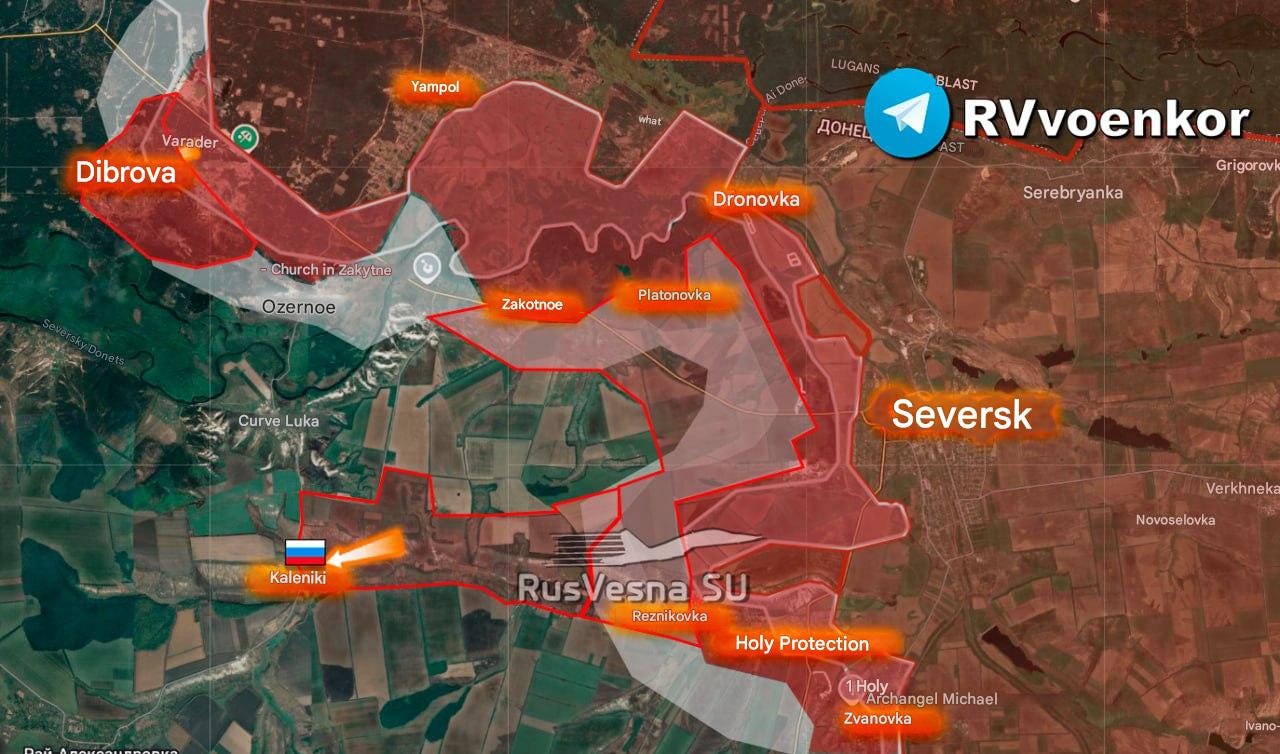
Last time we left off with Riznykivka only about half-captured. Now you can see Russian forces fully captured it and have advanced further west to reportedly capture Kaleniki today:
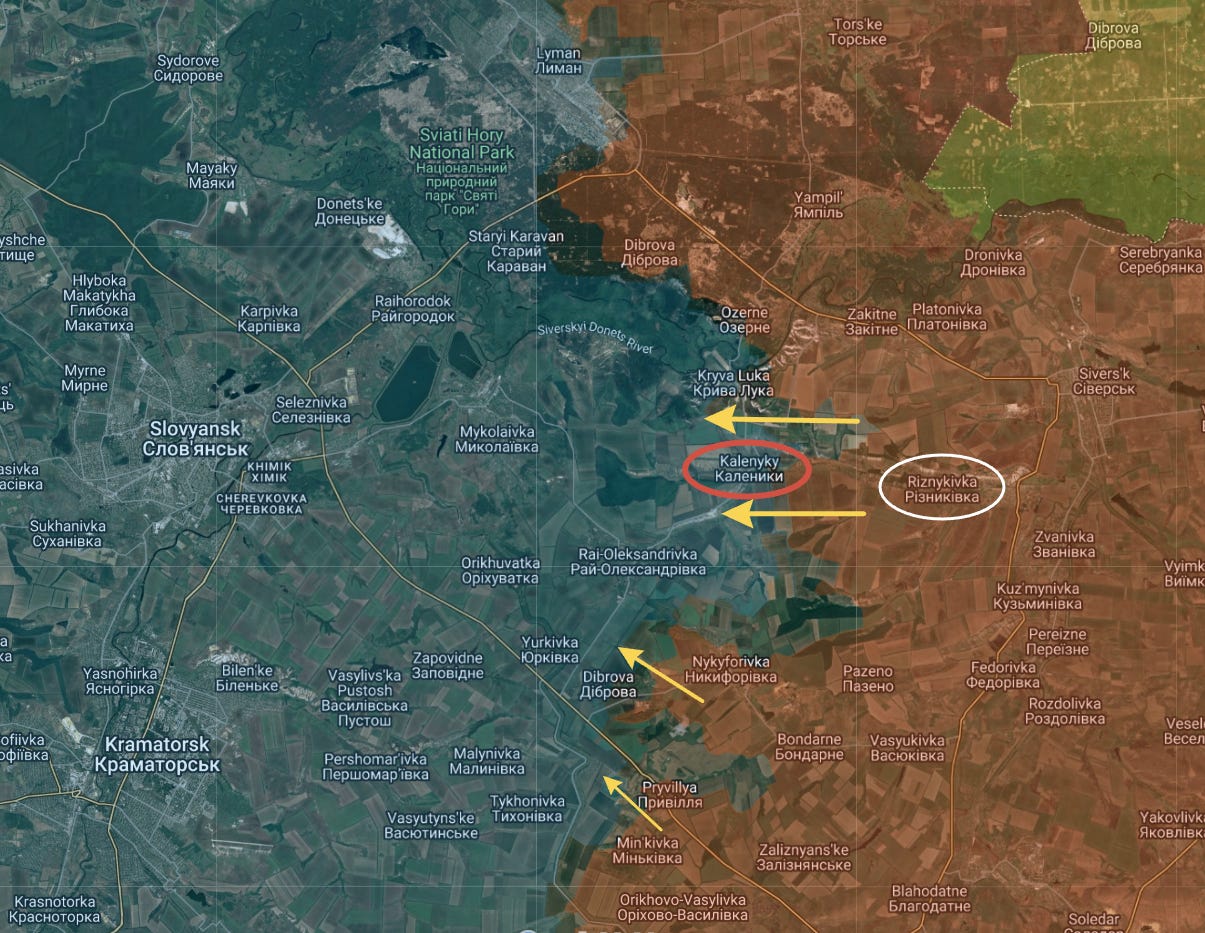
That being said, it’s true that beyond these axes, Russian advances have been uncommonly slow, with many people blaming the uncommonly harsh winter and rasputitsa season.
Of course, the Ukrainian side puts the blame squarely on ‘growing Russian losses’ and the exhaustion of the Russian army. I’m not here to proselytize so I don’t seek to implant one view or the other into my readers’ brains per se, but rather present as impartial a picture as possible using hygienic data sources to underwrite it all.
But what we do know is that for the past week or so, the Ukrainian side has suddenly been trumpeting some large-scale Russian offensive they claim is being built up on the Zaporozhye axis. Syrsky himself cited the mass buildup of Russian equipment being staged in the zone:
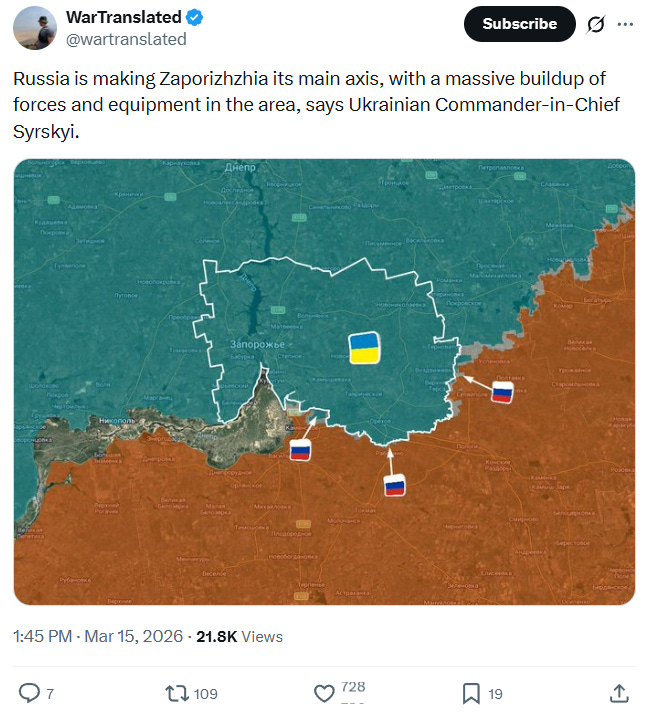
Note in the map above that the indicated area for Russian pushes appears to be precisely at the flanks of the earlier ‘bowl’—in short, a pincer to zip up the entire Zaporozhye region.
Zelensky himself, by the way, claimed that the Ukrainian attacks on this Zaporozhye front were in fact to prevent the coming Russian offensive:
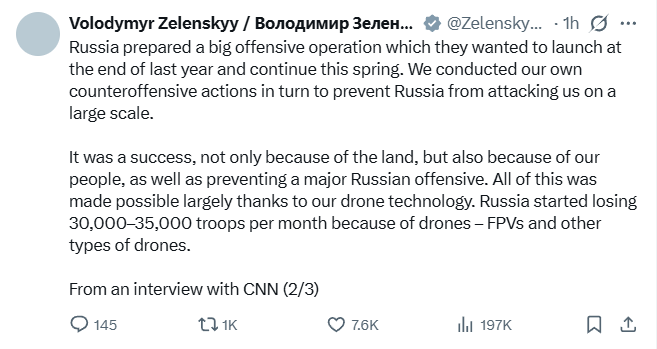
And there’s good chance that he was right, because it likely did slow things down and cause Russian forces to expend reserves and go into a defensive posture. But ultimately all that does is postpone the inevitable because Ukrainian troops themselves were said to have suffered major casualties in these pointless attacks, as happens anytime they leave their defensive entrenchments to attack out in the open.
That means Zelensky may have bought himself some time as usual, but he likely also weakened Ukraine’s own reserves in this region which now ripens it for Russia’s coming efforts.
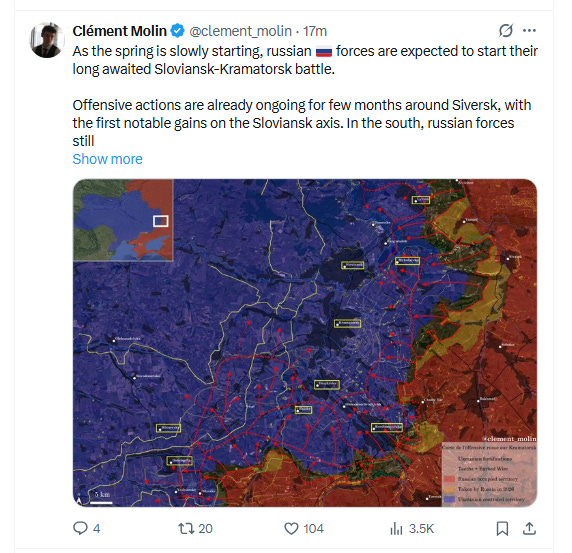
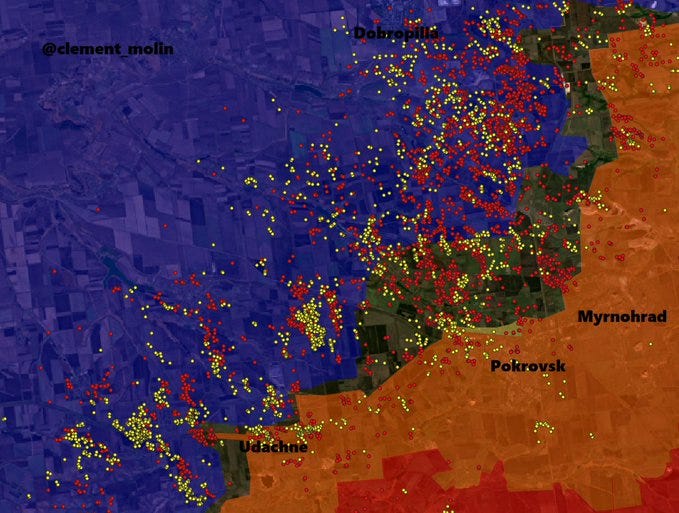
French analyst Clement Molin also believes Russia will see an uptick in offensive action based on his tracking of Russian artillery attacks, which according to his previous accounting, precedes major activity in given operational areas.
Another Ukrainian analyst announces the start of Russia’s offensive season:
Season of Arrows: Russia's 2026 Offensive
The Season is open…Russia is currently operating five Army Groups along the front line, with an additional Northern Screening Group whose primary purpose is border raiding, harassment of AFU positions, and fixing Ukrainian forces in place.
AGs act separately but will be forced to cooperate.
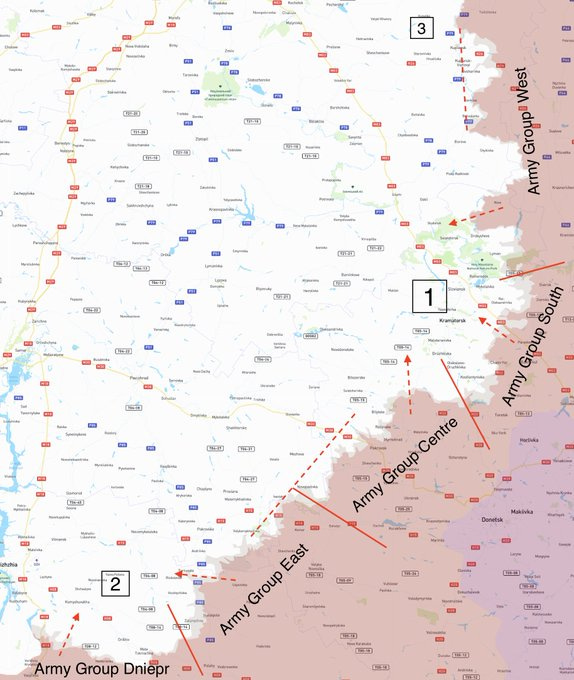
He believes the major 2026 offensive will be centered on Kramatorsk, with Zaporozhye being merely the secondary objective:
The major objective of Russia's 2026 offensive campaign should be assessed as Kramatorsk. The prerequisites for this operation are nearly complete. The secondary objective is Zaporizhzhia, an axis that has been partially disrupted by AFU counter-operations. The third objective is border consolidation — expanding and formalizing the buffer zone into Ukrainian territory.
Three Russian Army Groups are expected to converge on the Kramatorsk operation, Two at Zaporizhzhia, and whatever Skirmish Army will do.
From his map, you can see that Army Group Center is expected to push from the Pokrovsk-Dobropillya axis northward toward to cut Kramatorsk while Army Group South pushes head on from the Seversk axis. Army Group West is coming down from Krasny Lyman onto Slavyansk.
His characterization of Army Group East’s (“Eastern Express”) advances in Zaporozhye are accurate and echo my earlier thoughts:
Army Group East has captured Huliapole and currently faces no major intermediate objectives beyond a westward advance toward Orikhiv. Their principal challenge has been securing the northern flank, which they have reportedly addressed by establishing a defensive line along the Vovcha river, effectively isolating AFU groupings in that sector.
They appear to be operating with confidence despite ongoing Ukrainian counter-pressure — AFU has committed significant attention to this axis but achieved limited results thus far.
Those interested should read the whole thread as it is surprisingly impartial and even quietly laudatory toward Russian forces and upcoming achievements.
Paradigm Shifts Again
One of the more interesting recent developments from the Ukrainian side is the acknowledgment that the tenor of fighting has shifted, or evolved, into a new paradigm. We’ve been talking for months about the new level of dispersion, wherein the gray zone now dominates, often with neither side able to tell precisely where to delineate a given ‘control’ zone.
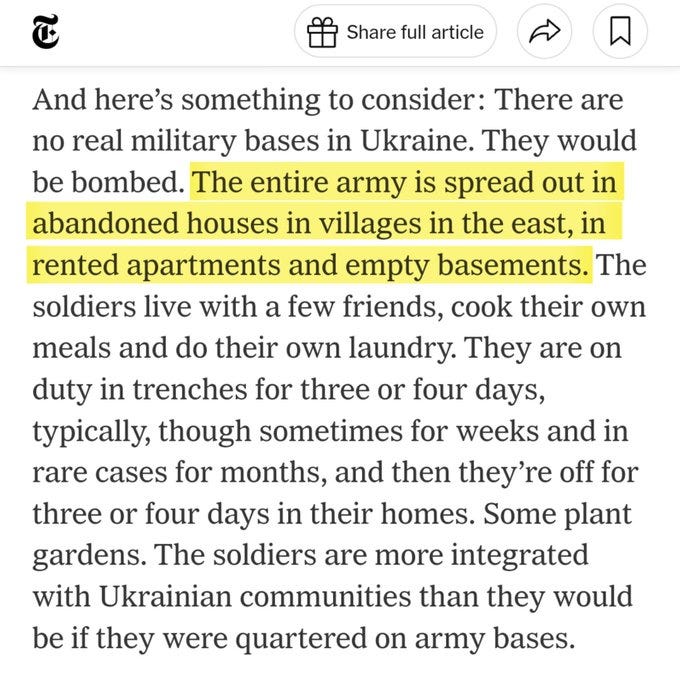
For instance, this NYT article from last month openly reveals the “entire [Ukrainian] army” is spread out in abandoned houses and rented apartments, which should also give you an idea of how and why it’s so difficult for Russia to root them out—they are literally embedded with civilians:
One Ukrainian post for context:
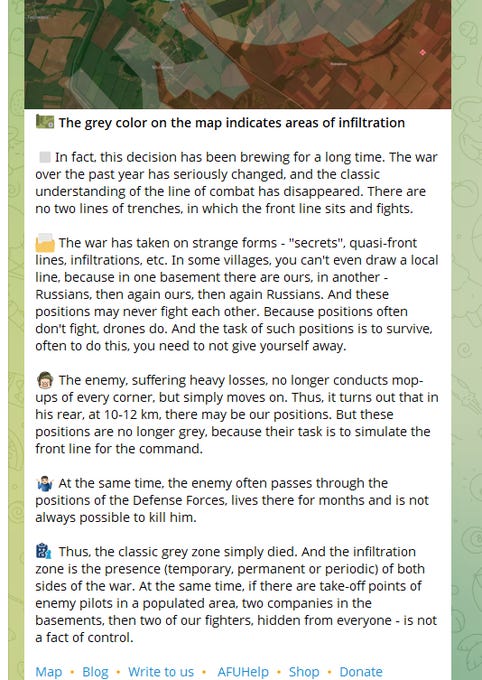
But more importantly, Ukrainian military figures have been quietly speaking up against the so-called strategy of attrition against Russia championed by Zelensky and various public officials wherein each month they proclaim some new ungodly number of Russian losses which is always just on the precipice of leading to Russia’s imminent collapse.
This new revolt against the status quo is best exemplified by the following post from a popular Ukrainian military analysis channel:
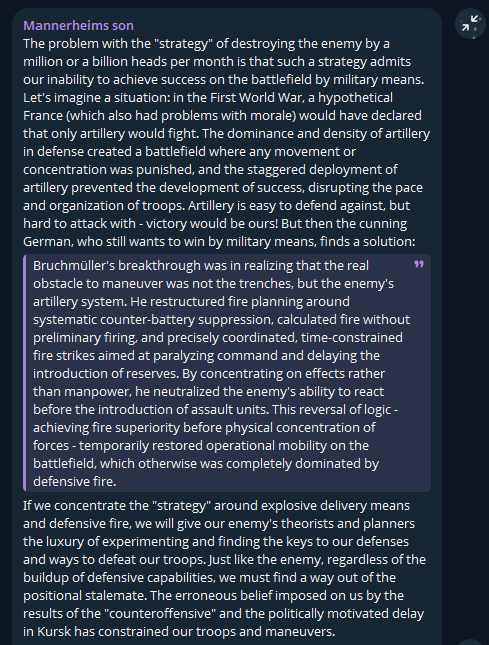
He rightly notes something that many other top Ukrainian figures have begun calling attention to of late: that the pure one-dimensional focus on blindly “racking up kills” on Russian troops via drones is hampering, or even condemning, Ukraine’s long-term strategic prospects.
For instance: Ukraine has famously adopted a new videogame-style “points” system for eliminating Russian troops with drones. But experts have noted this has spun-off into a negative incentivisation scheme because Ukrainian drone operators now privilege the “pointless” destruction of lone Russian troops on the very edge of the frontline while ignoring the much more consequential logistical buildups in the rear which are slowly developing a ‘base’ from which all Russian operations in the region can be sustained.
In short: in their view, taking out single “expendable” Russian troops creates good PR videos for insta-hopium and a hit of morale, but is an ultimately losing strategy as it completely ignores more critically systemic components of the Russian combat structure. The AFU has so heavily weighed the destruction of Russian grunts for PR purposes that they have neglected degrading the actual core heart of Russia’s military machine.
It is a shortsighted, one-dimensional strategy—one that, according to these same analysts, Russia itself has smartly skirted. It has done this via the newly-cited tactic of “isolating the rear”. This entails drone units specifically ignoring disposable Ukrainian “meat” on the tip of the spear, and going exclusively for strategic-value targets at the rear which cripples the Ukrainian operations in that region, leading to their slow systemic degradation and collapse, which has a kind of cascade effect in allowing the eventual progress and advancement of Russian assault troops through these previously-held Ukrainian positions and territories.
Top Ukrainian officer channel writes that things have changed drastically in 2026, with Russian drones now creating a total kill-zone at the 20-40km depth:
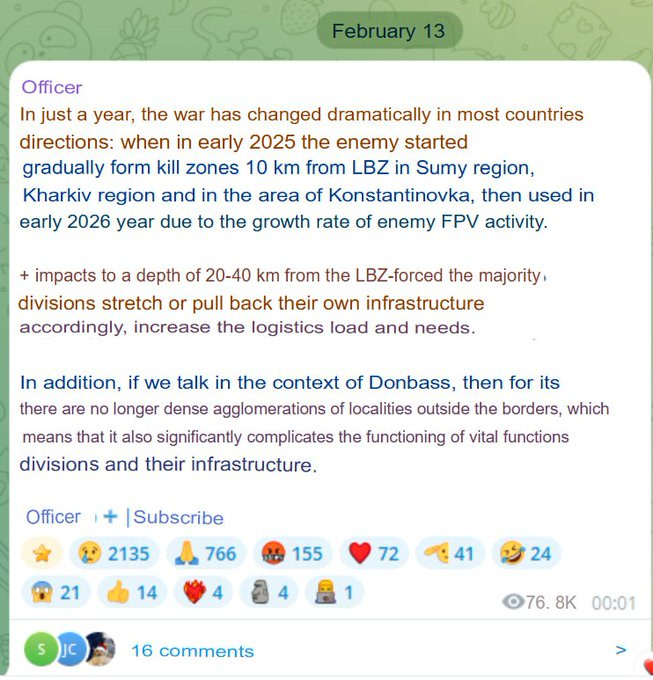
That said, clearly Ukraine’s drones are still having a major effect as Russian advances have been far below expectations of late:
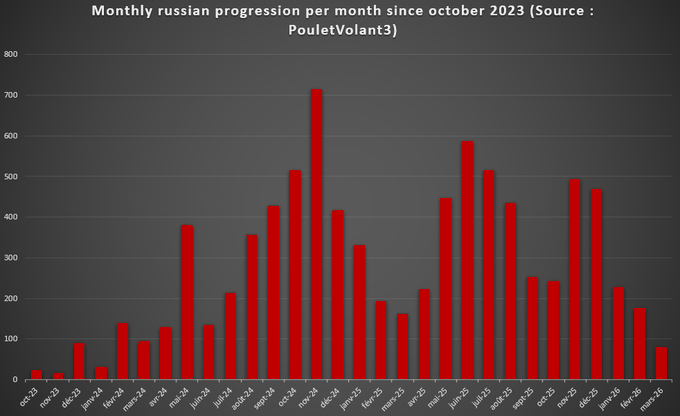
We will have to wait and see if the uncommon weather truly was the culprit, or if it was part of some new Russian strategy of slowing pointless assaults prior to ‘tenderizing’ the target areas. For instance, from the same French analyst above, we can see his latest artillery map continues to show a vast Russian artillery superiority along the Pokrovsk front:
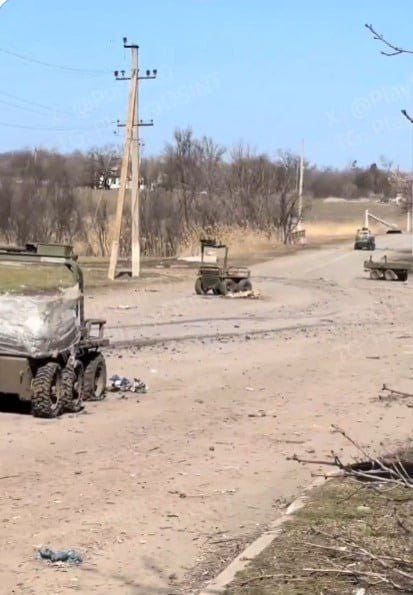
One thing we do know is that Ukrainian forces have done a good job in improving their autonomous ground system capabilities, with the battlefield now absolutely swamped with UGVs which deliver supplies in both food and munitions to pickets of isolated troops.
This new shot is said to show a ‘road of death’ of Ukrainian robotic ground transports somewhere along the front:
More and more both sides report “roving bands of drone swarms” which simply destroy everything in their path, which could explain Russia’s recent hesitation. This new shot of a Russian swarm illustrates:
Just two days ago Kiev itself was allegedly hit with an AI swarm of Russian Lancets and other drones. The Lancets involved had a never-before-seen pattern on their wings which experts believe are symbols made for AI interfaces to keep track of and control the swarm:
— The morning attack on Kiev also involved a “Lancet” with AI and swarm control technology, according to the AFU.
Judging by the photos of the “Lancet” debris that fell near the Independence Monument in Kiev, the drone had distinctive green and orange markings. It is assumed that they are needed for the UAVs to orient themselves towards each other as part of a swarm.Previously, similar markers were spotted on the V2U drone, which is also being tested for swarm flights (Photo 2).
It is likely that the morning strike on Kiev was also carried out as part of the next tests of this technology.
The distance from the Russian border to the center of Kiev is about 200 km, which significantly exceeds the known maximum range of the “Lancets”. This may indicate its new modification with an increased flight range.
As we get closer to the start of more significant Russian operations I intend to write a more detailed break down of new tactics and strategies, with the above being just a generalized overview.
For the time being, though, we can say that the Iran war certainly stands to energize the Russian effort in more ways than one, should it become a prolonged conflict like many fear. Not only has oil skyrocketed to the point where Russia is now making daily extra profit windfalls which are almost large enough to cover the entire daily SMO expenditures, but US is also expending all its most critical munitions which could have been sent to Ukraine—particularly Patriots, and potentially Tomahawks, etc.
That’s not to mention the general political focus shifting away from Ukraine to a large degree, which further weakens European solidarity and capability. All of these things will redound negatively onto Ukraine which could make the coming months particularly painful, should a large scale Russian offensive effort truly materialize.
Special thanks to you, the paid subscribers, who are reading this paywalled Premium article—you are the core contributing members keeping this blog in healthy, steadfast operation.
The Tip Jar remains as an anachronism, an archaic and shameless bit of double-dipping, for those who just can’t help lavishing their favored humble authors with a second greedy helping of largesse.