The US and Israel are Climbing the Escalation Ladder, Forcing Iran to Respond. A SITREP.
After energy production the next ladder; the power plants, the oil and gas fields, the desalination plants, the nuclear reactors, and finally the Armageddon option, nuclear weapons.
Guest Post by Sylvia M. Demarest
Note: This essay may be too long for Substack. If you receive this essay be email, hit the title and it will send you to the full article.
The Reality
This destructive war is moving so fast it is difficult to write anything definitive. This essay will only be able to discuss a small part of the overall picture. For example, yesterday as I was working an essay, Israel bombed Iran’s Natanz nuclear power plant, and Iran immediately retaliated by striking around Israel’s Dimona plant. An entire essay could be written about that.
Israel and the US keep climbing the escalation ladder, Iran keeps responding. Remember, Iran did not start this war--Israel did by launching a sneak attack murdering the Ayatollah, his entire family, and several Iranian leaders. The US gleefully joined in believing the Iranian government would fall and Iran’s energy resources would come under US control. We are now at day 23 with no end in sight.
I fear that this destructive war will continue until Iran is destroyed, a global depression is triggered, or the US and Israel are forced into a political solution that accommodates some of Iran’s demands. Even if the war ended today, the global economy has been greatly damaged-- -but if Iran can hold out and if this war continues, the risks include a global depression, a collapse of the global financial system, and widespread famine. The US and Israel could even use nuclear weapons which could trigger a nuclear war.
Meanwhile, Israel is busy killing any Iranian with the power to negotiate.
What will Happen Tomorrow?
Trump yesterday: “If Iran doesn’t FULLY OPEN, WITHOUT THREAT, the Strait of Hormuz, within 48 HOURS from this exact point in time, the United States of America will hit and obliterate their various POWER PLANTS, STARTING WITH THE BIGGEST ONE FIRST!
If Trump and Israel attack Iran’s power plants, Iran has threatened to retaliate by attacking power plants in Israel and across the Middle East. What’s next? Desalination plants? Without water, the entire Middle East becomes uninhabitable.
God Is a Comedian
Perhaps the only enjoyable response to Trump’s flood of statements came from a Substack called Gold and Geopolitics titled “God Is a Comedian” written under the pen name NO1. Here’s a sample: “Trump asked NATO to send ships to help secure the Strait of Hormuz. Every. single. ally. refused. Trump called them “cowards” and said NATO has a “very bad future”. He then announced that the United States doesn’t actually need the Strait of Hormuz. He then said countries that do need it should police it themselves. He then told China to police it. He then sent 5,000 Marines toward it.”
“This sequence of statements was delivered, as far as the public record shows, by the same person, using the same mouth, within roughly 24 hours. The allies are cowards for not helping with the thing he doesn’t need, which is why he’s sending Marines to die for it, unless the countries that do need it do it themselves, which they won’t, because they’re cowards.”
Carlyle’s Jeff Currie Sounds the Alarm
Carlyle’s Jeff Currie has written an important report and made it available to the public. The title is A Crude Awakening, and I highly recommend that you read it. So far, investors have been very complacent. Currie also served as a commodity strategist for Goldman. Below are the report’s conclusions:
“THE PHYSICAL CLOSURE IS WITHOUT PRECEDENT. Polymarket puts the probability that the Strait of Hormuz is still closed on March 31st at 85%. Thirty-one days at net 18.5 million barrels per day (b/d) is 575 million barrels of stopped flows — 1.4 times the entire US Strategic Petroleum Reserve. But this is not just an oil crisis. The strait carries gas, fertilizers, and metals. The system simply cannot accommodate that kind of disruption. Either Polymarket is wrong, or financial markets are wildly optimistic. In our view, policy options are unlikely to break crude’s ascent while Hormuz remains blocked.”
“THE NEW JOULE ORDER DEMANDS SECURITY FIRST. WE ARE NOWHERE CLOSE. The hierarchy of energy needs is security, affordability, and sustainability — in that order. The energy transition was born out
of the 1973 embargo, not environmentalism. More than fifty years later, the world is mid-transition: dismantling the old hydrocarbon system before the new one can bear the load. This increases vulnerability and in the interim, rising energy insecurity does what it always does — it triggers hoarding, which exacerbates the inability to substitute.”
“OIL IS THE RARE EARTH OF THE MACRO SYSTEM. Fifty years of efficiency gains have made oil cheaper per unit of GDP — but more irreplaceable in function. The remaining barrels are the ones for which no substitute exists: petrochemical feedstocks, aviation fuel, grid balancing, fertilizers. Remove them and you do not get demand destruction — you get production shutdowns. We believe the world is more vulnerable to an oil shock today than it was in 1973, not less.”
“THE SECURITY PREMIUM IS THE HOARDING PREMIUM. In 1979, a 4–5% physical shortfall triggered precautionary hoarding that doubled the effective demand impact. The same dynamic is now operating at a far greater scale. China has suspended petroleum product exports. Every major importer is securing supply simultaneously. We estimate that precautionary demand could be 2-3 million b/d over the next 3-6 months. The physical disruption is the trigger; the behavioral response is the multiplier.”
“THE CREDIT CHANNEL HAS BEEN REVERSED. In the 1970s, OPEC surpluses were recycled through Western banks, expanding global credit, in a process whose mechanics resembled quantitative easing.”
“Today, the transmission runs in reverse. MENA invests domestically and de-dollarizes. Federal debt stands at 120% of GDP, versus 32% in 1974. Inflation-indexed transfer payments automatically widen the deficit. Government borrowing displaces private sector credit creation far more aggressively than it did fifty years ago.”
“CONSIDER COMMODITIES AND HALO (HEAVY ASSET LOW OBSOLESCENCE) ASSETS. Every major geopolitical inflection point of the past fifty years has triggered a rotation from asset-light to asset- heavy. Energy has compressed to 3% of the S&P, while technology has expanded to 53%. In the 1970s, energy at 25% provided a natural portfolio hedge. At 3%, that hedge has vanished. The market priced energy as a declining asset and technology as a perpetual compounder. Hormuz is testing both assumptions simultaneously. Old economy and asset-heavy companies, or HALO, are well-positioned to ride out the storm of anticipated and unanticipated inflation.”
My take: Despite some confusion about why the war continues the belief persists that US/Israeli military supremacy will carry the day. The general feeling seems to be--we “don’t see how Iran can sustain against the combined might of US/Israel” --to “we think Trump will soon seek an off ramp.” The realization has yet to hit that the decision is not Trump’s to make--it is Iran’s.
How Many Ships are Trapped in the Persian Gulf?
As best I can determine there are 3200 total boats, including 480 tankers inside the Persian, along with 300 tankers idling outside. This includes five US ships: the APL Eagle, Alliance Fairfax, CS Anthem, Stena Imperative and Maersk Yorktown along with 100+ American mariners. All are running low on food and water. There is no indication when they will be granted passage to leave. The US boats report no communication with the US navy about escorts or when they can expect to leave the Gulf. All the ships are part of the US Maritime and Tanker security programs.
The Clock is Running
A sobering discussion by SHANAKA ANSLEM PERERA on his Substack explains the timeline our world faces in an essay titled “The Nitrogen Trap” i.e. “The Seven Clocks”. Given the criticality of each issue, among many others, complacency and the absence of political pressure to force an end to this war is very dangerous. Here are the Seven Clocks:
“Seven clocks are running. None of them negotiable. All of them counting down to the same weeks.”
“The planting clock. Mid-April is the biological deadline for corn and soybean planting across the US Midwest. Every day that passes without nitrogen becoming affordable and available narrows the window for corn. USDA projects corn falling to 94 million acres from 98.8 million. Soybeans rising to 85 million from 81.2 million. The seeds that go into the ground in the next three weeks determine America’s grain harvest in October. The decision is irreversible.”
“The USDA clock. March 31. Prospective Plantings. The report that converts farmer intentions into official data. Every acreage number, every corn-soy ratio, every nitrogen-dependent calculation becomes a published fact that traders, governments, and food agencies will use to model global supply for the next twelve months. The number arrives in twelve days.”
“The FAO clock. April 3. The Food Price Index. The first global reading that captures post-Hormuz commodity prices across cereals, vegetable oils, dairy, meat, and sugar. The 2022 peak was 159.7 in March 2022 after Ukraine. This reading will incorporate oil above $100, urea at $610, LNG halted, packaging repriced, and freight surcharges of $500 to $1,500 per container. The number that determines whether the UN declares a food emergency arrives in fifteen days.”
“The pharmaceutical clock. India’s API inventory buffers are two to three months, measured from the war’s onset on February 28. Late May is the depletion window. Methanol at 87.7 percent Hormuz exposure feeds the solvent chain for paracetamol, ibuprofen, metformin, and antibiotics. Once buffers deplete, the shortage becomes a patient access crisis for the 47 percent of US generics that originate in India.”
“The China crude clock. FGE NexantECA confirmed China is drawing commercial reserves at up to one million barrels per day. The draw sustains refinery operations for four to six weeks from March 19. Mid-April to late April is the exhaustion window. After that, China faces three options: accelerate Russian pipeline imports, reroute at massive premium, or crack open the strategic petroleum reserve. The third option reprices every commodity on the planet. “
“The helium clock. SK Hynix and Samsung hold two to three months of helium inventory. Late May to early June is the depletion window. South Korea imports 64.7 percent of its helium from Qatar. Ras Laffan is offline. If helium buffers deplete before alternative supply arrives, semiconductor fabrication faces rationing. The AI hardware supply chain hits a physical wall measured in months, not quarters.”
“The insurance clock. Solvency II requires 30 to 60 days of zero incidents before P&I clubs can reinstate war risk coverage. Even after a ceasefire, the insurance normalisation takes six to sixteen months based on the Red Sea precedent of 26 months and counting. The logistics system lags the financial relief rally by the longest duration of any clock in this crisis.”
“Seven clocks. The shortest expires in twelve days. The longest runs for over a year. The planting window, the USDA report, the FAO index, the drug buffers, the Chinese crude draw, the helium inventory, and the insurance cycle are all counting down simultaneously. None of them pause for diplomacy. None of them respond to presidential directives. None of them read sealed packets.”
Israel’s attack on the Pars Field Backfires
Four days ago, Israel struck the largest natural gas field in the world, the Pars field owned jointly by Iran (1/3rd) and the UAE (2/3rds). Why? Because it was considered “an energy lifeline for Iran” even though the products from this field are critical to global commerce. Iran responded by severely damaging UAE’s capacity to export LNG. This resulted in a back and forth between the US and Israel when Trump denied prior knowledge of the strike and demanded that Israel cease striking energy production facilities. Meanwhile, Israel insisted acting with US knowledge and consent.
Here’s Bloomberg: “Qatar’s Ras Laffan Industrial City — the complex home to the world’s largest liquefied natural gas export plant — suffered “extensive damage” after an Iranian attack that sparked a fire, officials said. Israel carried out a strike on South Pars, Trump said. The gas field is a core part of Iran’s energy infrastructure.”
“Trump said in a social media post that the US wasn’t involved in the South Pars attack, adding that Israel would refrain from further strikes on the site. He said any additional attacks by Iran on Qatar’s LNG facilities would prompt the US to “massively blow up the entirety” of the South Pars field. Oil pared gains and US stock-index futures rose after his comments.”
The field, shown below, contains 51 trillion cubic meters of gas--it would cause a global ecological and economic catastrophe if severely damaged--yet it was struck by Israel and Trump threatens to “massively blow up the entirety”. The result, the UAE has declared force majeure and suspended its contractual obligations.
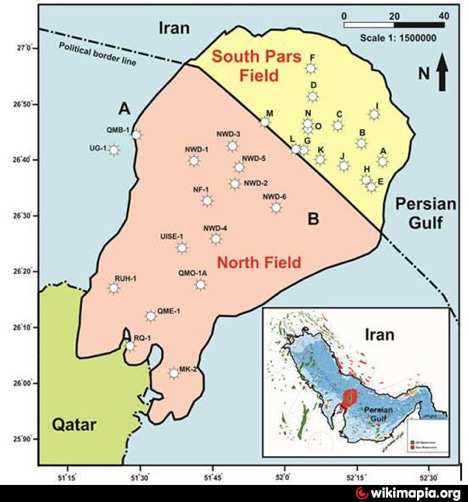
The LNG situation is increasingly precarious for much of the world given (1) the damage to gulf production from the war; (2) the number of tankers bottled up in the gulf comprising a large proportion of the global fleet (2) the low global stockpiles of LNG. I might add, the total insanity of decision makers in the US and Israel.
The US Lifts Sanctions on Energy and Fertilizer
Iran worked for years to get sanctions relief through diplomacy. Diplomacy failed. After 3 weeks of war the US offered sanctions relief to Iran without Tehran even asking for it. Of course, the lifting of sanctions had to be accompanied by a dose of propaganda with Treasury Secretary Bessent calling Iran “the head of the snake for global terrorism.” This is a lie and I will address why soon.
To ease shortages of energy and fertilizer, sanctions on Russian and Iranian energy and Belarusian fertilizer have been lifted. The hope is that oil and gas already loaded on tankers can now be delivered, easing energy shortages. There have been reports that 140 million barrels of oil are trapped, most of it Iranian. Yesterday in response US Treasury Secretary Bessent lifted sanction on Iranian oil for 30 days. Iran responded by saying it had no oil stranded in the gulf. See:
From Iran: “At present, Iran essentially has no floating crude or surplus available for international markets. The U.S. Treasury Secretary’s remarks appear aimed at giving hope to buyers and psychologically controlling the market.”
The Structure of the US Economy and Stock Market
In the 1980’s, Paul Volker raised interest rates to 20% to fight the inflation caused by the rise in oil prices resulting from the various Israeli wars and the overthrow of the Shah of Iran. The US federal debt stood at 26% of GDP. Today it’s 120%. The interest rate lever does not exist anymore. With the national debt bumping on $40 trillion the annual interest on that debt is now approaching $1 trillion.
What Buffet called “weapons of mass financial destruction” when OTC derivatives were at $85 trillion, now approach $900 trillion.
Add these items to problems with private credit, a bubble in artificial intelligence, and the fact that 1 in 5 companies in the Russel 3000 cannot service their debt from current income, and a picture is painted showing several areas of market vulnerability. The markets have been very complacent since this war started. Could this be about to change?
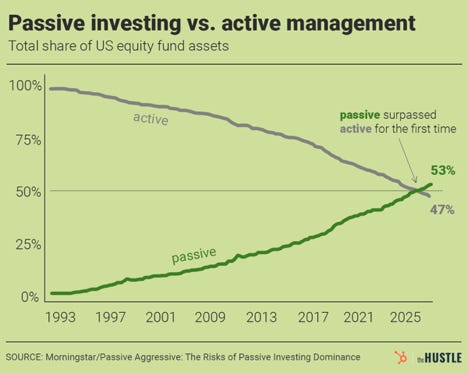
As this Substack has discussed in detail, more than half of American households are right on the edge financially, higher gas and food prices could send them over that edge. Stock ownership is concentrated in the upper 20% of wage earners. These investors are increasingly using passive investing indexes dominated by and managed by State Street, Vanguard, and BlackRock. In addition, ETFs comprise a significant part of the market. Many of these ETF’s are designed to mimic index funds. These products are highly liquid and if sold would require the underlying stocks that make up the index to also be sold. As the chart below shows, passive investing dominates the market.
The Marines are on their Way!
There are 8000 marines on the way to the Gulf plus it is rumored that the 82nd Air Borne Division is also being deployed. Their mission has not yet been defined. It is rumored that they will try to capture Kharg Island. This would be difficult since it requires going through the Strait of Hormuz and then traveling another 750 miles in the Persian Gulf right off the coast of Iran. This drawing courtesy of NO1 shows why any effort to capture Kharg would be problematic
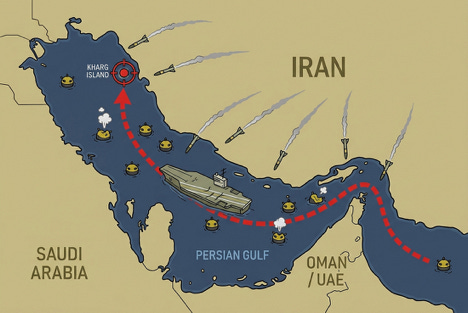
From Gold and Geopolitics “To reach Kharg Island, the Marines aboard the USS Tripoli and USS Boxer must first sail through the Strait of Hormuz, which Iran has mined. The strait is also, as of this week, a toll road. The IRGC verifies vessels on VHF radio and charges up to $2 million per transit, payable in cash, cryptocurrency, or barter. At least eight ships have paid. Iran’s parliament is legislating the arrangement formally, because even revolutionary theocracies require a compliance department.”
Unless, the marines will be used to evacuate stranded Americans, the most likely objective is to land at Chabahar in Southern Iran, with the objective of neutralizing Iran’s principal port outside the Gulf or stirring up trouble in Baluchistan in an effort to draw Pakistan into the war. It is just about the only patch of Iran where a landing seems at all feasible.
Here’s a short video on why a ground invasion of Iran would fail.
Iran Is Charging Ships Transiting the Persian Gulf
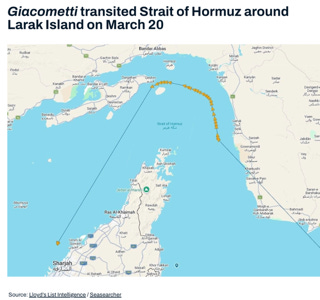
Iran apparently plans to maintain control of the Strait of Hormuz and is working management plans. The current plan involves charging a fee for safe passage, said to be $2 million per ship. This could also be how Iran plans to collect “reparations”. This plan is already in effect.
From Arabian Gulf Business Insight in Ships test ‘Iran-approved’ Hormuz corridor : “Ships are passing through the Strait of Hormuz via an “Iran-approved” corridor close to Larak Island off the coast of Iran for verification checks, according to maritime news outlet Lloyd’s List.”
“Speaking at Lloyd’s List weekly risk briefing on Thursday, editor-in-chief Richard Meade described the development as an “Iranian Revolutionary Guard Corps registration and vetting” process being coordinated with several governments.”
“At least nine ships have already used this so-called corridor, which effectively routes ships close to Larak Island for visual checks by the IRGC Navy and port authorities,” he said. “That’s going to require from the ships that move through a more extensive disclosure of vessel ownership, cargo destination – they want to know the full details.”
“We know of at least one where payments have been given in order to exit,” he told the briefing of maritime industry leaders.
An overview of the area:
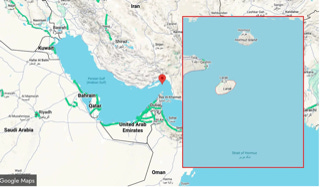
Where the mines might be placed.

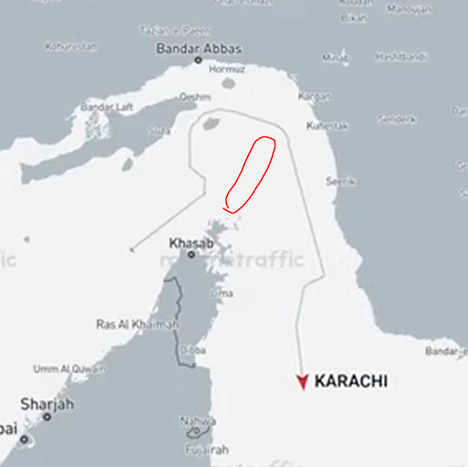
How the transit would work.
Is the US abandoning Bases in the Middle East?
US bases in the Middle East have been under missile and drone attack, including in Iraq, Northern Iraq, Baghdad, and the Green Zone It has been reported that the US has ordered the evacuation of the Kuwait airbase and the withdrawal of all naval ships.
The US retreats and abandons key strategic zones and assets:
-The largest airbase in the Middle East
- The most strategically important and busiest naval base in the Middle East, HQ of the US Fifth Fleet
- Baghdad Green Zone, US embassy, the US Victoria base and Baghdad, and possibly all of Iraq
- The waters of the Persian Gulf
-Half a dozen other large bases in Kuwait, UAE, Qatar, KSA.
Why is this happening? The bases are being constantly attacked. Naval assets do not have freedom of movement and increasingly must travel vast distances to resupply. Even distant bases are under threat. Attack aircraft must refuel multiple times to reach Iranian territory. This is a huge issue for the US.
For people who haven’t been paying attention, the situation on the ground at bases like NSA Bahrain is that a skeleton crew is there, a few dozen personnel. There’s no local SHORAD, Iranian drones hit the bases at will if they make it through Bahrain’s air defenses. The personnel who were once in these bases (tens of thousands of service members) are posted up in hotels. Some of these bases have been hit now hundreds of times, with the Iranians destroying radars, communication infrastructure, aircraft hangars, barracks, fuel storage, and anything else of importance. Even if the war ended today, it would take years to repair the damage.
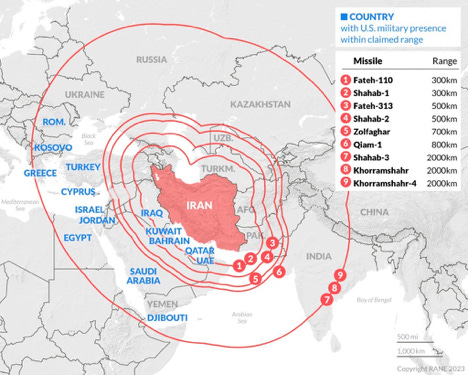
It is being reported that Prince Sultan airbase in Saudi Arabia is being abandoned, and all-American personnel and remaining aircraft are being relocated to a base on the West coast of Saudi Arabia. This base is still well within range of Iranian ballistic missiles as the graph below shows. Pushing the Americans back several hundred kilometers is going to further complicate the already fragile and fraying logistics of this mission. It also places them within the range of the Houthis.
Even NATO is leaving. NATO pulls several hundred personnel from Iraq amid Iran war https://www.cbsnews.com/news/nato-personnel-pulled-iraq-iran-war/
Iranian military official: We have recently raised the level of targeting and respond to every enemy mistake with surprise operations.
Is Iran systematically pushing the US out of the Middle East?
Is the US running low on standoff weapons?
This essay is already too long. I will follow up with another essay soon. Meanwhile, A U.S. Navy submarine was caught in the Balalan Sea, north of Cyprus, firing Tomahawk cruise missiles against Iran. This marks the first use of a submarine to attack Iran. This could suggest that the stock of Tomahawks on ships and aircraft is running low.
The three pillars of US hegemony are industrial, financial and military. Industrial hegemony has been lost via neoliberal offshoring to China. The US financial sector is overstretched and vulnerable. The US military is behind even the Houthis in missile technology and has been “demilitarized” by the wars of attrition in Ukraine and Iran. As a result, the US and Israel are running low on missiles and interceptors.
Is the US/Israeli Practice of Bombing and Killing Civilians Backfiring?
The US and Israel have been bombing Iranian civilians—is this backfiring? From Simplicius: “Multiple reports have now asserted that even the Western-leaning dissident population in Iran has now given up on the West due to the perceived barbarity of the US’s attacks against the Iranian people, rather than solely against the regime—not to mention Trump’s utter callousness in prosecuting it all.”
From the Economist: “Increasingly Iranians rage that their country, not the regime is under attack. Support for foreign intervention has dwindled.”
Israel and the US are committing war crimes in Iran. Israel committed a major war crime by attacking oil storage facilities near Tehran and creating a civilian and ecological catastrophe. Israel followed up by attacking the Pars gas field.
There’s another pinch point--the Bab El Mandab
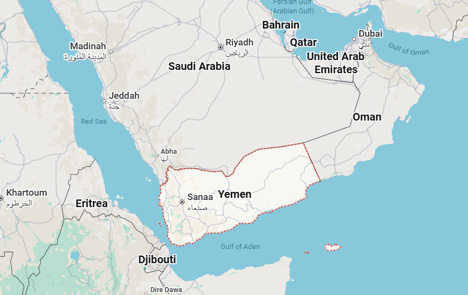
On the opposite side of the Arabian Peninsula is another pinch point, this one overseen by another ally of Iran, Ansarullah aka “the Houthis”. They are located in Yemen, right on the Horn of Africa. The Houthis officially announced that they have entered the war on the side of Iran.
“We will strike American ships in the Red Sea. This war is a war of the entire umma.” - the statement says.
The Houthis also reported that, thanks to the will of Allah, they have hypersonic ballistic missiles “Palestine-2” - with a range of up to 2,150 km and a speed of up to 16 Mach.
The Yemeni card and the implications: Saudi Arabia has been able to move close to 4 million barrels of oil per day (out of the 9.5 million barrels it produces) through a pipeline to the Red Sea. A huge fleet of tankers is waiting to load that SA’s Yanbu port between Jeddah and Mannish. This has provided a big cushion to the closure of the Strait of Hormuz. This assumes that this route stays open. Please look at the map below showing where Yemen is located. If Yemen enters the war and blows up some ships in the Red Sea, this alternative route will close. What would happen to oil prices then? What happens to Saudi Arabia?
Meanwhile, remember in December of last year, Israel recognized the independence of Somaliland—strategically positioned near the Bab El-Mandeb Strait. This could be a planned counter to the Houthi’s involvement.
I am not clear on all the implications, but the UAE has also been involved in supporting the wars in Somalia and Sudan. Obviously, this support has now been weakened, this could lead to a change in the status of Somaliland.
Has the US and Israel Underestimated Iran?
The happy talk that Iran is weak, incompetent, running out of weapons, about to revolt, and all the US had to do was keep pushing just a bit longer and Iran would fall like a house of cards, might still work, but it has not so far. The removal of the western elite from the real-economy, added to decades of bad conditioning of investment professionals, has resulted in a remarkable degree of complacency in the face of the catastrophic downsides that are starting to emerge.
The war on Iran was never “winnable” when all the risks were calculated. Now Trump claims no one thought Iran would close the Strait, attack US bases, or destroy US radars. This is like Vietnam where the impossibility of victory was known even before any major escalation. Daniel Ellsberg recognized the war was unwinnable, but could not get access to the President to explain why. He was a scientist at Rand and had access to the Pentagon Papers and released them to the New York Times. Where is today’s Pentagon Papers?
Iran continues to bomb the Gulf states that allow the US to use their territory, and to retaliate for US and Israeli attacks. The reality seems to be that Iran could destroy the Gulf countries. Given the geography it seems difficult to see how a boots-on-the-ground mission could work. US/Israeli options continue to shrink.
This is all for now. More soon.