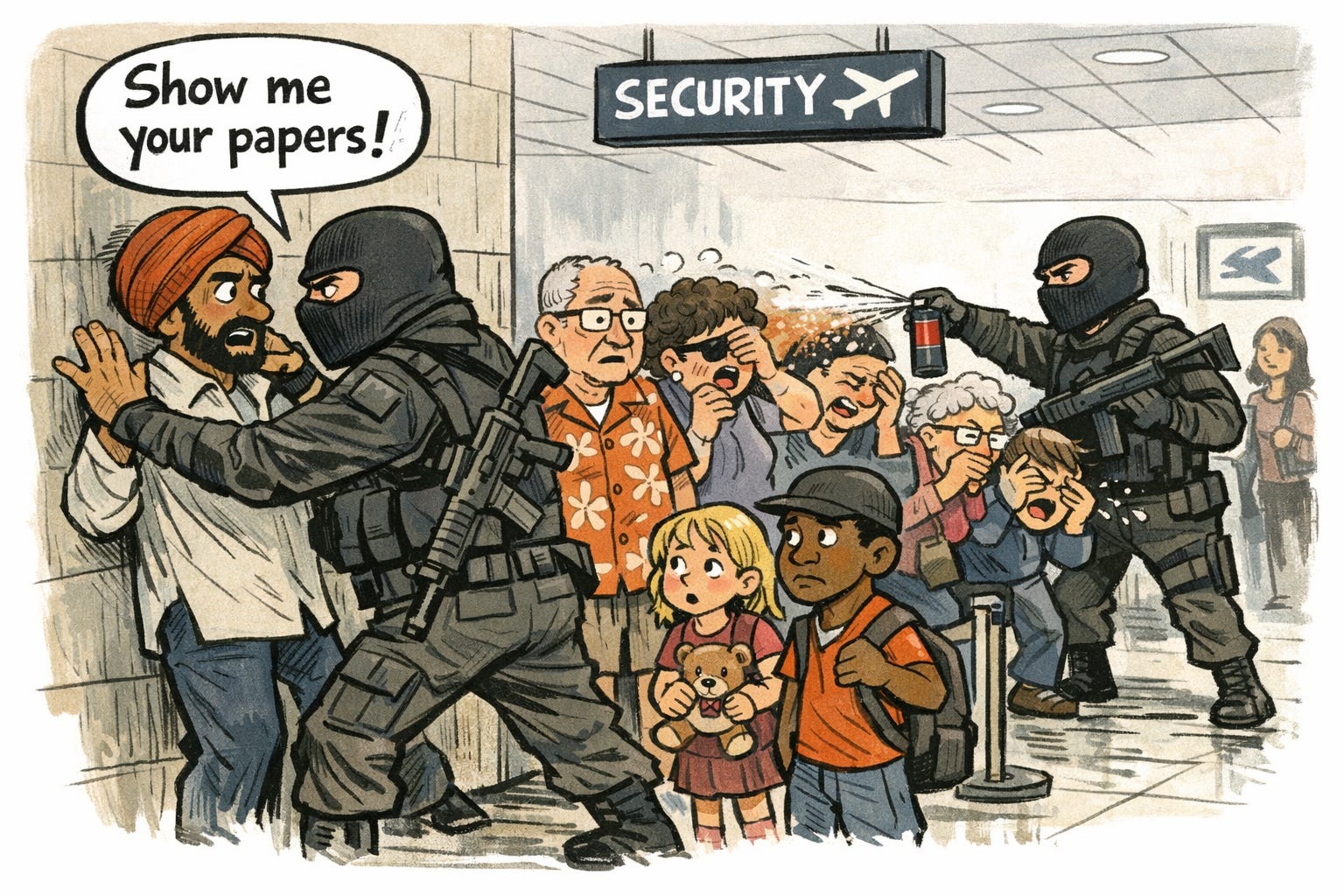
ICE agents substituting for TSA at the airport?
What could possibly go wrong?
The current partial government shutdown, which began on January 31, 2026, has affected several critical agencies, including the Transportation Security Administration (TSA), which is part of the Department of Homeland Security (DHS). TSA agents conduct pre-departure security checks at airports, and even when they’re paid and fully staffed, the process can be lengthy and unpleasant. With TSA agents required to work without pay, about 10 percent are absent from duty, resulting in long lines at departure gates and waits of over 2 hours. The lack of a DHS funding bill is due to disagreements between Democrats and Republicans on provisions to reform the Immigration and Customs Enforcement (ICE) component of DHS, in the wake of several egregious actions by ICE agents during the administration’s immigration crackdown.
On March 21, 2026, in a signature extortive move, President Donald Trump threatened to deploy ICE agents to airports starting on March 23 if Democrats didn’t agree to a funding package to end the DHS shutdown. In a social media post, he wrote that unless Democrats immediately sign an agreement, he will deploy ICE to airports to conduct security enforcement “like no one has ever seen before.”
Other than the implied threat in Trump’s post and the overly aggressive actions of ICE agents against immigrants and citizens alike on American streets, what can possibly go wrong with supplementing TSA’s unpaid agents with one of the only two elements of DHS getting a salary? The other is Customs and Border Patrol (CBP), thanks to Trump’s Big Beautiful Bill, Public Law No. 119-21, enacted on July 4, 2025.
Actually, there are probably many ways this bus’s wheels could come off, starting with the TSA folks having to work for free while ICE (and we have to assume they’ll be masked and armed as usual) agents are getting salaries. There’s also the history of ICE and CBP, dating from before they were combined in the new DHS after the September 11, 2001, terrorist attacks.
I’ve had less-than-pleasant encounters with immigration and customs officials at US airports and border crossings since the 1960s, when I was in the military. While I will admit that I found most to be professional and courteous most of the time, there were incidents.
Once, for instance, when I was assigned to the Defense Language Institute in Monterey, California, I did speaking trips for the Army Recruiting Command, and always took my family with me. On one trip to San Diego, we had some free time and decided to go sightseeing in Tijuana. There was no problem until we were on the way back. The immigration agent at the border accepted the military IDs for me, my wife, and my son, but my daughter, who is half-Black, half-Korean but looks Hispanic or Filipina, aroused the agent’s suspicions, so he demanded to see proof of her citizenship. Fortunately, because both children had been born abroad, we always traveled with their passports. The agent looked at her passport, smiled, and waved us through—not even apologizing for implicitly accusing an army officer of possibly human trafficking. But he was at least friendly.
Not so the post-9/11 immigration officer I encountered at the airport in Honolulu, when I was the US ambassador to Cambodia. I arrived on the first morning flight from Japan to attend a chief of mission conference, one of no more than five or six American citizens on the flight. At immigration, when I presented my passport to the agent (a US diplomatic passport with a notation identifying me as ambassador to Cambodia), the agent began asking me a series of questions unlike any I’d ever experienced. In the army, I’d been trained as a counterintelligence agent, so I recognized probing questions. After four or five such queries, I asked her why she was doing it. Her laconic answer was, “I wanted to make sure you could speak English.” I was drowsy from lack of sleep and achy from sitting in an airplane seat for over eleven hours, so it took me a second or two to react. I asked her whether I had passed the test and whether I spoke English well enough for her. She snapped, Yes.” “Good,” I said. “Because, as you’ll see from my passport, I’m from Texas, and most people don’t think we people from Texas speak proper English.” With a scowl, she flipped my passport back to me and didn’t even bother to say, ‘Welcome home.”
While the immigration and customs people I met over the years were all somewhat suspicious and humorless, after 9/11, when customs and immigration were combined, they’ve become downright surly, and, as their actions on the streets of Minneapolis demonstrated, occasionally aggressively violent.
So, picture an armed, masked ICE agent and a long line of impatient passengers of all ethnic groups who are worried about making their flight. Does that sound like the makings of an unfortunate incident? I think I’ll defer any trips involving flying for a while, thank you.