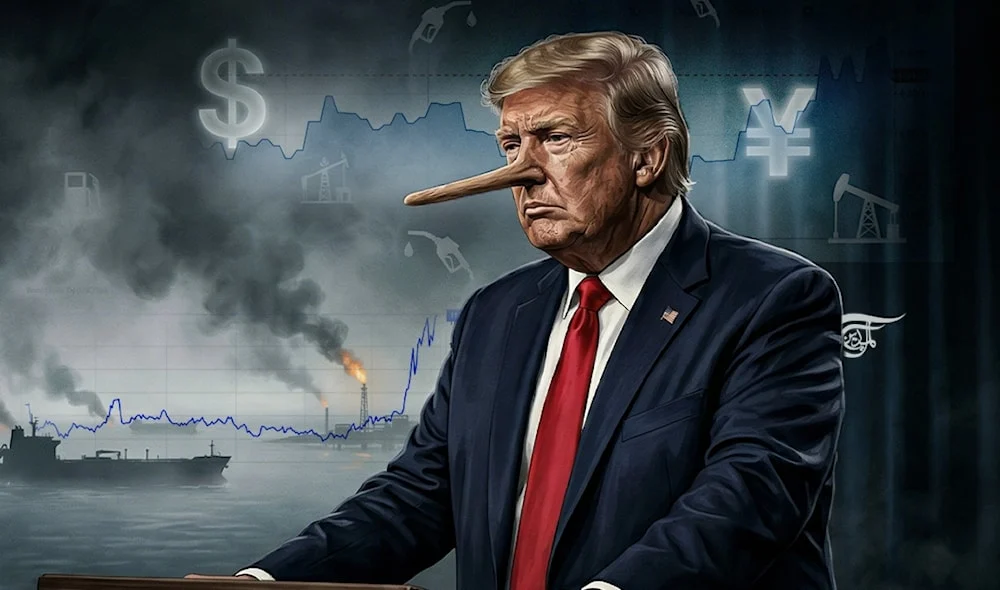
How long can Trump keep lying to the markets?
At 6:49 AM New York time on Monday, March 23rd, in a single sixty-second window, approximately 6,200 oil futures contracts, worth roughly $580 million, were traded. The trade followed no announcement, data release, or Fed speaker. Just a gigantic and perfectly timed bet that oil prices were about to fall.
Fifteen minutes later, at 7:04 AM, US President Donald Trump announced on Truth Social that the US and Iran had held "VERY GOOD AND PRODUCTIVE CONVERSATIONS" on ending the war.
Oil fell 15% in an hour, $1.7 trillion was added to global equity markets in minutes, and the person or entity that made that trade in that sixty-second window before Trump’s announcement made an enormous profit.
Iran denied that any conversations were held, and surely enough, within twenty-four hours, oil was rising again.
The gaslight machine
To understand what the Trump administration has done to global markets since February 28, it helps to understand a trade that Wall Street now calls the TACO, "Trump Always Chickens Out."
The name was coined during last year's tariff wars, when Trump repeatedly announced sweeping measures and then quietly walked them back. The pattern is as follows: Trump escalates, markets panic, Trump de-escalates, markets rally, insiders profit from knowing the sequence in advance.
Granted that the Strait of Hormuz is effectively closed, oil prices continue to rise the longer the closure lasts. Then Trump signals "peace," prompting optimism among traders that the Strait will reopen, so oil prices fall.
The window between a Trump statement and Iran's inevitable denial lasts, on average, a few hours. That window is worth billions of dollars to anyone who knows the statement is coming.
The cycle has played out several times
When Trump told CBS News on March 9 that the war was "very complete, pretty much," oil dropped more than 6% within the hour, from above $100 per barrel to $83.89, taking stocks from negative to positive.
A day later, US Energy Secretary Chris Wright posted on social media that the US Navy had successfully escorted an oil tanker through the Strait of Hormuz on March 10, driving oil prices to crash more than 17% in minutes. The post was deleted twenty minutes later, and the White House confirmed the Navy had done no such thing. Wright took "full ownership" of the "miscommunication," but oil never fully recovered to its pre-post level that session.
Almost two weeks after that incident, Trump posted his "productive conversations" announcement on March 23 at 7:04 AM, two and a half hours before US markets opened. Iranian Professor Seyed Mohammad Marandi was among the first to note it publicly: "Every week, when markets open, Trump makes these kinds of statements to drive down oil prices. Even his five-day deadline aligns with the closure of the energy market." The five-day pause Trump announced that day corresponded precisely with the energy market's trading week.
By late March, the pattern had become so transparent that market strategist Jim Bianco of Bianco Research declared Trump's statements officially dead as market information: "Any further statements by Trump about a deal are white noise to the markets. Only if the Iranians say the talks are going well will it impact markets." The verdict signalled the formal collapse of presidential credibility as a financial instrument.
Why he does it
The Trump administration's aggressive management of market messaging is a matter of political survival.
White House Chief of Staff Susie Wiles warned in internal meetings, according to Reuters, that inaction on oil and gasoline prices "could be catastrophic for Republicans in the midterm elections." US consumer sentiment has fallen to a twelve-year low on short-term economic expectations, with pessimism now visible not just among opposition voters but among Republican-leaning respondents as well. The S&P 500 has also fallen below its pre-election level.
This creates what energy analyst Bob McNally of Rapidan Energy Group has identified as the crisis's defining paradox. By keeping oil prices artificially suppressed through verbal interventions, the administration removes the very market pressure that might otherwise force Washington toward a real resolution.
"Is the market delaying the price signals that would otherwise jar the president and his advisers into either seeking to end the conflict or accelerating it one way or the other?" McNally asked in an interview for NPR. "Yes. Yes, it is."
In other words, the gaslight is also a trap. The manipulation that has kept oil below $120 may also be the reason the war is still going.
When the market stops listening
The credibility collapse has a measurable timeline. On March 9, when Trump declared the war "very complete," the oil price drop lasted through the close of trading. Later on March 23, his "productive conversations" post produced a 15% intraday crash in Brent, but within twenty-four hours, prices had recovered more than half their losses.
By March 26, after Iran formally rejected the US ceasefire proposal, Brent surged 5.66% in a single session, and the S&P 500 posted its worst day since the war began.
Wall Street had closed five straight losing weeks by the end of the fourth week of the war, the longest such run in almost four years. The Dow fell more than 10% from its recent peak and entered correction territory.
Additionally, the Nasdaq entered a correction. The S&P 500 was 8.7% below its peak in January. Big Tech collapsed: Nvidia fell 2.2%, Amazon fell 4%, and Meta fell 4%. The companies most vulnerable to households cutting back on spending as gas prices rise were consumer discretionary stocks. Starbucks dropped 4.8%, Chipotle dropped 4.1%, and Norwegian Cruise Line lost 6.9%.
The bond market's verdict
Of all the signals that something structural has broken, the most important has received the least public attention. It concerns the US government bond market, and it tells a story that no amount of Truth Social posting can change.
US Treasury bonds, the debt instruments through which the US government borrows money from investors, are traditionally considered the safest asset in the world. In times of war or crisis, investors have historically rushed into Treasuries, driving their prices up and their yields (the effective interest rate) down. This "safe haven" trade has been the bedrock assumption of global finance for decades.
Safe haven no longer safe
Since the war began, investors have been selling US Treasuries, not buying them. The yield on the 10-year Treasury note, the benchmark interest rate that ripples through mortgages, corporate loans, and government borrowing costs, has risen from 3.97% before the war to 4.44% by March 27, briefly touching 4.48%.
That is a rise of 47 basis points in one month, the biggest spike in almost a year. The 30-year yield briefly crossed 5%, a level not seen in years. These are not the moves of a bond market that believes a resolution is coming.
Why is this happening?
Three structural reasons, each compounding the others.
First, this war has produced an inflationary shock, not a deflationary one. When investors buy fixed-rate bonds in an environment of rising inflation, the real value of the interest payments they receive shrinks. Brent crude has risen more than 55% since the war began. Inflation is rising. Bond investors are demanding higher yields to compensate, which means bond prices are falling.
Second, the US fiscal position was already precarious before the first missile was fired. The projected deficit for fiscal year 2026 stood at $1.9 trillion; the national debt had reached $39 trillion. Every day of war adds to that bill; the total military cost has already exceeded $200 billion.
More deficit spending means more Treasury bonds need to be issued to finance it. More supply of bonds, all else being equal, pushes their prices down and their yields up. The war is creating the very conditions that make the US government's borrowing more expensive.
Third, the Federal Reserve's hands are tied. Before the war, markets expected the Fed to cut interest rates multiple times in 2026, providing relief to borrowers and investors who had been waiting out a period of elevated rates. Those expectations have evaporated.
The Fed held rates steady at its March meeting and can do nothing to combat an inflation driven by an oil supply shock. The earliest possible rate cut has been pushed to December 2026, with only a 60% probability even then.
The result is what analysts at The Global Treasurer have named a "triple premium" now embedded in US sovereign debt: inflation risk, term risk, and geopolitical risk, all priced simultaneously into the same instrument. JPMorgan told clients directly: "Traditional safe havens are broken, gold is selling off, while government bond yields have risen."
The petrodollar
Deutsche Bank's George Saravelos went further, warning that "the strategic importance of the Middle East to the dollar's role as the world's reserve currency should not be underestimated. The long-term legacy of the Iran conflict for the dollar could be the way it tests the foundations of the petrodollar regime."
The petrodollar, the arrangement by which global oil trade is priced and settled in US dollars, giving Washington extraordinary financial leverage, is one of the pillars of American economic power. If that pillar cracks, the consequences extend far beyond the current crisis.
The real economy is already heating
For most people, bond yields are abstract. Gasoline prices are not.
US retail gasoline, which sat at roughly $3.40 per gallon before the war, had reached $4.18 to $4.22 per gallon by March 25. Diesel, the fuel that moves goods across the US, is up 50% year-on-year, now at $5.38 per gallon. Jet fuel has nearly doubled since the start of the year, approaching $174 per barrel.
These are not futures-market numbers that Trump can move with a social media post. Physical stocks of refined fuel products, diesel, jet fuel, the products that factories and airlines and shipping companies actually burn, are already depleted.
The gap between crude oil prices (which respond to Trump's words) and refined product prices (which respond to physical availability) has become a chasm. As the Financial Times noted, had Brent moved in lockstep with jet fuel prices in Europe, it would now be trading above $160 per barrel, not $112.
University of Michigan consumer sentiment data came in worse than expected. A Redfin survey found that 25% of Americans are planning to delay or cancel major purchases because of the war. Bloomberg Economics puts US CPI for March at 3.4% year-on-year, up from 2.4% in February, with fuel as the main driver.
None of this is recoverable by announcement.
The April cliff
The stopgap measures keeping oil prices from spiking further are running out of road, edging the Trump administration closer toward the day of reckoning.
The IEA's record release of 400 million barrels from strategic reserves was the largest intervention of its kind in the agency's fifty-year history. Trump's administration has also temporarily lifted sanctions on Iranian and Russian oil stranded at sea, issued a 60-day Jones Act waiver to allow foreign-flagged ships to carry domestic US cargoes, and arranged a $20 billion maritime reinsurance facility.
These are extraordinary measures, but they are also, in the words of American Petroleum Institute CEO Mike Sommers, the end of the playbook: "The playbook is pretty bare at this point."
BCA Research's Marko Papic estimates that through mid-April, the world has been losing approximately 4.5 to 5 million barrels of oil per day as a result of the Hormuz disruption. By mid-April, he projects that figure will double, to 9 to 10 million barrels per day, as Gulf storage fills up and producers in Saudi Arabia and Kuwait are forced to cut output simply because they have nowhere to put their oil.
Even after the Strait reopens, restarting suppressed production takes weeks to months.
Who gains: China and the slow erosion of dollar dominance
While Washington scrambles and European markets reel, Beijing has been managing the crisis with the composure of a power that had prepared for exactly this contingency.
China's structural exposure to the Hormuz disruption is far smaller than most assume. Goldman Sachs estimates that only about 6% of China's total energy consumption is directly at risk from the Strait's closure, a product of decades of deliberate diversification.
China holds an estimated 1.3 billion barrels in strategic petroleum reserves, the largest in the world. Almost half of its imported gas arrives via pipeline from Russia and Turkmenistan under long-term contracts that bypass the Gulf entirely. And critically, Iran has signalled that vessels from "non-hostile" partners may continue to transit the Strait.
The financial markets have registered this asymmetry. China's top battery makers have gained more than $70 billion in market capitalisation since the war began. China already accounts for roughly 70% of global manufacturing capacity for solar panels, batteries, and electric vehicle components. The war is the best advertisement for that investment that Beijing could not have designed.
The Petroyuan
Iran is reportedly negotiating arrangements that would allow vessels to transit the Strait in exchange for payments made in Chinese yuan rather than US dollars.
Deutsche Bank's Mallika Sachdeva explained that "the conflict could be the catalyst for an erosion in petrodollar dominance and the beginnings of the 'petroyuan'."
The petrodollar system, under which global oil trade flows through dollar-denominated markets, anchoring demand for US currency and US debt, is the invisible foundation of American financial power. Every barrel priced in yuan is a chip removed from that foundation.
Beijing also holds a specific piece of leverage over Washington that has received little attention in Western media. The weapons systems the US is deploying in its aggression against Iran depend on rare earth elements for which China controls the global supply chain, of which the US holds only approximately two months of stocks. With Xi Jinping and Trump being scheduled to meet in May, China arrives at that table holding considerably more cards than it did before February 28.