"Sanctity Lost: Even Neocon Pantheon Declares US a 'Rogue Superpower'."
The era of American exceptionalism in the eyes of its most fanatic imperialists has drawn to an end.
Two weeks ago we had seen arch-neocon Robert Kagan making surprising comments to fellow neocon grandee Bill Kristol about Israel essentially being a burden to the US. This came as a shocking canary-in-coalmine moment signaling a kind of revolt amongst the deep state against the excesses of the current administration.
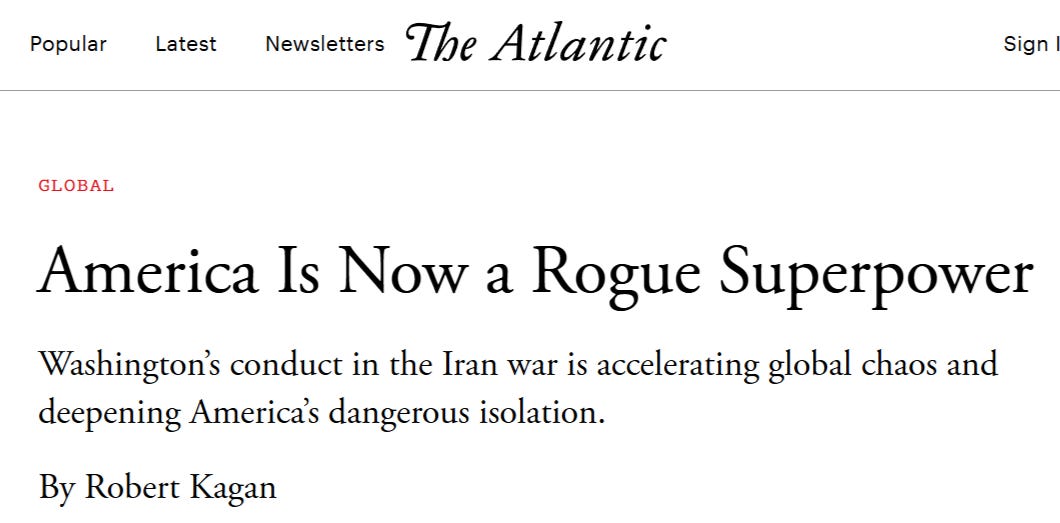
Now Kagan himself has penned an oped in The Atlantic outright calling the US a rogue state:
We know when such figures come out in this way, it represents true alarm behind the scenes rather than any kind of genuine benevolent empathy for the rest of the world. No, these people are alarmed that their empire has overstepped its boundaries, bit off more than it can chew, and is in a precipitous downfall.
Being that these figures have built their entire lives, careers, and oeuvres on hypocrisy, greed, contradiction, and other modalities of sin and deceit, it is not surprising that in the very opening paragraph of Kagan’s polemic, we’re immediately met with a rich hypocrisy:
Whenever and however America’s war with Iran ends, it has both exposed and exacerbated the dangers of our new, fractured, multipolar reality—driving deeper wedges between the United States and former friends and allies; strengthening the hands of the expansionist great powers, Russia and China; accelerating global political and economic chaos; and leaving the United States weaker and more isolated than at any time since the 1930s. Even success against Iran will be hollow if it hastens the collapse of the alliance system that for eight decades has been the true source of America’s power, influence, and security.
In Kagan’s twisted neocon worldview, it is China and Russia that are the “expansionist” powers when China has not done a single thing to any country—all of its ‘imagined’ schemes against Taiwan lie in the propaganda mills of the US military-industrial-complex. The US is currently occupying dozens of nations, has invaded several in the past year alone, is openly threatening to collapse or invade others like Cuba—but it is China that is ‘expansionist’. In Russia’s case, it is expansionist NATO that—urged on by the US itself—has been gobbling up the entire post-Soviet sphere to plop itself threateningly on Russia’s border, which caused Russia to finally react in Ukraine.
Though Kagan calls the US a ‘rogue superpower’, he does not actually liken its faults to those of Russia’s or China’s, which in his mind are far more pernicious. In reality, throughout the piece you realize he’s framing the term ‘rogue’ not to mean something particularly bad or unjust, but simply a state acting against the interests of the global deep state as represented by NATO and other US “allies”. In short, Kagan is arguing for the continuation of the Western Hegemonic Order and his critiques of the US amount to surface-level disagreements with Trump’s foreign policy, rather than the true deprecations aimed at the ‘bad guy’ states of Russia and China.
At least beneath the obligatory bias, Kagan remains lucid on the purely mechanical breakdown of the conflict thus far:
Some analysts have suggested that Russia and China have failed to come to Iran’s defense, and that this somehow constitutes a defeat for them, because Iran was their ally. But the Russians are helping Iran by providing satellite imagery and advanced drone capabilities to strike more effectively at U.S. military and support installations. And China has not suffered a loss in Iran insofar as Iran has granted safe passage to its oil shipments.
But he again quickly demonstrates the blatant hypocrisy his ilk have hung their hats on for generations:
More important, in Russia and China’s hierarchy of interests, defending Iran is of distinctly secondary importance; their primary goal is to expand their regional hegemony. For Putin, Ukraine is the big prize that will immeasurably strengthen Russia’s position vis-à-vis the rest of Europe. For China, the primary goal is to push the United States out of the Western Pacific, and anything that degrades America’s ability to project force in the region is a benefit. Indeed, the longer American attention and resources are tied up in the Middle East, the better for both Russia and China. Neither Moscow nor Beijing can be unhappy to see the war drive deep and perhaps permanent wedges between the United States and its allies in Europe and Asia.
The real showstopper, however, comes in the next few paragraphs, wherein Kagan effectively reveals the true secret reason behind the US’s perennial aggression against Iran, and again implies—as he did last time—that Israel is at the center of it:
The United States has long sought to prevent Iraq or Iran from acquiring weapons of mass destruction, but not because these countries would pose a direct threat to the United States. The American nuclear arsenal would have been more than adequate to deter a first strike by either of them, as it has been for decades against far more powerful adversaries. What American administrations have feared is that an Iran in possession of nuclear weapons would be more difficult to contain in its region, because neither the United States nor Israel would be able to launch the kind of attack now under way. The Middle East’s security, not America’s, would be imperiled.
Read that last part again because his point is not immediately clear without clarification: The only reason the US has terrorized Iran in the hopes of stopping it from developing nuclear weapons is not because those weapons would pose a threat to the US itself, but because a nuclear Iran would have credible deterrence in stopping the US and Israel from engaging in unprovoked aggression against Iran, the likes of which they are presently carrying out.
Can you say ‘Wow’?
Let’s read that again to make sure we’re not going crazy.
“What American administrations have feared is that an Iran in possession of nuclear weapons would be more difficult to contain in its region, because neither the United States nor Israel would be able to launch the kind of attack now under way. The Middle East’s security, not America’s, would be imperiled.”
But it gets worse.
Kagan bites down, redoubles on his points from weeks ago, and hoists what amounts to the banner of Groyperism—things have really fallen that far:
As for Israel, the United States committed to its defense out of a sense of moral responsibility after the Holocaust. This never had anything to do with American national-security interests. In fact, American officials from the beginning regarded support for Israel as contrary to U.S. interests. George C. Marshall opposed recognition in 1948, and Dean Acheson said that by recognizing Israel, the United States had succeeded Britain as “the most disliked power in the Middle East.” During the Cold War, even supporters of Israel acknowledged that as a simple matter of “power politics,” the United States had “every reason for wishing that Israel had never come into existence.” But as Harry Truman put it, the decision to support the state of Israel was made “not in the light of oil, but in the light of justice.”
He outright admits the US has no real interest in Israel and is only helping out of a sense of guilt for the Holocaust. Well, he’s not quite there, but it’s a start.
If you were shocked by those admissions, the next is arguably even more stunning:
Even the threat of terrorism from the region was a consequence of American involvement, not the reason for it. Had the United States not been deeply and consistently involved in the Muslim world since the 1940s, Islamic militants would have little interest in attacking an indifferent nation 5,000 miles and two oceans away. Contrary to much mythology, they have hated us not so much because of “who we are” but because of where we are. In Iran’s case, the United States was deeply involved in its politics from the 1950s until the 1979 revolution, including as the main supporter of the brutal regime of Shah Mohammad Reza Pahlavi. The surest way of avoiding Islamist terrorist attacks would have been to get out.
Another one that has to be read twice to be believed: America was the reason the Middle East even needed saving from so-called “terrorism”—a self-created dialectic.
One has to wonder at this point, are the neocons abandoning Israel because of a kind of moral awakening, or simply because they’ve realized like all intelligent people have that Israel’s fate is sealed, and it is doomed as a nation—thus, there’s no real further strategic purpose in trying to save it. For America, it’s a frostbitten limb that needs amputation lest it infect the entire body—a consequence sadly in its late stages of development.
For the first time in history, the neocons have resorted to operating under realpolitik and even Mearsheimer’s neorealism.
Kagan goes on to admit that the entire ‘significance’ of the Middle East to the US is a fictive creation of the post-war period:
That sense of global responsibility is precisely what the Trump administration came to office to repudiate and undo. The Trump administration’s new National Security Strategy, which has dramatically shifted the focus of American policy from world order to homeland security and hemispheric hegemony, appropriately downgraded the Middle East in the hierarchy of American concerns. A United States concerned only with defense of its homeland and the Western Hemisphere would see nothing in the region worth fighting for. In the heyday of “America First” foreign policy during the 1920s and ’30s, when Americans did not regard even Europe and Asia as vital interests, the idea that they had any security interests in the greater Middle East would have struck them as hallucinatory.
This strikes a particularly dissonant chord against Hegseth’s latest announcement of the ‘strategic’ construct of “Greater North America”:
Brian Allen@allenanalysis
Pete Hegseth just unveiled “Greater North America.” A new strategic map — from Greenland to the Gulf of America — claiming every sovereign nation north of the equator is part of America’s security perimeter.
8:43 PM · Mar 29, 2026 · 1.98M Views
1.61K Replies · 2.38K Reposts · 5.81K Likes
In the vein of the neo-Monroe (“Donroe”) Doctrine, and now the “Greater North America” construct, it makes particularly little sense that the US is so fiercely set on pouring all its resources into another Middle Eastern conflict. In fact, it is patently asinine to announce a reorientation to the Western Hemisphere in not one, but two separate official new strategies or doctrines, and then immediately violate their very core tenets by concentrating on the opposite point of the earth than what is enshrined as “main American protectorates and geopolitical interests” in those same doctrines. Only this administration can operate with such a lack of self-awareness.
Kagan—himself befuddled—underscores this in his very next sentence:
Yet now, for reasons known only to the Trump administration, the Middle East has suddenly taken top priority; indeed, to supporters of Trump and the war, it seems to be the only priority, apparently worth any price, including the introduction of ground forces and even the destruction of the American alliance system.
Most interesting as pertains the insight into the internal workings of the neocon deep state, Kagan goes on to insist that the chief tragedy of Trump’s term is the abandonment of Europe to Russia. The fact that Kagan views this as, essentially, a more consequential outcome than the abandonment, and presumed ensuing destruction, of Israel is extremely telling.

We mentioned Mearsheimer’s realism earlier, and coincidentally a similar new piece comes by way of realist Stephen M. Walt:
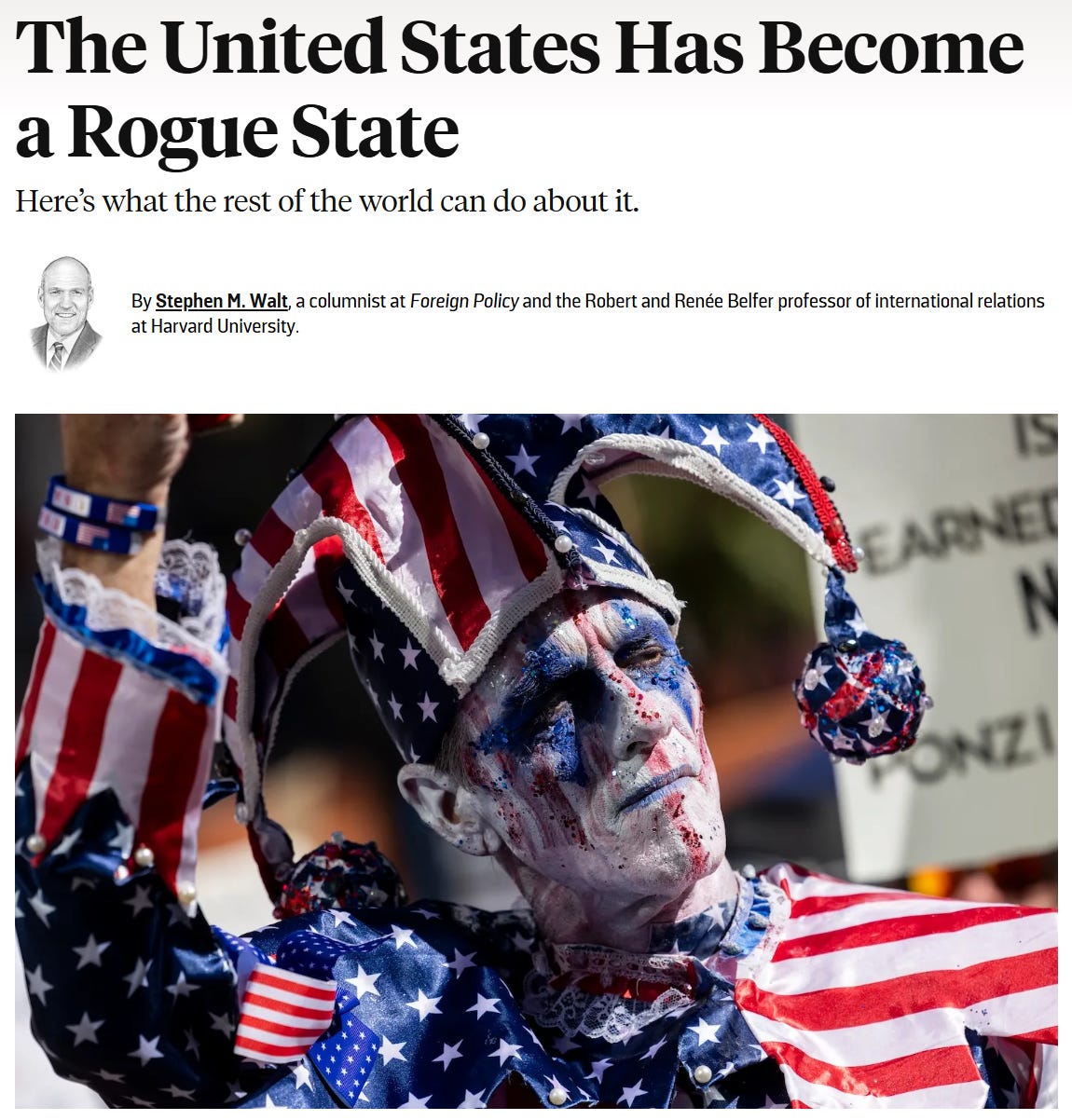
Second, as I have argued at length elsewhere, the United States is now acting like a predatory hegemon, exploiting positions of leverage built up over decades to exploit allies and adversaries alike. This zero-sum approach to nearly all relations with others includes a deep hostility toward most international institutions and norms, deliberately erratic behavior, and a tendency to treat other foreign leaders with ill-disguised contempt while expecting demeaning acts of submission and fealty from most of them. As the fallout from the war in Iran spreads throughout the region and around the world, it underscores that the administration either didn’t understand how its actions would affect other states or simply didn’t care.
One thing that’s worth noting, is that most of these analysts cast the US as a ‘rogue’ state notfor its international-law-breaking genocide complicity in Gaza, or its ruthless savagery against civilians in Iran, but simply for not standing with so-called “allies”. But this is a strange concept, particularly highlighted in Kagan’s earlier line:
For Europeans, the problem is worse than American disregard and irresponsibility. They now face an unremittingly hostile United States—one that no longer treats its allies as allies or differentiates between allies and potential adversaries.
This appears to operate under the given assumption that allies are something eternally baked-in, or more accurately, being an ally is an entitlement you earn and get to keep by virtue of your perceived historical ties. But we know that’s not how alliances work—they shift dynamically all the time, in real-time. Nothing entitles you to be considered an ally in perpetuity even if you no longer represent an ‘interest’ for the friend in question.
For the United States, European countries have long-since ceased being true allies: Trump, Hegseth, and co. were correct on this count when they tongue-lashed the Europeans for having utterly abandoned and betrayed the mandates of the West as beacons of certain types of freedoms, moralities, virtues, etc. By giving in to the globalist diktats, Europe has ceased representing what allies are meant to represent to one another in more ways than one. In fact, in the modern usage, the term ‘ally’ has become nothing more than a sneaky euphemism for globalist control under the bankster-led ‘Western Order’ in much the same way that phony shibboleths like “Rule of Law” and “Rules Based Order” are fig-leaves for the cabal’s one-sided system of control and domination.
Alliances have to be earned, on a constant basis—they are not something you “win” once and are entitled to hold forever. Likewise to much of the world, including Europe, China is now a far more logical and dependable partner than the United States; such dynamics must always shift toward naturally evolving poles just as previous “enemies” in WWII—Italy, France, Germany, etc.—have now become partners or allies.
Another example—Stephen Walt writes:
For this reason, a far-sighted great power will use its power with restraint, adhere to widely held norms whenever possible, recognize that even close allies will have their own agendas,and work to fashion arrangements with others from which all parties benefit. Maintaining the mailed fist of hard power is valuable, but so is cloaking it in a velvet glove. The United States did this tolerably well for most of the past 75 years and benefited greatly, but its present leaders are rapidly tossing that wisdom overboard.
What does the term “allies” even mean in this context? If your “allies” have an ‘agenda’ that differs from yours—let’s say is even adversarial or hostile to yours—then what makes them your “allies”, precisely, beyond merely a political gimmick to keep previous status quos and orders in power?
Israel is the perfect example: The US treats Israel as a perpetual “ally” even when it’s now evident more than ever before that Israel’s interests are actually in direct opposition to those of the US. The proof is in the US’s own earlier-mentioned doctrines that specifically identify the Western Hemisphere as the US’s core limitrophe of interest. US’s involvement in Israel’s local matters has only objectively weakened the US by every quantifiable measure—in any logical sense this would constitute Israel being closer to US’s adversary than “ally” of any kind; and that’s all before even getting to the “dark stuff” regarding Israel’s secret sabotage, espionage, and more toward the US.
Globalists have deliberately redefined the term “ally” to suit their furtive agenda—the word really does not mean what they pretend it does. As many people have stated, Russia has become logically a far more compatible ally for the US than Europe, not only from the standpoint of cultural and moral compatibility, but even from the potential standpoint of being a credible deterrent against China, widely considered to be US’s chief ‘adversary’.
The topic has particular pertinence today as Trump and his officials have signaled an increasing hostility toward NATO in the wake of the Hormuz debacle, with Trump openly telling The Telegraph in an interview he’s “beyond” considering leaving NATO:
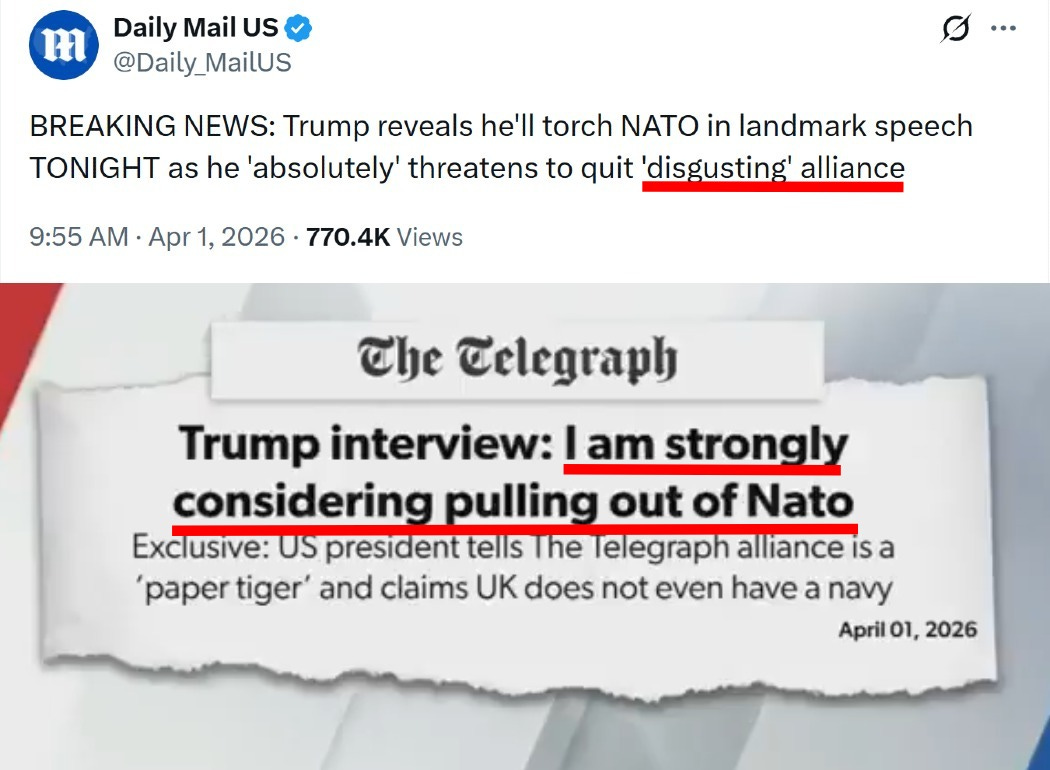
Mr Trump was asked if he would reconsider the US’s membership of Nato after the conflict.
He replied: “Oh yes, I would say [it’s] beyond reconsideration. I was never swayed by Nato. I always knew they were a paper tiger, and Putin knows that too, by the way.”
Well, it’s true: the US is a “rogue superpower”, but not in the disingenuously misleading way pundits have been supposing. It is not rogue because it has trampled on the decadently outdated, corrosive, and, frankly, obsolete so-called “allies” and their flimsily specious global security constructs. But rather, because the US has abandoned even the pretext of ‘just’, righteous, or moral actions in the pursuit of outright predatory and misanthropically destructive global conquests far removed from any even remotely sensible connection to the US homeland or the interests of the American people. It is a rogue superpower because it has embraced “might is right” in a most cynical, transactional, and unapologetically unctuous way under the leadership of an unprecedented cast of unqualified (Hegseth a Field Grade, Trump a reality TV star, etc.), circus-like hucksters that have given even the Biden era’s notorious “DEI-on-steroids” administration a run for its Monopoly money. It is a rogue superpower because it has totally abandoned the will of the people in pursuit of the financial interests of a tiny cabal of gangsters, themselves in thrall to an overseas mafia.
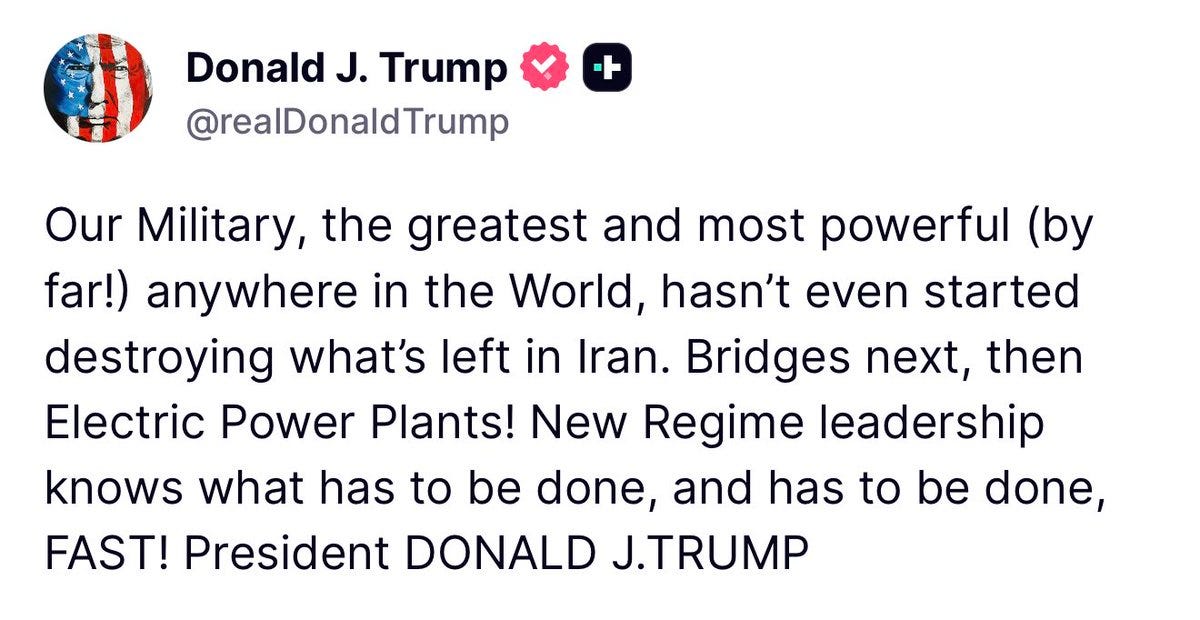
But as even blind squirrels occasionally find their nut, the divestment of these historically unworthy “allies” and their sinking-ship unions is a most praiseworthy accomplishment of the “rogue superpower” that at least comes as a kind of consolation prize to balance out the historic depredation of its rampant policies.
Special thanks to you, the paid subscribers, who are reading this paywalled Premium article—you are the core contributing members keeping this blog in healthy, steadfast operation.
The Tip Jar remains as an anachronism, an archaic and shameless bit of double-dipping, for those who just can’t help lavishing their favored humble authors with a second greedy helping of largesse.