Paradise Lost: The Zionist Reopening of the Catholic-Protestant Wound
Like Satan in Paradise Lost; for Pete Hegseth and Donald Trump “The mind is its own place, and in itself”...
Introduction
A reverse exodus is beginning to take place, only this time it manifests away from Israel rather than towards it. Large numbers of European and American Catholics are joining the pilgrimage away from Zionism due to its culture of ethno-religious supremacy and its brutal expansion into what it classifies as ‘Greater Israel’. Although Protestant-Evangelicals in the US remain strong advocates of Zionism, the framework of Western Judeo-Christian (Zionist) Civilisation has been weakened by a rising Catholic rejection of the recent warmongering in West Asia.
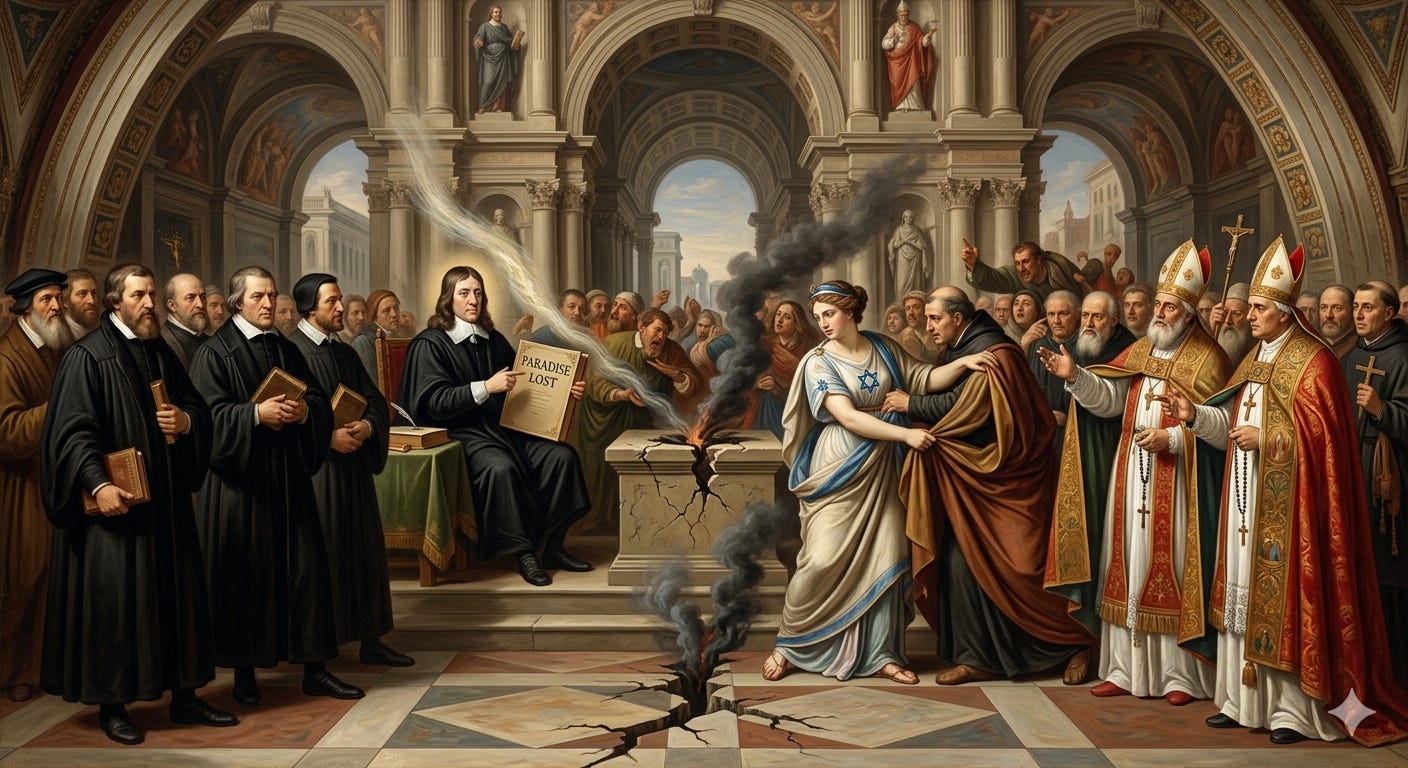
This reverse exodus is grounded historically in Christian theology and recently in Christian political thought. It represents an internalised historical understanding of the concept of ‘supersessionism’ (or replacement theory)—the idea that the Church had replaced Israel in God’s plan. Although the official Catholic Church has recently distanced itself from the doctrine of supersessionism, it is still widely accepted among traditional and orthodox Catholics. In January of 2026, the Patriarchs and Heads of Churches in the Holy Land released a statement condemning Christian Zionism and accusing it of promoting a “damaging ideology” that “mislead the public, sow confusion, and harm the unity of our flock.” The Christian Zionism referred to here, originates from Protestant Christianity and more specifically from the Puritan and Evangelical branch.
The Literary Satan and Protestant Rebellion
John Milton’s greatest work Paradise Lost, is an epic Protestant poem that reconstructs the biblical story of Genesis and the Fall of Man. With a revolutionary command of the English language, Milton explores themes of free will, rebellious revolution, temptation and the nature of evil. Paradise Lost was considerably shaped by the Protestant and Puritan sentiment that existed, theologically and politically, in 17th Century England. Milton himself was of the Puritan school of thought. The words he placed in the mouth of Satan (Satan’s soliloquies) are regarded as some of the greatest monologues in the English Language, notably for their extraordinary literary feat of giving a psychologically relatable voice to ultimate evil. William Blake and Percy Shelley regarded Satan as the true hero of Paradise Lost. Although Milton’s poem is not considered an authoritative religious book, it codifies a Protestant and Puritan culture of rebellion and the questioning of authority.
Dr. E. Michael Jones, an American traditionalist Catholic writer, editor, and former academic, has revealed an interesting link between John Milton’s Paradise Lost, Puritan Protestantism and Christian Zionism. Jones identifies the poem—particularly Satan’s soliloquies—as the “hidden grammar” of Puritanism and the foundation of America. Benjamin Franklin, Thomas Jefferson and John Adams have all hailed Paradise Lost as an inspiration for their ideas of religious and civil liberty in a democratic republic, with Jefferson himself writing on his admiration of Satan’s defiance and rebellion against God.
Importantly, Paradise Lost is still widely referenced to this day. During a 2024 campaign rally in Coachella, California, Donald Trump described the state as a “Paradise Lost”. In January 2026, during an interview with the New York Times, when he was asked whether there were any limits to his global power, he replied “Yeah, there is one thing. My own morality. My own mind. It’s the only thing that can stop me. I don’t need international law”. His proclamations eerily mimic those of Satan in Paradise Lost when he declares, “The mind is its own place, and in itself... Can make a Heav’n of Hell, a Hell of Heav’n.” (Book I, lines 254-255, Paradise Lost). Here the Devil protests that his mind is independent and not a subject of external conditions—or in Trump’s case, subjected to international law. In a leaked interview between Steve Bannon and Jeffery Epstein in 2019, Satan’s soliloquy was explicitly referenced. Bannon asks Epstein, “Do you think you’re the devil himself?” Going on to explain Satan’s story in the poem, Bannon then quotes his famous line, “Better to reign in Hell than serve in Heaven.” (Book 1, line 263, Paradise Lost).
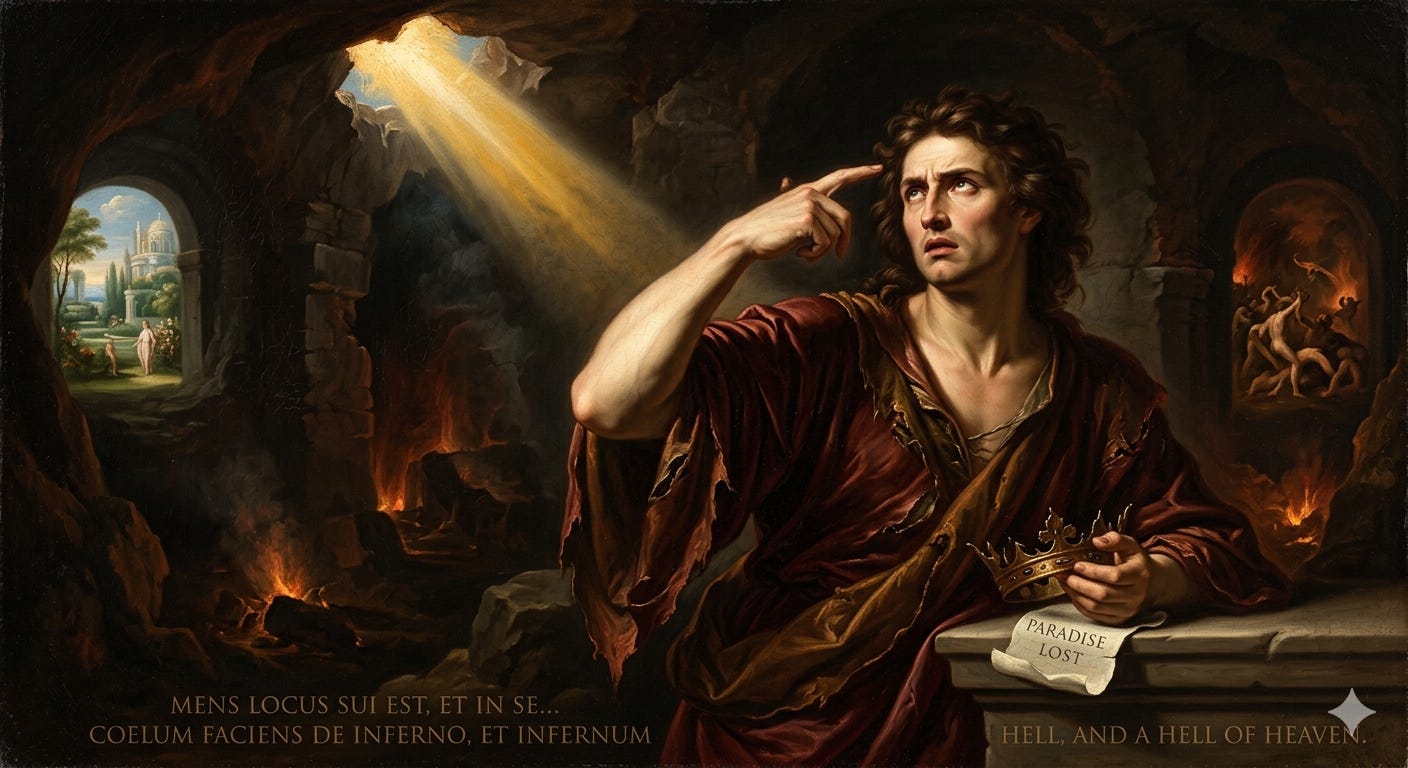
The Protestant and Puritan cultural inclination of rebellion against the Catholic establishment, laid the psychological groundwork for the adoption of Christian Zionism. The eschatological Evangelical accelerationists are theologically Protestant. It is important to consider that Evangelicalism is a movement within Protestantism and is trans-denominational, manifesting in Baptist, Methodist, Presbyterian, Pentecostal, Lutheran, Anglican, and numerous other non-denominational churches. It is a movement that is fundamentally opposed to traditional Catholicism.
The Scofield Bible: Protestant Heresy Becomes Policy
Cyrus Ingerson Scofield (1843-1921) was an American theologian, minister and writer. His annotated ‘Scofield Reference Bible’, was published in 1909 by Oxford University Press despite his lack of traditional academic or clerical training. His life evolved from lawyer and politician, plagued by controversy, to one of the most influential figures in modern Evangelicalism.
The Scofield Reference Bible is the key to understanding the accelerationist framework of fundamentalist Evangelical Christian Zionism. Scofield’s Reference Bible is the first to include a comprehensive commentary on the same page alongside the King James Bible. His commentary on the Bible introduced dispensationalism to the average reader and exhibited the notion “that [the readers] mind is its own place, and in itself.” Some of the key principles of dispensationalism are the following: God deals with humanity in seven distinct epochs, literal interpretation of the Bible including its prophecy, a rejection of traditional supersessionism—God will eventually deal with Israel— and the importance of eschatological study.
Scofield’s rejection of supersessionism manifests from his idea that Israel and the Church are on separate but valid paths, guided by God. Israel’s guidance is limited to a worldly existence while the Church is destined to a spiritual, heavenly existence. This concept is not only a direct contradiction of Catholicism but also of mainline Protestantism. However in 2026, 58% of all Protestants in the US now identify as Evangelical.
The growth of Western Evangelical Zionism paired with Israel’s expansion into Arab-Christian and Muslim lands will potentially lead to increasing historic tensions between Catholics and Protestants. Scofield’s Biblical commentary has re-opened the wound between Catholics and Protestants by cutting off the New Testament from its Old Testament roots in the Church and has created a theology of Christian Zionism as a prerequisite for biblical eschatology.
Catholic Doctrine and Theological Zionism
Traditional Catholic doctrine differs from Protestantism in its belief that the Church is the ‘New Israel’ and although the Jewish people hold a valid covenant, the modern state of Israel is strictly a political entity and one not based on theology. This logically leads to the Catholic’s expectation that the secular political state of Israel should be bound by international law, unlike Protestant Evangelicals. Pope Emeritus Benedict XVI (2005-2013) in a response to Rabbi Arie Folger, argued: “Without repeating all that I say in my text [Jesus of Nazareth: From the Entry into Jerusalem to the Resurrection], I would like to reiterate my thesis, which is important not only for Christians, that the state of Israel as such cannot be regarded theologically as the fulfillment of God’s promise of land”. The Catholic Church has been consistent in engaging with Israel solely as a political reality. In 1993, the Vatican recognised the State of Israel as a legitimate entity purely on political grounds, not on theological.
The Rising Catholic Rejection of Political Zionism
Pope Leo XIV’s (2025-present) feud with Donald Trump and criticism of the US/Israeli war on Iran, demonstrates a new political shift away from Christian Zionism. Prior to this public rift, on October 10th 2023, Israel bombed the third oldest church in the world located in Gaza. The Saint Porphyrius Church was guilty of sheltering Palestinian Christian and Muslim civilians countless times during the many Israeli incursions of the Gaza Strip. In March of 2026, Father Pierre al-Rahi, a Lebanese Maronite Catholic priest, was martyred by an Israeli artillery tank a day after he appeared on France24 stating that his duty was to “defend our land”. Also in March of 2026, for the first time in centuries the heads of the Church of the Holy Sepulchre were prohibited from conducting Palm Sunday mass by Israeli Police. Such a prohibition has never occurred during the 1,200 years of Islamic rule over the Holy Land. To this day the keys to the church—where Jesus was believed to be crucified, buried and resurrected—remain in the hands of two Muslim families who historically function as a security of the “Status Quo” agreement. These isolated examples of Christian persecution, at the hands of the Israelis, are responsible for the increasing Catholic resentment towards Zionism and is further amplified by prominent Christians like Tucker Carlson and Candace Owens (Catholic) who command a following in the tens of millions.
Conclusion
The damage caused to a unified Christendom by Protestant Christian Zionism has kindled historic tensions with Catholics. The genocide in Gaza and Lebanon has been raging for over two years. Catholics, Orthodox Christians and Muslims in West Asia have experienced arguably the worst atrocities in recent memory. Catholics in the West are now waking up to the plight of their Christian brothers and sisters in the Holy Land as well as its neighboring regions as they are relentlessly persecuted by the Israeli regime and its backers in Protestant-Evangelicalism. Like Satan in Paradise Lost; for Pete Hegseth (Evangelical) and Donald Trump (Protestant) “The mind is its own place, and in itself” enticing both to blasphemy. The former, glorifying a “Holy War” with Iran, unknowingly referencing Pulp Fiction’s fictitious scripture and the latter depicting himself as God. As US and Israeli wars in West Asia rage on, increasing numbers of Catholics and Orthodox Christians will distance themselves and oppose Christian Zionism with implications re-opening a centuries old feud with Protestants.