Flood of small parcels from China pushes Belgian airport’s capacity to limit
Published: 3:00pm, 25 Apr 2026
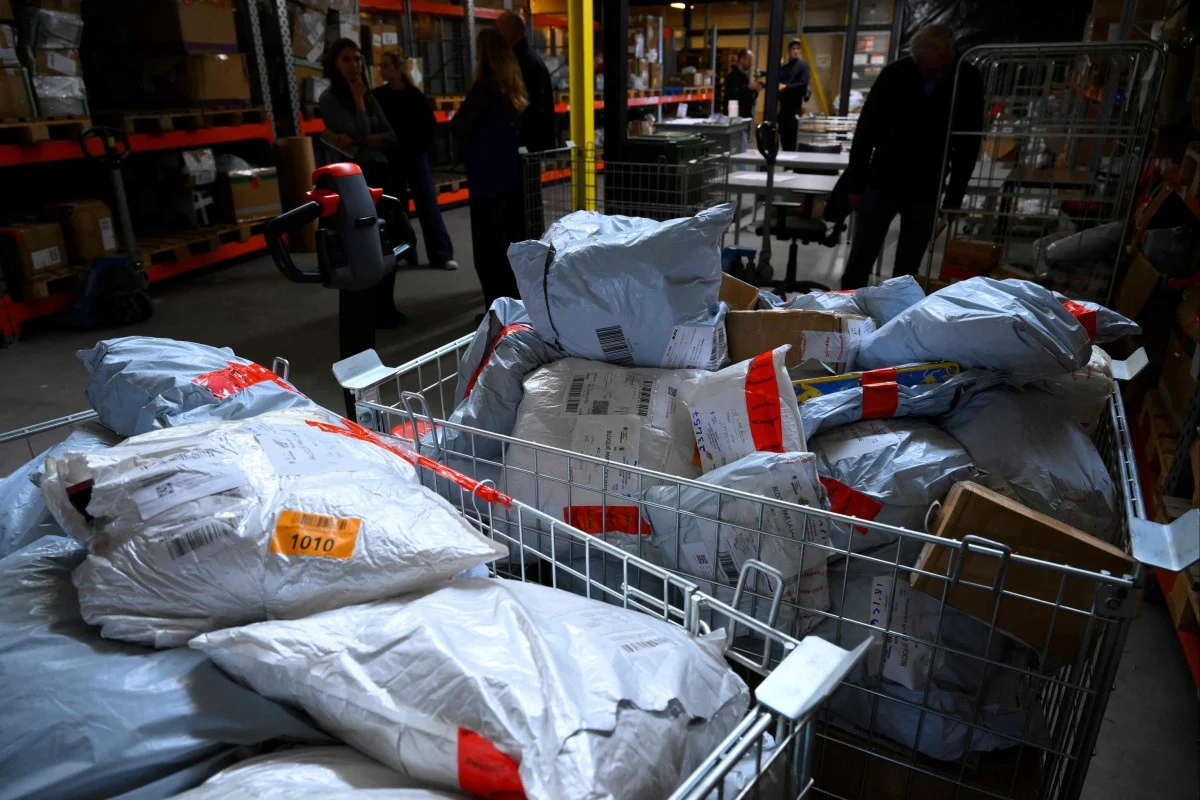
More than 4 million small parcels from China have arrived at the freight airport in Liege, Belgium, every day since the beginning of the year. On the receiving end, the Belgian customs inspection team at the airport has only 80 members.
Belgium’s top customs official, Kristian Vanderwaeren, said the airport, close to the Netherlands, Germany and France, was built, in part, to cater to e-commerce platforms such as Amazon, Shein, Temu and Alibaba.
But the “explosion” in the number of small parcels from China being diverted to Europe since US President Donald Trump’s return to the White House last year was pushing the airport’s capacity to its limit, he said.
An executive order signed by Trump on February 1 last year removed the “de minimis” exemption that allowed Chinese packages worth less than US$800 to enter the United States duty free.
Vanderwaeren said the situation in Liege had further deteriorated after Italy and France introduced their own handling fees for small parcels this year, because more parcels were now being redirected to the Belgian airport to avoid those charges.
Facing similar complaints from across Europe, the EU has proposed the implementation of a bloc-wide €2 (US$2.36) handling fee and a €3 flat-rate fee per small parcel valued below €150later this year. Beijing has said the proposed measures would be unfair.
While the proposed fees have been a source of tension between Brussels and Beijing, Vanderwaeren said the core of the problem lay elsewhere – with the quality of the parcels rather than their quantity. He said the solution was for both sides to work together to ensure Chinese products met European standards before they reached the continent.
“The problem for me, as a customs officer, is not so much the quantity,” he said. “The problem is that we’re being flooded with Chinese products that … do not meet European standards, whose value is not properly declared.”
Vanderwaeren said 30 per cent of the small parcels inspected were in violation of EU standards, while for certain goods, such as cosmetic products, the infringement rate was 100 per cent.
Belgian customs are at their wits’ end – they are now issuing fines very swiftly
The European Union bans or restricts over 2,500 substances in cosmetic products – compared with just 11 in the US – making it one of the strictest regulatory regimes in the world for products applied to the skin.
In its 2025 annual report, the European Public Prosecutor’s Office said a fraudulent chain controlled by Chinese criminal networks was using e-commerce platforms, among other things, to distribute goods brought in from China.
“The most important message is how China and Europe … can better collaborate to ensure that the number of violations decreases,” Vanderwaeren said, adding that fixing the compliance problem would see 80 per cent of the headache – handling fees included – disappear.
The compliance failures of Chinese e-commerce companies have long been known to the Chinese business community in Belgium.
Many Chinese e-commerce firms that expanded into Europe simply transplanted their freewheeling domestic habits without realising that European regulators were far stricter and that customs violations in the EU could trigger criminal investigations, said Xiufang Tu, partner and head of the China desk at the Brussels-based Daldewolf law firm.
Some Chinese electric scooter makers had shipped and sold products in Europe without any EU certification, she said, and other regulatory breaches, such as under-declaring values or declaring luxury items as common items, were also widespread because Chinese firms underestimated the consequences of such behaviour in the EU.
“Belgian customs are at their wits’ end – they are now issuing fines very swiftly and without hesitation,” Tu said.
Jiang Xiaojuan, a former deputy secretary general for China’s State Council, said at last year’s Boao Forum for Asia the digital infrastructure underpinning customs systems across the globe is often not advanced enough to handle the surging number of small-package clearances that pressure many countries’ operating systems.
Vanderwaeren has secured funding to hire 200 more agents, though the process will take time. He is also adopting a pragmatic approach to the issue, with a visit to China planned for the end of May, where he will travel to Beijing and Shenzhen to hold talks with his Chinese counterparts and visit e-commerce facilities.