Trump Courting Disaster With New Trade War On China
The reason behind the new economic attack on China is pretty obvious. The Anglo-Zionist war on Iran was launched under the assumption that it would conclude over a weekend with regime change in Tehran and would not involve any interruption of energy flow through the Strait of Hormuz. Woops! Given that crazy assumption, the Anglo-Zionists made no plans for the economic chaos that has ensued—due, precisely, to the interruption of energy flow through Hormuz—and which gets worse by the day. Nor were any plans made to deal with the prospect of massive support for Iran coming from Russia and China over the long term. Russia and China helped Iran prepare for war over the long term, and that’s what has happened.
Now the Anglo-Zionist led West has launched an ill advised economic war on China in the midst of a war that has already brought economic chaos—and possible collapse. The goal is to force China to stop buying Iranian oil and perhaps even to force China to buy expensive US energy. In addition, it looks like another blunt force attempt to defend USD hegemony, which the war on Iran has brought under increased pressure. That’s not a smart strategy—in fact, it looks like a desperate tactic. Sean Foo addressed the US side of this tactic yesterday, emphasizing China’s potential to respond massively. Past trade war attacks on China have failed, so there’s every reason to believe that China has gamed out most conceivable scenarios for renewed attacks on this front—just as Iran and Russia have done on their fronts. And that all three are coordinating.
Clearly this looks like a last ditch effort to achieve what failed before the ceasefire. The hope is to launch a renewed bombing campaign on Iran—despite US military advice against this—destroying as much of Iran’s infrastructure as possible while stripping Iran of support—financial and otherwise—from Russia and China. Thus bringing Iran to its knees—in Anglo-Zionist fantasies. My view is that Russia and China will not allow Iran to be defeated and that the defeat of the Anglo-Zionist Empire will prove even worse than previously seemed inevitable. But this prolonged war will devastate the world economy—time remains on the side of Iran and its partners.
UGLY: As Bessent CANCELS Major China Refinery, Beijing Is BANNING US Investments
The US is slowly drifting into an economic confrontation with the Chinese. And this won’t just end badly for the US--it’s going to reshuffle everything from global investments to the way currencies are being used. It will ultimately break the future of US technology as well. China’s been buying a ton of Iranian oil and, despite the war, Beijing is still buying enormous volumes. And why wouldn’t they? It would be supporting a BRICS partner, getting oil supply at a cheaper price as well. However, the US is angry because China is effectively funding Iran, and this funding is being done outside of the dollar. Now, Iran is under heavy sanctions and cut away from the dollar system. The Iranians are using China’s CIPS system and are accepting the Chinese RMB for oil payments. As a result, Bessent just punished China’s teapot refinery in Dalian. He’s hammering down on a teapot refinery as a warning to other big oil companies in China. If you buy Iranian oil, we will sanction you and we’ll cut you away from the US financial system.
Now, US sanctions can be brutal. It’s not just getting kicked away from the dollar system. It would also mean US companies and US allies can’t really do business with you, because if they do it could mean getting sanctioned themselves and, once again, losing access to American financial markets can be quite painful. Now this move is consequential for China because when a teapot refinery gets sanctioned their knock-on effects are quite serious. They can’t directly sell to many global customers. Even buyers that desperately need oil in Europe and Japan might reject shipments just to stay safe. The refinery might be forced to sell their refined products back into the Chinese market, which means lower margins and a crash in profits. And if Bessent decides to hammer more Chinese teapot refineries, this is going to translate into a more serious problem.
The justification from Bessent is simple. The refinery has been buying billions of dollars worth of oil products from Iran. And the tracking is being done not just on the payment systems, but through sanctioned vessels as well. BIG MAG, GALE, and ARES have been sanctioned. And any entity dealing with them is going to get punished as well. According to the US, the proceeds are being channeled directly into the IRGC and funding the Iranian military directly.
Now, it’s a big cry that the US can’t outlast Iran if the money keeps flowing from China to Tehran. So, Bessent is moving hard against Chinese refineries. What’s really bizarre is how Bessent is also blaming Iranian leadership for the struggles of the Iranian people. ... But is it really the country’s economic mismanagement or is it a consequence of economic sanctions of the US? Not to mention the bombing of Iranian infrastructure and the US blockade that is still going on. Considering the broken state of diplomacy, we can expect sanctions on Iran to just continue. Worst of all, the secondary sanctions on China would likely escalate and continue even further.
Is this Trump posturing before the talks with China? Perhaps—because bargaining with the Chinese is going to be more dangerous now. There are over 60 teapot refineries in China and many of them deal with sanctioned crude from around the world, which means Bessent can ramp up the pain if he wants to. This is going to piss off China to a huge degree. Chinese teapot refineries they’re running on tight margins and they can’t bid for conventional cargos. They would rather buy cheaper supplies from Russia, Venezuela and Iran. But the majority of oil is coming from Iran—in most cases more than 50%. The dependency here is very high and, if they can’t get those supplies, it won’t be good for the Chinese domestic market. Inputs for plastics and fertilizers could rise in price and really piss off Beijing. The teapot refineries would simply cut down their operations. Their utilization rate is going to drop.
The ploy might be to get China back to buying US energy. It might happen on the fringes, but China won’t want to do that for long because they will be dependent on an even more unstable source of energy. So we can expect the Chinese to fight fire with fire, and the Achilles heel of the US economy today is the backbone of the entire economy--which is farming. Because of the Hormuz shutdown, the global nitrogen supply chain has been shattered. That means growing food is going to be a whole lot more expensive. The war in Iran is triggering a fertilizer shock. According to Fortune, 70% of farmers in the US can’t afford what they need for this year’s growing season. This is an enormous concern because food production is the backbone of any economy, especially one as big as the United States. The last thing the US or any country needs is to be dependent on other countries for your own food industry to survive. But the impact of the double blockade has ground fertilizer shipments from the Middle East to a halt. Over the last 5 years, the US imported over $5 billion worth of nitrogen fertilizers from the Gulf States--half of it from Qatar. However, the rest of the world from Turkey to India and Australia also buy fertilizers from the Gulf. So now US farmers are facing an epic squeeze, when almost everything is rising in price as well.
NOLA urea is the most popular fertilizer used in the world, especially in North America. And prices are up by $230 or up 49% in a matter of 6 weeks. The cost of growing food is rising and is going to squeeze US consumers even more. Everyone needs to eat. But when your fuel costs are higher by 30% and inflation in general is rising, you’re going to eat less, which means US farmers will need bond buyers to come in. And the biggest consumer hands down is still China. And if China and other buyers walk away, it’s going to be a disaster. Farmers could suffer tremendous losses and food production in the US could collapse. Supply drops and prices continue to stay high or even rise. Now, this is how bad things can evolve. China not buying US chips is one thing. Not buying US energy is another thing. But walking away from US farm produce is a whole different story with a really, really ugly ending.
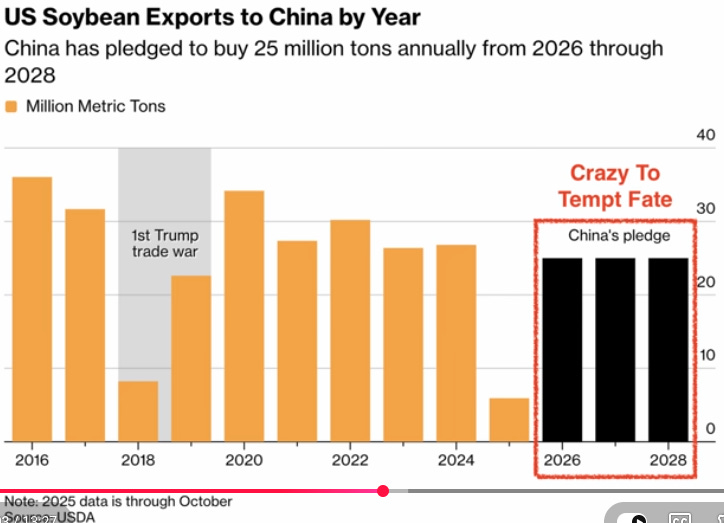
China used to buy over 25 million tons of US soybeans, but in 2025, the amount collapsed to just 6 million tons. At one point, there was zero amount ordered. $12 billion in revenue nearly crashed to zero. And from 2026 to 2028, China has pledged to buy 25 million tons annually again. But if Washington continues to squeeze China over Iran, one can assume Beijing might retaliate on this front. US farmers could get crushed into a risky spot. Either they discount their produce and eat a loss or they drop production for future harvest and lose market share. Countries like Brazil would catch up and snap things up in a heartbeat. We shouldn’t be naive and think China won’t take action. They have cut off rare earth supply before and they have also dropped US energy imports to--zero. Zero coal, zero oil, zero LNG. And this time they are sending a bigger warning to Washington that ‘we can and we will close off more of China to the US.’
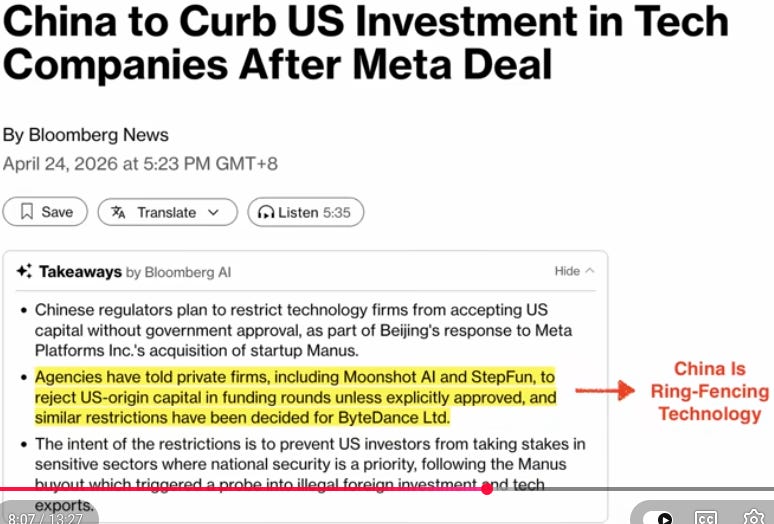
Now after the Meta deal, where the US acquired Manus AI, a China founded company, Beijing just lost it. Chinese regulators are ordering private AI companies to reject money or capital from the US. China is starting to ring fence their technology, especially AI tech from the United States. And part of this could be posturing before the Trump China summit. It could be a bargaining chip for sure. But the bigger picture is to increase pressure on the US when it comes to the tech war. China is basically giving Washington a simple warning. ‘We don’t want your market. We don’t want your money even more. We don’t want you owning our strategic technology.’ It’s risky for China, yes—because it will be losing access to US money, which is plentiful and easy access to US markets at the same time. But Beijing is choosing control over capital, and it’s a big bet that China’s own ecosystem will prevail.
Now, it’s true that the US has easier access to global capital thanks to the dollar system. But China has one clear advantage the US lacks, and that is the ability to stretch their spending power even further. In 2024, China and the US both crashed across the trillion dollar milestone. That’s how much money both economies piled into R&D. But because China’s PPP or purchasing power parity is stronger than the US, Chinese R&D actually surpassed them. Now if we turn this into GDP terms, it’s even more impactful. The US spent 3.4% of the GDP into R&D. China spent only 2.7% but the impact is equivalent to the US. And with this investment ban, China has determined that they don’t need American capital to grow their tech base, which also means US firms are going to lose the ability to access Chinese startups and AI firms.
Half of the world’s developers are Chinese and, sooner or later, they’re going to catch up. US hyperscalers could lose exposure to new engineering breakthroughs, AI application tools, and cheaper models. It gets even more dangerous when you realize that China has limitless energy and is full of data centers. They’re not short of hardware or brain power to make things happen. They might be behind in frontier AI models, but they have all the inputs needed to catch up. Even Nvidia’s Jensen Huang admitted this, front and center.
“The question is how much is needed? The amount of compute they have in China is enormous. It’s, I mean, you’re talking about the country is the second largest computing market in the world. If they want to deploy, aggregate their compute, they’ve got plenty of compute to aggregate. Why can’t they just put four, 10 times as much chips together? Because energy is free. They have so much energy. They have data centers that are sitting completely empty, fully powered.”
There is an additional reason why losing access to Chinese companies isn’t ideal for the US. Chinese AI models have a huge advantage that the US can’t replicate--not in a 100 years. And that is a massive industrial base where AI models can be trained en masse. That helps build stronger inference models. Basically AI can be applied to real world problems over here. And if one day regulators decide to only allow Chinese companies to use Chinese AI, the problem would really magnify. This is also coming on the back of the Trump administration proposing crazy budget cuts to R&D. The US is planning to cut a ton of money from federal research and development. The overall reduction would be an incredible 22%. For non-defense R&D, it could hit 36%, which is massive.
It’s really bizarre, but the US government is relying entirely on the private sector to fund tech progress. This isn’t going to fly when you’re going head-to-head with the Chinese industrial machine. Whether we like it or not, the Chinese government will subsidize their industries until the end of time. This is doubly true for critical sectors like semiconductors and AI. And this is why going head-to-head with China now isn’t a smart idea. China can fund their R&D indefinitely with their trade surplus. And the US cutting down on theirs will allow the Chinese to catch up. Now, by cutting down on the R&D budget by 20%, the Chinese will get a 10-year cumulative advantage of $1.5 trillion. That is one hell of a gap from just one decision. This allows the Chinese to bridge the gap. They might not even need 10 years to surpass the US.
The war on Iran is just making things worse. It’s causing Trump to lash out in weird ways that will damage the US economy in many sectors, especially technology. And if broad-based sanctions are imposed on the Chinese, things are going to look really nasty. Hitting more Chinese teapot refineries could melt down everything from US farming to AI tech.