Hezbollah drones pose 'significant challenges' for IOF in S. Lebanon
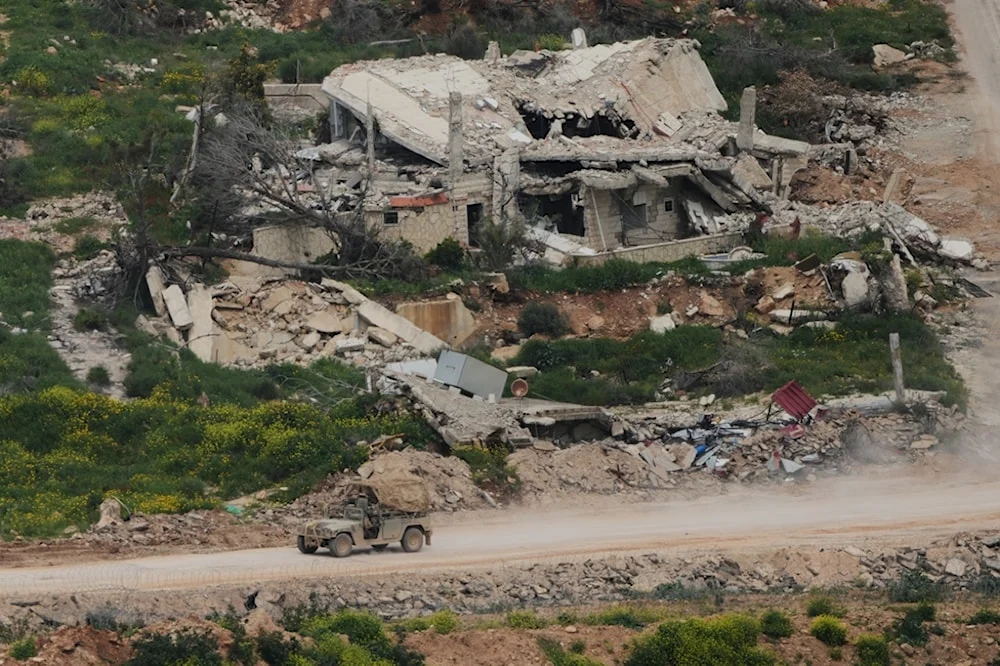
Hezbollah’s explosive drones are emerging as a growing challenge for Israeli forces in southern Lebanon, with Israeli media reporting limited countermeasures and increasing operational strain.
According to the report, Hezbollah is using quadcopter drones that are difficult to detect or jam. An Israeli soldier is quoted as saying that the devices can hover or remain stationed on rooftops before detonating once movement is detected, making troop movement in open areas increasingly risky.
The report added that some drones are now connected via fiber-optic systems, allowing them to operate silently without emitting signals, which further complicates Israeli detection and interception efforts.
Hezbollah drones pose 'complex threat'
The Israeli report described the drones as a “complex threat,” noting their ability to reach locations where fixed surveillance systems are ineffective, including rooftops, mountainous terrain, and densely populated urban areas, while also providing reconnaissance capabilities for targeting.
Israeli military officials admitted they have faced hundreds of such drones in recent months, describing them as a "very significant challenge" and acknowledging the occupation forces’ limited ability to counter them.
"The only solution is to have a soldier watching the sky. There is no real solution. By the time the drone arrives, it is already too late", the officer said.
The report also highlighted that Israeli military aggression in southern Lebanon has largely focused on the systematic demolition of homes in villages. One commander was quoted as saying, “The only mission is to continue destruction,” denying the presence of other operational objectives.
IOF 'destroying everything'
Another officer rejected Israeli claims that the demolitions target “terrorist infrastructure,” stating instead, “There is no terrorist infrastructure; they are destroying everything.”
According to the report, Israeli forces carry out daily demolitions of civilian homes, with commanders required to submit reports detailing the number of houses destroyed, while contractors reportedly receive financial incentives based on the scale of destruction.
The report highlighted a widening gap between political rhetoric and realities on the ground, warning that sustained operations under constant drone threat and unclear objectives are placing increasing physical and mental strain on Israeli forces.
Hezbollah drones catch 'Israel' off guard, IOF unprepared for threat
On a related note, a senior Israeli security official told i24News on Tuesday that Hezbollah’s use of explosive drones along the Lebanon front came as "a major and genuine surprise" to the Israeli military, adding that the occupation soldiers were not "sufficiently prepared for this threat."
According to the Israeli official, dozens of attack drones are being deployed every week across multiple fronts. These systems include drones designed to drop munitions as well as others intended to detonate directly upon impact with Israeli forces.
Undetectable, fast, and effective
The report has also characterized Hezbollah’s explosive drones as a more advanced iteration compared to earlier low-cost systems employed in previous rounds of aggression, including the 2024 war.
These kamikaze-style drones are reportedly capable of operating with minimal reliance on signal reception, significantly complicating efforts to detect or neutralize them through conventional electronic warfare measures.