 | |
The Beijing Summit: Managing a Rivalry, Not Resolving It
By Leon Hadar
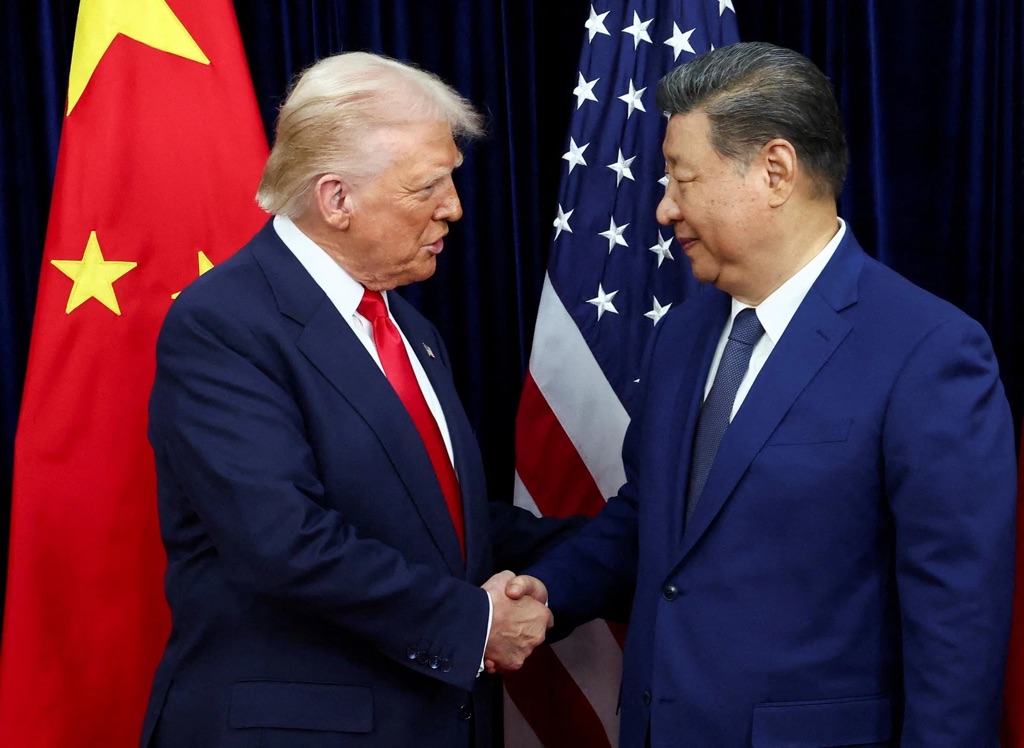
When President Trump steps off Air Force One in Beijing on May 14, he will become the first sitting American president to visit China since 2017. The optics will be dramatic: a state arrival, a reciprocal White House visit penciled in for later this year, the spectacle of two leaders who ostentatiously brand themselves as dealmakers sizing each other up. The temptation to treat the next 48 hours as either historic breakthrough or empty theater will be strong. Both readings would be wrong.
The summit lands at one of the most disordered moments in U.S.-China relations in a generation. The trip was originally scheduled for late March; it slipped roughly six weeks after Washington and Israel launched strikes on Iran on February 28, sending oil markets into convulsions and the Strait of Hormuz back into the headlines. That delay is the first thing to understand about the visit. Trump arrives in China not as the confident leader of a stable global order but as the wartime president of a country whose energy prices, inflation outlook, and approval ratings have all been bruised by a Middle East conflict the administration originally suggested would be brief. His domestic standing now sits around 36 percent.
That context shapes every file on the agenda.
Start with energy and Iran. Beijing's economic ties to Tehran are deep, and China is positioned to influence, though not dictate, what comes next. Trump has reasons to want Xi's help nudging Iran toward a ceasefire that lets the administration declare an off-ramp; Xi has reasons to be seen as a stabilizing global actor without alienating a partner. Expect carefully worded language about energy security and regional stability rather than a joint communiqué pressuring Tehran. The deliverable here is not peace in the Gulf. It is signaling — to oil markets and to capitals from Tokyo to Riyadh — that the world's two largest economies do not intend to let the Iran war metastasize into a U.S.-China rupture.
The economic file is where the summit can actually move metal, and where Beijing has visibly raised the price of admission. China has expanded export controls on rare earths and battery components, and recent U.S.-China talks in Paris focused on stabilizing rare-earth supply and sketching the outlines of a joint "Board of Trade," with a parallel investment mechanism under discussion. U.S. Trade Representative Jamieson Greer has indicated that Trump is going for stability rather than a reset, a quieter ambition than the rhetoric on either side suggests. Then, on May 2, twelve days before Trump's arrival, China's Ministry of Commerce issued Announcement No. 21, invoking for the first time its 2021 rules against extraterritorial U.S. sanctions and instructing Chinese firms not to recognize, enforce, or comply with a Trump executive order targeting Iranian oil. The timing was not subtle. It was a welcome mat written in legal code, and it tells Trump's negotiators something useful: the rules of the road are being rewritten, and Beijing intends to do some of the writing.
For business, the realistic outcome is a narrow but real set of mechanisms, including predictable channels for handling rare-earth flows, semiconductor disputes, and investment screening, that keep the relationship from sliding from managed competition into open economic warfare. That is not a grand bargain. It would still be more than Washington and Beijing have managed in years.
On Taiwan and the military balance, the summit is likely to underdeliver, and that is probably the right outcome. Substantive movement on Taiwan, advanced-chip export controls, or the South China Sea is not on the table; the structural disagreements are too deep and the political costs of concession too high on both sides. What can happen, and what would matter, is the reaffirmation of military-to-military communication channels and crisis hotlines, the unglamorous infrastructure that prevents an aircraft incident or a fishing-boat collision from spiraling into something larger. Past summits, including the 2023 Biden-Xi meeting at Woodside, showed that these channels are reopened in person and quietly atrophy when leaders disengage. Keeping them open is worth a trip.
The most underappreciated story of this summit is not what Trump does but what Xi has been doing for months. China's foreign policy machinery has been running hot. Foreign Minister Wang Yi traveled to Pyongyang in April for the first time in more than six years, restoring Beijing's role on the Korean Peninsula at a moment when Washington is distracted. China has positioned itself as a potential intermediary on Iran, expanded its coercive economic toolkit, and courted partners across the Global South. Xi will arrive at the negotiating table with leverage that may exceed what Washington's pre-summit talking points assume.
None of this guarantees a Chinese win in Beijing. China carries its own structural problems, from a property sector still in convalescence to a working-age population that is shrinking and a youth unemployment problem its statistics no longer pretend to count. But the Xi who greets Trump in the Great Hall of the People will be a leader who has spent the past year accumulating options while Washington has spent it spending them.
This is the right frame for measuring the summit. Five decades of U.S.-China presidential meetings show that these encounters rarely transform the relationship. What they can do, when handled well, is make a dangerous rivalry less volatile, including set boundaries, clarify red lines, and preserve enough predictability for markets and militaries to plan. Judged against that standard, success in Beijing looks modest: a few concrete deliverables on trade and rare earths, restored crisis-management channels, calmer signaling on Iran, and a reciprocal visit that keeps the diplomatic track alive into 2027.
The risk is not that Trump and Xi fail to produce a breakthrough. It is that either side, under domestic pressure, treats the summit as a stage for performance rather than a tool for management. A presidential photo op in Beijing followed by a fresh tariff salvo a week later would be worse than no summit at all. So would a triumphant communiqué that papers over disputes the bureaucracies cannot actually settle.
The most useful thing Trump and Xi can do on May 14 and 15 is also the least dramatic: lower the temperature, narrow the agenda, deliver what can be delivered, and leave the rest for the working levels to grind through. In a year already shaped by war in the Middle East and shifting economic ground beneath the global trading system, that would be its own kind of achievement.