European Wargames Bolster West's Delusions While Conveniently Stoking Fears
Europe continues gaming and prepping for war against Russia.
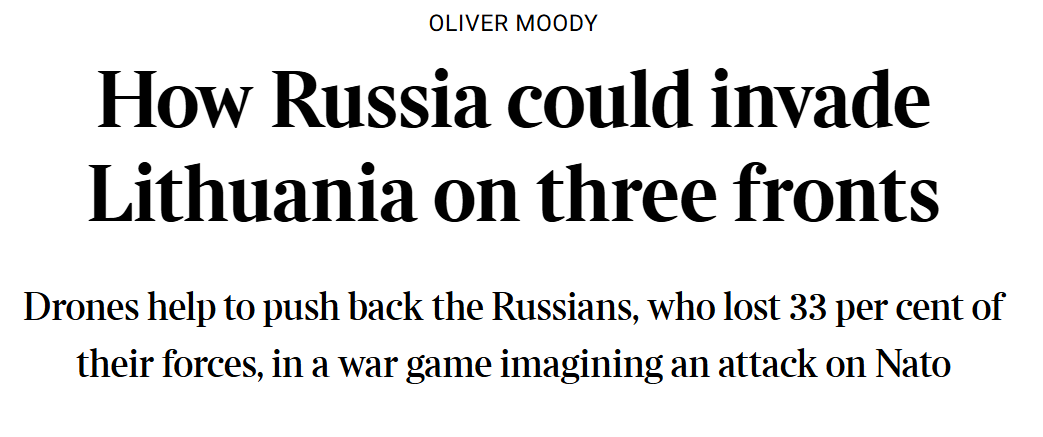
A new war game funded by European “artificial intelligence defense firm” Helsing has claimed that Europe could wipe out a sizable portion of the Russian “invading army” with drones in mere days, as written up by The Times:
They imagine Russia attempting to launch a three-pronged invasion of Lithuania from Kaliningrad, Belarus, and Russian territory to the east:
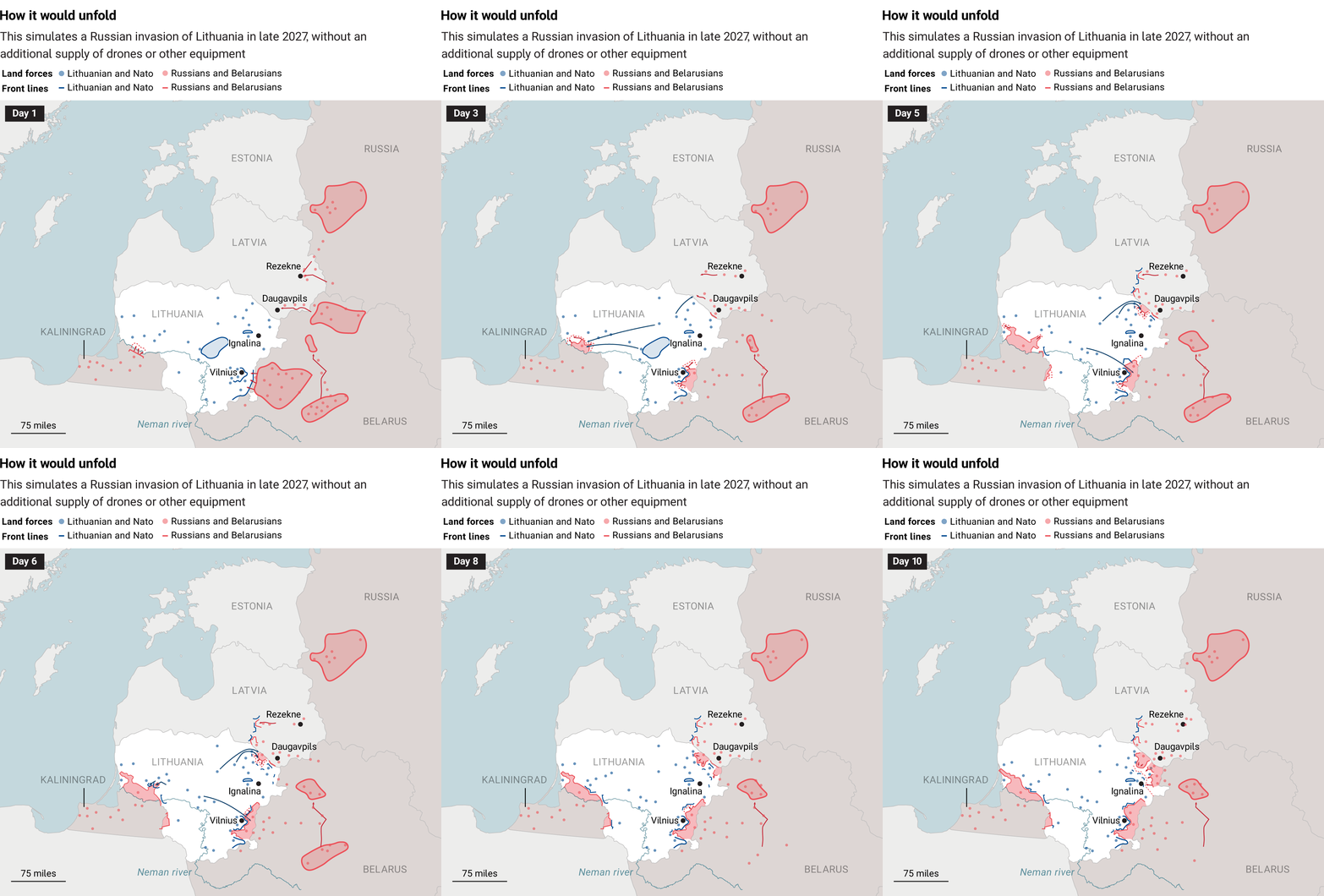
The humorous fact comes next when they reveal that the invasion was only unsuccessful after the “defending” Germans and Lithuanians were armed with Helsing’s own proprietary drones, which stopped the first phase of the Russian advances dead in its tracks…how convenient!
In a scenario where the starting conditions were identical but the Lithuanians and the Germans began the war with 12,000 of Helsing’s HX-2 “kamikaze” loitering munition drones apiece, the first phase of the Russian invasion was effectively a busted flush.
With a range of about 60 miles, weighing a little more than a 12-month-old baby and stooping to the kill at roughly the same speed as a golden eagle, these contraptions are essentially intelligent flying bombs, typically carrying a payload of shrapnel or a warhead strong enough to hammer through the armour plating of a Russian tank.
The selling point is not so much any of these details as the AI guidance system behind them, which can carry the drone to its target even when electronic warfare knocks out conventional navigation tools.
For those that didn’t twig it: a British drone manufacturer runs a war game that concludes the only way for Europe to win is—you guessed it—for Europe to buy tens of thousands of that very drone manufacturer’s massively price-inflated drones.
You can’t make this up.
The next paragraph is even richer, admitting the drones proved worthless in Ukraine:
The drones have been used on the front line in Ukraine for about a year. At first, an official in the German defence ministry leaked an internal report that suggested the first batch had misfired roughly three times out of four under intense Russian jamming.
But now things are different: they claim they’ve improved and are hitting “60-80%” of their targets. Do you believe them?
Certainly the exercise couldn’t merely be a PR stunt for the firm in question to sell more of its worthless junk, could it?

Nah, it’s too cynical a take!
NATO has been conducting all kinds of exercises of late, including “Cold Response 2026” near the Arctic, wherein the sluggish and overladen American Marines did not fare well:
The latest glimpse into the West’s involvement in the Ukrainian conflict came from a new CNN segment that showed off the Ukrainian “PRISMA” battlefield management system which leverages Palantir’s AI data centralization to allegedly give Ukraine a total battlefield view of everything that’s happening even over Russia itself:
Analysts have derived from the footage that Palantir’s technology likely uses sophisticated AI tracking of Russia’s air defense systems to inform Ukrainian drones of optimal flight paths deep into Russian territory—and that’s only a tiny fraction of what the system does.
But ultimately, it’s not much different from the various systems like DELTA which have been used in Ukraine since the beginning, leveraging AI detection and satellite image collation to expedite the process of target allocation and generally improve the entire kill chain. This new CNN video only really drew gasps from the fact that it showed tracking of Ukrainian Lyuti OWA-UAS over Russian territory proper, which somehow feels more ‘threatening’, despite the technology being no different than before.
Of course, some will draw attention to the fact that Ukraine appears to have had more success in such deep strikes of late, which would seem to imply that such Palantir systems must be integral to the recent uptick—and that could very well be the case.
What is often ignored in such discussions of Western preparations for war, however, are the costs being borne by European leaders and systems of governance. Just in the past week alone we heard news that Starmer could finally resign as over 70 MPs recently called for his resignation, sparking fears of a “civil war” in the Labour Party:

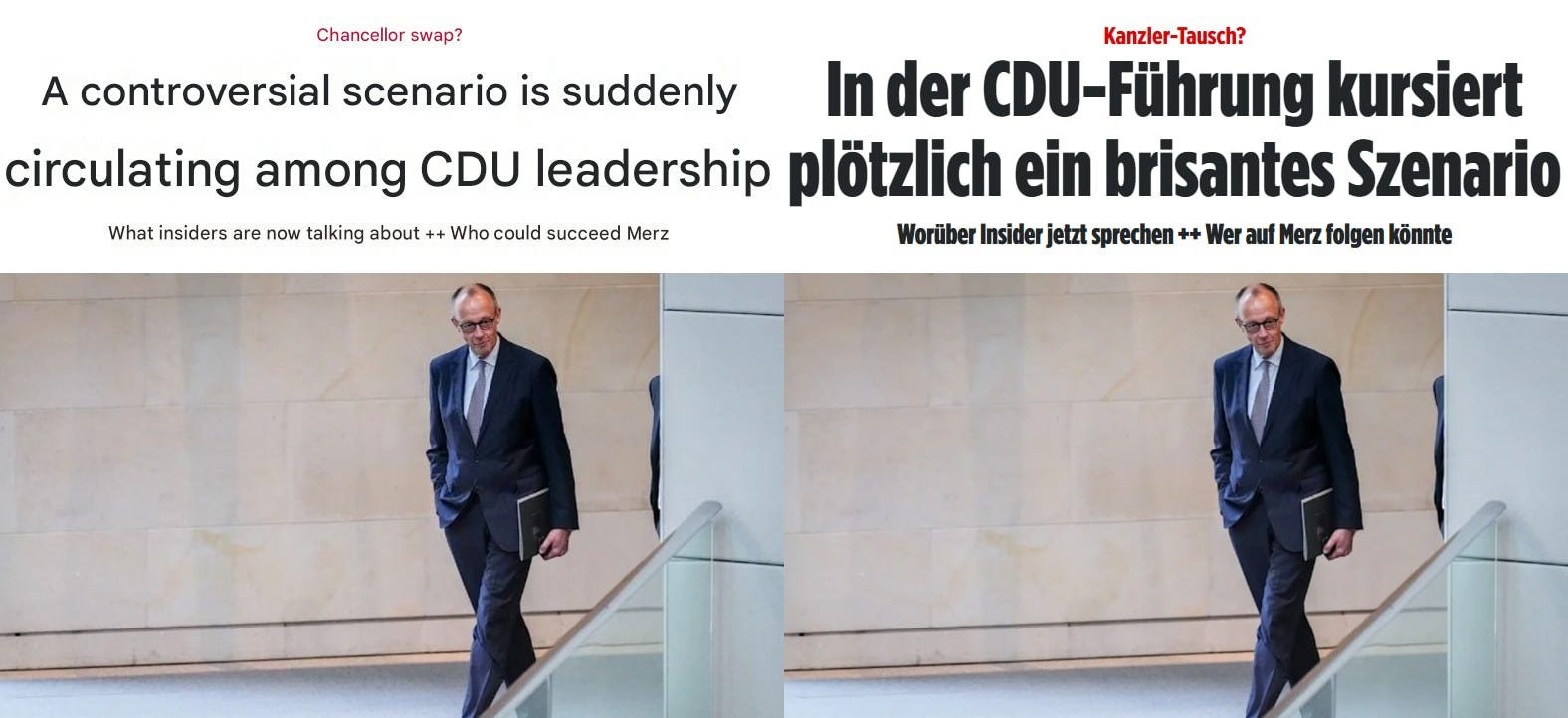
At the same time, Germany’s Merz is in danger of being “replaced” due to his disastrous public image and overall political downfall:

BILD reports how the CDU is plotting to oust him:
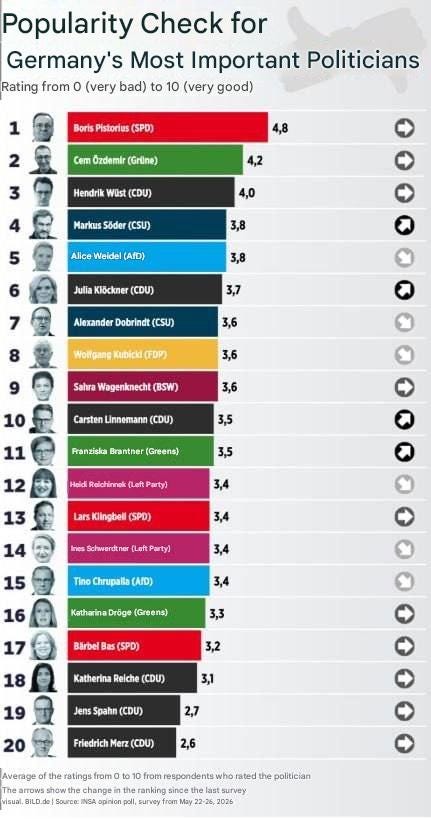
Merz even unprecedentedly sank to the bottom of the barrel in a German political opinion poll:
Let us also be reminded that for the past couple days France has been engulfed by riots once again, leaving cities looking like war zones:
All this turmoil in European countries happens at a time when we’re to be convinced that it is Russia which is deteriorating and failing, and Putin who is nearing some ‘precipice’ of his own political collapse. That is the main missing ingredient from all the faulty analyses of Russia detractors: the understanding that no matter how “badly” Russia may be doing at any particular moment, its adversaries are facing even worse circumstances, and even less favorable social, political, and economic outlooks.
Granted, it’s fair to argue that a “united” Europe of ailing and failing nation states could potentially still collectively out-muscle Russia—no matter how diseased and deteriorative each independent country is, together they still pose a threat. Ukraine’s recent drone surge, after all, appears to be largely a consequence of European investment and manufacture backstopping.
A slew of recent British articles point to Putin’s purported decline in Russia—an obvious MI6-managed info campaign:
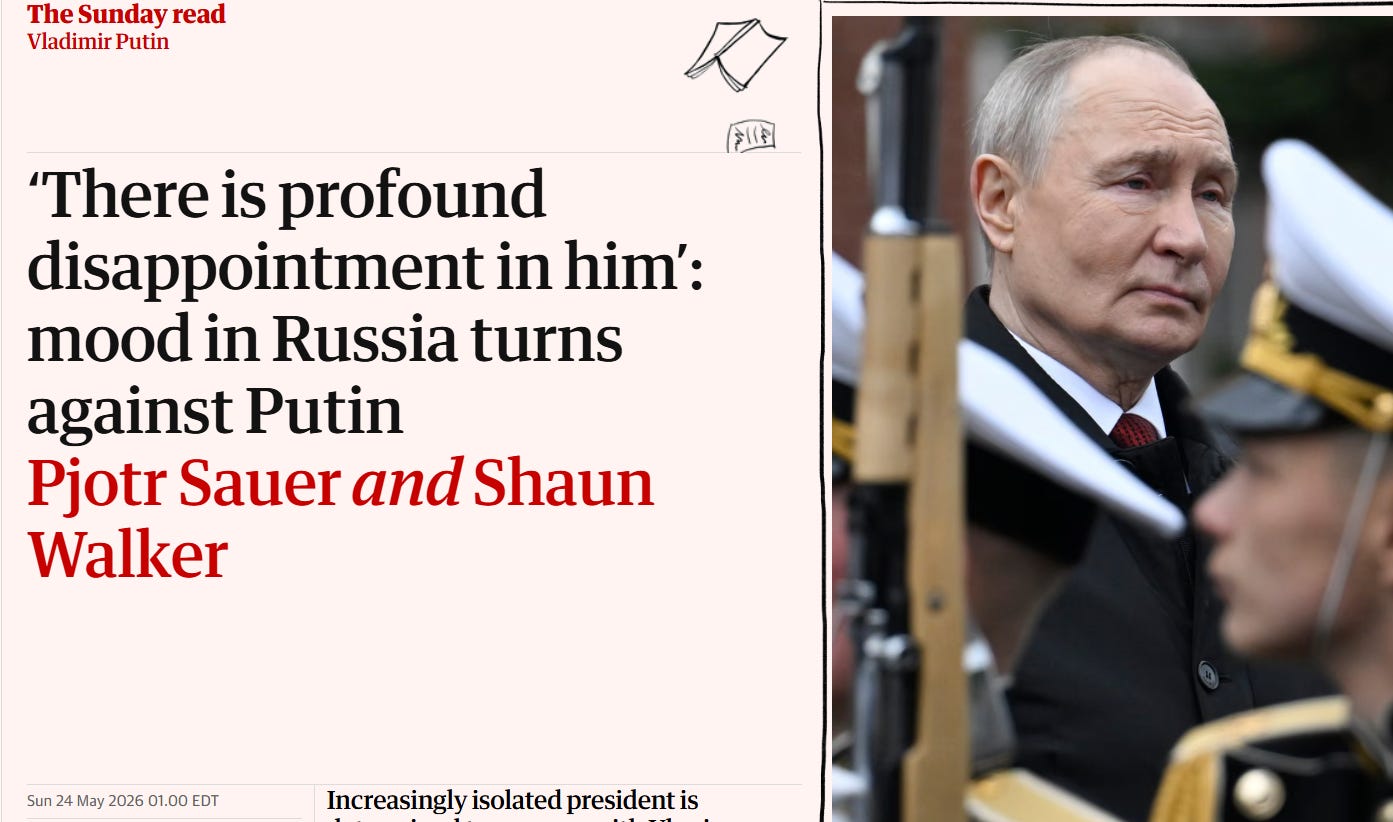
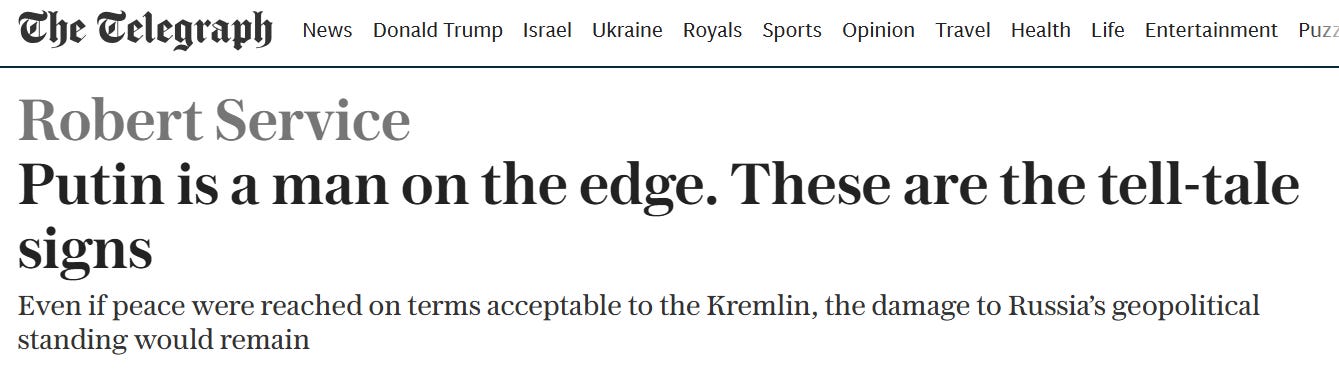
They all intimate the same thing: Russia’s “elites” are turning on Putin; Putin is a man on the edge, teetering on crisis, etc., etc. There isn’t a single shred of evidence for any of it beyond the usual increased tones of ‘concern’ amongst the Russian commentariat about Ukraine’s recent recharged strike campaign.
Emblematically, in the Telegraph piece above, the most “substance” they could provide in support of such claims is in their conclusion of the last few paragraphs that Putin is getting “older”—which is supposed to invoke some kind of ominous portend, rather than being the jejune statement of a groping hack that it really is:
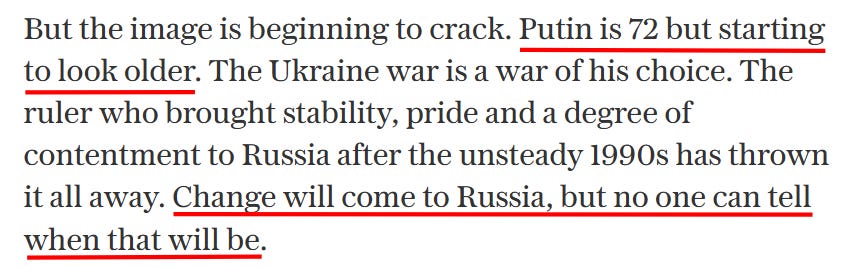
The last sentence above is also representative of the desperation in these MI6 narratives: “Change will come to Russia…we have no clue when, but trust us, it’s coming!”
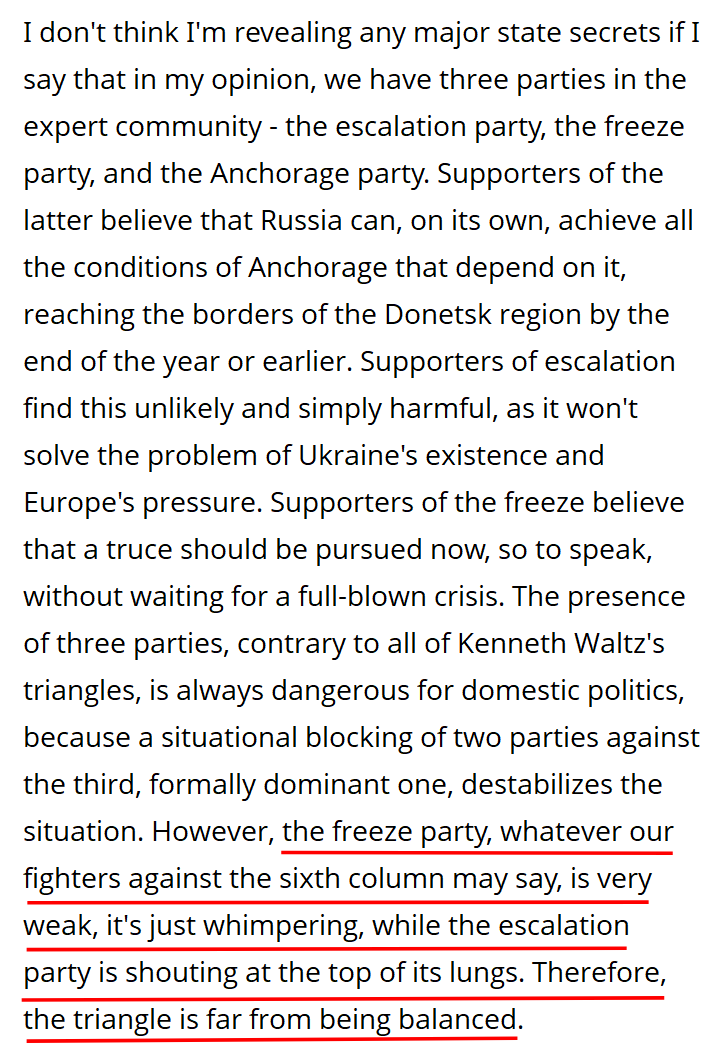
One Russian analyst aptly described the current Russian climate as follows—from a summary by Brian Mcdonald:
Conservative Russian political philosopher Boris Mezhuev writes that Moscow’s expert community has split into three camps over the Ukraine conflict: the “party of escalation,” the “party of freezing,” and the “party of Anchorage.”
The “Anchorage party,” he says, believes Russia can fulfil the relevant conditions from the Anchorage framework, allegedly agreed with Trump last summer, by reaching the borders of Donetsk Region by the end of the year, or earlier.
The escalation camp considers this unlikely and harmful, insisting that it wouldn't solve the problem of Western pressure on Russia. So it wants to adopt a more aggressive approach.
The freezing camp believes Moscow should agree to a ceasefire now, without waiting for the situation to deteriorate, and call victory along the current front lines.
Mezhuev concludes that the freezing camp is very weak, while the escalation camp is making its case “at full volume.”
As a last take, the anti-Russian, ex-BBC writer Leonid Ragozin accurately summarizes the current dynamic in the most impartial way I’ve yet seen:
Ukrainian drone forces have managed to cripple Russia supplies in the occupied southeast of Ukraine and cause fuel shortages in Crimea at the start of the tourist season.
This success is directly affecting Russian offensive, as well as defensive, capabilities in Zaporizhzhia region where Ukrainian forces are visibly building conditions for counter-assault operations.
A real achievement compared with the much advertised strikes on oil depots that produce beautiful TV pictures but their economic impact is questionable, as per the latest analysis by Reuters and Meduza.
The Russians, judging by their public analysis, are going to respond by scaling up anti-drone defences and possibly escalating strike on the critical infrastructure in large Ukrainian cities.
Zelensky’s government is trying to build a case for American military support in the anticipation of GOP defeat in midterm elections this fall.
Its PR surge in the media over the last couple of months, aimed at creating the perception of a “turning point” in war, has been barely grounded in reality so far, but now this is something tangible which the Russians will need to some time to overcome.
The head of the Russian-imposed administration in Crimea, Sergey Aksenov, has promised to tackle fuel shortages in Crimea within 30 days. Watch this space in July.
Virtually everything stated above is accurate: Ukraine’s previous strikes on Russia’s oil refineries have mostly been PR spectacles, as I’ve outlined in detail in the last premium piece. However, the new spate of strikes on Russian logistics along the Crimean corridor have taken a tangible bite.
But he is also correct in noting that Russia has already begun to respond to the latest Ukrainian campaign by organizing new anti-drone fire patrols as well as rumored construction of net ‘tunnels’ along key corridors, which had lagged until now. Also, as he hints, Russia was rumored to consider a new deep strike campaign against civil infrastructures in Ukrainian cities to help paralyze the AFU’s logistics in the same way Ukraine is attempting to do.
In short, Russia has already begun organizing defenses and responses, and the new Crimea “drone scare” will likely again wither from news cycles in a matter of weeks, until a new PR holdfast can be secured to ply the narrative that Ukraine is gaining some kind of ‘initiative’.
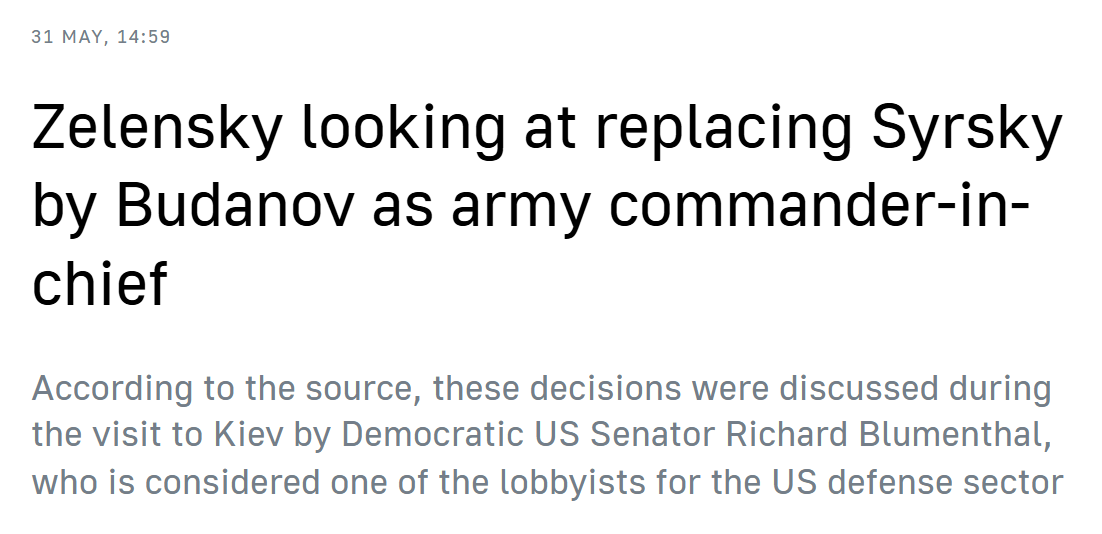
In the meantime, TASS reports that Zelensky is considering removing Syrsky and replacing him with Budanov as C-in-C of the Ukrainian Armed Forces:
—
To circle back, as a bonus, Ukrainian outlet RBK reports that Russia is increasingly working on drone swarms:
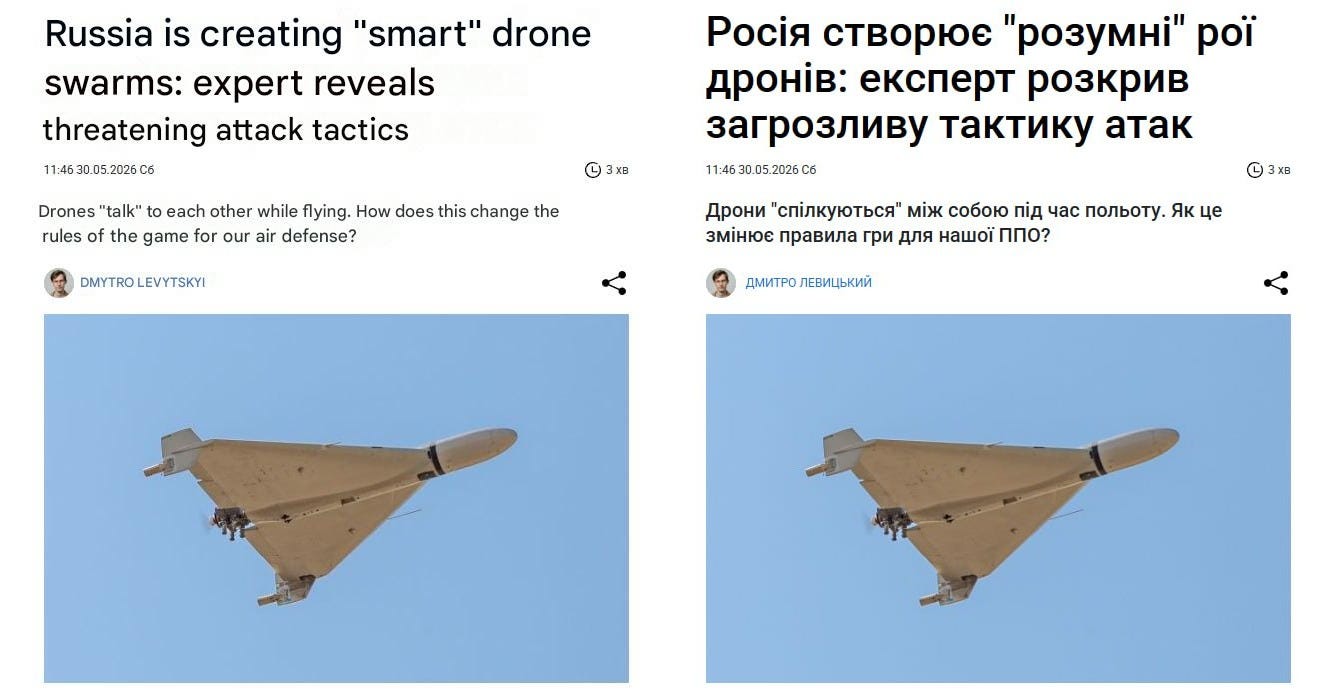
Why they consider this a particularly dangerous development:
Why swarms of drones are more dangerous than missiles
Unlike cruise missiles, which follow a pre-set route, modern drones are able to flexibly adapt to the situation in the sky. Thanks to the introduction of mesh communication, Russian UAVs can transmit information to each other directly during the flight, the expert explained.
In practice, this is how it works according to the expert:
How does it work? If the first vehicles in the group are intercepted by a Ukrainian mobile fire group or an interceptor drone, they notify the operator and the drones behind them. To do this, there is even a special chat bot in Telegram.
“The next drones change their trajectory, bypass this particular place, because there is a threat here,” Khrapchinsky said.
In addition, some modifications of the Shahids are now equipped with electronic intelligence equipment. This allows them to independently detect Ukrainian radar stations or electronic warfare systems and be guided to them by the emitted signal.
The last part about Geran drones being equipped with radar detectors recently is true, as has been confirmed by Ukraine’s own Sergei ‘Flash’ Beskrestnov.
The expert tells RBK:
According to Khrapchinsky, the classic rule of air defense “saw and destroyed” in countering swarms of drones is no longer effective. In modern Russian attacks, groups of drones have a clear distribution of roles:
some carry out direct reconnaissance;
others work exclusively as communication repeaters;
some of them are designed to counteract Ukrainian aviation, which is trying to shoot them down.
For an effective fight, Ukraine needs a “smart air defense system”that will primarily knock out repeaters.
On that note, famed Azov neo-Nazi Andrey Biletsky described how Russia will likely quickly adapt to the lack of Starlink, though the adaptation will never quite match the original:
Giorgi Revishvili@revishvilig
General Biletsky, Commander of Ukraine's 3rd Army Corps: After Starlink was blocked for Russian forces, the gap between their effectiveness and ours narrowed dramatically, because replacing Starlink as a battlefield communications system is practically impossible. 1/15
2:07 PM · May 7, 2026 · 176K Views
14 Replies · 393 Reposts · 2.56K Likes
He states:
The only thing that can replace Starlink is another Starlink. Therefore, Starlink’s influence on the course of the war right now is enormous. Over the past two weeks, the effectiveness of Russian strike operations has significantly deteriorated — by approximately 20–40%.
Within one or two months Russia will partially improve their effectiveness through other means — Russian communication satellites and so on (ed: mesh systems, as well).
However, they will never be able to fully restore the same level of effectiveness they had when using Starlink, at least not in the foreseeable future. I do not think we are talking even about the next three to five years.
In the end, territorial control is determined only by infantry — not by equipment, not by drones, but only by infantry.
Only infantry can seize the critical points that matter in war: territories, settlements, road junctions, crossings, elevations, and other positions that provide control over vast areas. Through this, tactical and operational success is achieved.
Well, you heard it from the man himself. No matter the level of gizmos, infantry remains irreplaceable for the foreseeable future—and infantry is precisely what Ukraine lacks most.