Russia at the Crossroads as Elites "Sour" of Putin's War? Not So Fast
As a continuation of yesterday’s piece on Ukraine’s increasing escalations by way of “blurring the lines” of the conflict by potentially launching attacks via third countries, we will examine the ramifications of this process, should it continue to develop along the same track.
But first, we will address one of the most popular topics currently making the rounds apropos the Russian conflict: that of Russian elites supposedly increasingly “souring” toward the war. This was most notably discussed in a recent WSJ piece which covered the topic in about as impartially credible way as can be done by a Western press outlet:
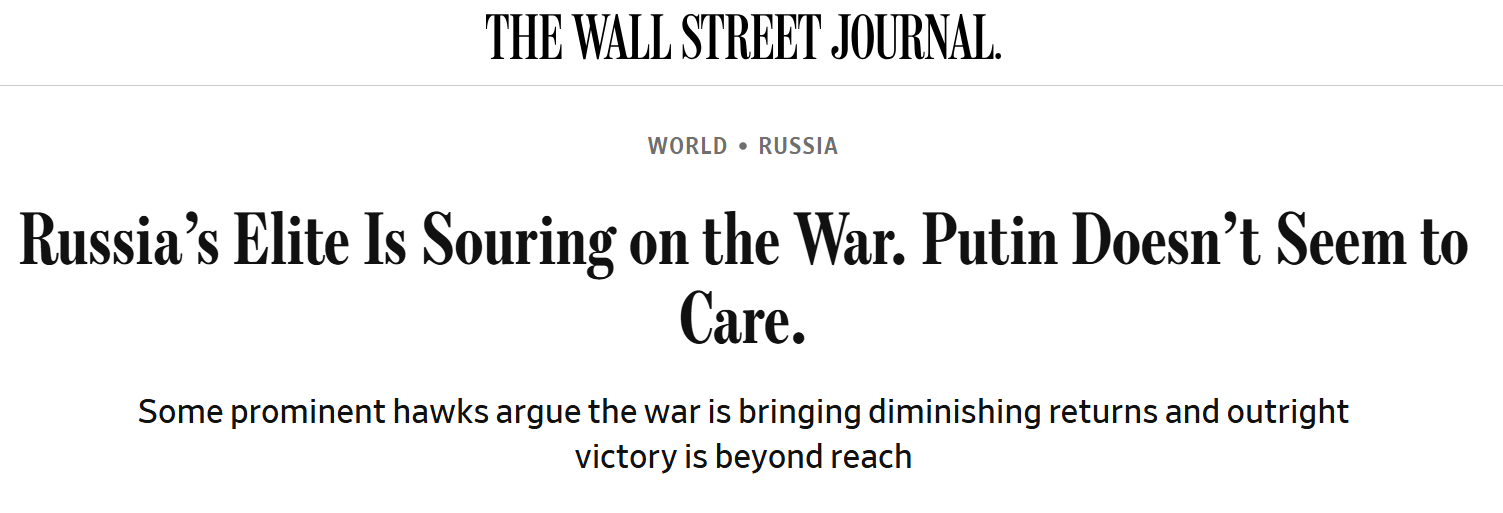
It notes that several high profile Russian figures have admitted that Russia’s aims in the war are no longer possible to achieve. Popular figure Oleg Tsaryov, for instance, wrote in his Telegram last month that Russia should just end the war now and declare victory, as standing up to Europe and regaining most of Novorossiya is alone already a victory.
[They wanted Russia] to be isolated. Turned into a pariah. But it didn't work out. On the contrary. Thanks to Russia's resilience, the West has lost its monopoly on controlling the world. Looking at Russia and China, India and the global South have become bolder in defending their national interests. Russia has shown that one doesn't have to obey someone else's dictate. Thanks to Russia, the world has become multipolar.
And the West, as a result, has fallen apart. A crisis in Europe. Parties that supported the war against Russia are losing ratings. The US and Europe are at loggerheads.
Having stood our ground, we have won. We should proceed from the fact that we have already won. Our task is to end the war and hold on to the gains, build a prosperous Novorossiya.
The biggest plus from the end of the war is that our defenders will return home. We will stop losing Russian lives. All plans to "bury" Russia have failed. We've paid a high price. But we've stood our ground and brought our land and our people home. For the country, this is a victory.
What made even bigger waves was a piece written by Russian political scientist Vasily Kashin. In it, he likewise views a peace settlement based on the Anchorage formula as being a major victory for Russia, given the alternative.
What is that alternative?
He credibly argues that dreams of major military victory over Ukraine are unrealistic at this point because the power disparity between the entire West which backs Ukraine and that of singular Russia is simply too vast:
Power ratio of the parties
The SVO is being conducted on the territory of Ukraine, it is supported by fifty developed economies of the world, and Russia’s allies are the DPRK and Belarus. Taking into account the Western assistance attracted (both in equipment and in monetary terms), Ukrainian capabilities are approximately equal to the Russian military budget and exceed Russian expenditures directly on the SVO. Ukraine has a smaller population, but it is carrying out a general mobilization, while Russia has carried out only one wave of mobilization of three hundred thousand people during the war. Therefore, in terms of human resources, the capabilities of the parties are comparable.
Russia has superior firepower and air defense capabilities, but Ukraine, with access to Western capabilities, has an advantage in important areas such as tactical intelligence and communications. The use of drones, a key weapon in this war, is at a comparable level between the two sides.
Thus, the war is between comparable opponents. Historically, such wars have rarely led to the complete destruction of one side. Additionally, they can have a long duration, and the goals of the parties in such wars are significantly adjusted based on the course of the conflict. This adjustment is not surprising, and it does not necessarily indicate failure.
But what separates his critique is that he directly responds to the most popular argument from pro-Russian maximalists that once Russia turns up the intensity and switches the SMO to a “full scale war”, things will be different and Ukraine will be handily defeated. He dismisses such fantasies as childish.
War “for real”
Can we achieve significantly better results if, as many well-known authors write, we demonstrate “will,” “start fighting for real,” “stop holding back,” “unite for victory,” etc.? No, we have no solid basis to expect such qualitatively different results. Military planning should be based on the worst-case scenario as the baseline and cannot be based on dreams.
Ukraine is undoubtedly depleting its human resources faster than Russia. However, unlike Russia, Ukraine is operating under a state of war, which gives it greater resilience, allowing the government to control the domestic agenda and use violence to suppress dissent. The Ukrainian economy has been largely destroyed, and Ukraine’s economic growth is largely artificial, relying on external funding for military purposes. However, as long as the European Union continues to fund the war, this is not a significant concern. The criteria for resilience applied to a typical war-torn nation relying on its own resources do not apply to Ukraine. The Ukrainian authorities can withdraw much more of their population from the economy and lose much more of it on the battlefield than a “normal” country.
We see growing difficulties with mobilization and an increase in attacks on TSK employees in Ukraine, but so far this has not escalated into any coordinated protest actions, even at the level of individual regions. There is no reason to predict that this will happen in the foreseeable future. We must assume that Ukraine will continue to hold the front for several more years.
Equally, we have no reason to expect that the positional impasse in the war in Ukraine will be overcome in the foreseeable future. So far, no tactical or technical solutions have been found that would give us a chance to return to mobile warfare in the face of the transparency of the battlefield and the massive use of FPV-drones in the absence of effective countermeasures.
There is no reason to expect the rapid development of technical means and tactical techniques that would allow for a deep breakthrough of the enemy’s defenses. It is possible that such techniques are being developed in secrecy, but we can only rely on the information that is available to us. Therefore, the idea that we can quickly collapse the Ukrainian front by “mobilizing, straining, and striking with all our might” should also be discarded and forgotten. The Russian command is operating within the constraints of the situation, trying to achieve the best possible outcome.
He also dismisses the idea of “destroying the Dnieper bridges”, and how that would cripple Ukraine. He believes Russia is already operating at maximum military capacity and cannot realistically cause greater strain unto Ukraine than is already being doled out.
Ultimately, he he concludes the freezing of the conflict along current lines is the only reasonable expectation, given historical precedents.
On the flip side, the Carnegie Endowment’s Russia-Eurasia Center believes the “conflict of the elites” angle is completely overblown.
In a new piece they write that such wishful thinking vastly exaggerated an internal elite squabble that had no real existential parameters:
For several weeks, some commentators have been proclaiming that Russian President Vladimir Putin is losing control, that his popularity is waning, and an open conflict between Russian elite groups is undermining the regime. The main indicator of the system’s instability was supposedly the unusual level of frustration over internet shutdowns in Moscow and St. Petersburg.
Insiders cited by Bloomberg suggested Putin would ease restrictions in the face of pressure from his domestic politics bloc. The Guardian’s sources disagreed, claiming Putin was doubling down because of his total reliance on the Federal Security Service (FSB).
None of this was idle fantasy. Tension within the Russian political system really did grow, but it was not an existential crisis. The conflict over internet restrictions was bureaucratic—not political. It was not a fight for freedom, nor an attempt to seize power. It was a clash between two groups of bureaucrats seeking to protect their interests, and the fall in Putin’s rating was just a weapon in this conflict.
Ultimately, Russia’s security establishment came out on top. The online restrictions have become normalized, and the FSB and the government have been tasked with working together to ensure certain key functions remain accessible.
Their conclusion? Putin and the “security state” won, showing rapid stabilization of any internal quarrels:
In other words, the conflict was settled without endangering the regime. The system was successfully stabilized.
The piece even decries Putin’s recent “popularity drop” in polls as mostly illusory, and more the result of deliberate political maneuvering by opponents in the so-called ‘bureaucracy’.
The virulently anti-Russian Moscow Times agreed with this take:
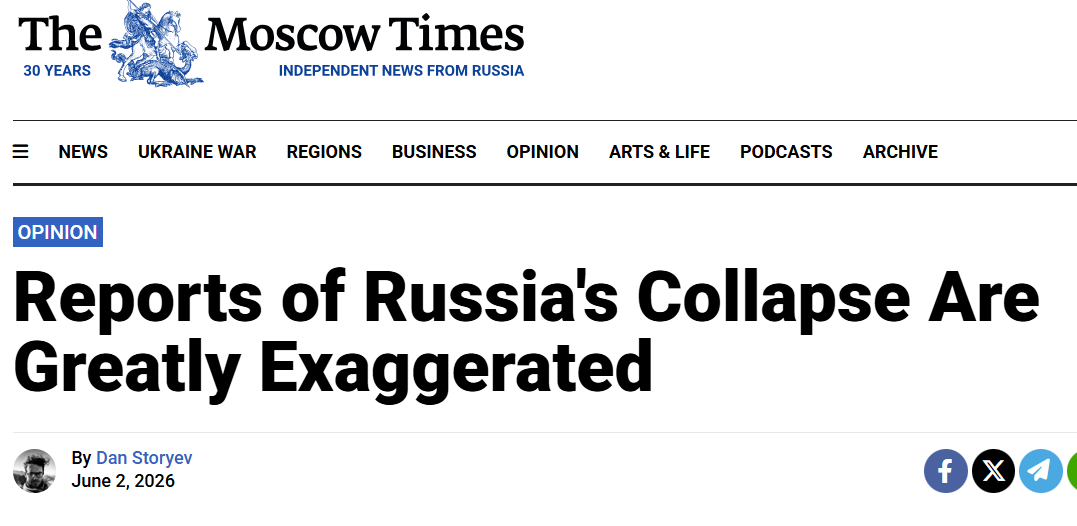
The authors glibly point out that the recurring zeitgeist should be obvious to anyone:
Russia is waging a war against its neighbor. Its economy is overheated and dependent on the continuing conflict, while the country is rapidly growing more authoritarian as political rights are further curtailed.
The date is not 2026, it’s 1999. Or 2008. Or 2014. It doesn’t matter. Each time, Russia did not collapse.
…for some decades, one could see headlines that Russia is either on the brink of collapse or is collapsing at any moment. A 2001 cover story in The Atlantic proclaimed that “Russia is finished.” Recently, a new slew of arguments for Russia’s decline has been spritzed into the discourse, predicting the collapse of the Russian military or even a coup back in Moscow.

They likewise conclude: don’t hold your breath, Russia is doing fine and is building huge inroads with the Global South despite being under historic-level sanctions.
How to reconcile these two sides?
A Western, anti-Russian contingent warns that Russia is not going away any time soon and can keep plying the Ukrainian campaign indefinitely, while an “increasing amount” of Kremlin insiders themselves admit the war may be an intractable stalemate best to be settled as soon as possible.
As I recently wrote about in another piece, another Russian expert considered the Russian hardliners to be the loudest voice, despite the rise of the “defeatist” camp. At the ongoing Russian SPIEF (St. Petersburg International Economic Forum) several other prominent Russian figures unveiled a different, even far more maximalist vision of the Russian SMO.
A retired Russian SVR colonel stated that the country must prepare for decades of conflict:
“We need to learn to live with this war. That doesn’t mean we need to stop everything, stop developing the economy. On the contrary — we need to build our state system and our economy in such a way that they fulfill not only the task of development, but also the task of defense,” Bezrukov said.
Both AI dub and captioned translation of one of his statements:
Russian Secret Agent, Bezrukov who operated undercover in the US for over a decade, tells about the “new type of wars” & “strategy of the West”:
“The West’s strategy is very simple. They gradually increase the degree of escalation. And they will not stop, because they have nowhere to retreat. We are an existential threat to them.
It’s now useless to seize territories, prices have stopped rising & no point in occupying them. This is a war of attrition and devastation. We already see this on our front and in the Middle East.”
This sentiment was shared by Russian figure Konstantin Malofeev, founder of Tsargrad, who outlined multiple possible trajectories for Russia’s future.
Slide summaries:
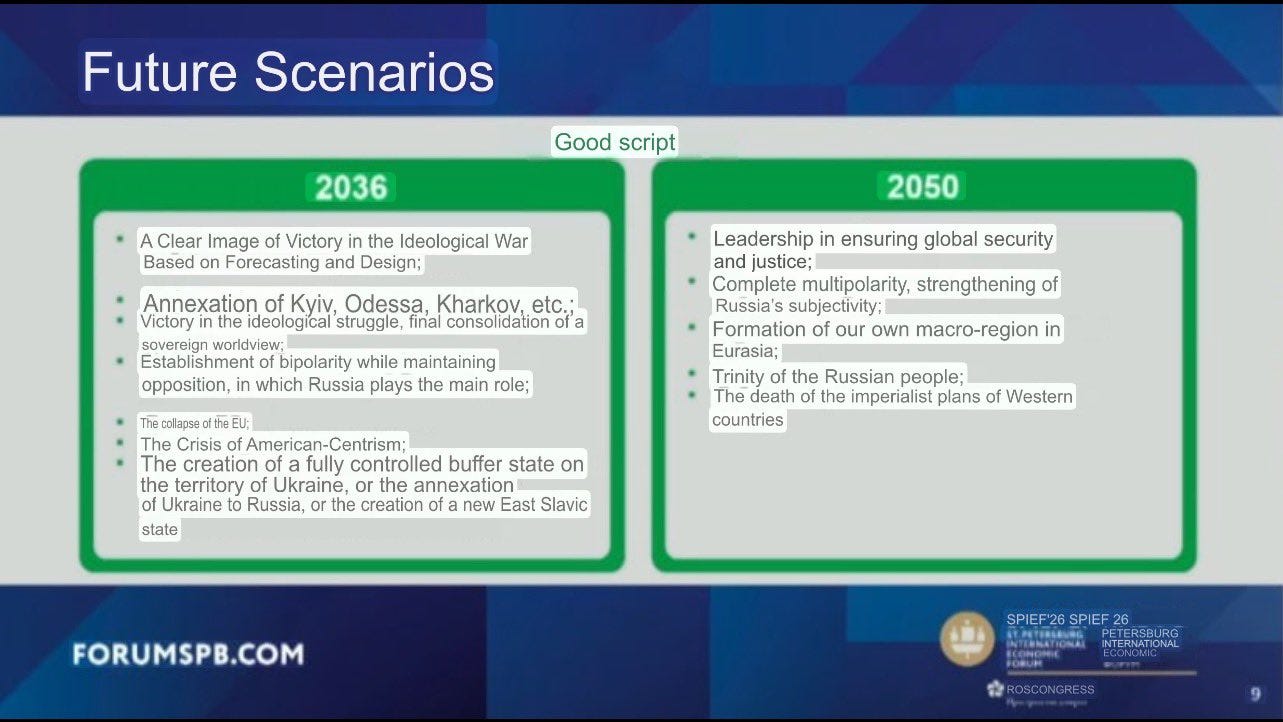
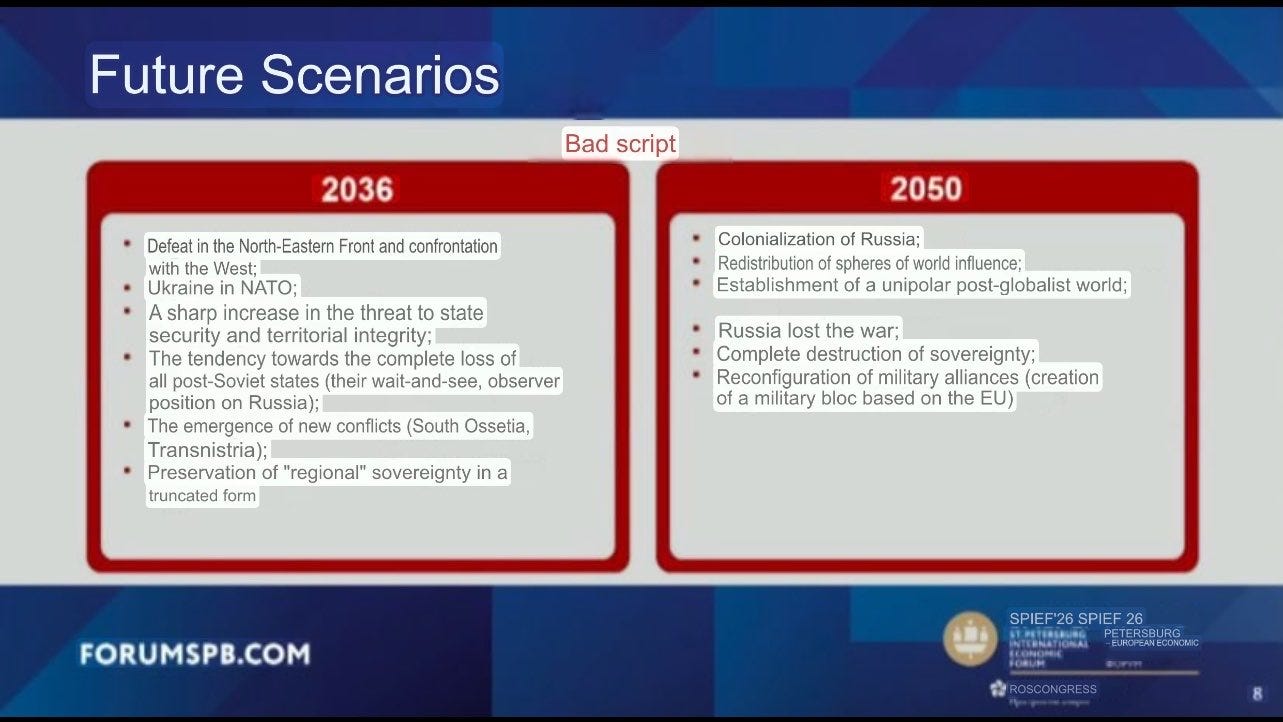
If the above slides are hard to read, here is the transcription of the favorable outcomes.
First, the ten year timeline:
2036
A Clear Image of Victory in the Ideological War Based on Forecasting and Design;
Annexation of Kyiv, Odessa, Kharkov, etc.;
Victory in the ideological struggle, final consolidation of a sovereign worldview;
Establishment of bipolarity while maintaining opposition, in which Russia plays the main role;
The collapse of the EU;
The Crisis of American-Centrism;
The creation of a fully controlled buffer state on the territory of Ukraine, or the annexation of Ukraine to Russia, or the creation of a new East Slavic state
First it should be mentioned that Malofeev is one of the most important “oligarchs” connected to the SMO, as Igor “Strelkov” Girkin started out as his personal body guard and it was said that Malofeev was instrumental in organizing the first uprising which led to the events of 2014 and onward. As such, he should be afforded due attention when he speaks on the SMO’s future.
As can be seen above, he views the timeline as being quite long, with Kharkov, Odessa, and Kiev being seized perhaps by 2036. He appears to see no issue with this as he—and presumably the powerful interests connected to him, and which he represents—believe the conflict is an existential issue for Russia which has no time limit, and must be prosecuted to the very end no matter the costs.
His roughly ~25 year favorable timeline for Russia goes as follows:
2050
Leadership in ensuring global security and justice;
Complete multipolarity, strengthening of Russia’s subjectivity;
Formation of our own macro-region in Eurasia;
Trinity of the Russian people;
The death of the imperialist plans of Western countries
Deputy Head of Russia’s Foreign Ministry echoed this:
“Russia can continue its special military operation in Ukraine for as long as necessary,”said Sergei Ryabkov, the Deputy Head of the Russian Foreign Ministry.
▪️Russia may continue its special military operation in Ukraine for as long as necessary, stated Deputy Foreign Minister Sergei Ryabkov.
▪️He also announced that Russia may resort to the use of nuclear weapons under certain circumstances
➖”Attacks on Russia’s territorial integrity by aggressors in the worst-case scenarios could lead to the use of nuclear weapons,” noted Ryabkov.
▪️According to the Constitution, this also applies to the territories of the LNR, DNR, and the Zaporizhia and Kherson regions, from which Russia demands the withdrawal of Ukrainian troops, the media remind us.
In the earlier statement by ex-SVR colonel Bezrukov, he stated:
“We need to build our state system and economy in such a way that it fulfills both the task of development but also the task of defense.”
What can be clearly inferred is that many top Russian elites, particularly those tied to the state security apparatus (Malofeev himself is also often linked to GRU), envision a generationalexistential conflict for Russia which goes far beyond the mere capture of some nameless “Mala Tokmachka” along the drone-scourged barren front.
We can only assume that Putin is of a similar mindset, particularly given his new statements at SPIEF, wherein he appeared to confirm the maximalist standpoint several times, again reiterating that all objectives of the SMO will be completed, including the taking of Donbass and de-Nazification as well.
In light of this, the CFR’s Foreign Affairs journal published an interestingly astute piece this week:
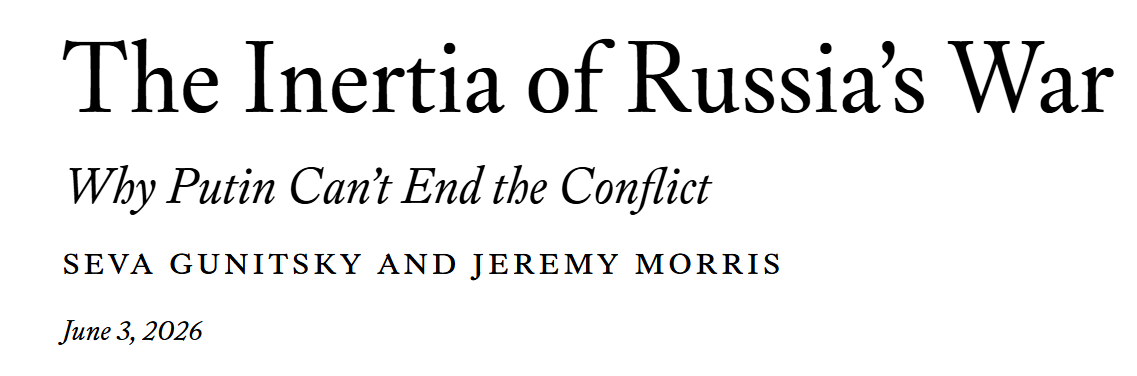
In it, they argue that Russia has retooled its entire economy and society around the war, and this means there is very little chance that Russia can or will bring the war to a close any time soon; its ‘inertia’ is simply too great, and too many critical facets of Russian society are now intrinsically tied to the war’s propagation.
But after more than four years of conflict, Russia’s economy and society have been reorganized around war, creating a powerful set of domestic incentives that makes ending the war difficult, and even dangerous, for Russia’s president.
But if you think the above is a kind of harsh condemnation of Russia, you wouldn’t be entirely in the right. The article notes—albeit somewhat underhandedly—that Russia has in fact benefited remarkably from the conflict, stabilizing its economy and unifying its populace.
In the process, the war has produced a self-sustaining institutional and economic order that constrains even Putin. Russia’s fiscal and industrial base has become structurally dependent on military spending, so much so that entire regions and sectors cannot survive without it. Combat pay and expanded defense wages have given millions of Russians in depressed regions their first real income gains in years.
And an expanding shadow economy—one made up of smuggling and lax customs enforcement—now keeps consumer goods flowing into a sanctioned country, spawning new commercial interests and supply chains around the war that cannot easily be reversed.
The number of enterprises in Russia’s military-industrial complex has roughly tripled since the invasion, and these firms now employ around four and a half million people. War-related manufacturing grew by 20 percent in 2025 alone.
One small but interesting tangent: The article notes that 140,000 veterans have “returned from the war”.
Another source of tension for the Russian state is its growing class of veterans: an estimated 700,000 soldiers will eventually return from the front. Some 140,000 have already permanently come home, and over half a million more will eventually join them. The Kremlin is working to turn former soldiers into a loyal political base; Putin has called war veterans the “new elite.”
Recall how we were told that Russia’s troops are never discharged from the war, and a signed contract is “eternal” until death. This was key in the West’s claims that Russia’s losses are sky high because despite recruiting huge numbers of troops, Russian army’s size does not proportionally grow. I argued since the beginning, Russia was discharging veterans whose contracts have expired, and now we have a strong confirmation from the CFR.
In fact, later in the piece they bafflingly list an even higher number:
In January, Russian state media reported that some 250,000 veterans were unemployed. The story was quickly scrubbed from the Internet, a sign of the issue’s political sensitivity.
So, Russia has 250,000 veterans that have already returned from the war which are likely counted amongst “losses” by Western sources when subtracted from the “in-out” equation of recruitment versus army growth absent recorded casualties?
Getting back, the article aptly concludes:
[Putin] cannot demobilize without setting off a vast unemployment and reintegration crisis. He cannot cut defense spending without devastating the regions and industries that depend on it. And he cannot abandon the narrative of existential struggle without undermining the legitimacy on which his authority rests.
The war may have begun with the decision of one man. But it will end only when the underlying incentives that sustain it change, whether through exhaustion, external pressure, or off-ramps that make peace less costly. Understanding the invisible constraints that limit even the ruler’s choices is the first step toward designing those off-ramps. Too much diplomatic energy has been spent trying to read Putin’s mind. It would be better spent trying to understand the war machine he has built, and the ways in which that machine now runs the country without him.
As you read the above, recall once more the words of Bezrukov:
“We need to build our state system and economy in such a way that it fulfills both the task of development but also the task of defense.”
Note how similar it all sounds to the strategy already well-known to have been chosen by Putin: i.e. the infamous “balancing” act of keeping a low-simmer SMO progressing while still focusing primarily on development of the Russian economy and social spheres.
One researcher even correctly notes of this vision:
What this and other similar arguments miss, however, is that this whole dynamic does not necessarily require a high‑intensity war of the kind we see now. A low‑intensity war, or even better a regulated “cold war” with Europe, would similarly serve the same interests in Russia, but at a lower cost.
Adding to this mix the projections of top Russian figures who envision the war lasting upwards of decades longer, we can conclude the following. That, contrary to fretful doomsayers and ‘concern trolls’, Russia does not view the conflict on a short timescale but is committed to potentially dragging it out for generations—as long as necessary, until all objectives are met. This may seem counterintuitive because it has already effectively surpassed the lengths of both World Wars, but this does not appear to concern Russian leadership presumably because they do not view the war’s continuation as a dire threat to the economic and social fabric of the country, and perhaps even to the contrary at this point—as per the Foreign Affairs piece—a motivating and incentivizing factor for these aims.
At the SPIEF forum, Putin continued to make clear that he believes Ukraine is losing catastrophic numbers of troops via both desertion and as casualties. It’s clear he views—based on the MoD’s internal data projections—that Russia is still effectively demilitarizing the AFU and is leading to its collapse.
The recent spate of desperate calls by Zelensky for ceasefires and “talks” with Putin appear to indicate that Ukraine is doing much worse than it is wont to admit. We cannot be absolutely certain which aspect precisely is causing Zelensky such urgent anguish: the manpower issue, economic woes, political pressures, or perhaps all of the above. But it’s clear that Russia remains poised and confident despite the spate of manufactured crises from “long range strikes”, whose effects are vastly exaggerated by information warfare. And Ukraine is increasingly desperate to get Putin to sit down—with Zelensky making an unprecedented direct appeal to Putin himself earlier today via an open letter, and even more unprecedented attempt to contact Putin privately via back channel, according to some sources:
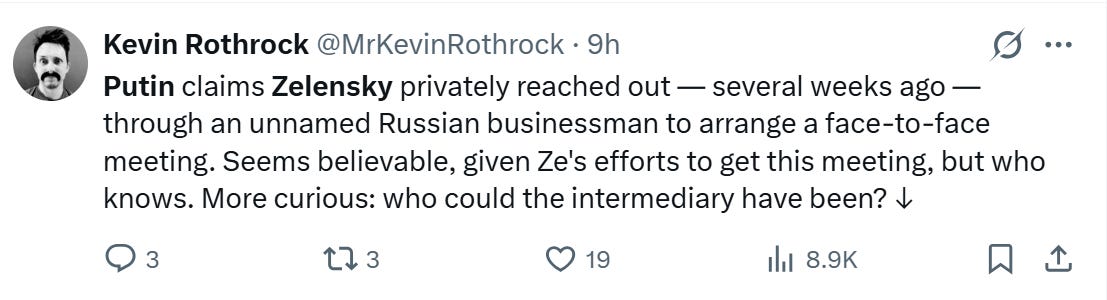
Ukrainian MP Goncharenko revealed that the mystery businessman was Roman Abramovich. Would the “winning” party go to such lengths for a fast settlement?
For those interested, the official “open letter” can be read in its callous entirety here:
At the SPIEF, Putin addressed Zelensky’s pitiful PR letter, whose intention appeared more to insult and offend the Russian president and garner “gotcha” points with Zelensky’s own claque of Euro-stooges, rather than facilitate an actual sit down. As a direct message of Russia’s intent, Putin’s answer to the disrespectful letter was concise—instead of addressing Zelensky directly, Putin addressed the Russian troops with the immortal words: “Work, brothers.”
As a bonus clip, Russian pundit Vladimir Soloviev undressed a Die Welt journalist in his own uniquely characteristic way as regards the SMO:
Granted, I later discovered the Swiss-born journalist, Roger Koppel, is a conservative who actually shares many of Soloviev’s Euro-skeptic views and is partial to Russia, but it’s safe to say Soloviev is speaking to the entirety of the West here.
The full interview has many other highlights, for those interested:
Special thanks to you, the paid subscribers, who are reading this paywalled Premium article—you are the core contributing members keeping this blog in healthy, steadfast operation.
The Tip Jar remains as an anachronism, an archaic and shameless bit of double-dipping, for those who just can’t help lavishing their favored humble authors with a second greedy helping of largesse.