Trump and Rubio Hopeful Ukrainian Deep Strikes Bring Russia to Negotiating Table
Much is being made about Rubio’s new statements during the NATO summit regarding Ukrainian long-range strikes. Both he and Trump appeared to support the idea of Ukraine striking deep Russian targets, remarking that this campaign is creating the “space” for Russia to be brought to negotiations.
But more fascinating is the history behind this sentiment, which reveals a secret behind-the-scenes US effort to give Ukraine more ability to inflict pain on Russia for the purposes of creating leverage against Putin.
Six months ago, NYT released an investigative piece which described how the CIA continued its operations in Ukraine at “full strength” even after the Trump admin’s Pentagon, by way of Hegseth, began to curtail its own role:
In so many ways, the partnership was breaking apart. But there was a counternarrative, spooled out largely in secret. At its center was the C.I.A.
Where Mr. Hegseth had marginalized his Ukraine-supporting generals, the C.I.A. director, Mr. Ratcliffe, had consistently protected his own officers’ efforts for Ukraine. He kept the agency’s presence in the country at full strength; funding for its programs there even increased. When Mr. Trump ordered the March aid freeze, the U.S. military rushed to shut down all intelligence sharing. But when Mr. Ratcliffe explained the risk facing C.I.A. officers in Ukraine, the White House allowed the agency to keep sharing intelligence about Russian threats inside Ukraine.
Now, the agency honed a plan to at least buy time, to make it harder for the Russians to capitalize on the Ukrainians’ extraordinary moment of weakness.
While major US systems like ATACMS were prevented from being used against targets insideRussia, the CIA was allowed to facilitate targeting missions for Ukraine’s own drones deep inside Russia:
One powerful tool finally employed by the Biden administration — supplying ATACMS and targeting intelligence for strikes inside Russia — had been effectively pulled from the table. But a parallel weapon had remained in place — permission for C.I.A. and military officers to share targeting intelligence and provide other assistance for Ukrainian drone strikes against crucial components of the Russian defense industrial base. These included factories manufacturing “energetics” — chemicals used in explosives — as well as petroleum-industry facilities.
After initial failure, the CIA began to coordinate even more deeply with Ukrainian counterparts, resulting in greater successes. And here comes the clincher: they admit that the CIA was essentially responsible for entirely crafting the new strategy, and with Trump’spermission to boot, owing to Trump’s reported exasperation with Putin who he believed was leading him on:
In June, beleaguered U.S. military officers met with their C.I.A. counterparts to help craft a more concerted Ukrainian campaign. It would focus exclusively on oil refineries and, instead of supply tanks, would target the refineries’ Achilles’ heel: A C.I.A. expert had identified a type of coupler that was so hard to replace or repair that a refinery would remain offline for weeks. (To avoid backlash, they would not supply weapons and other equipment that Mr. Vance’s allies wanted for other priorities.)
As the campaign began to show results, Mr. Ratcliffe discussed it with Mr. Trump. The president seemed to listen to him; they had a frequent Sunday tee time. According to U.S. officials, Mr. Trump praised America’s surreptitious role in these blows to Russia’s energy industry. They gave him deniability and leverage, he told Mr. Ratcliffe, as the Russian president continued to “jerk him off.”
Critically, the CIA was then authorized to help in hitting Russian oil tankers as well:
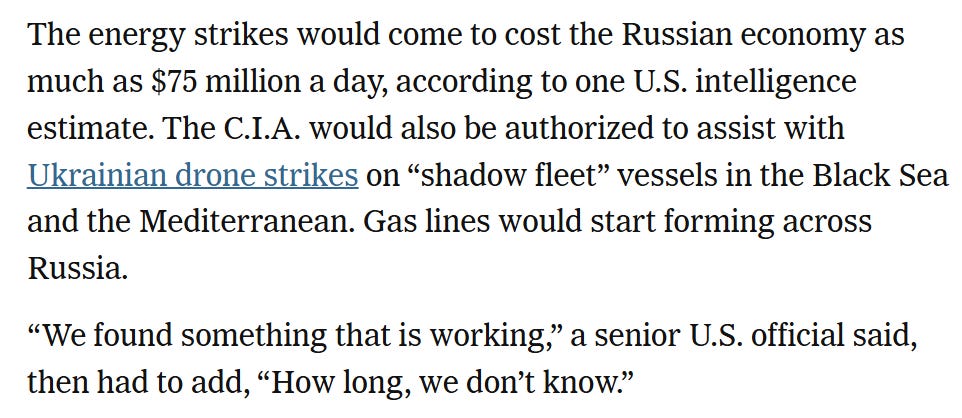
Now NATO is fully backing this campaign to strike the Russian civilian ‘rear’ as much as possible.
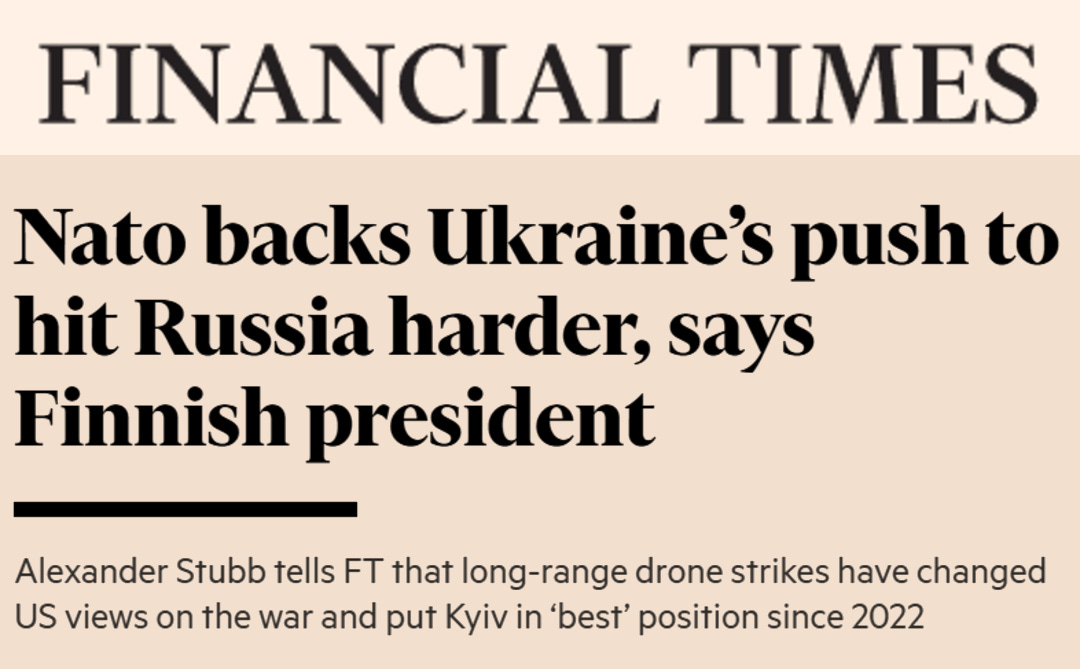
Finnish President Alexander Stubb told FT above that:
“Our reading is that Russia will not end this war due to losses on the battlefield, which of course are colossal,” said Stubb. “It’s not going to be about a declining economy. But it is going to be about a change in public opinion. And public opinion is now changing in Russia.”
Read that again: NATO has apparently decided that Russia can no longer be defeated militarily or even economically. The only way they now deem it’s possible to bring Russia to the negotiating table is by inflicting pain on the civilian population, which they believe will rebound onto the political elite, putting pressure on Putin to end the war. This appears to always be the final equation for the Empire—its last favored standby.
The problem is, as we discussed recently, the Russian population is far more hip to the true contours of global events than the propagandized Western populaces. Russians know they are fighting an existential war led by the West with the goal to destroy Russia completely. As such, Russian people are not being in some way “radicalized” against their own government, at least not in the ways the West thinks.
Here even the Western propaganda organ Meduza reports that a Russian driver affected by the recent fuel shortages expressed anger at the government, but not for the expected reasons:
Meduza in English@meduza_en
A Russian driver spent 39 hours waiting in line for gas. He blames the Russian authorities for the fuel crisis — not because they started the war with Ukraine, but because he thinks they're being "too soft" on Kyiv.
meduza.io
39 hours in line for gas: One driver’s road trip through Russia’s fuel crisis — Meduza
1:09 PM · Jul 3, 2026 · 204K Views
52 Replies · 79 Reposts · 600 Likes
This says it all: “He blames the Russian authorities for the fuel crisis—not because they started the war with Ukraine, but because he thinks they’re being “too soft” on Kiev.”
This is the widespread view of most Russians.
In fact, recently even top “Russian opposition” oligarch Mikhail Khodorkovsky spoke about how Russian society has settled into three chief groups: 15% pro-Westerners, 15% “war beneficiaries” who want Putin to go even harder against Ukraine, and 70% of the main bulk who do want the war to end, but only on Russia’s terms. Even this virulently anti-Russian propagandist is now admitting that the vast majority of Russians, essentially, are peace-loving people who will not accept a surrender, or even the appearance of one.
“We have a lot of pressure on President Putin. I don’t think he likes what’s going on,” Trump said. “But I talked to President Putin a lot. He wants to end the war.”
We can deduce that Trump wants to operate under maximal plausible deniability in order to bring leverage onto Putin and Russia while still being able to play coy and pretend the US is not fully involved.
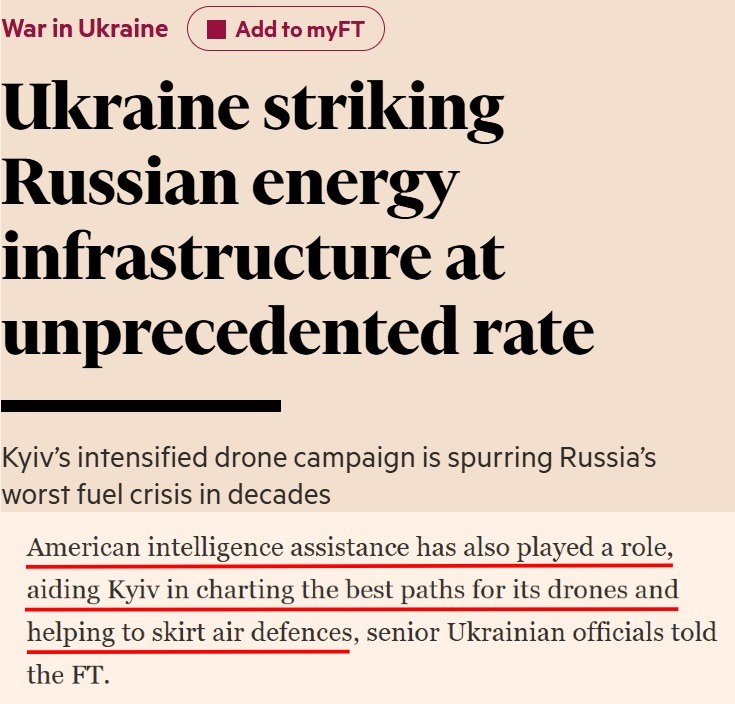
The latest FT piece likewise quotes Ukrainian officials with saying that American intelligence assistance has been helping Kiev plot the best paths for its drones into deep Russian territory, skirting Russian AD and EW systems:
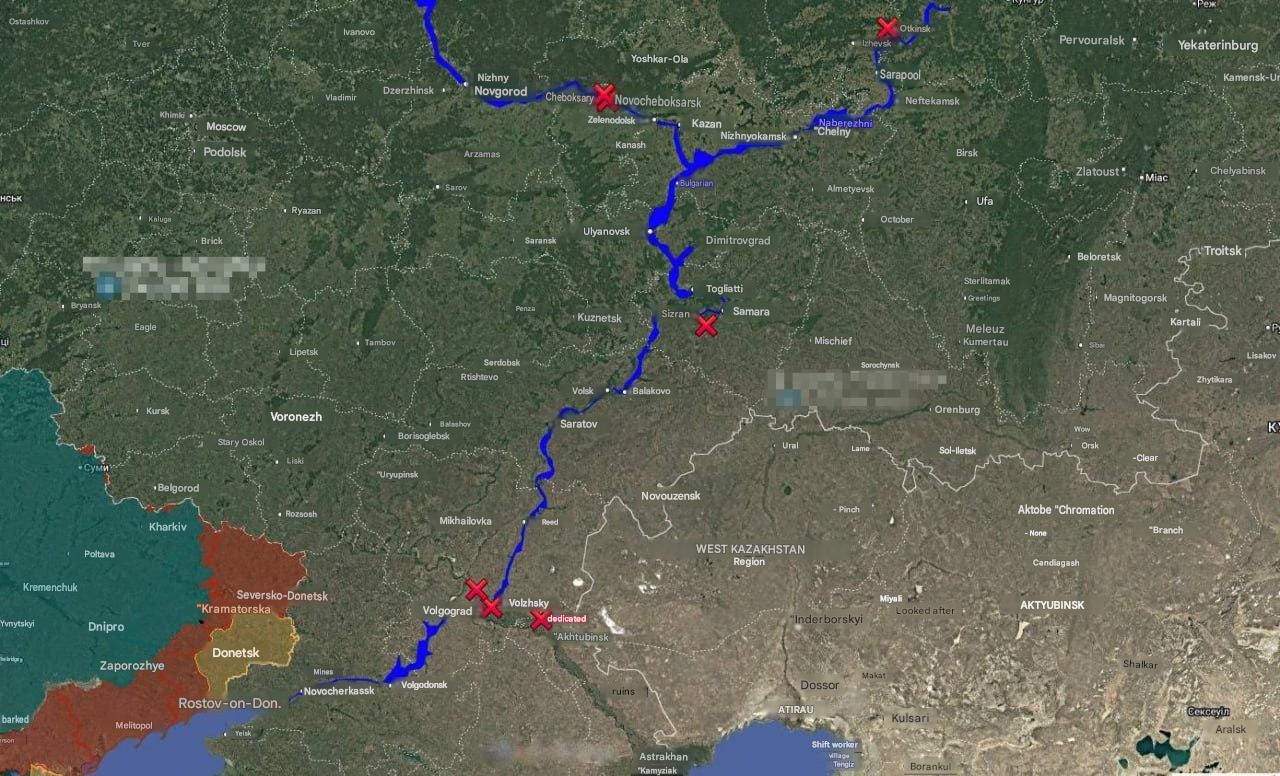
Recently it was revealed that Ukrainian Flamingo missiles have simply been utilizing major Russian river systems to bypass detection, as all the strikes from the heavy Flamingo have occurred along the Volga river:
In the most recent strike attempt, a Russian A-50U AWACS plane was spotted which is said to have played the key role in detecting the Flamingos from above and allowing them to be taken out.
But even Ukrainian experts are not as convinced as popular media narratives suggest that Ukraine has gotten such an upper hand via the latest long-range strike campaign. Ukrainian military blogger and AFU drone operator Oleksandr Karpyuk wrote a new piece arguing to the contrary that Russia has greatly expanded its countermeasures, including blocking Starlink along large sections of the front which cripples Ukrainian long-range strike attempts.
He writes:
2) Strikes on logistics.
This is currently a game-changer, and we’re making the most of this opportunity. But the enemy is actively countering this, and not without success. Some sectors are already blocked from Starlink by electronic warfare (EW) systems, and—unlike those footage clips showing openly parked trailers with antennas being hit—these are now camouflaged. In addition, the “underground complexes” that the Russians are currently building in two tiers clearly have pits where they will deploy this electronic warfare equipment. So far, Russia has only a few such systems, and they are very expensive, but they are gradually stockpiling them. Over time, this will become a problem, because if Starlink is taken out, how many of our drones can fly 100 km using radio communication and successfully hit a target? Not very many. Take the Hornet [attack drone], for example: to have such capabilities without Starlink, it needs a communications module that costs about $15,000. That’s just the communications module—without the drone itself. Are we ordering the necessary number of radio modules under the Military-Technical Cooperation program? I don’t know. But I hope that a balance is being maintained in this regard.
The enemy’s anti-aircraft crews are increasing their effectiveness, and their ability to counter our strikes on logistics is growing. But it’s not enough to block our capabilities. Besides, there’s simply less logistics now, and it’s hard to hit a target that isn’t on the road. Activity in the logistics sector has decreased, and the number of drones required to take out a single target is rising, but for now, we still dominate the air. All of this has a significant impact, which should influence point 1 above.
Even more critically, he argues that unlike the AFU which has put all its eggs in the foreign Starlink basket which could theoretically disappear at any time, Russia is developing its own native comms infrastructures.
Read carefully:
3) The enemy’s game-changers.
Unlike us, who are becoming increasingly dependent on Starlink, the enemy has begun to develop its own communications infrastructure. We have to admit that they’ve made significant progress in building mesh networks using drones. And this is a problem, because we haven’t evolved as quickly in electronic warfare (which, by the way, is no less important for our air defense than interceptor drones). It’s just that the scale of investment in electronic warfare and UAVs is very different, so it turned out that if UAVs are the sword and electronic warfare is the shield, then our sword has become enormous, while our shield—well, it’s more like a buckler, to use that analogy. They’re working on the problem, and I hope that countering enemy drone mesh networks will soon reach a new level. Otherwise, we’re screwed. Because they’re launching all kinds of crap at us—if the mesh network can even slightly increase the effectiveness of what they’re firing at us, then oh boy. In addition, optical navigation systems, object identification systems, and capture/guidance systems are appearing more and more frequently on drones; with each iteration, the enemy is making them simpler and more effective, so we must not underestimate the latest evolutionary changes in Russian drones.
Likewise, former Ukrainian C-in-C Valery Zaluzhny has written a new oped for the Telegraph which even top pro-UA figures are calling a “sobering” reality check:
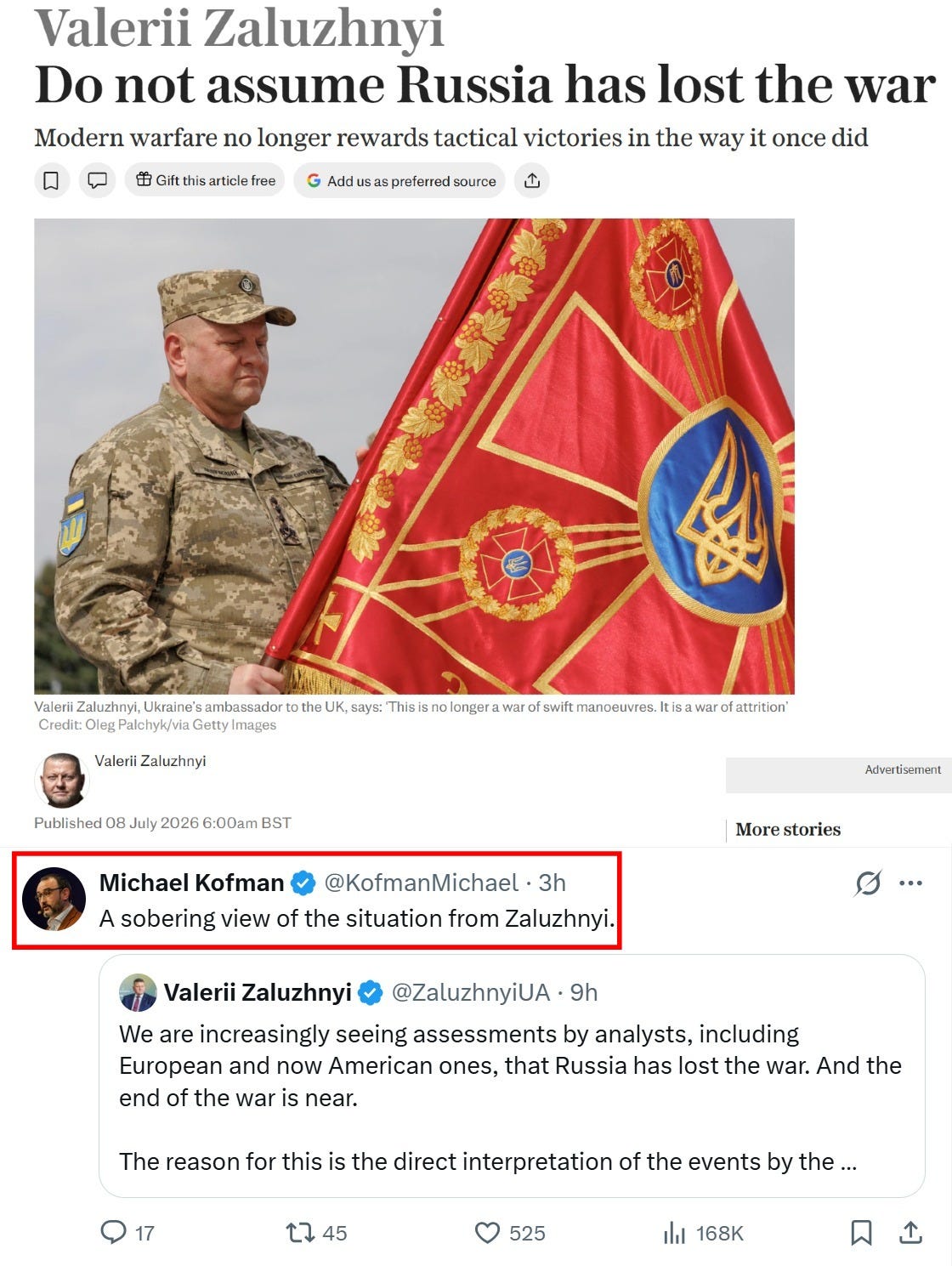
In the piece, Zaluzhny immediately focuses on this latest Ukrainian deep-strike campaign and how it has spawned a total mis-reading of the current war dynamic:
A growing number of Western analysts now argue that Russia has effectively lost the war.
They point to Ukraine’s successful strikes on logistics, attacks on critical infrastructure and the steady erosion of Russia’s military position as evidence that the conflict is approaching its end.
That is a dangerous misreading of the war.
One of the critical statements is that Ukraine’s “effective” strikes come at a major cost to Ukraine itself—not only are the strikes themselves greatly demanding and costly for Ukraine, but Russia strikes back harder:
The same is true beyond the front line. Ukraine’s increasingly effective strikes against Russian logistics and critical infrastructure have imposed real costs on Moscow. But these attacks are expensive, technologically demanding and ultimately reciprocal. Russia retains the ability to strike back with equal or greater force. Neither side can rely on this form of warfare to produce a decisive strategic outcome.
He correctly frames the conflict as now being one of attrition, rather than any tactical advances or PR hits on some enterprise or another. And in that war of attrition, Russia has major advantages:
Moscow understands this. Its strategy increasingly rests not on rapid advances but on exhausting Ukraine economically, militarily and psychologically. Russia still possesses deeper reserves of manpower and industrial capacity in several critical sectors, including ballistic missile production. Air defence alone cannot fully offset that advantage.
He rightly notes that Ukraine’s entire effort is hinged on Western support, and that there are “worrying signs of strain”—which is putting things lightly.
Zaluzhny goes on to mince his words a bit, but essentially implies that the war is now about total societal endurance, and that the only real way for Ukraine to win is via solidarity of the entire combined West by way of NATO. This is correct, which is one of the reasons why Putin had no problem slowing down the battlefield aspect of the war in order to balance the economic and social aspects of the broader struggle for the long haul, betting on the fact that Europe would not be able to outlast Russia politically and economically.
So far, this seems the correct bet, but that doesn’t stop the West from correcting its own approach to now favor hurting Russia precisely at this key crux point: its economy and society, rather than focusing on battlefield losses, which the West has already given up on doing as it has realized all its ‘wunderwaffen’ were proven useless and made little difference in the war.

For Ukraine, the battlefield situation continues to worsen, and this campaign to make Russian society “feel the pain” is all that it’s got left.
Anti-Russian outlet Meduza revealed today that the territorial advancement continues to shift in Russia’s favor, as Russian forces pick up steam along the front once more:
Kevin Rothrock@MrKevinRothrock
4:25 PM · Jul 8, 2026 · 5.98K Views
3 Replies · 23 Reposts · 79 Likes
Now the West is faced with a harsh choice: to save Ukraine it must commit fully to helping Ukraine achieve unprecedented levels of “pain” for the Russian society and economy. But each escalation brings Ukraine itself closer to the precipice as Putin is pressured to take the gloves off more and more.
Some now believe the “siloviki” are in charge and Putin has lost influence. It’s a wishful bit of fantasizing, but if it were true, it means Ukraine will be in for a rough rest-of-the-year. And given that the US and Iran’s war has kicked off again, Patriots will be in short supply at a time that Russia is producing Iskanders like never before.
A final topical video which demonstrates just how far the Europeans are willing to go. Russian GRU operatives “comedians” Vovan and Lexus—under the guise of impersonating former Ukrainian Defense Minister Rustem Umerov—recently fooled Estonian Presidential Advisor Madis Roll into admitting that Estonia is prepared to assist Ukraine in its attacks on Russia.
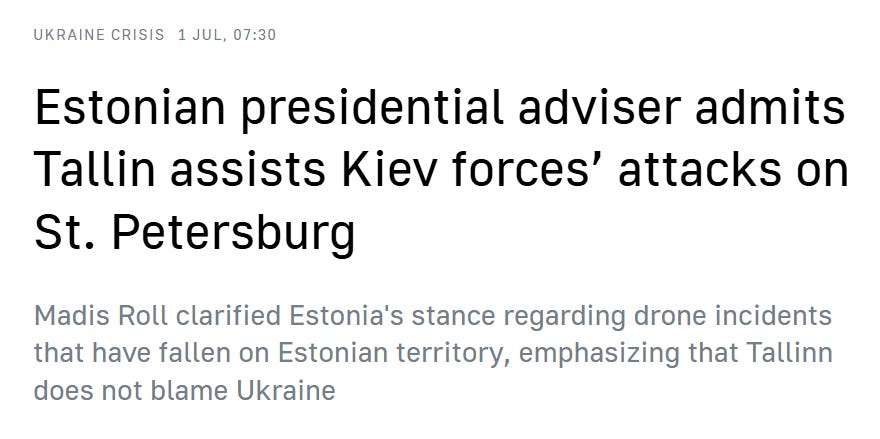
Granted, it’s hard to know for sure what he meant by offering help in “coordinating” such actions, but it’s clear that behind the scenes, the Europeans are much more willing and permissive toward Ukraine than they admit in public.
Why doesn’t Russia “attack Europe” in response? There are many possible reasons, but one of the more likely ones is that Russia is confident of its ability to finish off Ukraine without needing to escalate toward WWIII. The Russian MOD’s internal figures presumably see Ukraine collapsing long before Russia is immiserated to the point of needing some “desperate” nuclear strike or attack against NATO.
But that’s just an educated guess—you can share your own views.
Your support is invaluable. If you enjoyed the read, I would greatly appreciate if you subscribed to a monthly/yearly pledge to support my work, so that I may continue providing you with detailed, incisive reports like this one.
Alternatively, you can tip here: buymeacoffee.com/Simplicius