Rima Hassan is breaking Europe’s Palestine taboos. France put her on trial
Prosecuted for defending Palestinians’ right to resist, the MEP says Gaza has exposed a ‘complete divorce’ between governments and their publics.
On Monday, EU foreign ministers were locked in a tense meeting in Brussels over whether to ban trade with Israeli settlements in the occupied West Bank. Every single one of the 27 member states agreed that these settlements were illegal, yet the measure fell short of the majority needed to force the European Commission to act, with Ursula von der Leyen’s executive continuing to resist.
As those debates played out in Brussels, the politician who has done more than most to force that reckoning among European states was preparing for another court date amid a trial in which she stands accused of alleged “apology for terrorism.”
Rima Hassan was born to a Palestinian father and a Syrian mother in a refugee camp in Aleppo, Syria, leaving her stateless at birth. The granddaughter of Palestinians expelled from the Galilee village of Al-Birwa during the Nakba of 1948, she arrived in France as a child and has since built her political career around the conviction that the struggle for Palestinian liberation belongs as much in Europe as in Palestine.
In 2024, Hassan was elected to the European Parliament representing Jean-Luc Mélenchon’s left-wing La France Insoumise, quickly emerging as one of Europe’s most influential advocates for Palestine. She has led the campaign to suspend the EU-Israel Association Agreement, repeatedly forced debates on Palestine onto the European Parliament’s agenda, and even joined the Freedom Flotilla to Gaza in June 2025. Long denied entry to her homeland, she saw the flotilla as both a means to raise awareness of Israel’s blockade and to put an end to her exile.
Hassan belongs to a new generation of leaders in the Palestinian diaspora who are unwilling to soften their convictions to suit Western sensibilities. It is precisely because of this stance that the French state has deployed the full weight of its institutional machinery against her. Since entering office, 16 judicial proceedings have been filed against Hassan, the majority relating to charges of “apology for terrorism,” all concerning her remarks on Israel-Palestine.
The terrorism-related cases largely stem from Hassan’s public defense of the right of peoples under foreign occupation to resist, a principle recognized in UN resolutions. (The latest, for which she is currently standing trial, revolves around her sharing a post on X quoting Kōzō Okamoto, a Japanese militant who took part in an attack on Israel’s Ben-Gurion Airport in 1972 that killed 26 people. The quote read: “As long as there is oppression, resistance will not only be a right, but a duty.”) At the same time, she has consistently described the killing of civilians on October 7 as a war crime and condemned the taking of hostages.
Thirteen of the cases against her have already been dismissed. Hassan has nevertheless been summoned by police six times, spending a total of more than 45 hours in custody or interrogation. She has attended each summons without invoking her parliamentary immunity, in solidarity with ordinary citizens facing similar prosecutions without the same protections. During her recent detention in April, false claims that she had been found in possession of drugs were leaked to the media, generating a flurry of news reports before toxicology results — already in the prosecutor’s possession — cleared her completely.
+972 sat down with Hassan on July 1, one week before her latest court appearance, to discuss the criminalization of Palestine solidarity in France, Europe’s enduring relationship with Israel, and why she believes Palestine has become a test for Western democracies. The interview has been edited for length and clarity.
You have been the target of multiple judicial proceedings under France’s anti-terrorism laws, including a court summons on July 7. What has that experience been like, and what does it say about the climate in France for people who speak out in support of Palestine?
This is first and foremost a political trial. One of the complaints that led to it came from the [Paris] police prefect, who answers directly to Interior Minister Laurent Nuñez [from the Renaissance Party founded by President Emmanuel Macron]. The second came from a far-right MP [Matthias Renault of the National Rally].
There has also been a clear circumvention of my parliamentary immunity, which is supposed to protect my freedom of _expression_, including on social media. I was elected with the Palestinian question at the center of my campaign, and I have fully owned that. I have always said that Palestine is a European issue and that it would be at the heart of my mandate. And it still is. I sit on the [European Parliament’s] committee on foreign affairs and subcommittee on human rights, where almost every month we have debates, discussions, and initiatives on the Israeli-Palestinian question and the EU’s role in it.
So this is a political trial because of who is driving it, the extraordinary means that have been mobilized, the circumvention of my [parliamentary] immunity, and the distortion of anti-terrorism laws. This has never happened before. I met with the president of the European Parliament, Roberta Metsola, who confirmed that no member of the European Parliament had ever previously been placed in police custody over a tweet.

President of the European Parliament Roberta Metsola meets with speaker of the Knesset Amir Ohana, during her visit at the Knesset, Israeli parliament, in Jerusalem, February 13, 2025. (Chaim Goldberg/Flash90)
Then there is the custody procedure itself. During my custody, the Justice Ministry’s spokesperson participated directly in leaking false information to journalists, feeding the whole media circus around the case.
Some 700 articles were published about my detention. Many were designed to smear me, although some were more honest about the facts. BFMTV [a French 24-hours news channel] alone dedicated 12 headline alerts that day to my detention and the false allegations concerning drugs.
The fact that it was the Justice Ministry’s own spokesperson leaking details of the investigation is frankly staggering for a country that prides itself on upholding the rule of law. This was not just some rogue police officer wanting to take revenge for my political positions. It came from the Justice Ministry itself.
Add to that the surveillance resources deployed against me. They geolocated me and monitored my movements for three months. They mobilized [the French national railway operator] SNCF, Air France, and Europol to trace all my activities. It was completely disproportionate and abusive. It resembles the procedures of a police state. All of this over a tweet.
[One of the reasons] why I have been so heavily targeted in France [is that] I am not just an activist for Palestine. What I am trying to do is break four taboos in the French public debate on Palestine, including on the left.
The first is recognizing Zionism as a colonial ideology. The second is defending the right of return for Palestinian refugees. The third is discussing the legitimacy of Palestinian armed struggle. And the fourth is moving beyond the two-state paradigm and advocating for a single state. Those taboos need to be broken once and for all, and that requires rethinking the diplomatic approach of European states, particularly France, on the question of two states.
Figures on the French right and far right have called for you to be stripped of your French citizenship. What does that reveal about the particular place Palestine occupies in French politics?
The way I think about it is that Palestine is a test for Western democracies. It produces Kafkaesque situations, in which states proclaim their commitment to the rule of law and moral standards, only to find themselves in complete moral and political failure when confronted with the genocide in Gaza. [Faced with that contradiction], they go so far as to turn against their own citizens and elected representatives in order to preserve their political, material, economic, geostrategic, or even ideological support for Israel.

Palestine solidarity activists demonstrate in front of the British bank Barclays in Paris, France, to protest against the bank’s massive investment in Israeli arms and security companies, among them Elbit Systems, January 15, 2024. (Anne Paq/Activestills)
The ideological dimension concerns the far right more specifically, because for them it is above all an ideological alliance. But the French state also has longstanding interests. Israel is viewed as a piece of the West planted in the East, so it receives protection. [France allows Israeli Prime Minister Benjamin] Netanyahu to fly through French airspace. We continue weapons deliveries. We continue to trade. We maintain the [EU-Israel] Association Agreement [the treaty that dictates bilateral relations between the two], which is worth around €45 billion a year, and we continue industrial, scientific, and academic cooperation.
It is important to remember that the question of stripping citizenship is something that was introduced under the Vichy regime for elected officials. It is in the DNA of fascism. So when [former Interior Minister Bruno] Retailleau and others — including several dozen MPs from Macron’s camp, the right, and the far right — called for it to be used against me, I find that very revealing. It shows that Palestine forces those who claim to honour the law and democracy to either persist in defending that [democratic] France, or the masks fall and their true ideology is revealed. And that is what is happening.
But what I found particularly revealing is that they ultimately abandoned the proposal not because they considered it immoral or contrary to democratic values, but because I would become stateless. So it was quite ironic for me to see French politicians who are hostile to me and frequently deny my Palestinian identity — who say ‘You are not Palestinian, you are Syrian. You were born in Syria, so you are Syrian’ — being forced to acknowledge that I am not Syrian after all. Because if I were, I would have dual nationality, and they might have been able to pursue the procedures concerning the revocation of my citizenship.
Since the start of your mandate in 2024, you have led the campaign in the European Parliament to suspend the EU-Israel Association Agreement. Can you walk us through that effort?
During my campaign, I launched a petition calling for the suspension of the EU-Israel Association Agreement under Article 2, which makes the agreement conditional on respect for human rights. It gathered nearly 200,000 signatures in France.
Over the past year, we have worked with many MEPs to push the issue inside the European Parliament. We were systematically met with a political majority that blocked us, and above all a European Commission that refused to hear any of it, and most member states, with the exception of Spain, Ireland, and a handful of others, that wanted to preserve the agreement.

The Israeli and European flags outside the Israeli parliament during the official visit of president of the European Parliament Roberta Metsola, in Jerusalem, February 13, 2025. (Chaim Goldberg/Flash90)
So we turned to a European Citizens’ Initiative, a direct democratic tool that allows EU citizens to formally request action from the European Commission. To succeed, it requires 1 million signatures and minimum signature thresholds in seven member states. Both criteria have been met. We are currently at 1.3 million signatures, and it will be submitted to the European Parliament on July 15. The Commission will then have six months to respond to citizens’ request to suspend the agreement.
There seems to be a growing disconnect between European public opinion on Palestine and the positions of European governments. How significant do you think that gap is?
There is a complete divorce taking place, precisely because we are dealing with democracies that are betraying their own commitments to respecting international law and human rights. They are deploying scandalous tools: disproportionate cancellations of conferences and demonstrations, police raids on activists and associations, and the distortion of anti-terrorism laws to repress Palestine solidarity. All of these tools are indeed fracturing something between public opinion and political leaders.
For me, this is symptomatic of the moral and political panic our governments find themselves in today. Censorship is truly the last resort of those who have already lost [the argument], when they are no longer even capable of engaging with ideas or political debate.
Take the question of a one-state versus a two-state solution. I belong to the post-Oslo [Accords] generation. Oslo was conceived around the time I was born, and I no longer believe in it. It has been obsolete for too long. And yet when a journalist asks [French Minister for Europe and Foreign Affairs] Jean-Noël Barrot: ‘Madam Hassan defends a one-state solution, you continue to say you believe in two states, what do you have to say?’ The only thing the minister says in response is [words to the effect of]: ‘Madam Hassan is dangerous, she is a sower of hatred and she is dangerous for public debate.’ The logic is that I must be silenced.
Everyone is in a moral panic because they have no answer to the substantive questions. They have no answer to whether France is complicit in the genocide. No answer to whether France and the EU are still delivering weapons to Israel. No answer to whether Israel should be prosecuted internationally. No answer to whether arrest warrants against Israeli leaders should be enforced.
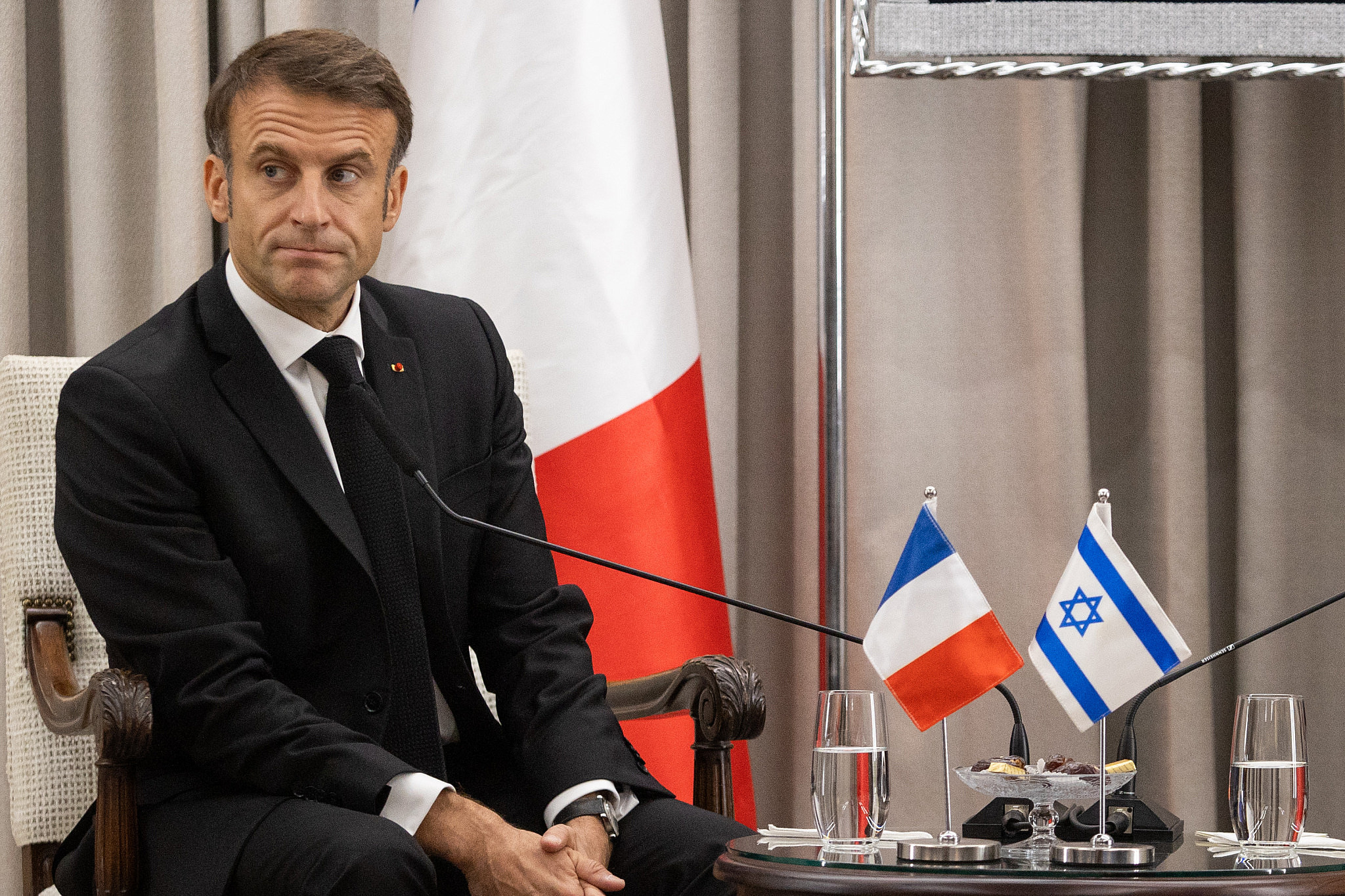
French President Emmanuel Macron during a meeting with Israeli president Isaac Herzog at the President’s Residence in Jerusalem, October 24, 2023. (Oren Ben Hakoon/POOL)
For me, there is a parallel with South Africa. During apartheid, it was international public opinion that did the work of mobilization and contestation. And eventually, governments gave in and suspended cooperation and progressively isolated the apartheid regime until it fell. And it will be the same with Israel.
Kaja Kallas, the EU’s foreign policy chief, has generally been much less vocal about the crimes unfolding in Gaza than her predecessor, Josep Borrell. In that context, do you welcome her recent comparison of Israel to South Africa and her apparent push for sanctions? Does it represent a genuine shift, in your eyes?
It is quite something that I find myself reduced to defending Madam Kallas. I do not think she is particularly sincere. That said, I think she may be starting to open her eyes, because she is being challenged quite regularly.
If you follow the debates in the European Parliament, including in the most recent plenary in Strasbourg, she has come under pressure not only from the radical left but also from centrists, Greens, and Social Democrats to suspend the EU-Israel Association Agreement and impose sanctions on Israel. I think she can see that something is shifting, and of course she also receives reports and briefings on the situation.
On the question of apartheid, it appears she made those remarks believing they would remain private, and the information leaked. But that is precisely the problem.
In my speech at the last plenary session, I told her: ‘Madam Kallas, you should not be saying this in private. You should be saying it here, from this podium, because you have a responsibility.’
Apartheid is not something abstract or merely a political term. It is a crime against humanity. It is defined as such in the Rome Statute of the International Criminal Court. Amnesty International and Human Rights Watch have documented Israel’s apartheid regime in reports since 2021, and the International Court of Justice’s 2024 advisory opinion on the issue has only reinforced that legal assessment.

Israeli soldiers patrolling through the Old City of Hebron, in the occupied West Bank, 4 July 2026. (Mosab Shawer/Activestills)
So we cannot be satisfied with or congratulate ourselves for saying it in private. European leaders have a responsibility to name crimes for what they are. We are supported by the taxes of European citizens. Whether one is an activist on Palestine or not is another question. But honesty in politics requires at minimum referring to the compass of international law, to the reports of international organisations, to the decisions and opinions of international courts. And it is particularly worrying that European decision makers fail to do so.
We have seen the Israeli government once again physically — and sexually — abuse members of the latest Gaza flotilla. There is a sense that Israel has become increasingly brazen, not only in its treatment of Palestinians, but also in its willingness to use violence against European citizens and other foreign nationals. Israel is supposedly at its weakest point in terms of international standing, yet it appears to be acting with greater audacity than ever. How do you make sense of that contradiction?
It is not a contradiction. Throughout history, colonial powers that become increasingly isolated and accused [of grave crimes] often enter a logic of total destruction, [driven by] ambitions completely disconnected from reality.
What I find truly striking about Israel is that there is also a process of self-destruction. They have indeed destroyed the Palestinians; that is the very purpose of the genocide and the ecocide. But alongside that, what we are witnessing today is an Israeli suicide.
I think Israel senses that the state ideology that has structured its politics is reaching its limits. The distinction between left and right has always mattered more to Israelis than to Palestinians. From the Palestinian perspective, occupation and colonization were maintained under both left and right governments. Ethnic cleansing is the same.
The denial of Palestinian existence is not new either. It was [Labor Prime Minister] Golda Meir who said that Palestinians do not exist. Today that is also what [Israel’s far-right Finance Minister] Bezalel Smotrich says. The denial of the existence of the Palestinian people is structural; it is intrinsic to Zionism itself.

Israeli Finance Minister Bezalel Smotrich attends a press conference announcing his plans to approve more than 3,000 housing units in the E1 settlement project between Jerusalem and Ma’ale Adumim, August 14, 2025. (Yonatan Sindel/Flash90)
So what I observe behind this facade of overwhelming power is a panicked state and a panicked society, deploying their last forces to preserve an ideology they know — even if they are still somewhat in denial — cannot last much longer.
The Palestinian cause has suffered a number of setbacks in Europe, most notably in the UK with the proscription of Palestine Action and recent sentencing of the “Filton 4” — the first time that convictions for criminal damage have been classified as terrorism. As someone who has experienced setbacks herself, what would you say to those activists, and to the movement more broadly?
The right to self-determination and national liberation is greater than any of us. So when you commit yourself to [that struggle], you must not do so expecting immediate returns.
[Many liberation] struggles have spanned entire generations. We are simply one generation in a long history. There was the generation that fought apartheid, the generation that mobilized against the Vietnam War, and, in the French context, the generation that fought against the colonization of Algeria. Today, there is a whole generation defined by the genocide in Gaza.
We must not confuse defeat with failure. You can suffer some defeats on particular fronts, while the struggle itself remains in motion.
Take the example of the boycott. In France, 10 years ago, people were taken to court for calling for a boycott. It took a decade before the European Court of Human Rights ruled that boycotts are protected as freedom of _expression_. I have met people who are now in their forties and fifties who were picked up by the police and criminally prosecuted and convicted merely for handing out leaflets outside shops.
We need to see what is happening today with Palestine Action, and with activists denouncing the genocide and European complicity with it, in that same [historical] perspective. We are in the service of a struggle that is greater than ourselves. Some will pay a higher price than others. Some may face only a fine or an arrest, while others may be convicted, prosecuted, or lose their jobs.
Each person has to make their peace with that and say, ‘I chose to give what I could.’ And sometimes that means giving your body, giving your mind, working to write books and articles, to organize, to build an organization, to go into politics, to be a trade union activist, to be an artist and put your creative talent in the service of certain struggles.