US Careens Into Senseless Iran Escalation Amidst Lack of Options
Netanyahu’s recent visit to DC has come with marching orders, which according to reports Trump is dutifully following with plans for launching a major strike campaign against Iran’s energy infrastructure.
We don’t know yet for certain if it will happen, but there are definitely signs, such as this account which follows US carrier group movements indicating that carriers always begin distancing themselves from Iranian shores just before major onslaughts:
MoloMonitor 🇮🇹@MoloWarMonitor
I would like to provide some context for this post regarding the position of the American aircraft carrier. I have been doing this work for months, and typically, whenever I have seen these assets move away from the Iranian coast, it was right before a major escalation occurred,
MoloMonitor 🇮🇹 @MoloWarMonitor
I just found a Nimitz-class aircraft carrier (USS Abraham Lincoln or USS George H.W. Bush) on Sentinel-2 satellite imagery, 30/07/2026. It is currently sailing southward into the Arabian Sea, escorted by a single destroyer. Coordinates: 22.307628, 60.549109
10:47 AM · Jul 31, 2026 · 53.4K Views
It has again recorded one of the US carriers fleeing toward eastern Omani shores to put the doctrinal ~300km+ between itself and Iranian coastal anti-ship launchers.
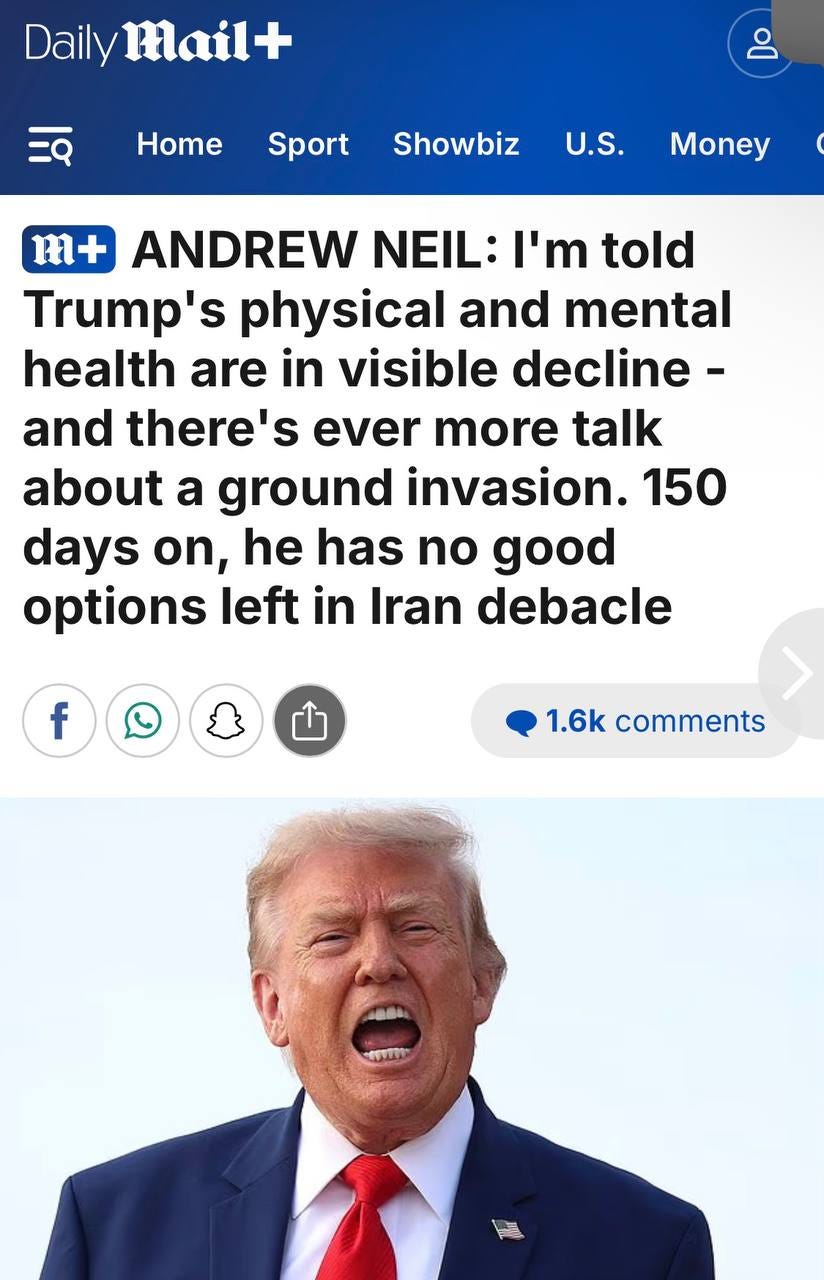
Behind the scenes, there are increasing reports that a deranged Trump is simply losing it over the failure of his aides and gophers to draw up any kind of credible plan of victory against Iran:
Even in latest press events, Trump had no choice but to concede that Iran is much tougher than expected, but still claimed that they would capitulate eventually if US simply keeps the bombs coming:
Now the entire establishment is scrambling to come up with solutions to the intractable Iran crisis that is destroying the last vestiges of credibility the feared US military machine once possessed.
Two authors from the Atlantic Council think-tank gave a realistic assessment of Trump’s approach in a piece for the FP:
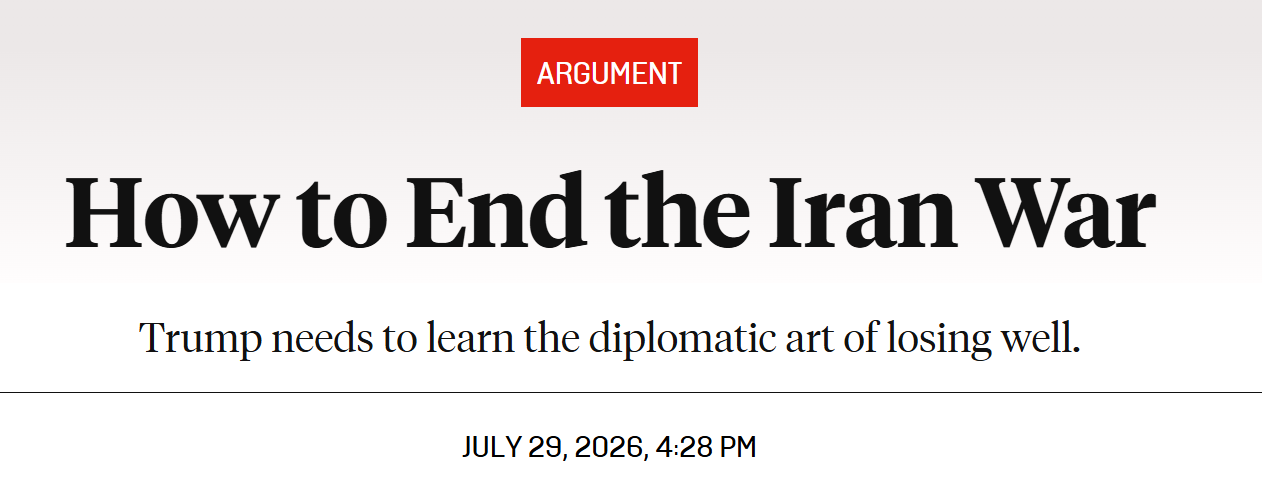
They argue that the sunk cost fallacy of Trump’s war will lead only to the diminishment of US’s negotiating leverage the longer it drags on, which is essentially an admission that Iran is now running away with its victory and the US should simply cut its losses:
The administration has repeatedly fallen prey to the sunk cost fallacy. In the face of this strategic failure, President Donald Trump has mostly acted as if the problem were one of scale or duration. In reality, U.S. negotiating leverage has diminished as the war has progressed and will likely continue to erode as the United States exhausts its munitions and domestic political consequences mount. New Houthi attacks on Saudi oil exports add precarity to a war that has already induced global economic shocks, damaged U.S. credibility, and put America’s regional allies in the middle of a conflict they advocated against.
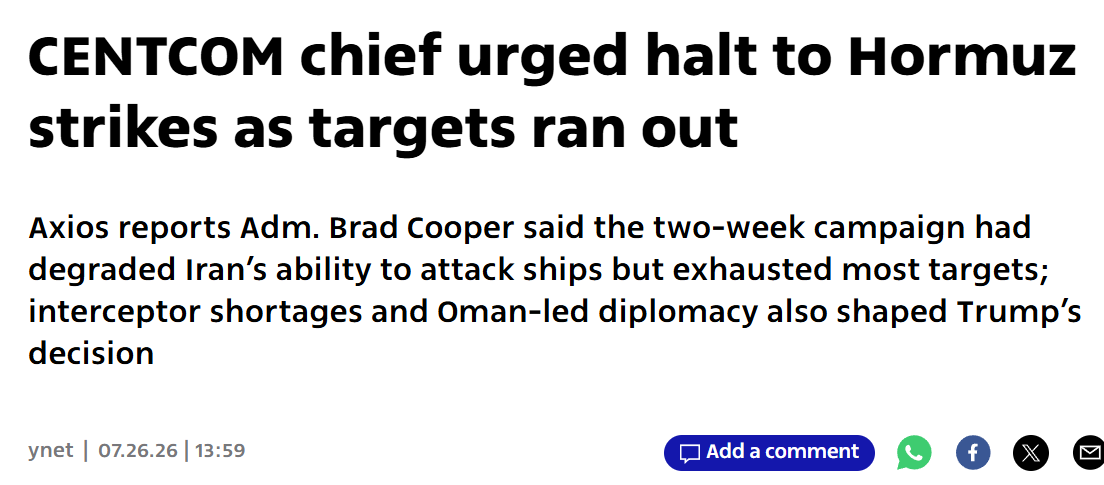
It is true, especially given recent admissions by Admiral Brad Cooper that the US has ran out of worthwhile targets to even hit along Iran’s coast, and due to long-range standoff weapons shortages, is unable to consistently hit anything deeper in the country anyway.
Particularly relevant from the FP piece is the passage about trying to break Iran with “pressure”, which Trump and his Israeli advisors continue to lean toward as a workable strategy:
There is a myth in Washington that pressure alone can break Iran. For nearly five decades, the United States has used every form of military, economic, and political pressure available to try to bend Iran to its will. It has not worked. Pressure has occasionally shaped Iranian decision-making but only when paired with other tools, such as inducements, coalitions, mutual respect, and patience. If Trump continues to believe Iran will simply surrender to U.S. power, he will fail.
The Atlantic Council authors propose a surprisingly intelligent and politic solution for the conflict. They rightly acknowledge that the only way to end it would be for both sides to receive enough room to claim victory to their own domestic audiences, which would lower the ego and political-driven necessity to continue plowing on toward some unattainable coup de grace:
The key to any sustainable deal is that both parties need to be able to legitimately claim victory. Both sides can best accomplish this by aiming for small, concrete results. For the United States, this means reversing active unilateral Iranian control over the passage of ships through the Strait of Hormuz and a viable pathway to a future nuclear deal. For Iran, it means significant financial compensation and the acknowledgement of its newfound position in the strait.
They give many specific prescriptive recommendations for how this can be achieved, but it will all likely fall on deaf ears as Trump’s foreign policy is sourced in Tel Aviv, anyway, which is why immediately following Bibi’s visit Trump began immediately agitating for an expanded campaign of new strikes.
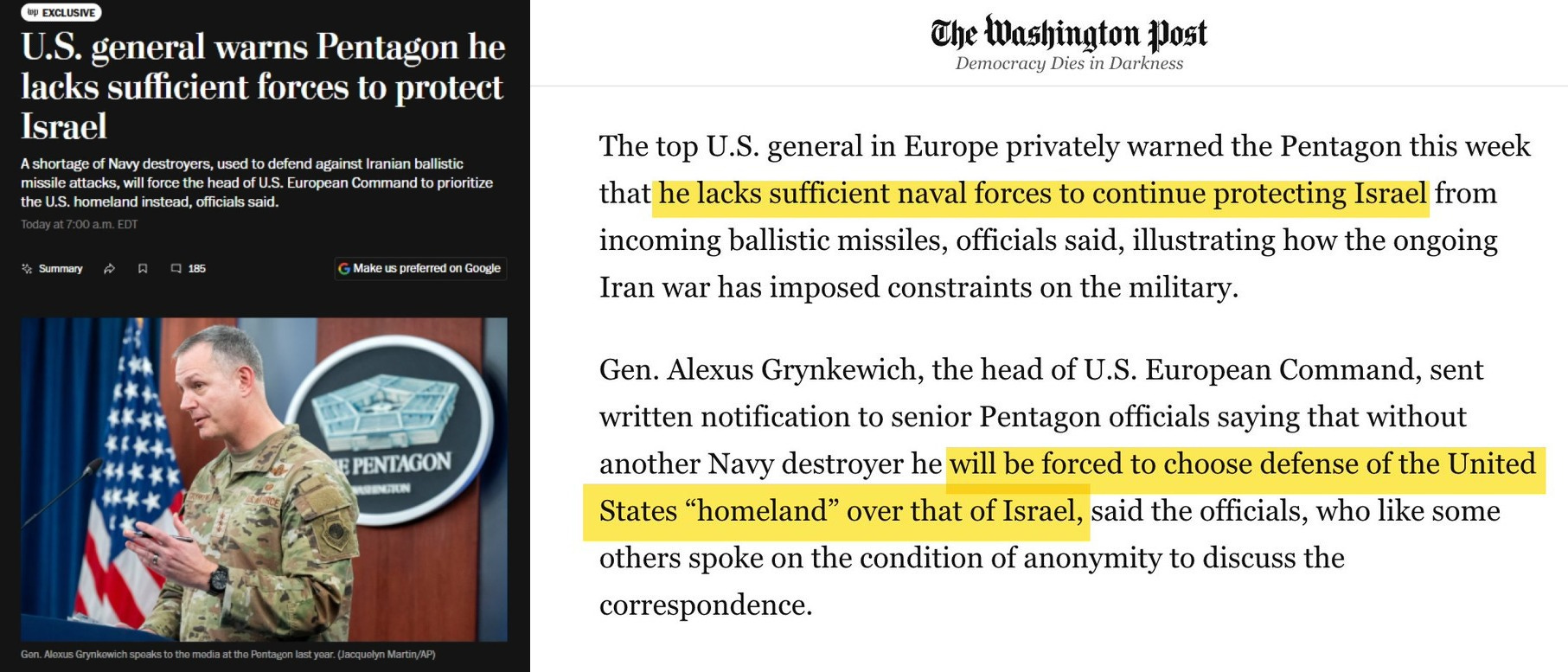
A more astonishing admission came by way of a new WaPo piece wherein the head of US European Command urgently declared that his lack of resources would soon force him to choose between defending the “homeland” and Israel:
“Maintenance issues” have reportedly sidelined many US ships worn down by the dragging campaign against Iran:
The Navy has five destroyers that deploy from a U.S. port in Rota, Spain, with a sixth expected to arrive there later this year, Pentagon officials have said. But maintenance issues have piled up due to the Iran war’s tempo, complicating matters for Grynkewich, officials said. The Washington Post withheld specific details about the ships’ availability at the request of military officials, who cited security concerns.
As The Post reported in May, Pentagon assessments conducted earlier in the war showed that U.S. forces have shouldered the brunt of defending Israel from Iranian ballistic missiles. The assessments found that American weapons, including the Terminal High Altitude Area Defense and naval interceptors launched from the eastern Mediterranean, were used far more frequently than Israeli air defense weapons.
As the above notes, US forces have “shouldered the brunt” of defending Israel because wiser US allies chose to avoid precisely the type of caustically interminable bog that General Grynkewich is complaining about.
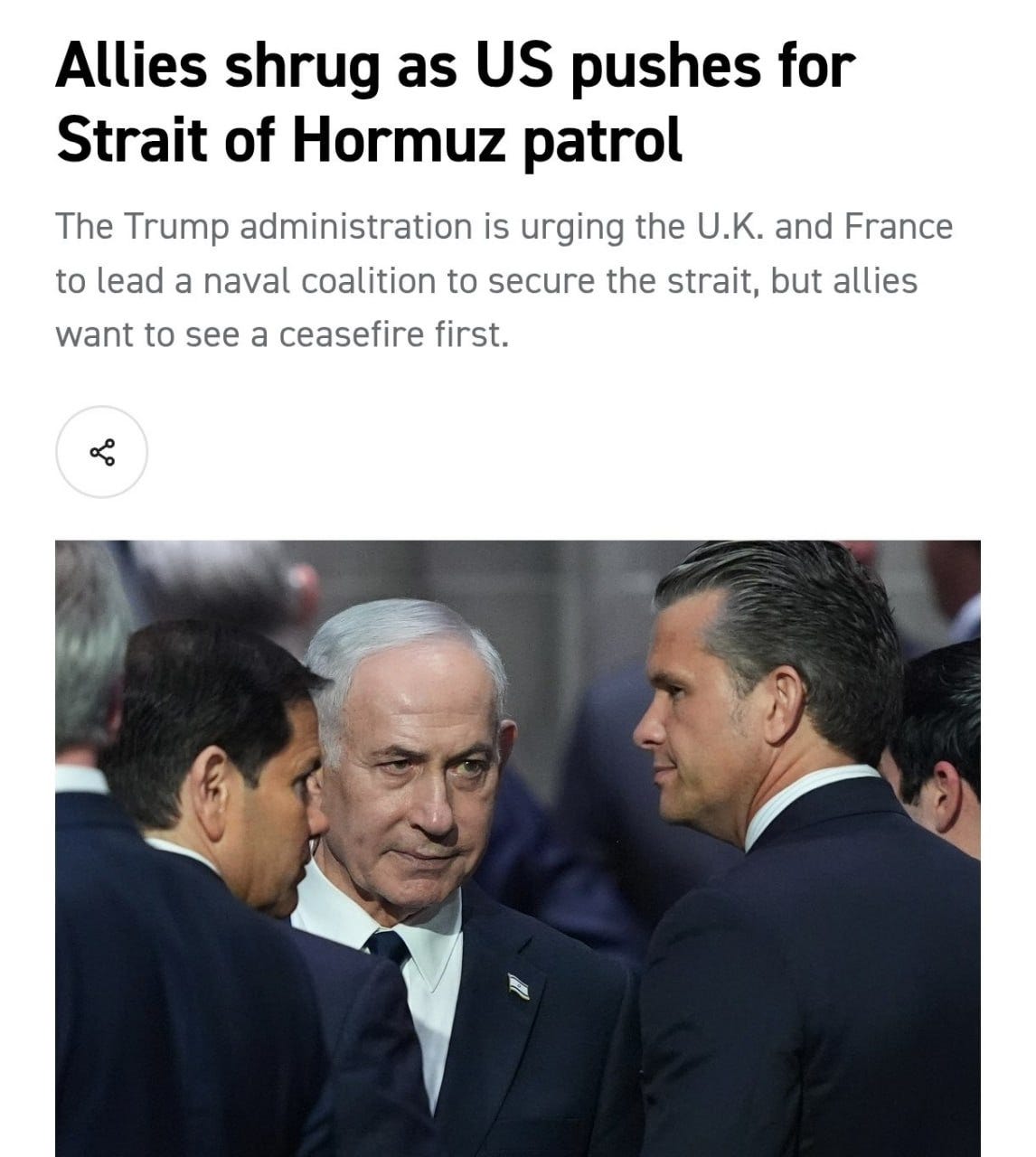
Virtually everyone in the world other than Trump recognizes the Iran debacle as just that: a mindless and pointlessly egomaniacal crusade.
WaPo notes the plummeting public opinion of the war:
The Iran war is increasingly unpopular among the U.S. public, and members of Congress — from both political parties — have grown frustratedwith the administration as top officials struggle to articulate a plan for ending the conflict on terms deemed favorable to the United States. There is a deepening worry among many Republicans, particularly, that the war’s impact on the price of gas, food and other goods will cost the party in November’s midterm elections.
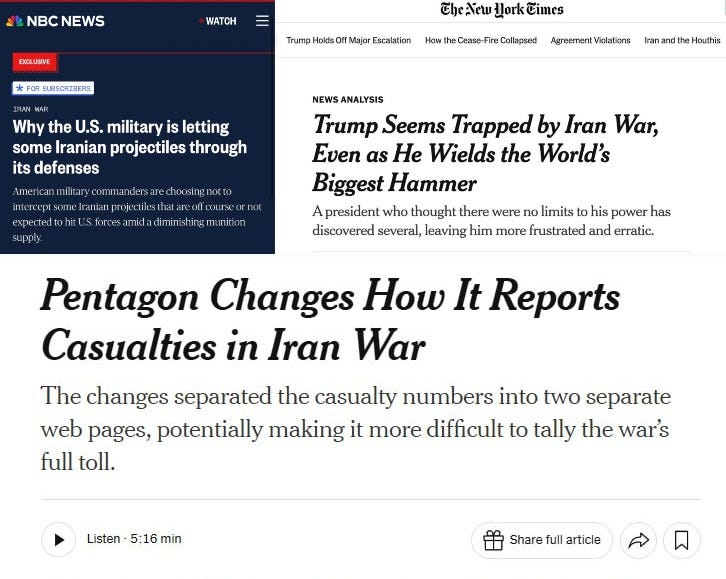
Sources continue to report that the IRGC is now in full control and that Trump’s people are merely talking to “figureheads” without the power of real authority:
Officials now believe the IRGC is firmly in control of Iran’s decision making, leaving political figures the US has been talking with as figureheads. Complicating matters are internal dynamics of the IRGC itself, where a handful of senior commanders are all jockeying for
9:22 AM · Jul 31, 2026 · 557K Views
Of course, anything that comes from mainstream rags should be treated with skepticism, but it is true that the US and Israel have been desperately searching for ways to reach someone of authority that can be reasoned with. The catch? By “reasoned with” the US generally means someone compliant with US demands like was the case in Venezuela; but we’ve now seen time and again: Iran is no Venezuela.
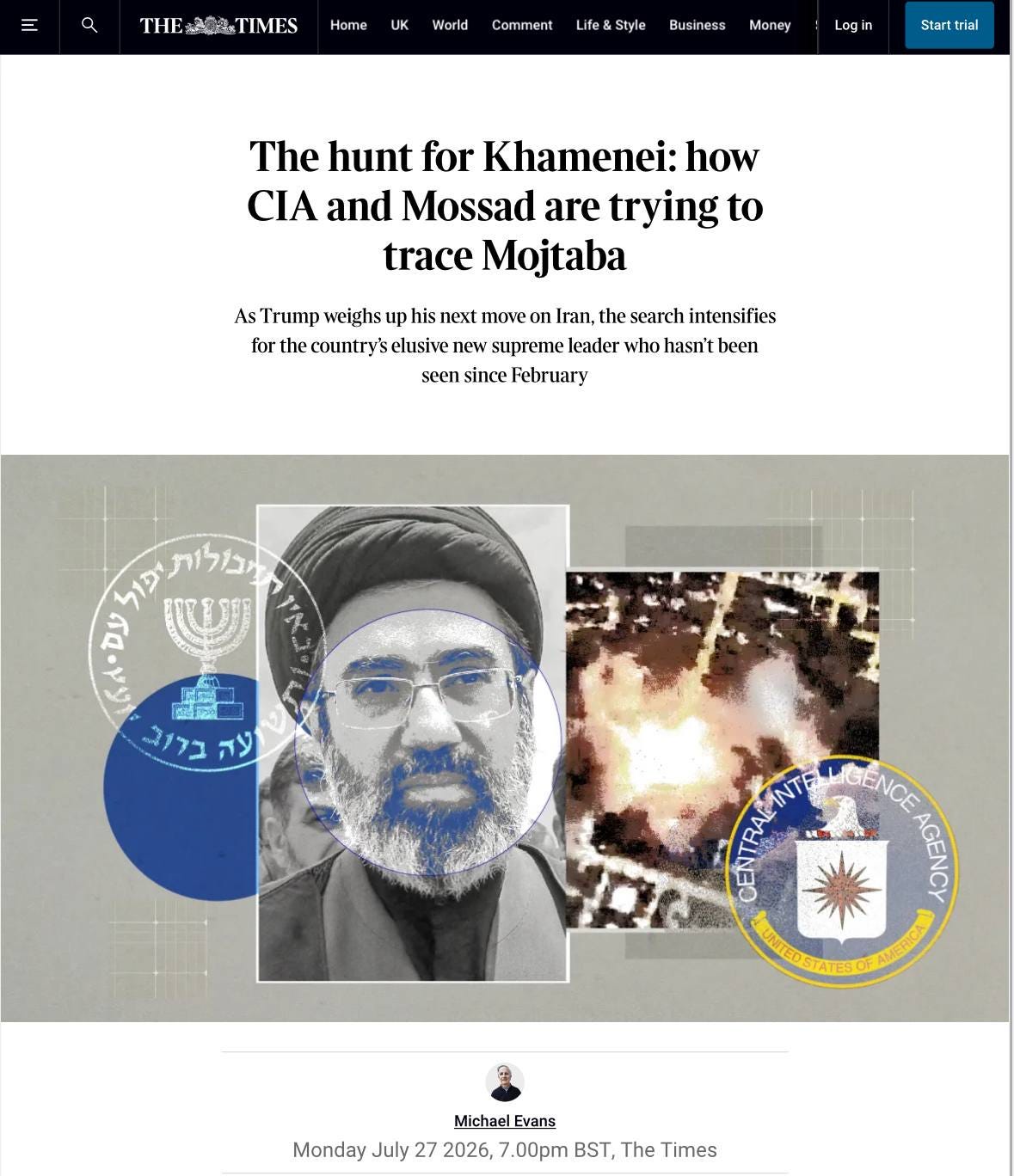
On the eve of another ill-fated escalation that deep within the sclerotic sepulchres of his addled braincase Trump must sense will lead to nothing more than further disaster, there is the desperate need to make some sense of what has become an inscrutable enigma for the US military industrial complex. Iran’s now-legendary mosaic doctrine has utterly befuddled an empire that has gotten fat on straight-forward pushovers and dwarf-nations of yes-men.
The Times piece above warns that the new supreme leader may soon be forced out of hiding to quell public demand for his whereabouts—a fact of irony in stark contrast to the situation of his American counterpart, whose public would at this point likely be relieved to never see him again:
At some point, the Iranian people will demand to see their new supreme leader. He failed to appear for his father’s funeral this month. They only evidence for his existence is several official statements about the war issued in his name.
As of this writing, rumors abound of Iranian dispersals of officials and IRGC in Hormozgan and other provinces neighboring the coasts in preparation for potential US attacks.
Other reports claim Iran has been pushing heavy equipment westward in seeming preparation for something bigger:
OSINTWarfare@OSINTWarfare
The Islamic Republic of Iran Army was spotted moving T-72M/M1 main battle tanks (MBTs) along Road 39 on the Ahvaz–Abadan Expressway toward Abadan, near the Iraqi and Kuwaiti borders.
7:44 AM · Aug 1, 2026 · 44.1K Views
20 Replies · 73 Reposts · 624 Likes
The latest rumors are that Trump wants to cut electricity to Tehran in its entirety, punishing the Iranian people he so valiantly professed to be defending from the “regime” he now can’t even locate.
But it is this very misunderstanding of the Iranian people that is fatefully leading Trump into his Waterloo moment. The Times piece provided a glimpse into how the people of Tehran already feel about the bumbling dotard even without his further instigation of their ire:
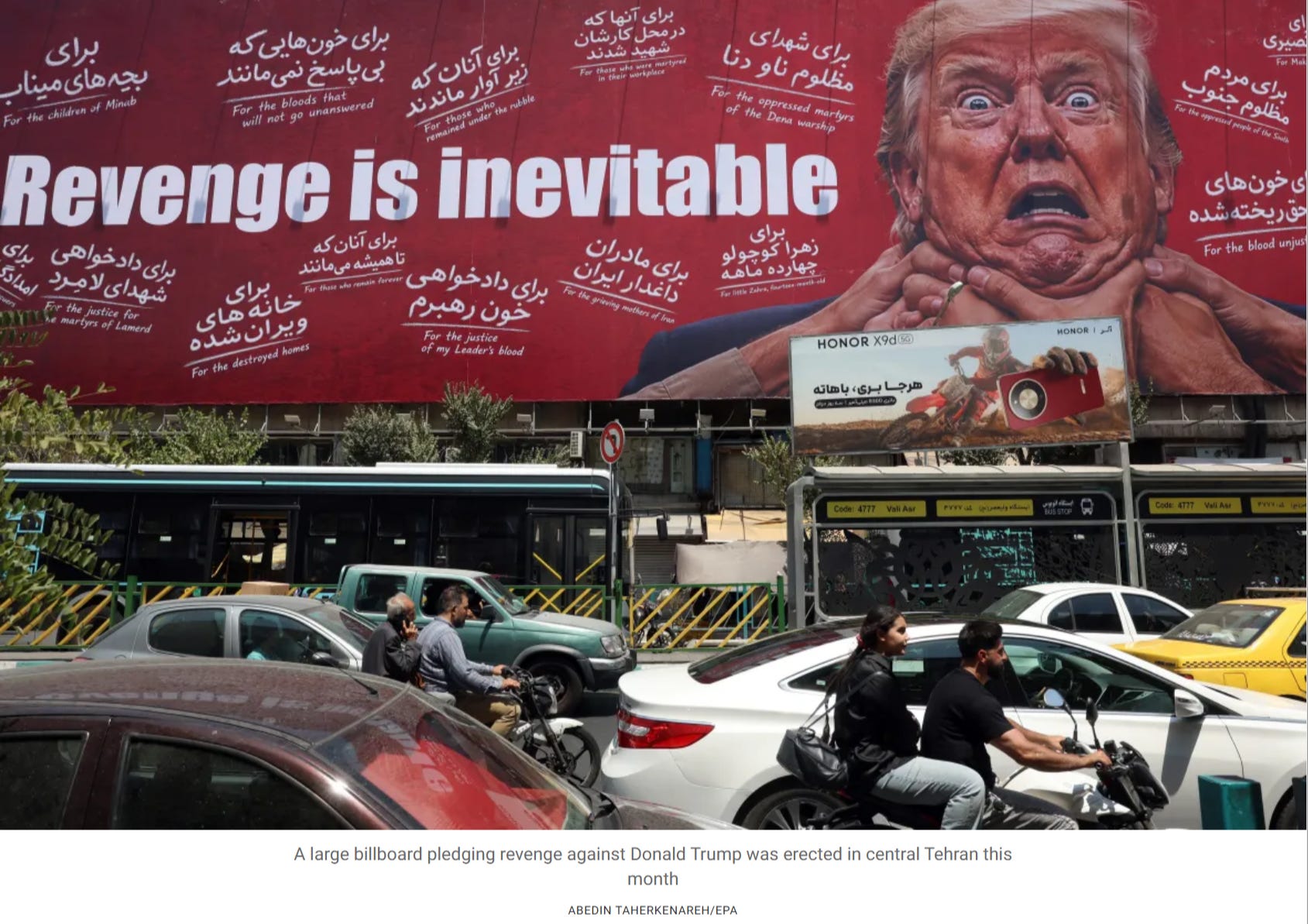
Cutting their power will surely turn them against the “regime” this time!
On the eve of more senseless escalation, the US Empire ever-asymptotically remains “just one more bombing run” away from total victory.