Ukraine's Air Defense Crisis Turns Global as Russian Ferocity Puts Country on Brink
The crisis in Ukraine continues to come to a desperate head. After offering various ceasefires to Russia, Zelensky is now apparently beginning to make some limited concessions:
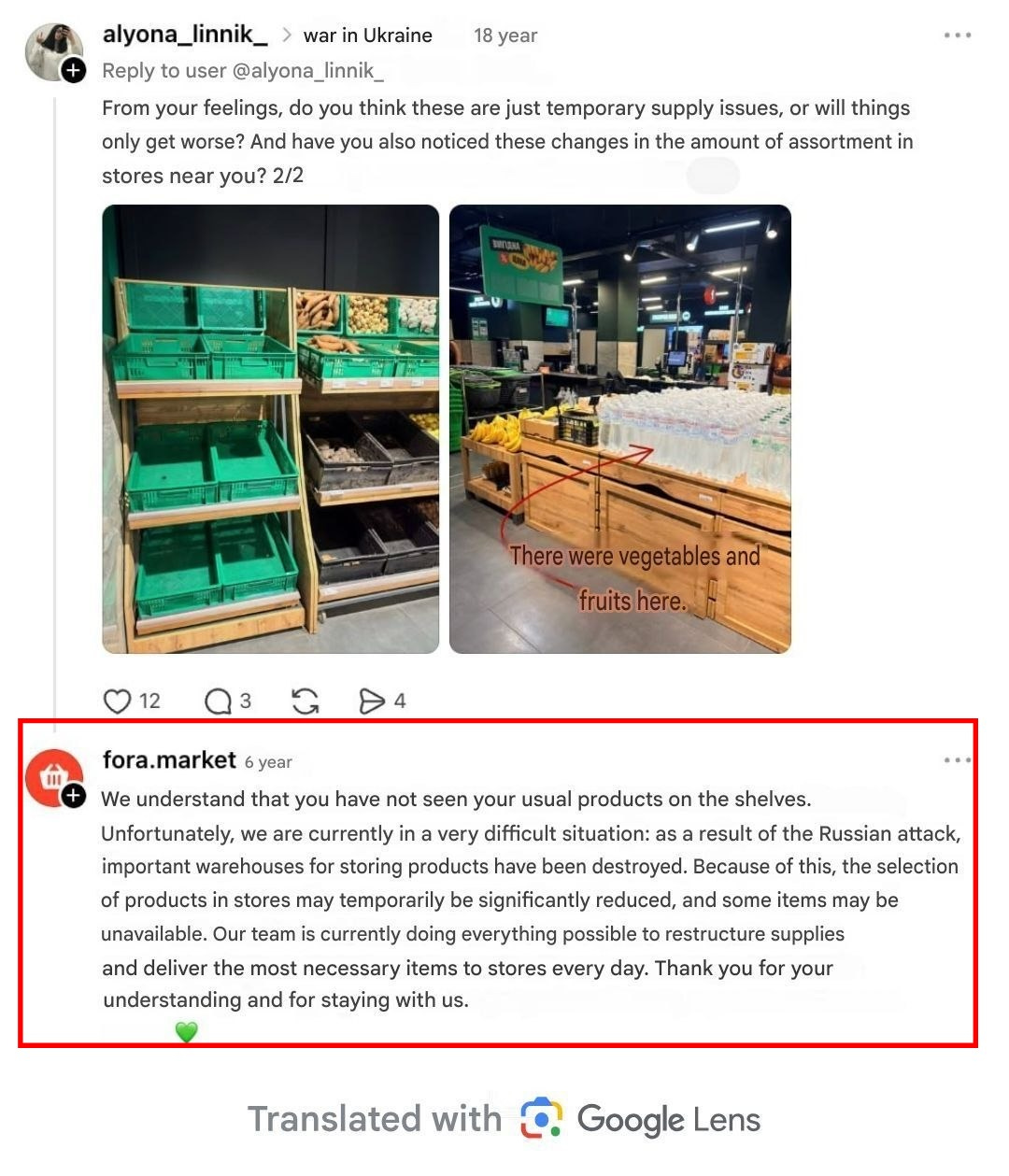
The Russian strike campaign against Odessa and surrounding infrastructure has been sending the Ukrainian commentariat into a panic. Major Ukrainian supply chain distributors have been admitting that Russian attacks have wiped out their warehouses as stores begin to empty—a clear repercussion of Zelensky’s campaign against Russia’s Wildberries:
A Ukrainian analytical center reports that Russia’s attacks on the ports have caused Ukraine’s iron output to decline by up to 35%, and that 2026 is the most difficult year since the start of the war:
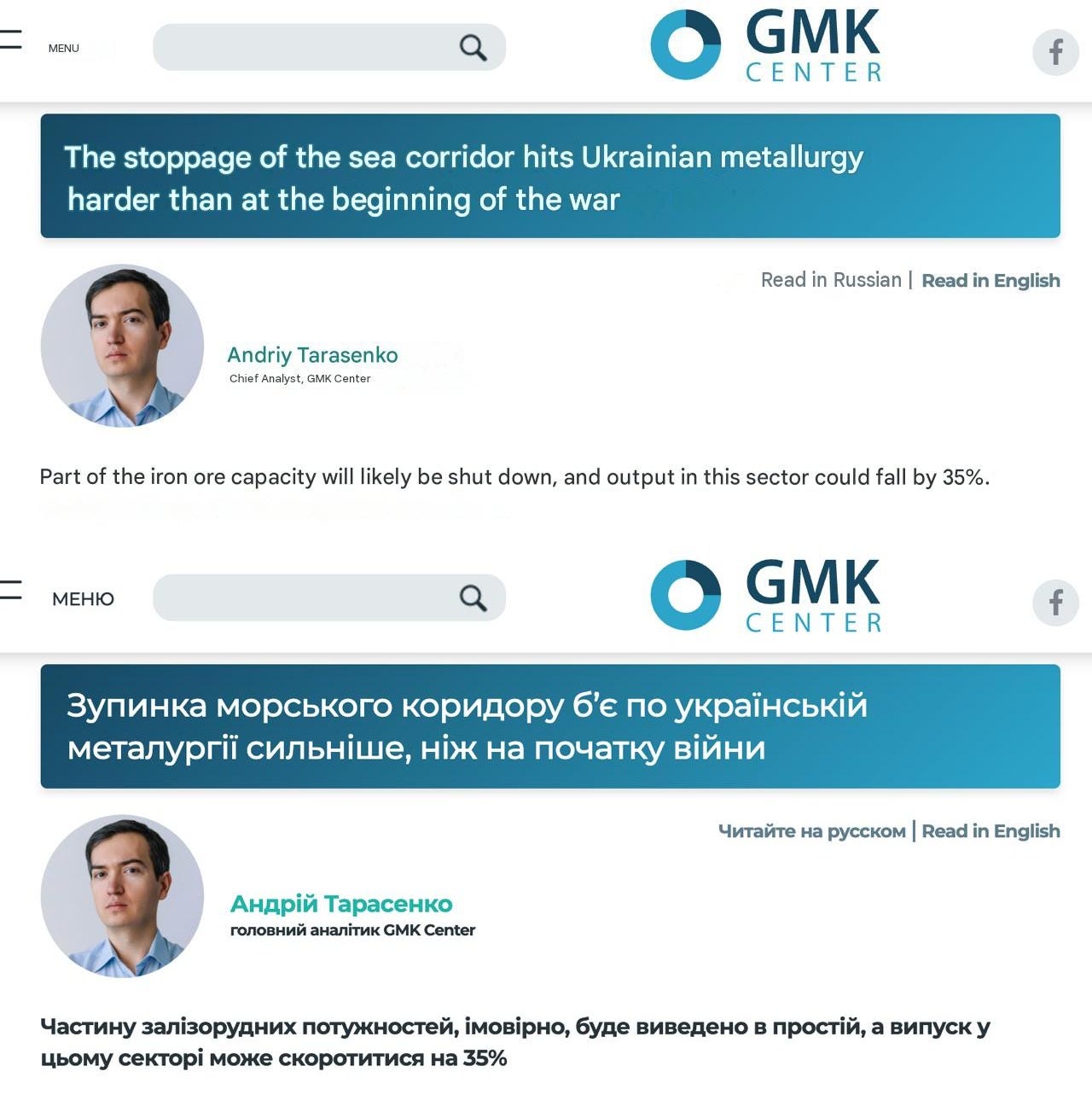
Part of the iron ore capacity is likely to be put into idle mode, and output in this sector may be reduced by 35%.%
At first glance, the shutdown of the sea corridor in July 2026 can be perceived as a repetition of the already experienced scenario. It’s not a big deal. In the end, the Ukrainian steel industry has already withstood the complete blockade of sea exports in 2022-and survived. But this comparison is incorrect. According to a combination of factors, 2026 is a more difficult year for the industry than the first, most acute year of a full-scale war. It’s not the fact that the sea is closed, but what has changed around it.

There continue to be various rumors that Russia intends to put a final finishing blow on Kiev, if not all of Ukraine. Ukrainian experts believe on top of power plants, this winter Russia plans to strike various water and waste facilities to shut Kiev down.
Allegedly, this has already begun to some extent, according to Ukrainian Pravda:
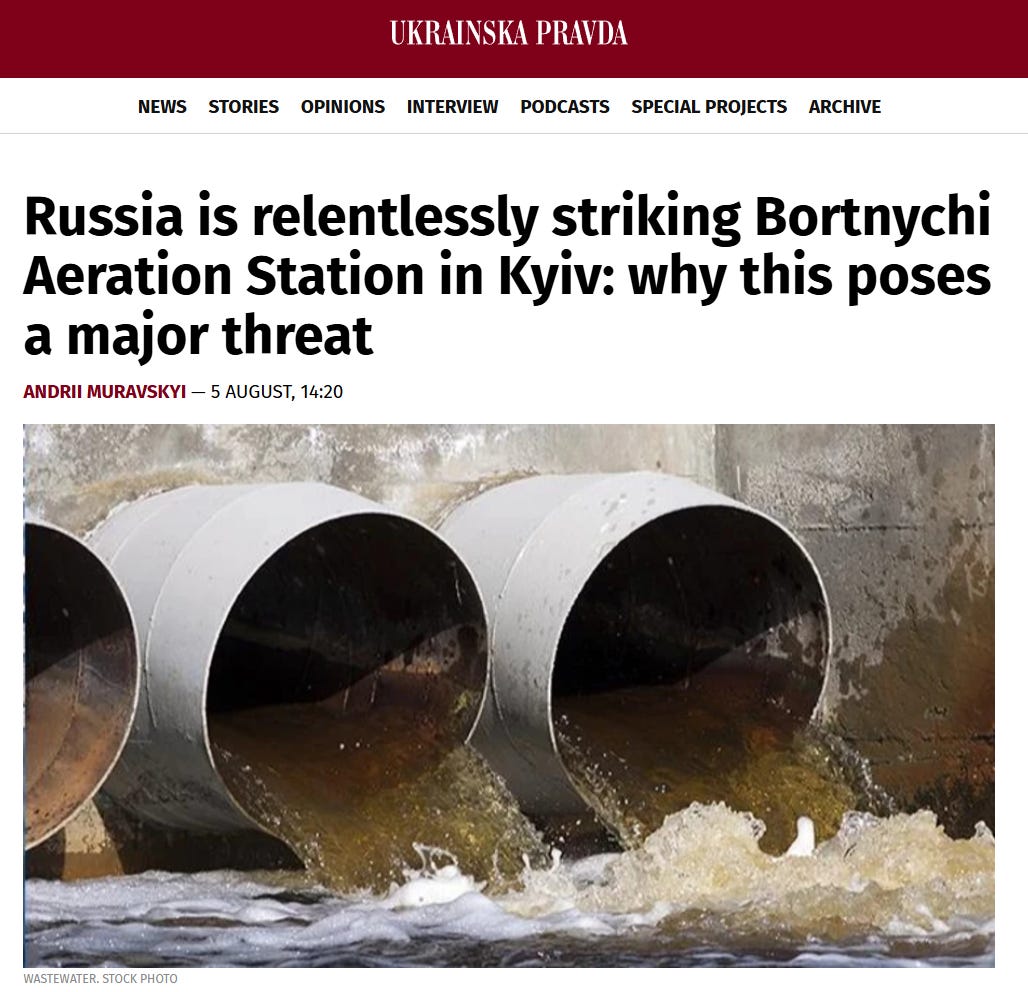
The Russians are relentlessly striking the only aeration station that treats wastewater from Kyiv and surrounding towns using ballistic missiles in an apparent attempt to trigger a humanitarian catastrophe.
“The Russians have once again struck the Bortnychi Aeration Station with ballistic missiles. This is yet another strike over the past year, demonstrating a systematic campaign against a single target. The Bortnychi Aeration Station is the only wastewater treatment facility serving Kyiv and the surrounding cities, towns and settlements in the oblast.”
Details: The facility has a design capacity of approximately 1.8 million cubic metres per day, and its actual workload ranges from 600,000 to 900,000 cubic metres per day. There is no backup system.
Many other rumors are growing.
Several Russian channels claim Surovikin is being welcomed back to lead a major ‘deathblow’ campaign against Ukraine:
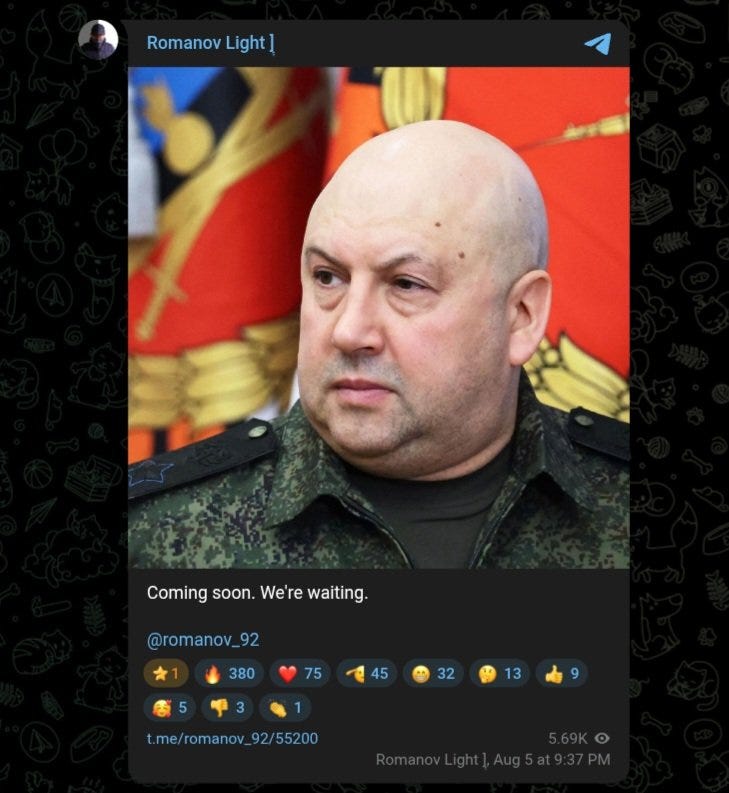
Everything is completely speculative, so don’t hold your breath. But the point is to get a sense of the shifting tone of the war.
Ukrainian channels have passed rumor that Russia may even begin completely splitting Kiev into two parts by eliminating its bridges:
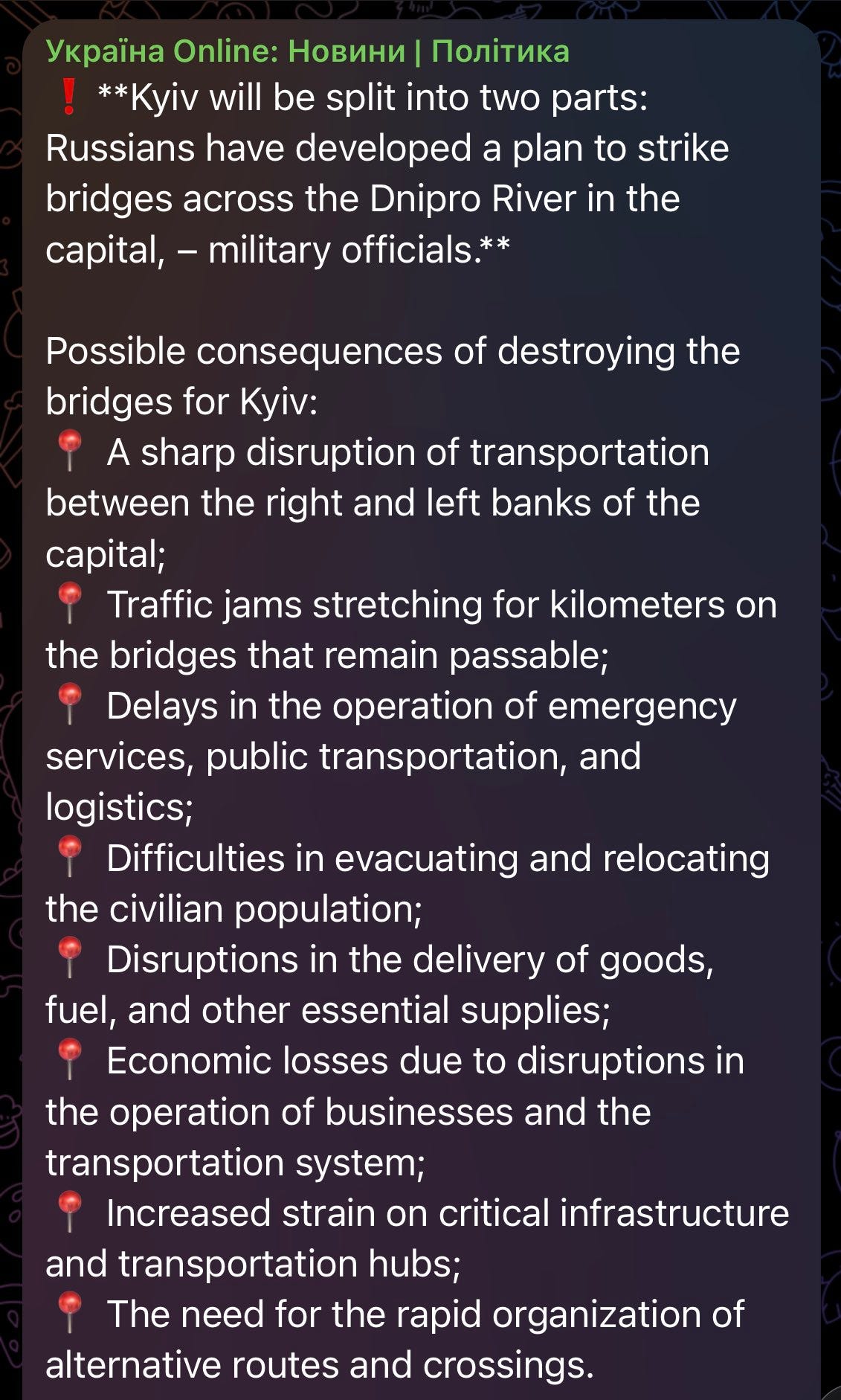
Now MSM channels have been shrieking that North Korean ballistic missile units will be deploying to Russia to assist in the new campaign of destroying Ukraine’s infrastructure by firing their own North Korean KN-23 ballistic missiles:
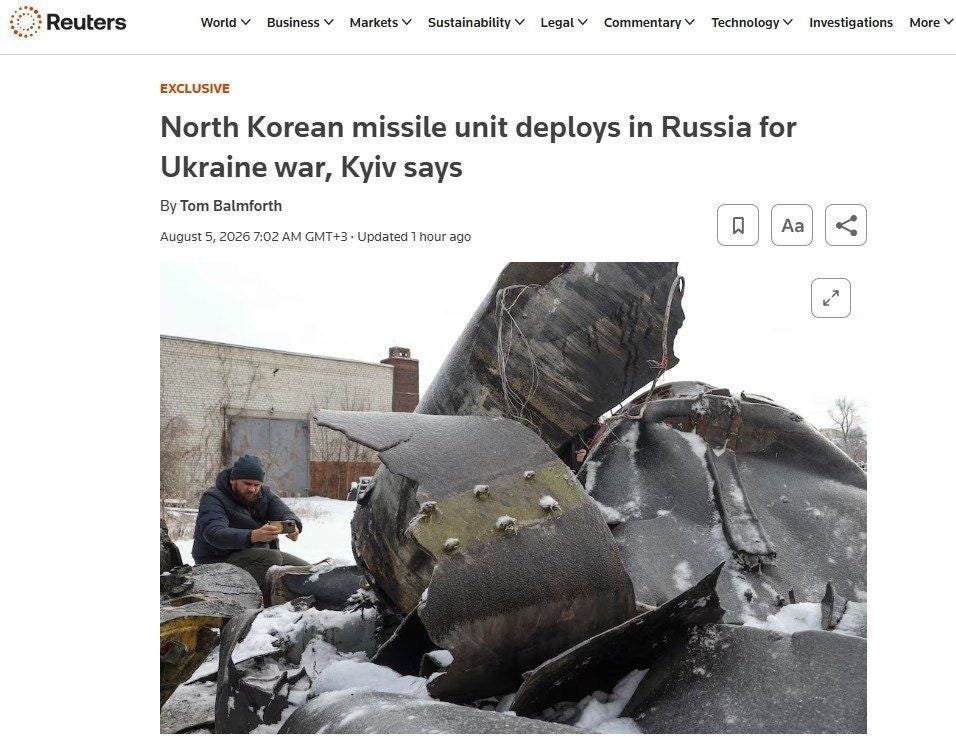
LONDON, Aug 5 (Reuters) - A North Korean missile unit has begun deploying to western Russia and could be equipped with 120 ballistic missiles and six launchers for strikes against Ukraine, an official at Ukraine’s military intelligence agency said.
Ukraine is very short of high-end air defences and Russia has tried to exploit this by using more ballistic missiles, which are particularly hard to shoot down.
While some dismiss the above is propaganda, it would make logical sense for Russia to use this current period of Ukraine’s total anti-missile defense deficit to saturate the country with as much ballistic damage as possible.
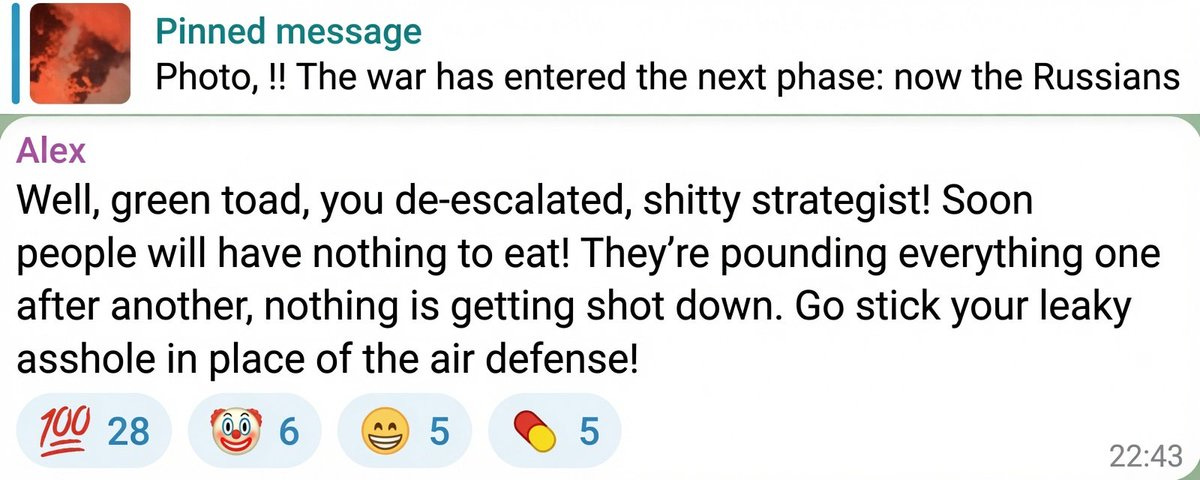
Ukrainian channels are inflamed at Zelensky for provoking this new unprecedented Russian blowback on their country:
No one can seem to find any hope for Ukraine’s situation lately. Erstwhile triumphalist and now-resident-doomer Julian Roepcke wrote a sobering analytical piece after having just visited Ukraine and spoken to many soldiers and officers.
Read the full translated text below, particularly the bolded parts:
Julian Röpcke 🇩🇪🤝🇺🇦@JulianRoepcke
#Analyse Nach einer weiteren Woche in der Ukraine, zahlreichen Gesprächen mit Soldaten – darunter drei Colonels der ukrainischen Streitkräfte – sowie vielen positiven, aber auch ernüchternden Eindrücken, hier meine Einschätzung der aktuellen Lage im russisch-ukrainischen Krieg.
6:29 AM · Aug 6, 2026 · 54.1K Views
28 Replies · 154 Reposts · 617 Likes
#Analysis
After another week in Ukraine, numerous conversations with soldiers—including three colonels of the Ukrainian armed forces—and many positive but also sobering impressions, here is my assessment of the current situation in the Russian-Ukrainian war.The cautious optimism of early summer has largely evaporated on the Ukrainian side. As recently as June, there was hope that the intensifying Ukrainian attacks on Russian logistics in the occupied territories and deep in the Russian hinterland could sustainably weaken the invasion army and bring its offensive to a halt. This expectation has not yet been fulfilled.
The extraordinarily high Russian casualty figures since the start of the year have also only partially produced the hoped-for strategic effect so far. While the pace of the Russian advance has noticeably slowed, it has not been stopped.
At the same time, numerous soldiers report a clear intensification of Russian attacks on positions at and behind the front. Russia is now deploying significantly more kamikaze drones, glide bombs, and long-range weapons than just a few months ago. The approach increasingly feels systematic: forest belt by forest belt, village by village, and bridge by bridge are being destroyed to sustainably weaken Ukrainian logistics behind the front.
Even far behind the front, a new quality of Russian warfare is emerging. While Russia has frequently targeted gas stations, logistics centers, or civilian infrastructure at random in recent years, Ukrainian officers now observe a markedly more systematic campaign against the Ukrainian supply structure. Notably, Russia is now attacking logistics centers on a similar scale to what Ukraine does on Russian territory—albeit with far greater firepower. Many of these facilities are located along key highways. During our trip, we passed numerous logistics sites that had been destroyed just hours or days earlier.Unlike Ukraine, which predominantly uses precision weapons for such strikes, Russia often deploys ballistic missiles or entire swarms of Shahed drones. The result is far greater destruction around the actual targets, along with correspondingly high casualty figures.
From the numerous conversations with Ukrainian soldiers, two distinct assessments of the further course of the war emerged.
The more optimistic view is: If the West—particularly Germany—continues to support Ukraine consistently, this war can ultimately be won. The underlying conviction is that the economic and industrial capacity of the Western supporters could lead to a resource advantage over Russia in the long term.
However, I only partially share this assessment. Russia continues to receive substantial military and industrial support from China, North Korea, and Iran. These factors make a prolonged war of attrition extremely challenging from a Ukrainian perspective.
The second, far more sobering analysis from a Ukrainian officer was: Russia must be pushed into a domestic political crisis faster than it can achieve its operational goals in Ukraine.
In his view, the momentum on the battlefield remains predominantly on the Russian side. Particularly in the Kramatorsk and Sloviansk areas.
According to this, the Ukrainian deep strikes primarily serve the purpose—or the hope—that Russia must abandon its war aims politically or economically before it can fully achieve its military objectives. In the best case, through a downfall of Putin from within his own ranks. Whether that ever happens, “we’ll only know on the day it does,” the officer said.
The key thesis proves that Zelensky has been waging his latest campaign against Russian civilian targets in order to try and push Russia into a domestic-political crisis.
Let’s repeat the section again:
The second, far more sobering analysis from a Ukrainian officer was: Russia must be pushed into a domestic political crisis faster than it can achieve its operational goals in Ukraine.
In his view, the momentum on the battlefield remains predominantly on the Russian side. Particularly in the Kramatorsk and Sloviansk areas.
Again, they believe some magical “downfall of Putin” can be brought about by bombing Wildberries warehouses—a strategic assay so intellectually bankrupt as to be prima facie comical.
According to this, the Ukrainian deep strikes primarily serve the purpose—or the hope—that Russia must abandon its war aims politically or economically before it can fully achieve its military objectives. In the best case, through a downfall of Putin from within his own ranks. Whether that ever happens, “we’ll only know on the day it does,” the officer said
And of course, Roepcke reaches the natural conclusion:
Notably, Russia is now attacking logistics centers on a similar scale to what Ukraine does on Russian territory—albeit with far greater firepower.
If presidents can be brought down by warehouse destruction, does this mean Zelensky’s on his last legs, going by their own logic?
His final conclusion:
After this week in Ukraine, my impression therefore remains ambivalent. The Ukrainian armed forces are impressively rapidly advancing their capabilities in many areas. At the same time, Russia continues to be able to sustain its offensive despite enormous losses and maintain the military pressure. Based on the impressions of many frontline soldiers, there can be no talk yet of a strategic turning point in favor of Ukraine.
So, the current narrative du jour is that one consolation of the current catastrophic situation for Ukraine is that Russia is still experiencing “enormous losses”. Except that loss trackers continue to show that Ukraine’s losses are lopsided in favor to Russia.
Recorded vehicular losses from the month of July:

As a capstone, the Spectator believes a turning point has indeed been reached in the war, but just not one that’s in Ukraine’s favor:
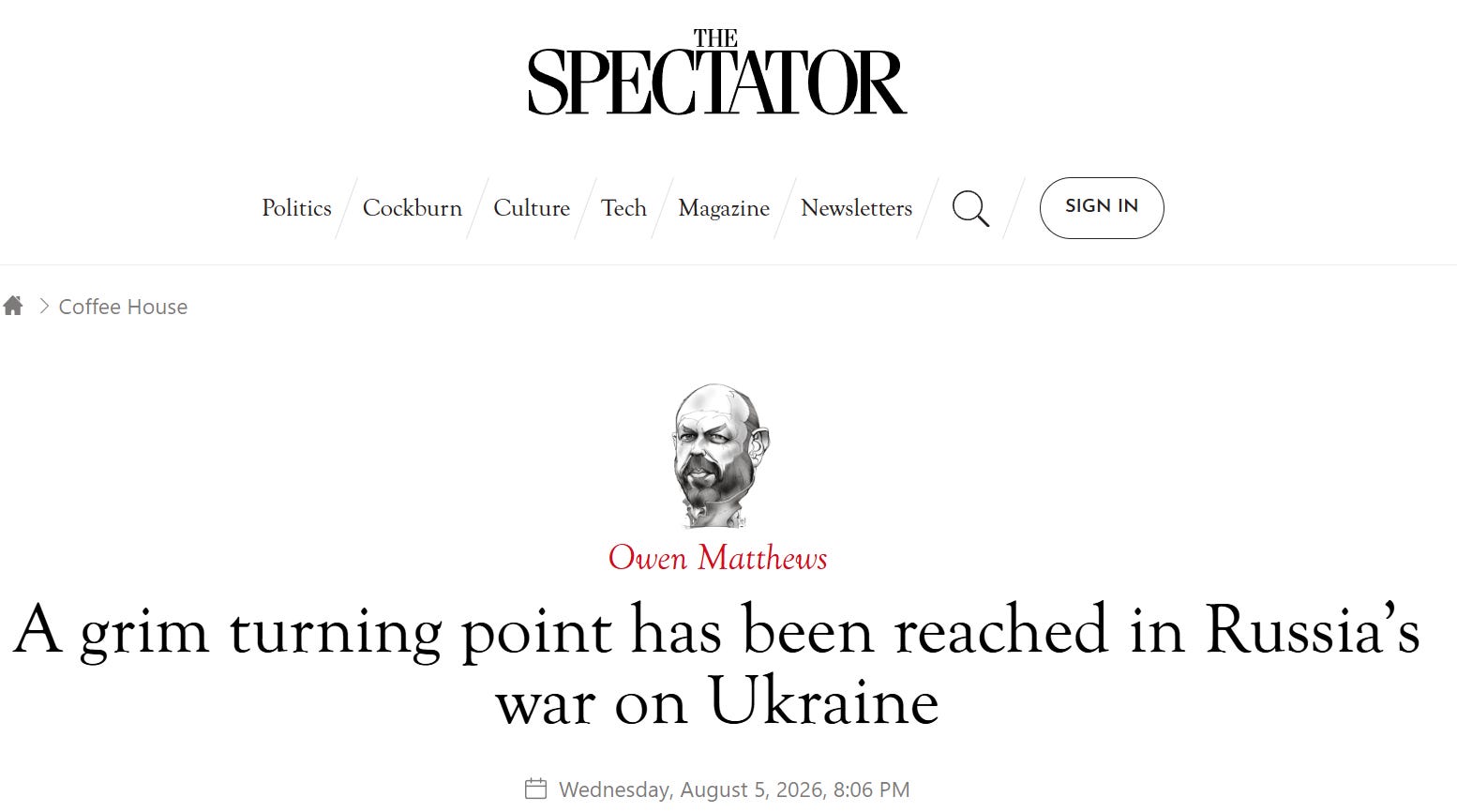
An important turning point has been reached in Russia’s war on Ukraine. But unfortunately for Kyiv, it’s not the “tide is turning” in Ukraine’s favor narrative that Volodymyr Zelensky has been pushing ever since his long-range drone attacks began smashing oil refineries and logistics warehouses deep inside Russia and sinking dozens of ships in the Sea of Azov.
Rather, last night not one of the 27 ballistic missiles fired by Russia at and around Kyiv was shot down. At least 17 people were killed and a series of huge warehouses and major Ukrainian retail outlets were devastated.
The article goes into the arithmetic behind Ukraine’s lack of air defense, noting that even with additional supplies it will not come close to abbreviating Russian ballistic swarms.
Ukraine’s Serhiy Flash discussed Russia’s latest strike, explaining that Russia will continue launching ~100 ballistics per month at Ukraine.
The Spectator goes on:
But far more worrying for Zelensky is Russia’s ability to continue its systematic destruction of Ukraine’s energy, water, petrol distribution and heating infrastructure. During an earlier phase of tit-for-tat, Russian short-range missiles smashed up almost every gas station in Kharkiv province and beyond, forcing drivers to carry spare cans in order to make it to less devastated areas. Now the Kremlin has set about wrecking not only retail facilities in retaliation for Wildberries but also taking out vital water aqueducts and heating pipes. Four winters of regular attacks have wiped out roughly 61 percent of Ukraine’s electricity generating capacity according to the International Center for Ukrainian Victory. DTEK, Ukraine’s largest private power company, had lost 90 percent of its generation capacity while every one of 15 of Ukraine’s gas- and coal-powered thermal power plants have been damaged or destroyed, with their share of the energy mix collapsing to around five percent.
Well, unfortunately for Ukraine, Russia’s firepower continues to set new records:
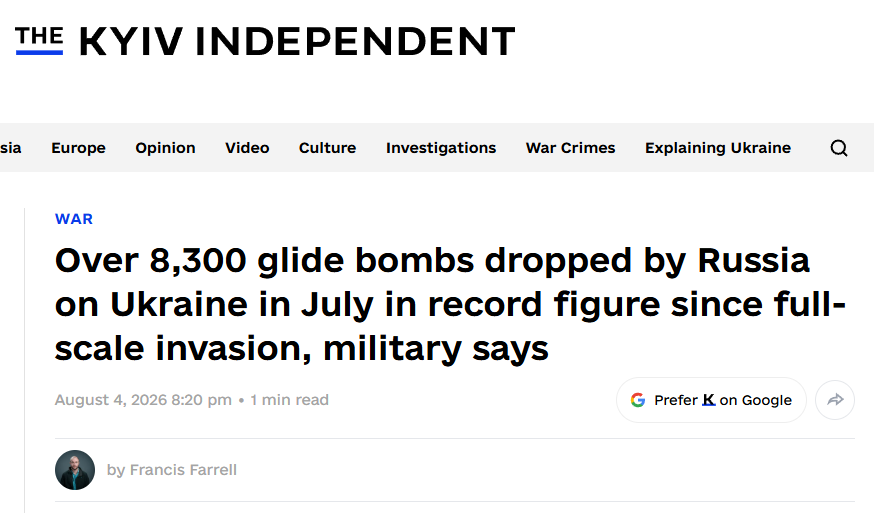
It’s clear the future trends ever bleaker for Ukraine.
But you never know, there are some bright ideas on the Western side that could decisively turn the conflict around:
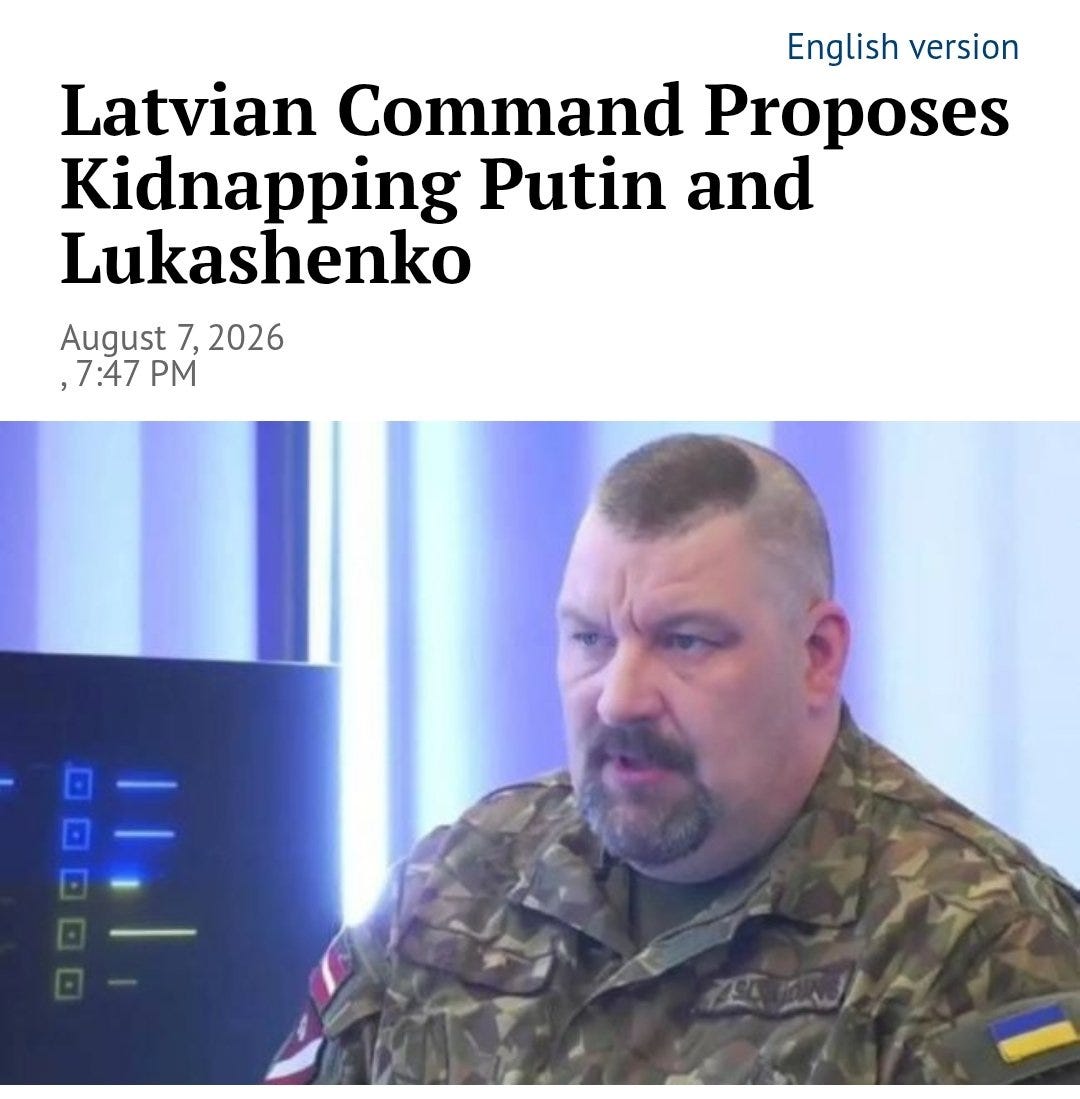
What do you think, could it work?