The Most Important Book of 2026: Clifton and Lustick’s “Israel’s Lobby”
The year was 2018, and I was toying with the idea of starting a new think tank in Washington—one that could help shift U.S. grand strategy away from endless wars and needless foreign entanglements.
I was frustrated. More than a decade of work to secure the Iran nuclear deal had come to nothing when Trump simply walked away from it. Most people saw the explanation in Trump’s persona. While most saw the explanation in Trump’s persona, I detected a deeper systemic problem: For a deal like the JCPOA to survive, it needed to be embedded in a larger grand strategy that would sustain such achievements. But Liberal Hegemony sustained endless wars in Afghanistan and Iraq, but would not protect a diplomatic agreement that evaded war.
If a new think tank were going to challenge that system, it would have to punch far above its weight.
So I began studying Washington’s think tanks: how they were governed, their communication strategies, how they raised money, and—perhaps most importantly—who actually funded them. That last question was harder than it sounds. Many think tanks are remarkably opaque about where their money comes from. I needed someone who knew how to follow the money.
So I called Eli Clifton.
Eli was an investigative journalist who had made a specialty of tracing funding networks and uncovering the real power players behind Washington institutions. He was, as they say, one of the best in the business.
Eli, of course, became a co-founder of the Quincy Institute.
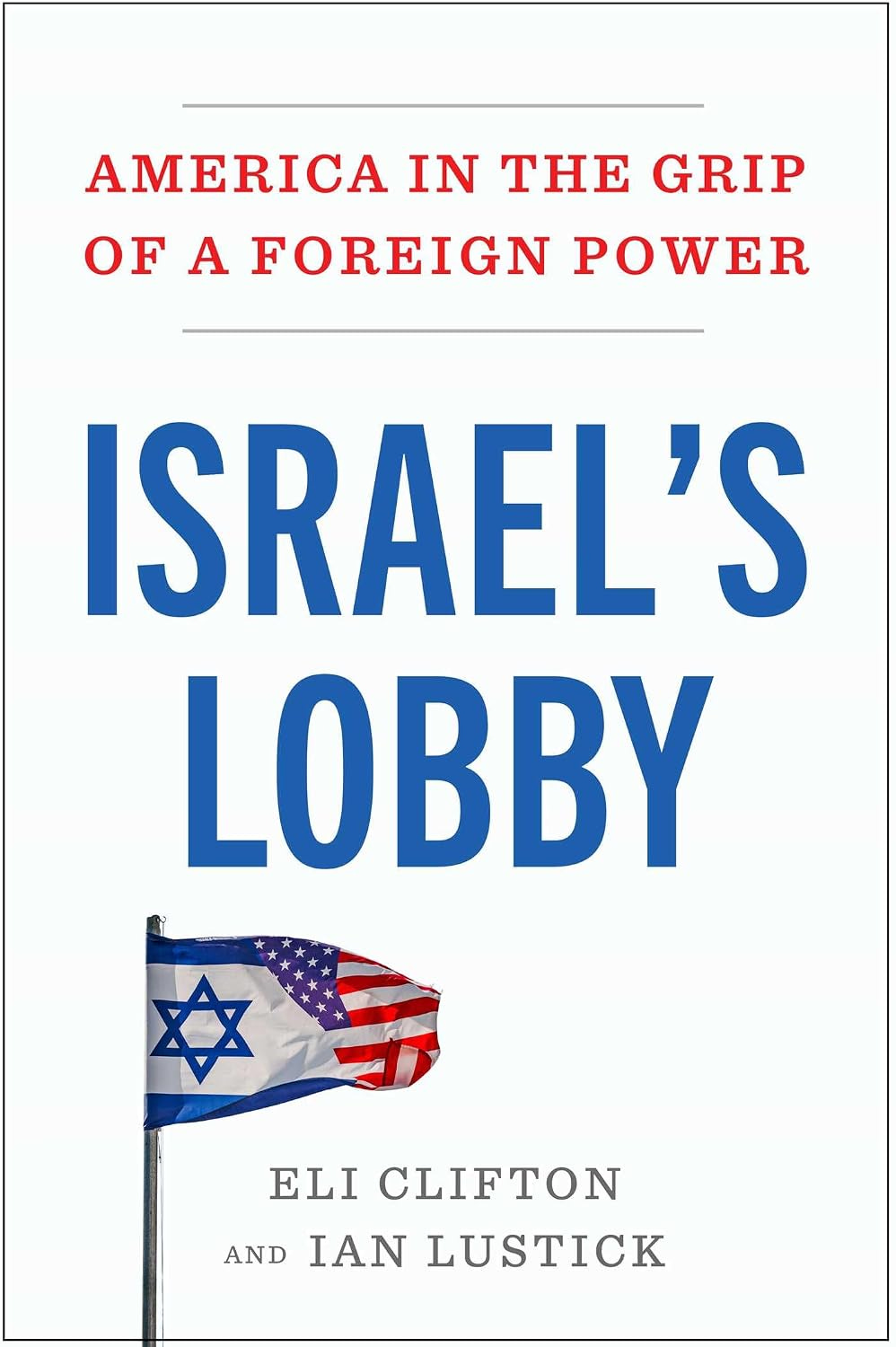
I tell you this backstory because it goes directly to the significance of the extraordinary new book Eli has written with UPenn professor Ian Lustick, Israel’s Lobby: America in the Grip of a Foreign Power, which is officially released today.
I believe it will become the most important book of 2026.
If you haven’t bought the book yet, you should do so right away!
Israel’s Lobby is neither a sequel to John Mearsheimer and Stephen Walt’s groundbreaking 2007 book, The Israel Lobby and U.S. Foreign Policy, nor simply an update of it. It does something different.
Eli and Ian provide a systematic history of the moments when, in their telling, Israel and its American supporters have worked against U.S. interests. But they also add a dimension that Mearsheimer and Walt did not explore at length: money—and, specifically, the financial machinery behind efforts to put Israel’s interests ahead of America’s.
They follow that money.
Eli and Ian trace the funding that fuels the pro-Israel lobby, identifying major donors behind donor-advised funds and other vehicles that can obscure the money trail. Drawing on leaked emails and extensive investigative work, they map the donors’ connections to Israel and document the methods through which money and political influence are brought to bear on U.S. foreign policy.
They then layer this financial investigation onto a broader historical argument: that Israel and the pro-Israel lobby have repeatedly sought to thwart U.S. presidents, pressure lawmakers, and derail policies they viewed as contrary to Israel’s interests—even when those policies served America’s. The book examines efforts to fuel Islamophobia, spread false rumors about American presidents, and weaponize accusations of antisemitism to marginalize and silence critics of Israel.
As Ian explains in the video below: “The point of this book is to tell the American people that they have faced, and are facing, a danger from the Israel Lobby in the United States that doesn’t just compromise American interests abroad but threatens American freedoms at home.”
But the reason I believe this will become the most important book of 2026 lies in the collision between its findings and its timing. Never before have Americans been so willing to openly debate the once-taboo question of Israel’s influence in American politics.
Indeed, we have reached an inflection point. America’s relationship with Israel—and the genocide in Gaza—has become a litmus test in consequential Democratic and Republican primaries. The New York mayoral race and the Michigan Senate primary were not isolated episodes. They are data points in an emerging trend.
For years, Washington operated according to a peculiar asymmetry: what was bad policy for America could still be good politics for individual politicians. Aligning with the pro-Israel lobby might undermine sound U.S. policy, but it could help keep lawmakers safely in their seats.
That equation is breaking down. Bad policy is increasingly becoming bad politics.
Support from AIPAC and other elements of the pro-Israel lobby can now carry a political cost rather than confer political protection. And politicians who challenge Israel’s conduct in Gaza or its supporters’ influence over American politics are discovering that doing so can win them not only votes, but donations.
That is a profound change in American politics. And it is precisely the moment into which Israel’s Lobby arrives.
A paradigm shift in U.S.-Israel relations is coming. And I suspect Eli and Ian’s book will play an important role in accelerating it—and in making this long-overdue shift impossible for Washington to ignore.
P.S. If you want a taste of the book before diving in, The Guardian has published a fantastic excerpt, adapted from Israel’s Lobby: “The pro-Israel lobby has swayed US presidents since Truman. It must end with Trump.”
P.P.S. Ian and Eli have also agreed to join me for a Geopolitical Chat with paid subscribers in September. You’ll have a chance to put your questions directly to them. I’ll share the details as soon as we have a date.