Zelensky is Ukraine’s greatest leader. But is his time up?
As the country’s desire for political change competes with the demand for unity against Russia, the president faces a democratic crisis
Published 24 August 2026
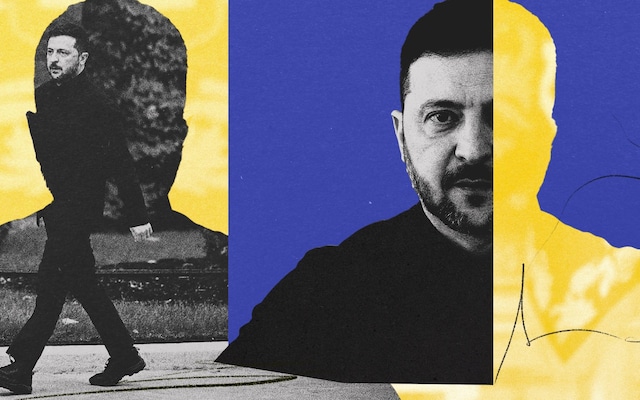
In 458 BC, Cincinnatus, after saving Rome, went back to farming. In 1945, Winston Churchill was voted out of office by a war-weary British public. In 2026, is the time coming for Volodymyr Zelensky to similarly hang up his green T-shirt?
Mykhailo Fedorov, Ukraine’s former defence minister, did not mention his erstwhile boss by name in his explosive call for presidential elections this week, but that is clearly what he was suggesting.
Though his gambit was met with widespread consternation inside Ukraine, which remains under martial law and daily bombardment, it brought into the open a dilemma that becomes starker with each passing year of war.
At what point does the imperative of national defence become an erosion of democracy? When should a wartime leader throw in the towel? How long can Ukraine set aside normal politics when polls show many are yearning for a change of government?
“Democracy cannot be held hostage by Russia,” declared Fedorov, 35, in a nine-minute video address released on Tuesday. “We must find a legal, safe and realistic mechanism that will allow Ukraine to restore a full democratic process, even amidst a prolonged war.”
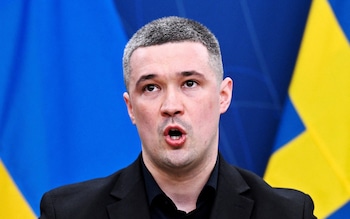
Mykhailo Fedorov, the former defence minister, has called for presidential elections following his dismissal Credit: Fredrik Sandberg/TT
Condemning a “systemic crisis of governance” and calling for the overhaul of the “old system” made his meaning clear. Zelensky, whose term officially ended in May 2024, ought to go.
However, holding elections in wartime is against the Ukrainian constitution, and, say many, common sense. Constant Russian drone and missile bombardments would make casting ballots a suicide mission.
Many Ukrainians, including Zelensky’s bitterest political opponents, fear Moscow would quickly exploit the return of electoral politics to sow dissent and division, and no doubt attempt to manipulate the outcome.
The fact that, for seven years, Federov loyally served the government he was attacking did not aid his case. Having served as Ukraine’s first deputy prime minister and the minister of digital transformation, he began his six-month defence stint in January of this year.
Fedorov was credited with overseeing a new drone-inspired strategy that appeared to be turning the tide in the war during his tenure. But perhaps, more importantly, he was welcomed by many soldiers and civilians as a moderniser who might finally tackle endemic corruption and impose long-overdue military reforms. In short, he became a lightning rod for those who believe that Ukraine cannot afford to continue fighting the way it has up to now.
However, Fedorov quarrelled with Oleksandr Syrsky, the chief of the military, over tactics and resources, leading Zelensky to fire him last month.
That provoked an immediate public backlash, which saw thousands take to the streets of Kyiv to demand his reinstatement and Syrsky’s dismissal. Zelensky eventually bowed to the pressure of the demonstrations and fired Syrsky, but Fedorov did not get his job back.
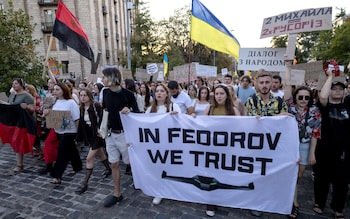
Following Fedorov’s dismissal in July, thousands took to the streets of Kyiv in protest Credit: Serhii Okunev/Getty Images
There is no doubting the former defence minister’s popularity. Or at least that was the case until Tuesday’s intervention, which seems to have badly backfired.
“This is ridiculous,” says one former security official, speaking on condition of anonymity. “It looks quite obvious that he’s trying to transform his current popularity into a political perspective for himself or his party... It’s childish.”
“I have some questions,” adds a deeply unimpressed Oleksiy Honcharenko, a member of parliament from Odessa. He is an outspoken critic of the Zelensky government, but does not see an election as in any way feasible.
“How do you protect people if they go to polling stations? How will the military vote? How will refugees vote? How will people on the territories bordering the fighting area vote? I have absolutely no idea how to do this, and if Fedorov wants to have such elections, he can’t just say, ‘Hey, it’s difficult, but we can find a way.’ No, tell us the way. What is the way?”
The risks of getting it wrong are enormous, warns Honcharenko. The winner of an election compromised by the war could never quite claim to have the legitimacy of a truly free and fair vote, which fatally undermines national unity in the middle of a fight for Ukraine’s survival.
Such sentiments appear to be widespread, including among people who are not shy of grumbling about Zelensky, who has not directly responded to Fedorov’s challenge.
It is convenient, scoffed one citizen in Kyiv, that Fedorov suddenly found his voice as an opposition politician the same year he turned 35 – the minimum age to run for president.
Even Dmytro Koziatynskyi, a former soldier who organised the protests demanding Fedorov’s reinstatement as defence minister, distanced himself from the idea.
“I view elections during wartime negatively. I can’t imagine how to technically enable thousands of soldiers currently on the front lines to vote and run for office. I’m also deeply concerned about the societal divisions during the election process and how that could affect the course of the war,” Koziatynskyi wrote in a post on X.
Tellingly, even Zelensky’s most formidable actual and potential rivals in a presidential race – Petro Poroshenko, the former president, Yulia Tymoshenko, the former prime minister, and Valery Zaluzhny, the former head of the army and current ambassador to London – have continued to observe the taboo on political confrontation.
All of which would appear to stymie Fedorov’s political ambitions – at least for now.
But that is not the whole story. The former minister may have misread the public mood, but he is voicing a grumble heard more and more in Ukraine, a fifth of which remains occupied by Russian forces.
“There’s clear demand for renewal,” observes Volodymyr Fesenko, a Kyiv-based political analyst. “The key question is in what context. At the moment, most of those who want a change of government also believe it should come only after a ceasefire.”
A poll by the Kyiv International Institute of Sociology (KIIS) published in June found 67 per cent of Ukrainians wanted a new president after the war, up from 23 per cent in 2023. But the most recent polls also show only 15 per cent of Ukrainians back a vote in wartime.
Meanwhile, a KIIS study of Zelensky’s own approval ratings, published in July, suggests he holds the trust of 56 per cent of Ukrainians, at least while the war continues. Fedorov, by comparison, is trusted by 63 per cent of the country.
The tension between these two urges – unity against Russia on the one hand, yearning for political change on the other – becomes more pronounced the longer the conflict drags on.
Zelensky’s team is aware of the tension and has discussed the possibility of elections if a ceasefire is achieved.
The president is also under pressure from abroad, with Donald Trump’s White House suggesting last year that Kyiv was “using war” to avoid a vote. Zelensky responded by saying that Ukraine could be ready for elections within 90 days if its allies helped guarantee the country’s security.
Earlier this year, Zelensky’s office reportedly reached out to Zaluzhny to ask for reassurance that he would not run in such an election. The former commander-in-chief declined to make such a promise.
For now, such discussions remain academic. The war, the law and public opinion all rule out a ballot in the near future.
But with the prospects of a ceasefire still dim, there could yet come a point, says Orysia Lutsevych, the deputy director of the Russia and Eurasia programme at Chatham House, when the consensus against a wartime vote changes.
One looming watershed could be three years from now, suggests the former security official. At that point, Zelensky will be approaching 10 years in power – the equivalent of the maximum of two full presidential terms allowed in peacetime.
The public may begin to ask what kind of war a constitutional ban on elections was designed for? A five-year war? A 10-year war? What about 15 years? If the war lasts for decades, does that mean Zelensky’s presidency must last for decades too?
The growing tension between Ukrainians’ instinctive democratic urges and the need to maintain unity in the face of Russian attack is also reflective of the fact that Zelensky’s personal popularity is now well past its peak.
The president’s standing has been badly dented by a series of corruption scandals involving close aides, a perceived lack of accountability and a tendency to centralise power. In contrast to Churchill, who brought the Labour opposition into a wartime coalition, Zelensky has never included his opponents in the same way.
Some of Zelensky’s troubles, including the transformation of Fedorov from ally to political rival, are of his own making.
Firing Fedorov last month was an unforced error. It looked to many young Ukrainians like another betrayal of the tech-savvy, Western-leaning, graft-free future they have been fighting for since the 2014 Maidan Revolution, which overthrew the pro-Russian government of Viktor Yanukovych.
Hence the protests, and Fedorov’s decision to reinvent himself as an opposition leader.
That is only the tip of the iceberg of Zelensky’s domestic political woes, however. Last summer, he was forced into an embarrassing U-turn after an ill-considered plan to curtail the independence of anti-corruption watchdogs triggered the first anti-government protests since the war began in February 2022.
A few months later, those same watchdogs unveiled an investigation implicating several top government officials in a $100m (£73m) kickback scheme at the country’s nuclear-power monopoly.
Zelensky’s energy and justice ministers were forced out after they were named. A few weeks later, Andriy Yermak, his long-serving chief of staff, also resigned.
That scandal re-erupted on Wednesday when Zelensky was obliged to dismiss Iryna Mudra, a presidential deputy chief of staff, following reports in Ukrainian media that her house was being searched in connection with fresh allegations related to the case.
No recent British prime minister would have survived such an omnicrisis. Yet Zelensky has weathered previous storms, and there is no reason to believe he will not survive this one, observes Fesenko.
He is still the legitimate president. Both constitutionally and practically, elections are impossible. Nor would a Keir Starmer-style resignationsatisfy critics. Under the constitution, he would be replaced by Ruslan Oleksiyovych Stefanchuk, the speaker of parliament, who is a close ally.
In the meantime, there is no obvious solution to the tension between national unity and democracy.
“In the United Kingdom, there were no elections between 1935 and 1945, and nobody doubted that it was a democracy,” says Honcharenko. “But Churchill created a government of national unity, and Zelensky is doing everything absolutely the opposite way. He will not co-operate with the opposition.”
It is possible that just by talking about elections, the consensus will begin to change?
“There won’t be any elections whatsoever at least in the next year at all, and Fedorov knows that,” says Fesenko. “The significance of that video is not the call for elections in wartime – it is basically his application letter for the job of opposition leader.
“But if by the beginning of next year it becomes clear that there is no prospect of peace, the topic of elections in wartime will become a topic for discussion.”
In the meantime, perhaps the impossible demand is simply a battering ram for something else – a way to articulate the growing sense among many Ukrainians, both soldiers and civilians, that if they are to win the war, things cannot go on as they are.
“I expect he is going to keep raising it on social media. It is a way to ramp up pressure on Zelensky,” says Lutsevych. “Pressure to listen more and not to take decisions just with him and a couple of people. Pressure to understand that the system is probably reaching the maximum capacity of what it can do, and if the war lasts longer, everything must change for everything to stay the same.”