BLUF: Senior U.S. military leaders are reportedly warning that the Pentagon’s current deployment orders are straining American forces beyond what available ships, weapons, logistics, and readiness can sustainably support. Yet rather than finding an exit from the Iran War, the Trump administration appears poised for further escalation even as the Pentagon reviews nuclear doctrine. The danger is that Washington, having depleted much of its conventional arsenal without achieving a decisive outcome, could increasingly view tactical nuclear weapons as a way to break the strategic deadlock—with consequences neither the United States nor its military can reliably control.
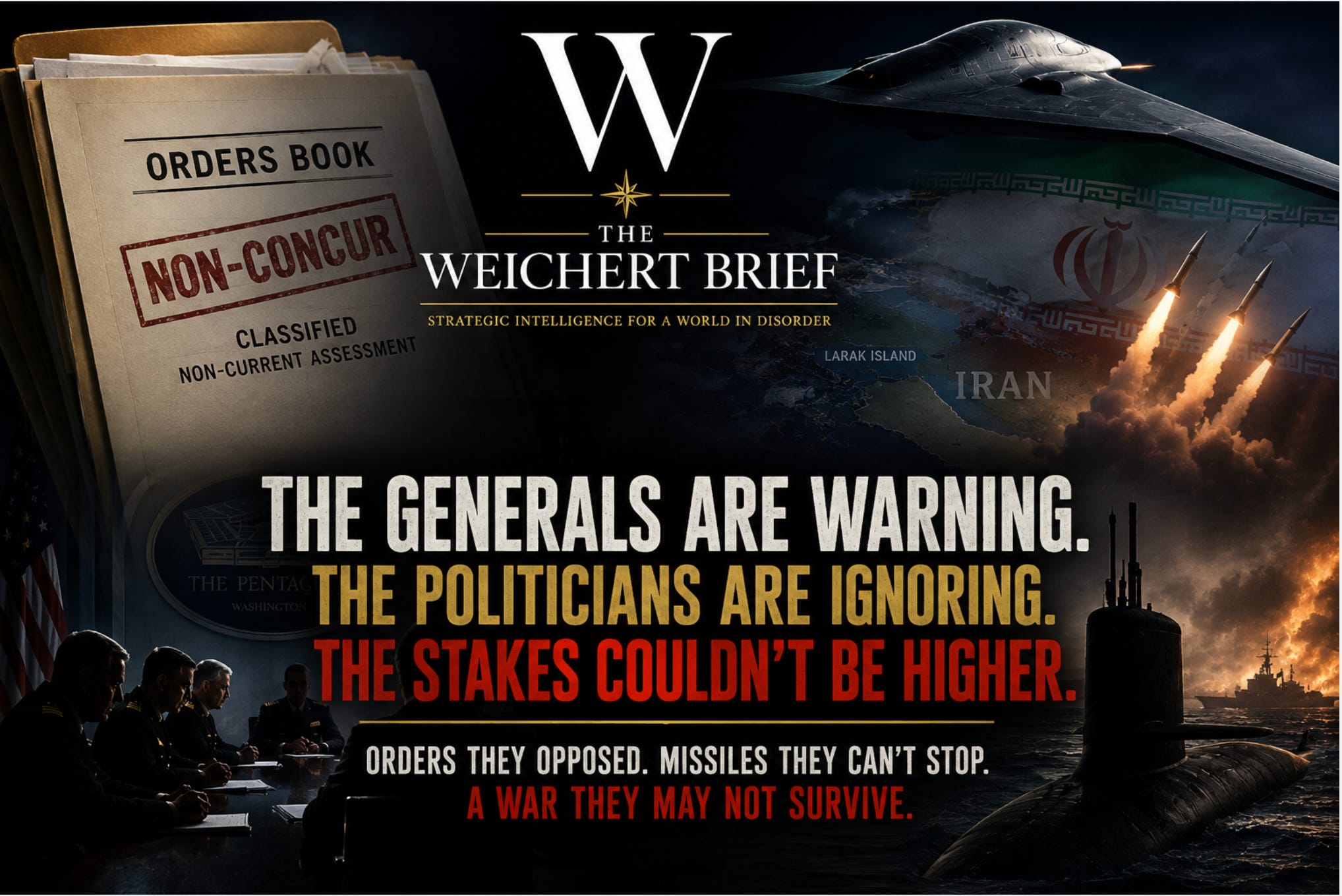
The Pentagon is irate because the Washington Post has revealed that the uniformed military leadership has written a non-current assessment of the Secretary of War’s orders book. This is basically the document that the Secretary of War signs, ordering each military element to its assigned areas of operation.
It details not only where those elements will operate but also how they are shaped by the available logistics chain and the arsenal.
Multiple Pentagon leaders are opposed to the current order book because, as these uniformed commanders see it, Pete Hegseth’s deployment orders unduly strain the force. In fact, these generals and admirals believe that the current set of orders issued by the Secretary of War is incompatible with available capabilities.
In other words, the political appointees of the Trump administration (undoubtedly acting under orders from the president himself) are leading the United States to strategic ruin.
Of course, these uniformed military leaders are in no position to openly challenge the civilian leadership. There are pathways for contesting these orders. That’s why the non-concur assessments that were leaked to the Washington Post came about in the first place.
Yet, that leak isn’t having the desired impact. The uniformed military commanders, at least a sizable portion of them, are concerned enough to risk their careers by leaking such sensitive written dissent to the media.
This move to leak opposition to the current orders book is indicative of a broader concern among the US military’s leadership: the president is breaking the United States Armed Forces.
Since the military is not able to challenge the civilian leadership the way that some might think, and because many of the top leaders of the US military are themselves political creatures, they won’t be more direct than they’ve been. But it is clear that fear is driving these leaks. Fear of a true strategic defeat that a snappy media campaign cannot cover up.
And fear that the United States military is about to be asked to escalate in a way that it cannot hope to win—or survive.
As this scandal erupts, with the Pentagon’s chief spokesman threatening to prosecute the Washington Post for leaking classified information, the president has ordered an attack on Larak Island with drones.
Shortly after the US military’s drone strikes on what the Pentagon claimed were Fajr missile sites that were preparing to launch mines into the Omani side of the Strait of Hormuz (SoH), Iran retaliated with an overwhelming barrage of missiles directed against US military facilities in Jordan, Kuwait, and possibly Qatar.
Jordan claims that its missile defenses shot down eight of the Iranian missiles fired at the country.
Iranian leaders have vowed to escalate in rapid and unpredictable ways against the United States if it fully returns to warfare with the Islamic Republic.
At the same time, President Donald Trump is propagating a seemingly endless cavalcade of increasingly bellicose posts on his Trump Social page threatening Iran with more violence:
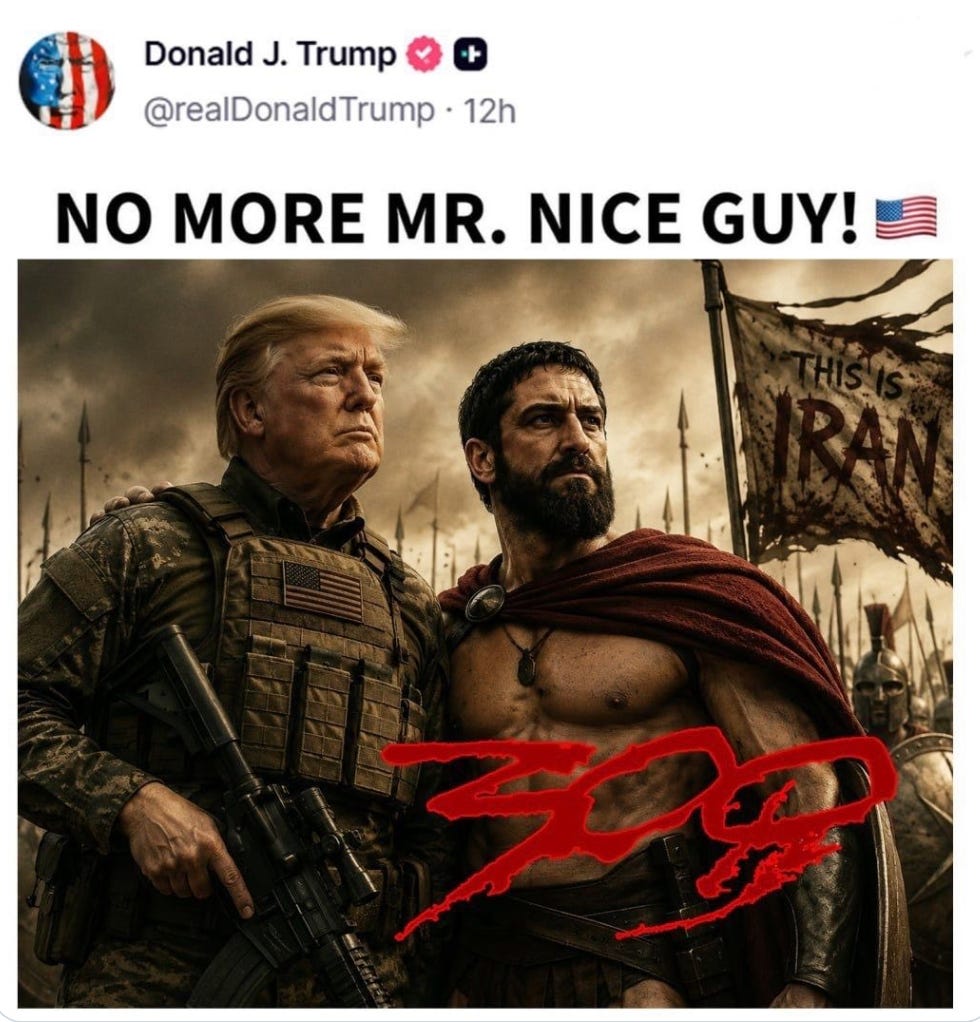
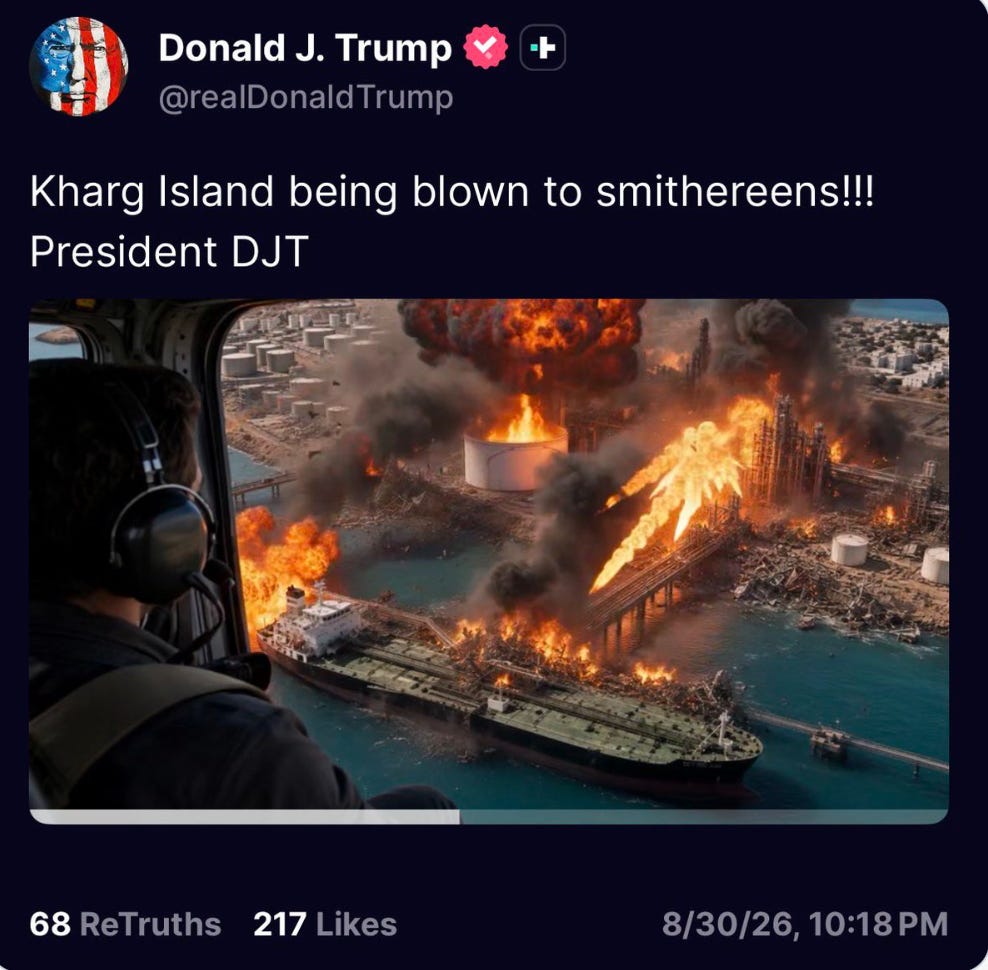
This comes on the heels of news that Undersecretary of War for Policy Elbridge Colby is feverishly leading the effort to rewrite the Pentagon’s nuclear warfare doctrine to make the use of non-strategic (tactical) nuclear weapons easier to use in warfare; to treat those nuclear systems as little more than giant artillery pieces rather than the heralds of the apocalypse that they so clearly are:
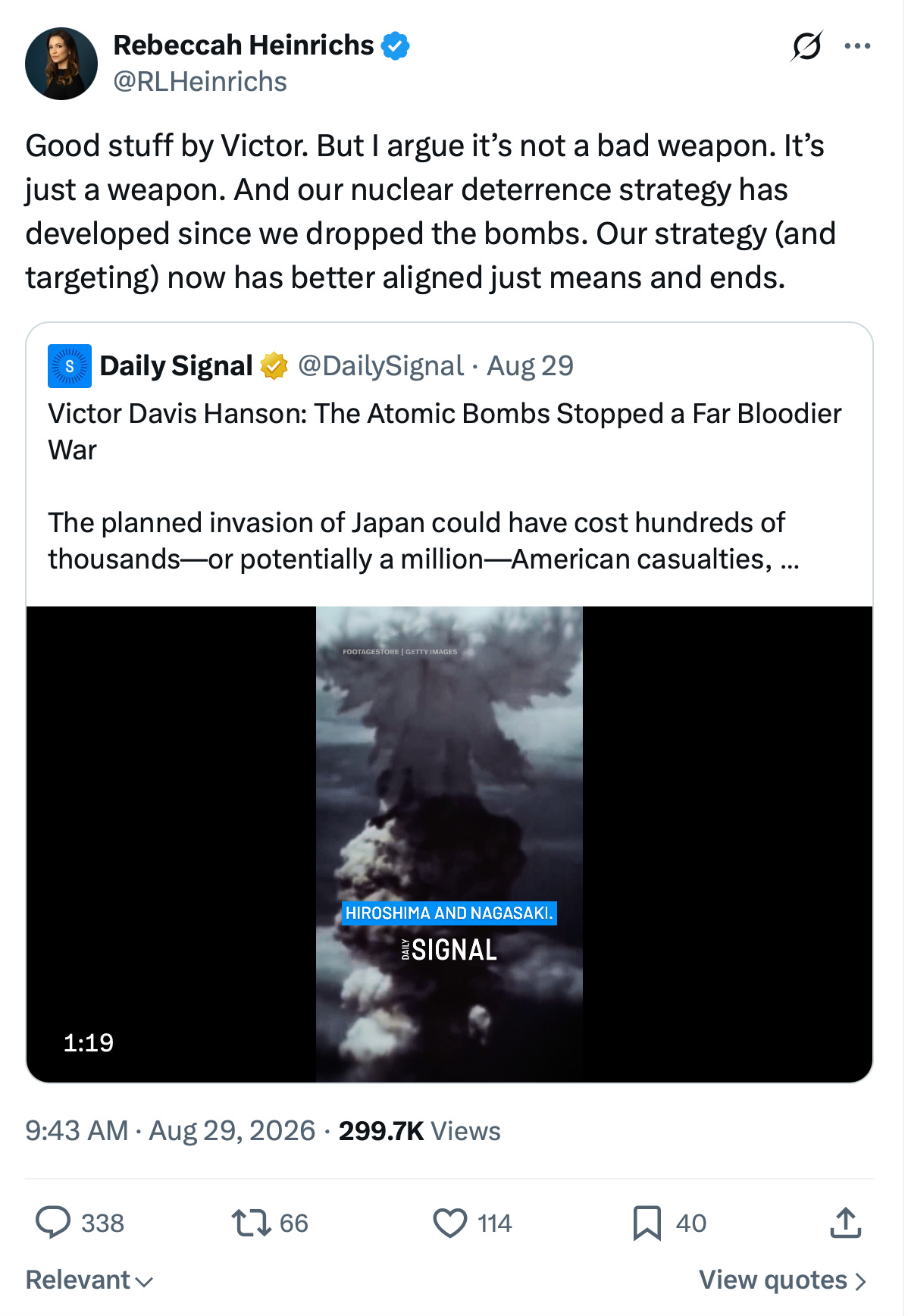
The “it’s just a weapon” crew that now almost exclusively gets heard by the president are likely the reasons behind why the president is posting such antagonistic statements about escalating with the Iranians on his Truth Social page—and why the uniformed military leadership are taking extraordinary steps to alert the public about the abject failure and utter irresponsibility of the Secretary of War and most of the rest of the current crop of civilian leaders.
More than six months ago, when President Trump initiated his war of choice against the Islamic Republic of Iran, the world had no idea that this is where we would be today.
Few could have envisioned that the Americans would have effectively drained their critical stockpiles of munitions within the first four weeks of the war (with no reliable replacements available).
Still fewer could have anticipated that the response to the apparent failure of the US military mission against Iran would have resulted in threats like this:
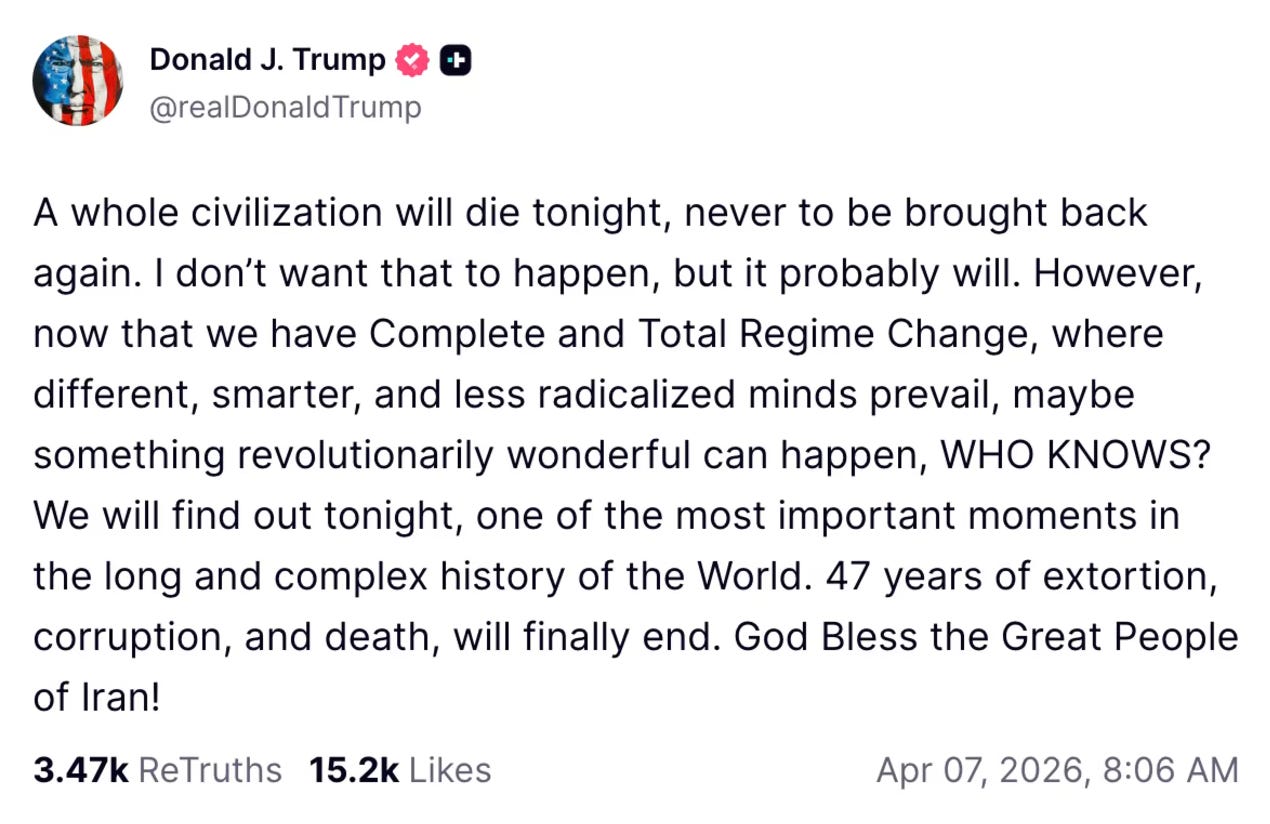
Or that the Pentagon would be ignoring the best advice of its top military leaders and would instead be “updating” the nuclear weapons strategy to make the deployment of tactical nukes easier.
And let us not even mention the possibility of extreme moves by the Pentagon to retain its current force levels (potential reimplementation of the dreaded stop-loss policies from the height of the Iraq War and even a potential national draft).
All because the president committed the United States to an unwinnable war, and rather than just admit that the country lost, Trump now wants to blunder ahead with a bigger conflict.
The uniformed military leadership understands that they will soon be tasked by the Trump administration with trying to resolve the war favorably by force.
Whether it be the launching of a nuclear weapon or the expansion of the war to include some ground incursion or even just a bigger set of airstrikes against Iranian targets, the fact remains that the military will not achieve its objectives. Whatever fallout occurs will be blamed on the military.
America’s military, especially its navy, is in dire straits.
The bulk of the key conventional weapons platforms that the US military relies upon to wage modern war have been depleted. The defense industrial base is completely incapable of replenishing these losses at any significant rate. Yet, the Trump administration appears less interested in ending its foreign entanglements than at any other time before.
Hence, the ongoing rewrite of the US nuclear warfare doctrine is reducing the threshold for non-strategic nuclear weapons to be deployed.
Of course, the forty-seventh president has publicly denied his interest in deploying nuclear weapons. Then again, the president insisted that he would never get the country into another endless Middle East war of choice.
Anyway, multiple inside sources highlight the fact that the president in recent months has become increasingly interested in using a nuclear weapon. These sources have been proven right repeatedly on a variety of other issues related to the administration.
Most disturbing, though, is that the deployment of a non-strategic nuclear weapon, like the B61-13, targeting a part of Iran’s suspected nuclear weapons program, such as the incomplete Pickaxe Mountain underground facility, is likely seen by Trump as a nearly painless end to the war.
The B61-13, housed at Whiteman Air Force Base, can easily be loaded onto a B-2 Spirit long-range stealth bomber, flown to Iran, and dropped on the target, replicating the non-nuclear B-2 strikes last year that ended the 12-Day War.
Trump might even think that this is his way out. Put on a dazzling light show in a sparsely populated area of Iran, send a stern message of resolve to Tehran that implies the leadership must now be more amenable toward US expectations in any negotiation, and avoid the really nasty parts of a protracted war. But the enemy gets a vote. And there is little in Iran’s current repertoire lending itself to the notion that Tehran would buckle under such a nuclear strike.
That’s to say nothing of the Israeli factor.
Once the US drops a nuke on Iran, no matter how limited or small that attack might be (for nuclear standards), that knocks open the door for the Israelis to follow on the US nuclear strike with strikes involving nuclear-tipped cruise missiles fired from their Dolphin-class submarines, many of which are likely floating off the coast of Iran right now.
Israel doesn’t want peace.
Nor do they care about regime change in Tehran. Israel just wants Iran flattened and no longer a factor geopolitically.
That is likely why key elements of the Pentagon’s brass are leaking their non-concurring assessments to the Washington Post. They fear what might be coming.
The brass is desperate to make it public so the civilian leadership in Congress will rush to their aid (or political pressure can be mounted and get Trump to back off from this most destructive course). But no restraint is coming. Trump is going to escalate, and it might just be with nuclear weapons.