A good secretary of defense has to be a jack of many trades and master of a few.
With an almost trillion dollar budget, with more than two million military personnel and over three-quarters of a million civilians in the workforce, with something north of 750 bases overseas and several hundred more on American soil, and with hundreds of thousands of heavy weapons systems and several thousand nuclear devices in the Pentagon’s arsenal, he has to be a strategist, an economist, a psychologist, a manager, and a mediator.
Pete Hegseth came to us from the weekend anchor couch at Fox.
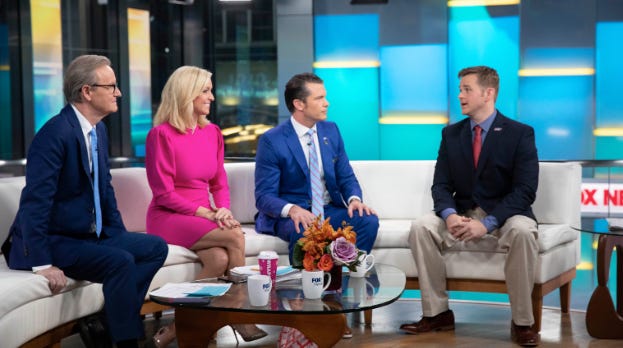
But no matter. President Trump didn’t install Hegseth at the pinnacle of the Pentagon for his skills as a strategist, an economist, or anything else. Do you know why he hired Hegseth, besides the fact that from his couch at Fox he endlessly berated the press, which made the president a big fan? Trump has told us why repeatedly, and said it again to his cabinet in May: Pete Hegseth is “straight out of central casting.” In Donald Trump’s world, apparently here’s what central casting looks like. For those who want to know, this tattoo is a common symbol for Christian nationalism.

And as if coming from central casting isn’t enough to earn Trump’s admiration, Pete Hegseth, Trump has told us, “loves war.”
As The Economist put it a few months ago, “That should disqualify him.”
Five-Star General and future president Dwight Eisenhower, the man who orchestrated the successful invasion of France on D-Day on which the future of a free Europe relied, said not long after the end of the Second World War, “I hate war as only a soldier who has lived it can, only as one who has seen its brutality, its futility, and its stupidity.”
But Pete Hegseth, by his boss’s own reckoning, loves it. From the language he uses, it is deep in his DNA. He doesn’t call his men and women in uniform “soldiers.” They are “warriors,” sometimes “warfighters.” He wants them focused on a “warrior ethos.”
That might be all well and good, except Hegseth himself is focused on something else. From his first days on the job, he was focused on ridding the Pentagon of any vestige of DEI— Diversity, Equity, and Inclusion. Earlier this year he told the aerospace company Rocket Lab, “We’re eliminating all the distractions. No more DEI, no more dudes in dresses, no more social engineering. We’re done with political correctness.”
As if there actually were dudes in dresses.
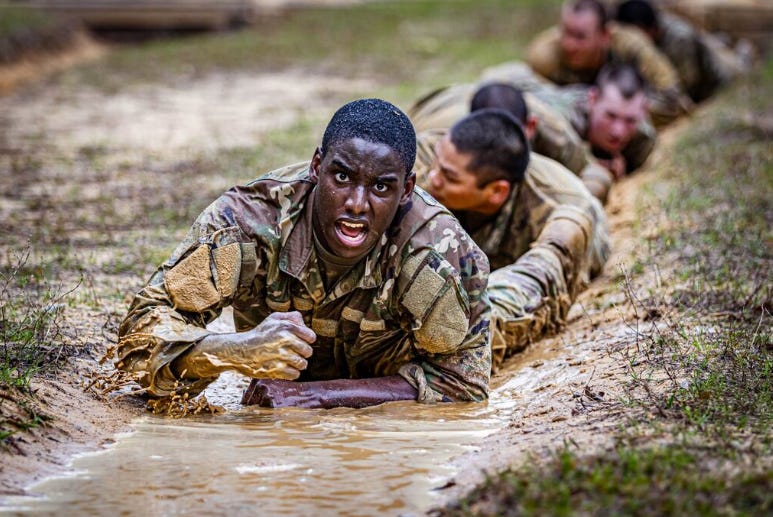
But just to make sure, in July the secretary ordered annual tests for personnel 30 and older for “testosterone deficiency.” His rationale? “Ensuring you have the right testosterone levels to operate at your absolute best.”
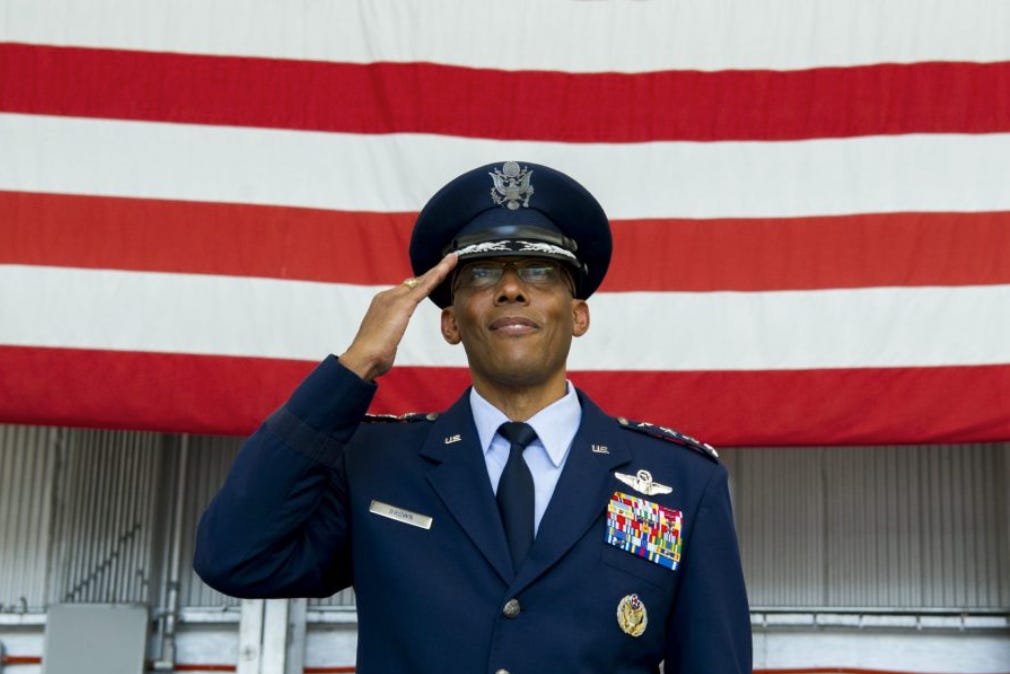
Hegseth inherited a first-class chairman of the Joint Chiefs of Staff, Air Force General Charles Q. Brown, whose combat record pretty much proves he had the testosterone he needed: with 130 combat flight hours on his record, he led the air war against ISIS in Iraq. What did Hegseth do when he got to the Pentagon? He fired him. His stated reason was, Brown, who is black, was “not the right man for the moment.” The kinds of DEI policies he supported “weakened military readiness.”
Since then, more top officers and civilian leaders at the Pentagon have been fired, asked to retire, or quit. That honor list includes General Randy George, the Army’s top officer, General David Allvinthe, the Air Force chief of staff, General Christopher Donahue, the commander of forces in Europe and Africa, Admiral Alvin Holsey, the top officer for Central and South America, Admiral Lisa Franchetti, the chief of naval operations, as well as John Phelan, the secretary of the Navy, and as of this week, Dan Driscoll, the secretary of the Army.
The Air Force secretary in the Biden administration, Frank Kendell, says, “Mr. Trump and Mr. Hegseth do not want candid, sound and independent advice from senior military leaders…. They want personal loyalty and compliance with their orders.”
The end result is, under Hegseth, some of our top brass have been shown the door. Some of them in the middle of a war.
Hegseth also has blocked the promotion of at least 45 other high-ranking officers, despite the approval of the services’ different peer-review boards. As Slate pointed out a few days ago, “Half of those officers have been Black or female, which does not seem to be a coincidence. Hegseth has frequently derided the very notion that women should be in the military, at least in combat roles, and he has wondered out loud whether Black officers have been promoted to the ranks they’ve attained because of DEI policies, which he opposes on principle.”

Author Richard North Patterson, in his new book called Tripwires, writes about one specific act by the secretary of defense that defines his detestation of DEI, which is the racism that drives him.
“One of Hegseth’s first efforts to revive camaraderie was to purge the Department of Defenses’s website of a tribute to that noted subversive, baseball hero Jackie Robinson. Evidently, Robinson committed the seemingly unavoidable sin of being Black while serving in the segregated Army during World War II. After protests, the reference to Robinson was restored.
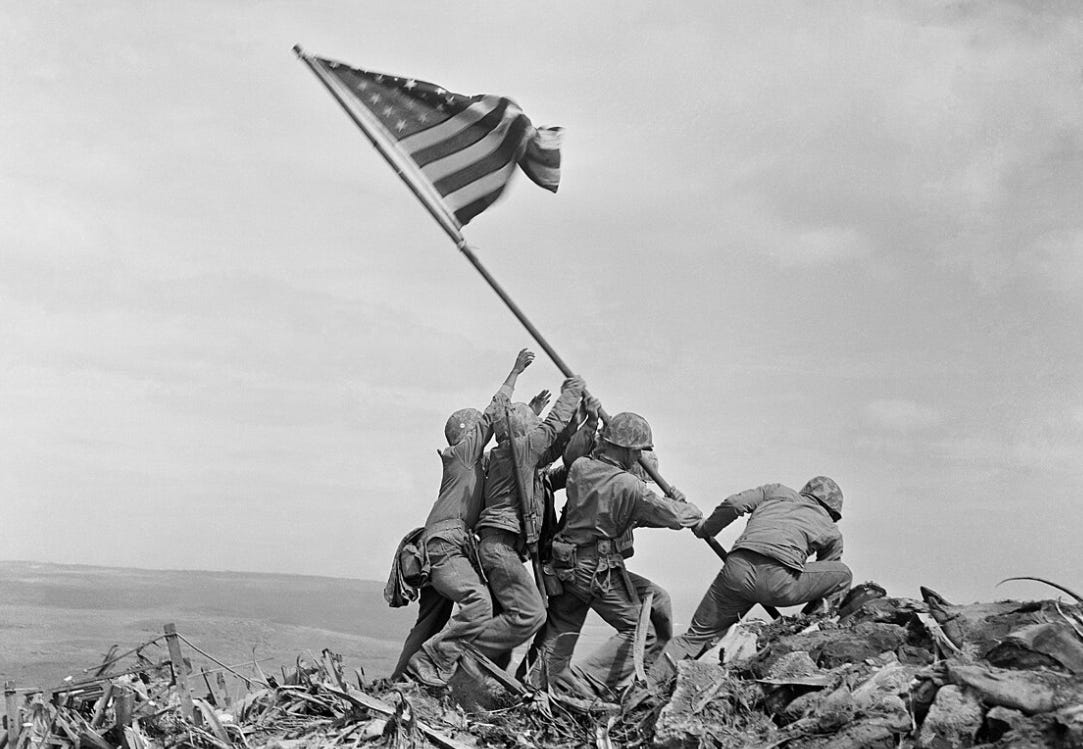
“But Hegseth’s deputies also removed tributes to the Black female pilots of the Second World War, to an African American general awarded the Medal of Honor for heroism in Vietnam, to the Native American soldiers who used their given languages to create codes the Japanese couldn’t break, and to the Navajo infantryman who helped raise the flag in the iconic photograph at Iowa Jima.”
Departing Army Secretary Driscoll, to his credit, reportedly fought with Hegseth over the very issue of how many qualified, experienced, war-hardened military leaders he has demoted or dismissed. Now he’s gone too.
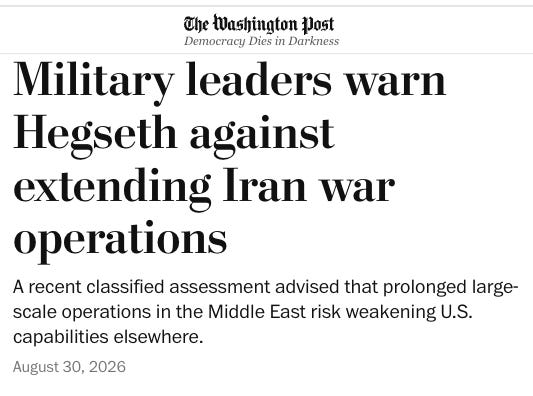
It sounds like the ones who are left have been restive. Over the weekend, The Washington Post broke this story: “The three (remaining) four-star commanders in charge of U.S. military operations in Europe, the Pacific, and South America, as well as the Navy’s top admiral, all informed Hegseth that because so many of their planes, ships, and other weapons systems have been diverted to the war in Iran, they could no longer perform their tasks if a war broke out in their part of the world.”
The upshot of their admonition? If we have to fight another war in another place, we’re not equipped, we’re not ready.
This is why the secretary of defense has to be a strategist, an economist, a psychologist, a manager, and a mediator. This is why Pete Hegseth is so pitifully unqualified.
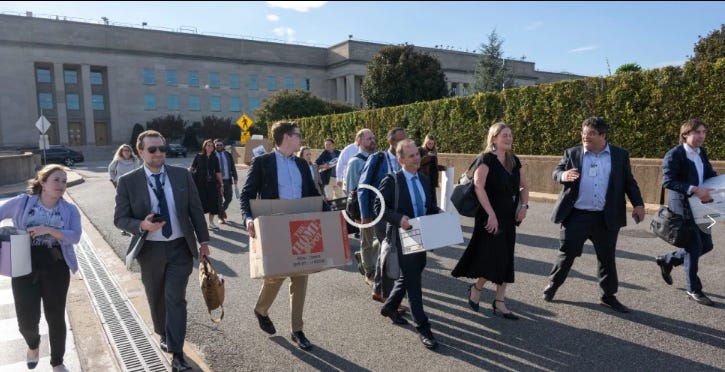
He has presided over shameful pieces of American history, from executing alleged narco-traffickers in the Pacific and the Caribbean without an ounce of due process, to giving his president bum advice about what the U.S. could achieve in Iran, to letting the U.S. military get to the point where fighting another war right now would be risky. He booted reporters out of the Pentagon if they wouldn’t sign what amounted to a loyalty pledge— even correspondents for his old network Fox walked out in protest— and according to a scoop last winter in The Washington Post, ejected still photographers whose photographs of him— our secretary “straight out of central casting”— were “unflattering.”
The guy’s not stupid— he has degrees from Princeton and Harvard. And he’s no novice to the military— he did tours in Iraq and Afghanistan and earned two coveted Bronze Stars.
But those things don’t qualify him to be running the biggest military force on earth, the military force on which our national security and the Western world depend. And they don’t qualify him to be advising the president of the United States, who needs informed and sound advice like no president before him. We need look no farther than Iran to see, he can’t get that from Pete Hegseth.
Hegseth belongs on the couch at Fox. Any other president would send him back.
Over more than five decades Greg Dobbs has been a correspondent for two television networks including ABC News, a political columnist for The Denver Post and syndicated columnist for Scripps newspapers, a moderator on Rocky Mountain PBS, and author of two books, including one about the life of a foreign correspondent called “Life in the Wrong Lane.” He also co-authored a book about the seminal year for baby boomers, called “1969: Are You Still Listening?” He has covered presidencies, politics, and the U.S. space program at home, and wars, natural disasters, and other crises around the globe, from Afghanistan to South Africa, from Iran to Egypt, from the Soviet Union to Saudi Arabia, from Nicaragua to Namibia, from Vietnam to Venezuela, from Libya to Liberia, from Panama to Poland. Dobbs has won three Emmys, the Distinguished Service Award from the Society of Professional Journalists, and as a 40-year resident of Colorado, a place in the Denver Press Club Hall of Fame. He also has been a consultant for the Counterterrorism Education Learning Lab.
You can learn more at GregDobbs.net