Trouble in the Pentagon as Leaked Report Paints Iran Trouble in the Pentagon as Leaked Report Paints Iran Conflict as “Unsustainable”
Something has been not-so-quietly brewing in the Pentagon.
Called by some the “revolt of the generals”, a leak has exposed that a handful of senior US commanders have formally dissented against Hegseth while warning that US’s Middle East plans are unsustainable.
A summary:
"Revolt of the generals" at the Pentagon over the Iran war: four senior US commanders push back against endless Middle East entanglement
The heads of European, Indo-Pacific, and Southern Command, plus the Chief of Naval Operations, formally "non-concurred" with Defense Secretary Pete Hegseth's push to keep 50,000+ troops in the Middle East — warning the extended deployment is unsustainable and gutting US readiness elsewhere, including at home. The dissent was recorded in the classified Secretary of Defense Orders Book, first reported by The Washington Post.
Over 50,000 US troops remain in the region; some units are ordered to stay through September, others through 2027. Commanders flagged depleted stocks of Patriot, THAAD, and Tomahawk missiles — and the US has burned through roughly a quarter of its MQ-9 Reaper drone fleet.
Pentagon spokesman Sean Parnell called the leak "a crime" and "a betrayal of the force" — while admitting the objections themselves are real: "non-concurs are standard... the Secretary sees them constantly."
The chaos doesn't stop there: Army Secretary Dan Driscoll — a Vance ally who helped shape the Russia-Ukraine negotiating track — just resigned after months of turf war with Hegseth.
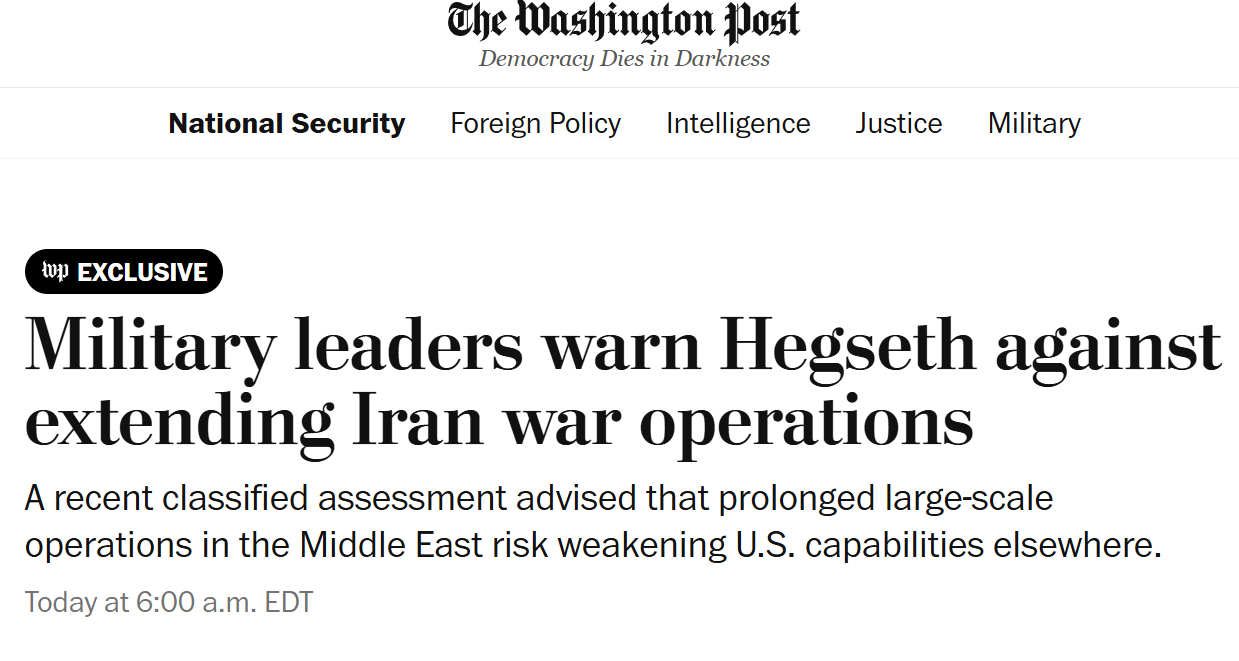
From the above WaPo piece that broke the story:
Several U.S. military leaders have advised Defense Secretary Pete Hegseth that prolonging large-scale operations against Iran is unsustainable and risks weakening their ability to confront threats elsewhere, including the U.S. homeland, according to people familiar with a recent assessment prepared for the Pentagon chief.
The warnings — detailed for Hegseth by the heads of the Army, Navy and Air Force and the four-star commanders overseeing U.S. operations throughout Europe, Asia and Latin America — appear in the Aug. 14 edition of the Secretary of Defense Orders Book (SDOB), these people said. They described the assessment to The Washington Post on the condition of anonymity because the document is classified.
As can be seen above, the warnings allegedly appeared in an internal classified document, and as such the descriptions thereof are considered to be major leaks, which has pushed Trump over the edge:
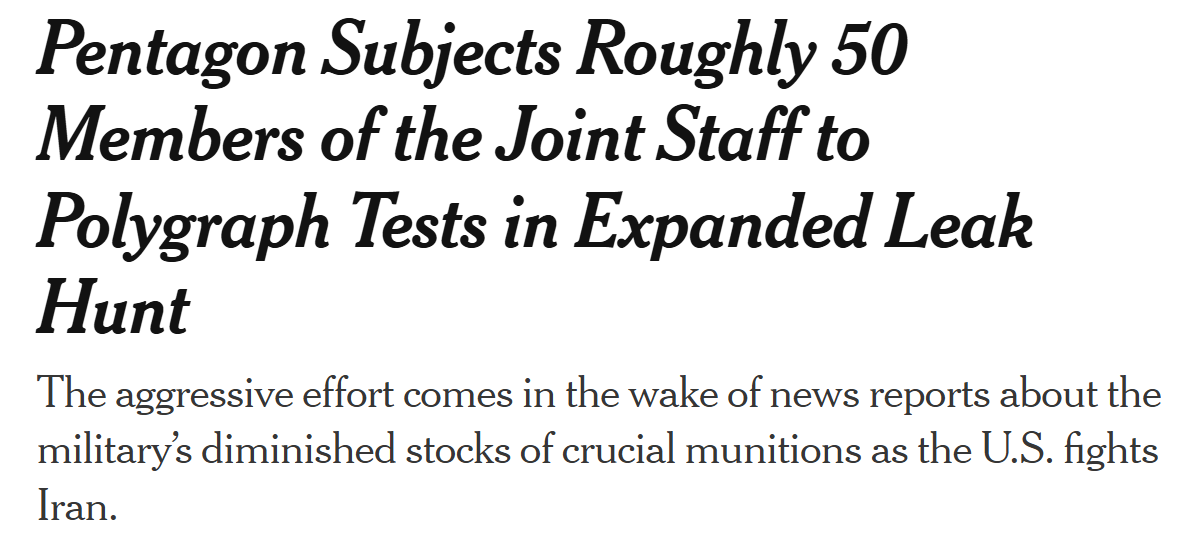
But let’s focus on the important part, which ties into the overall thesis we’ll get to later:
Consequently, U.S. Central Command, the headquarters responsible for prosecuting the Iran war, has kept a force of more than 50,000 troops on alert for months in case the president orders additional attacks.
The US has kept around 50,000 troops on alert for continuation of the Iran war, and these top Pentagon generals are essentially declaring this is unsustainable, particularly after US bases in Bahrain and elsewhere were wiped off the map.
Chief of Naval Operations Admiral Daryl Caudle is said to be one of the dissenting bigs. He himself had just declared this week that the US Navy will not be returning to Bahrain any time soon:
U.S. Navy personnel will not be returning to Bahrain soon, and the USS Theodore Roosevelt will be the next carrier to take up station in the Arabian Sea, the Navy’s top admiral said Monday during a “worldwide town hall” with sailors that also touched on pay, housing, health care and even the cost of haircuts.
The U.S. Navy is facing a serious logistics problem in the Middle East. Around 20 ships carrying roughly 20,000 sailors and Marines need more than 420,000 meals and about eight million gallons of fuel every week. The situation became much harder after Iran destroyed a key Navy …
3:57 PM · Sep 3, 2026 · 240K Views
77 Replies · 721 Reposts · 2.74K Likes
As for the “non-concur”, it means the generals do not agree with Hegseth’s assessment but will carry out their orders nonetheless:
Leaders of the U.S. European Command, the U.S. Pacific Command and the U.S. Southern Command, along with the Navy’s top admiral, responded with what is characterized in the SDOB as a “non-concur,” those familiar with the assessment said — meaning they disagree with the secretary’s order to extend their forces but will execute it nevertheless.
Overall, the tenor from the military leadership is that the ongoing Iran operation, having reached the six-month mark, has been “too much for too long,” said one person familiar with the assessment.
This came only a few days after Army Secretary Dan Driscoll outright resigned over his disagreements with Hegseth, particularly regarding the ‘purges’ the SecDef has been carrying out:
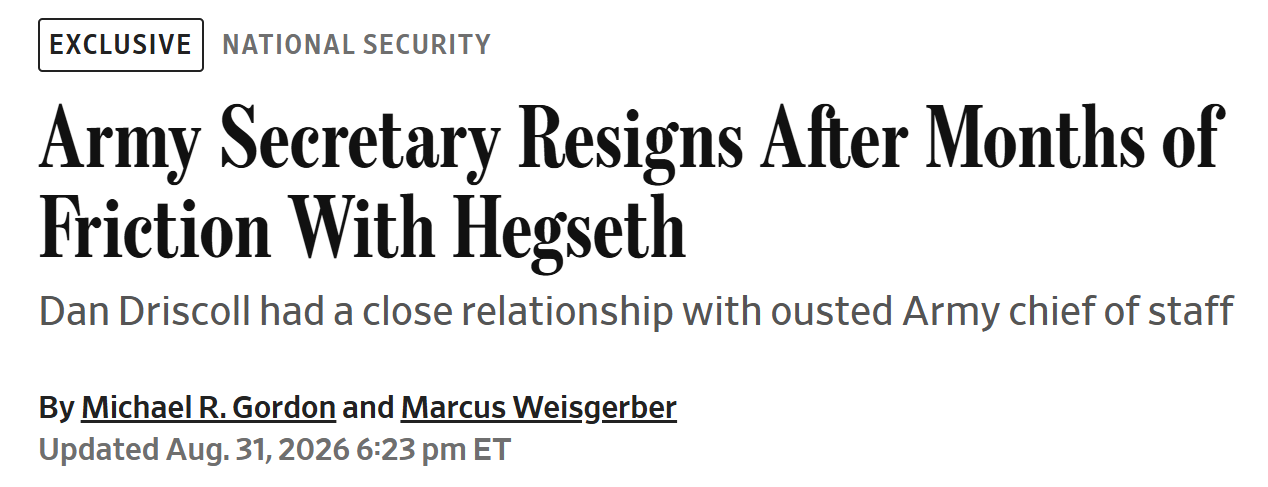
WASHINGTON—Army Secretary Dan Driscoll has submitted his resignation to President Trump following months of tension with Defense Secretary Pete Hegseth over the direction of the service and the ouster of numerous senior Army officers.
He is expected to leave the Pentagon in coming days.
With Driscoll’s departure, the Army will lack top Senate-confirmed civilian or military leaders. Gen. Christopher LaNeve has served as acting chief of the service since Hegseth fired his predecessor, Gen. Randy George. Mike Obadal, the Army undersecretary, would be the highest ranking civilian after Driscoll departs.
While projecting a face of calm on the surface, beneath the facade the US military, and particularly the Navy, appear to be undergoing unprecedented decay. Days ago the USS Lincoln made port call in Thailand looking like something out of a bad AI lampoon:
All while Trump screeched the usual boilerplate about Iran’s putative defeat:
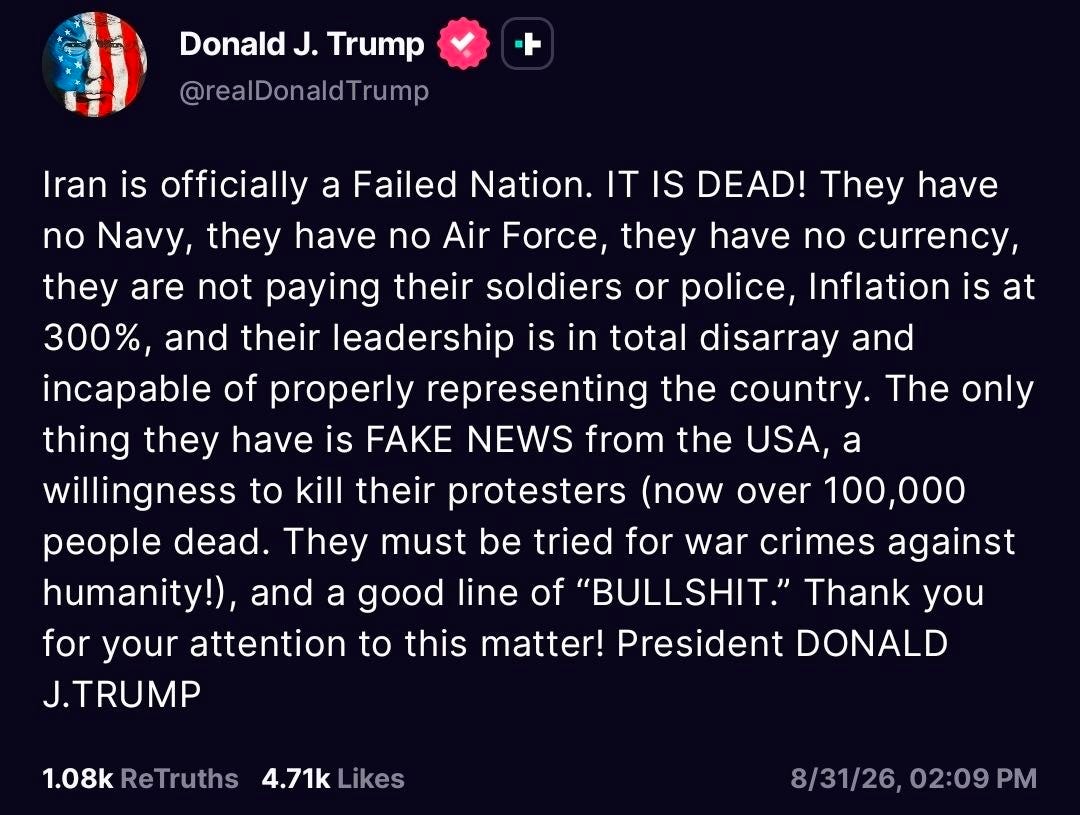
But he brings up the final point, which we alluded to earlier. Trump appears to believe that time is on the US’s side, and that by continuing its economic strangulation of Iran the US can bring the nation to its knees sooner than the US itself faces any kind of critical danger. Some have criticized our coverage of the Iran war here by pointing out that it’s biased toward Iran, and dismisses the genuine effect US’s blockade has had, which is said to be forcing Iran into economic crisis, mass inflation, monetary debasement, etc.
This could be partly true, and the following WSJ piece certainly argues this fact:
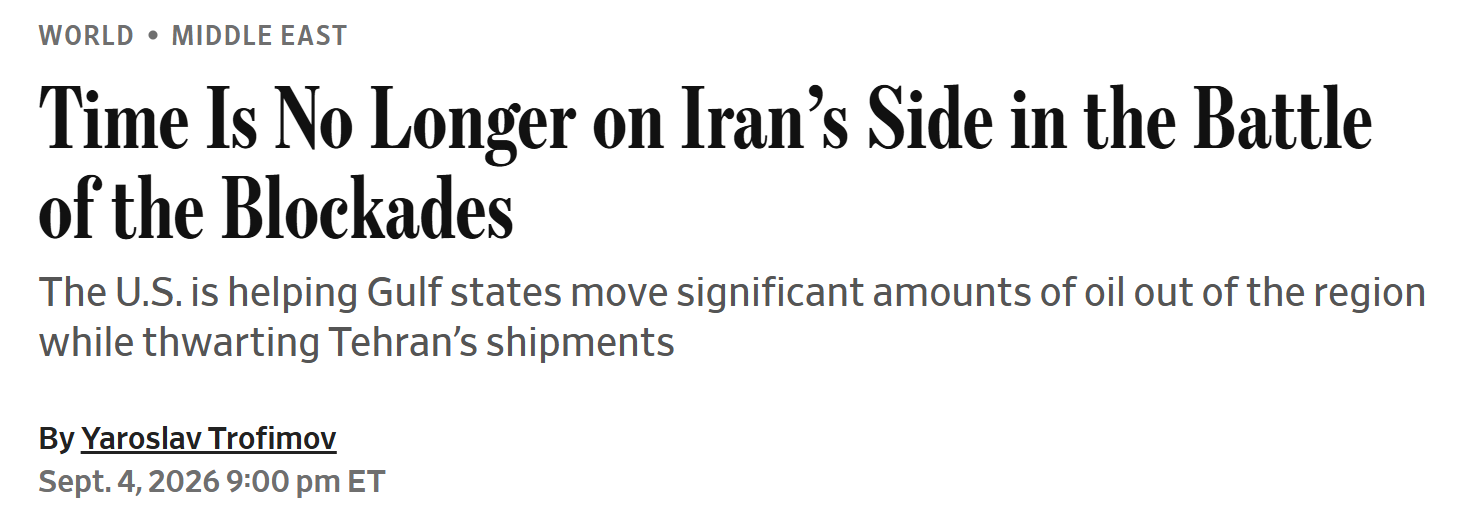
One of its arguments is that the US is still facilitating huge movements of oil for allies in the region, stealthily through the Omani route, etc.
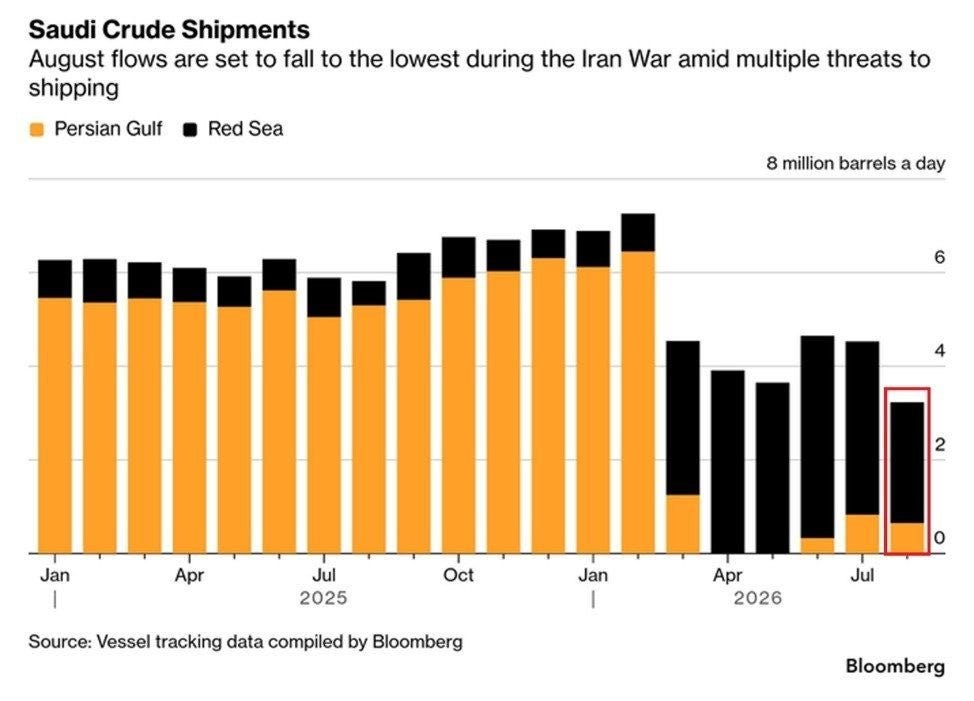
Bloomberg showed that in August, one such ally—that of Saudi Arabia—was still at a massive deficit compared to previous Persian Gulf shipments:
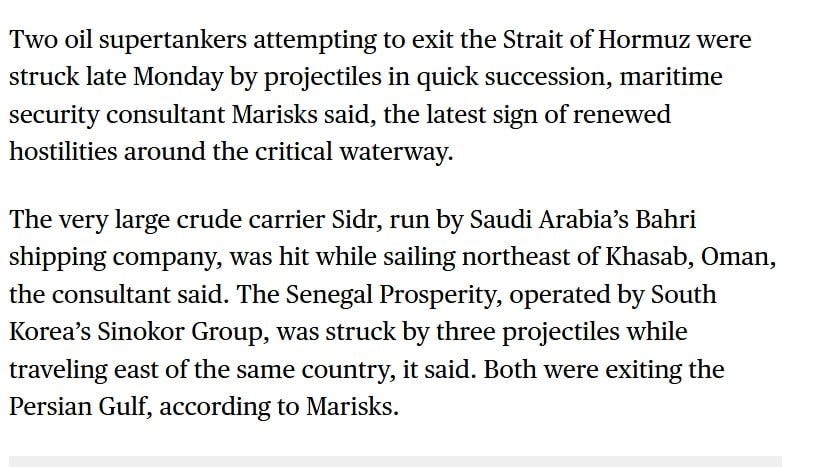
The article however essentially strawmans Iran’s chief aims, claiming that Iran failed to “crash the global economy” when that was never Iran’s intention. Iran’s true aim is simply the defeat of the US, and “crashing the global economy” does not necessarily need to be a key component of that. Iran is achieving its objective as is simply by eradicating the US’s regional reach via base destruction, as well as plunging the US into political turmoil, as now seen playing out with the Pentagon scandals.
No one is saying that Iran is not taking real and quantifiable hits to its economy, but the question is who can outlast whom?
But to speed things along, some believe Iran has now embarked on a new strategy: attacking US ships directly in order to crush what remains of their sustainability, now that Iran has already strained the logistics chains necessary to keep the fleet actively resupplied through indefinite operations:

This came about during another exchange which saw the US hit three Iranian tankers, with Iran responding by reportedly firing missiles at not only US warships, but also oil tankers being escorted through the US blockade-breaking route:
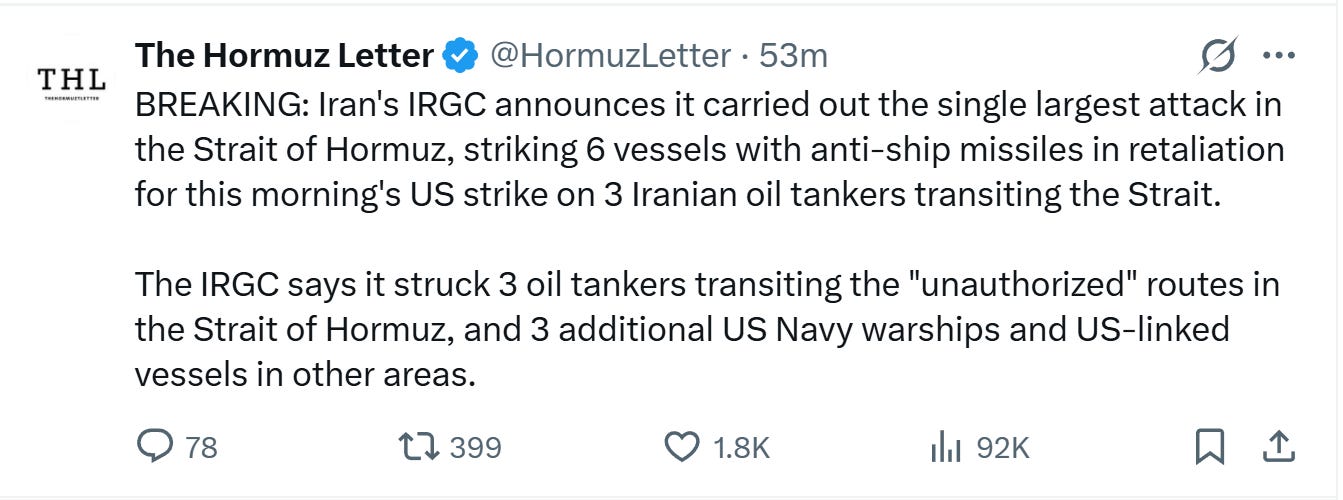
The attacks reportedly hit six such ships, which Iran even released a video of, which further refutes the WSJ-posed thesis that it is Iran for whom time is running out because Iran is not able to prosecute its blockade of the Strait as tightly as required. If Iran was able to hit half a dozen tankers within minutes at the drop of a hat, it would seem to indicate that if any tankers were previously getting through, it was only at the behest of Iran, perhaps by way of some secret backdoor deal or good faith attempt at de-escalation.
Trump, in the meantime, resorted to cheesy AI videos of bombarding Iran’s Kharg island:
Granted, just as with any ongoing conflict, there are subjective ways to re-interpret ongoing events to favor one’s preferred side. One can argue the US is “winning” because there have been real signs of inflation in Iran, as well as some political friction amongst the IRGC.
The US’s own inner turmoil is easy to use as argument for time being on Iran’s side. Recall, it is the desperate US administration doing polygraph tests on its own generals, as per earlier reports. Imagine the outcry and global ridicule if the IRGC was rounding up senior members for lie detector tests—it would be widely hailed as the “Iranian regime” being “brought to its knees”.
Today Iran proved that it can hit vessels at will, and there continue to be contradicting reports about how little oil is actually passing through the Strait for the US and its allies. Meanwhile, the US Navy is forced to strain its forces, cycling aircraft carriers from faraway theaters and command districts while Trump’s administration politically rots away. It’s certainly not a black-or-white issue, but it’s clear that Iran has at least a marginal—if not definitive—upper hand.
Both countries are employing virtually the same strategy of dual competing blockades on the same Strait, seeing who can bring the greatest economic hardship to the other. Both likewise have secondary options and lifelines: for Iran, it’s the rearward supply lines through Pakistan, the Caspian to Russia, etc. For the US and its allies, it’s the limited land route through KSA to the Red Sea, and the iffy Omani route.
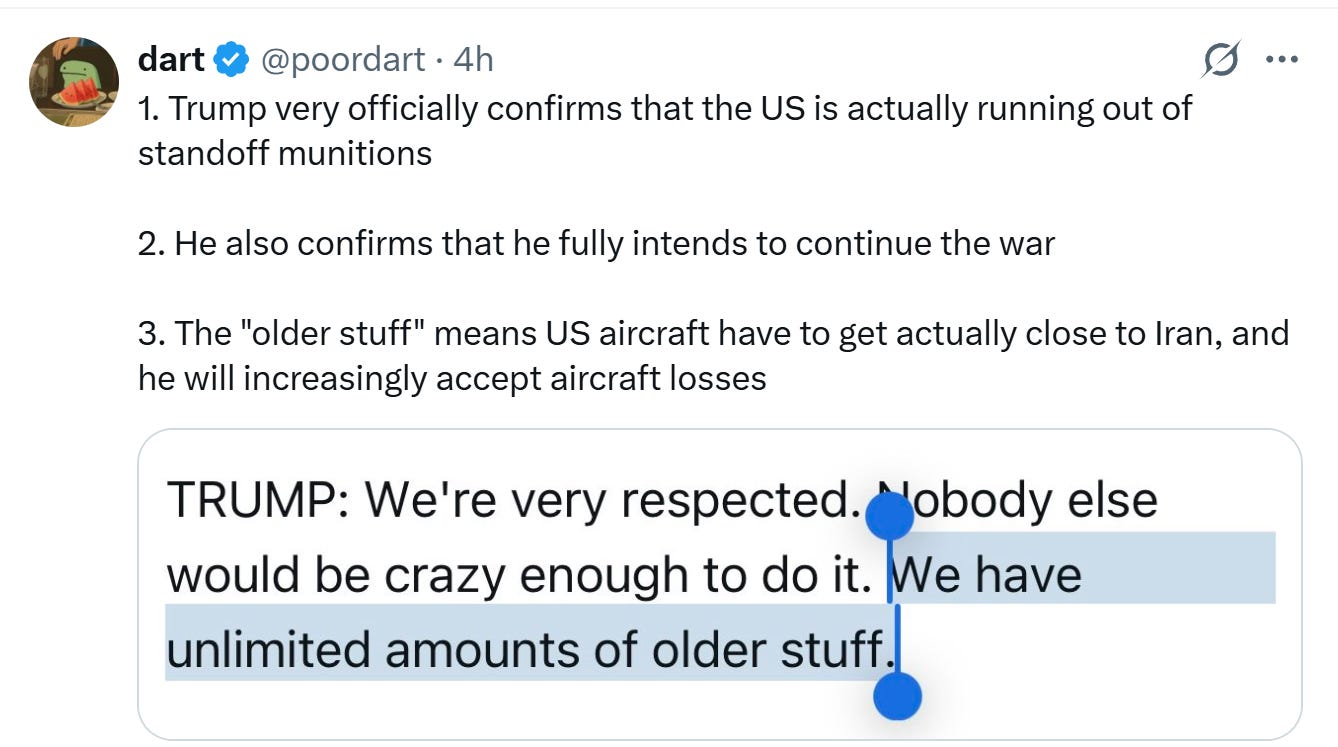
The one area where Iran continues to hold dominance is in escalation potential: it has by now rebuilt virtually everything that’s been lost earlier in the war, with missile production said to be thrumming. The US on the other hand is suffering from such major shortages of critical munitions that it has prevented Trump from escalating to a wider campaign.
In fact, today’s US “retaliation” on three Iranian oil tankers was telling: Iran had just again attacked US bases in Jordan, Iraq, and Kuwait several days ago, and attempted to hit patrolling US warships today. For this, the US could only manage to hit three Iranian tankers, rather than some significant military target. This represents a major turning point. The fact that an adversary and middle power can now send preemptive volleys of damaging strikes on major US military assets at will, and no longer even suffer any serious kinetic response, is a major development.
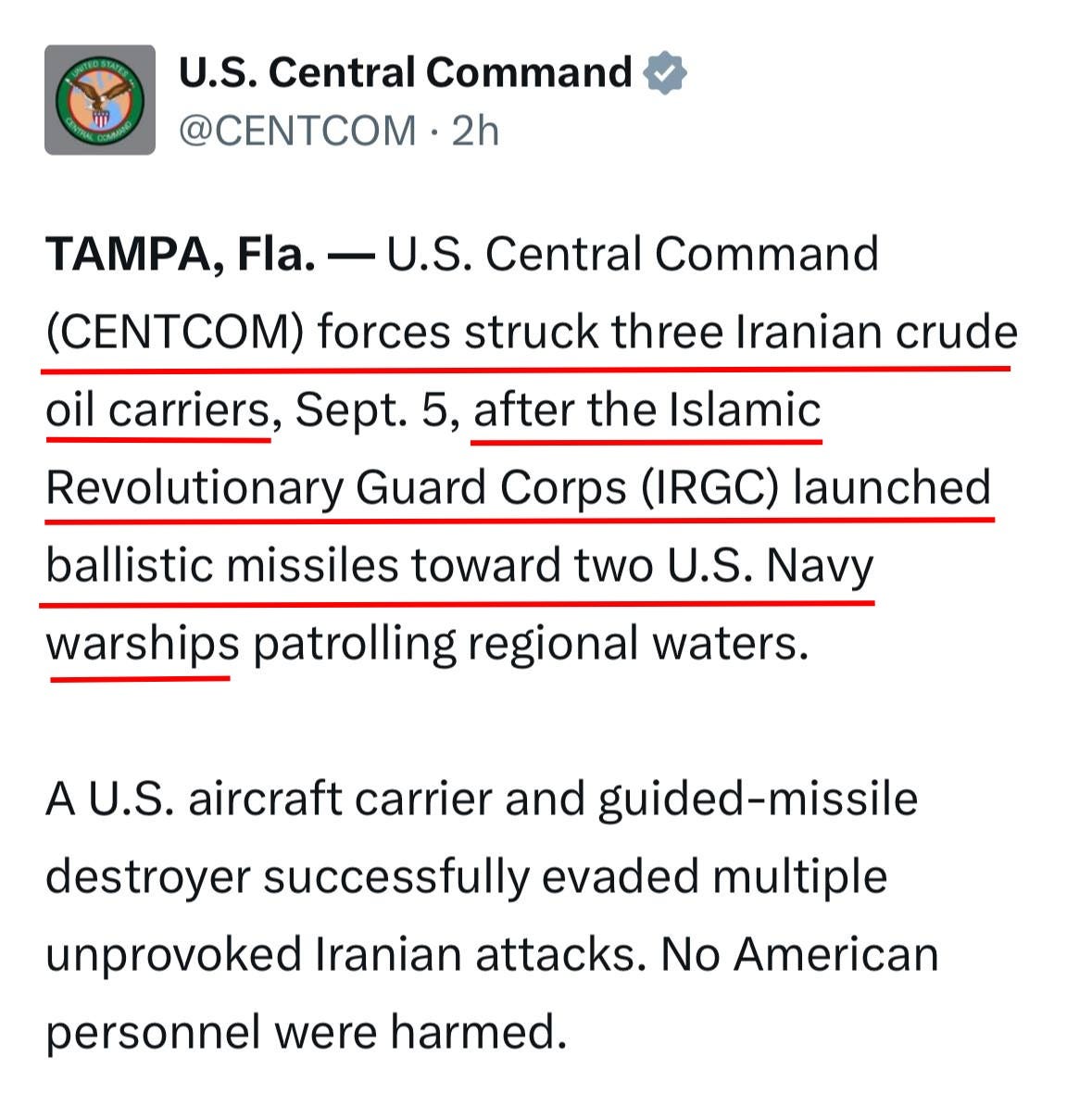
Just read the admission from CENTCOM itself: Iran is able to send strikes at US military assets, and the US can only hit meaningless civilian vessels in turn.
Recall how earlier in the war a huge deal was made over the claims that it was Iran’s strike tempo that was diminishing, while the US sortie count was soaring and all kinds of “major” military targets in Iran were being hit. Now the US appears totally spent—an exhausted and impotent force—like an old boxer in his last few rounds, winging slow, ineffective punches with no pop to them. Iran has demonstrated that it now holds escalation dominance, having called all Trump’s loudest bluffs and withstood the storm. And the longer this goes on, the more the internal revolts inside the Pentagon and in Trump’s administration appear to be growing as officials begin to comprehend the dire nature of the debacle.
This tells us that it is Iran that continues to hold the cards and the advantage in time.
Special thanks to you, the paid subscribers, who are reading this paywalled Premium article—you are the core contributing members keeping this blog in healthy, steadfast operation.
The Tip Jar remains as an anachronism, an archaic and shameless bit of double-dipping, for those who just can’t help lavishing their favored humble authors with a second greedy helping of largesse.