On the Eve of Rosh Hashanah, Israel's Longest War Is Nowhere Near Its End - Israel Security
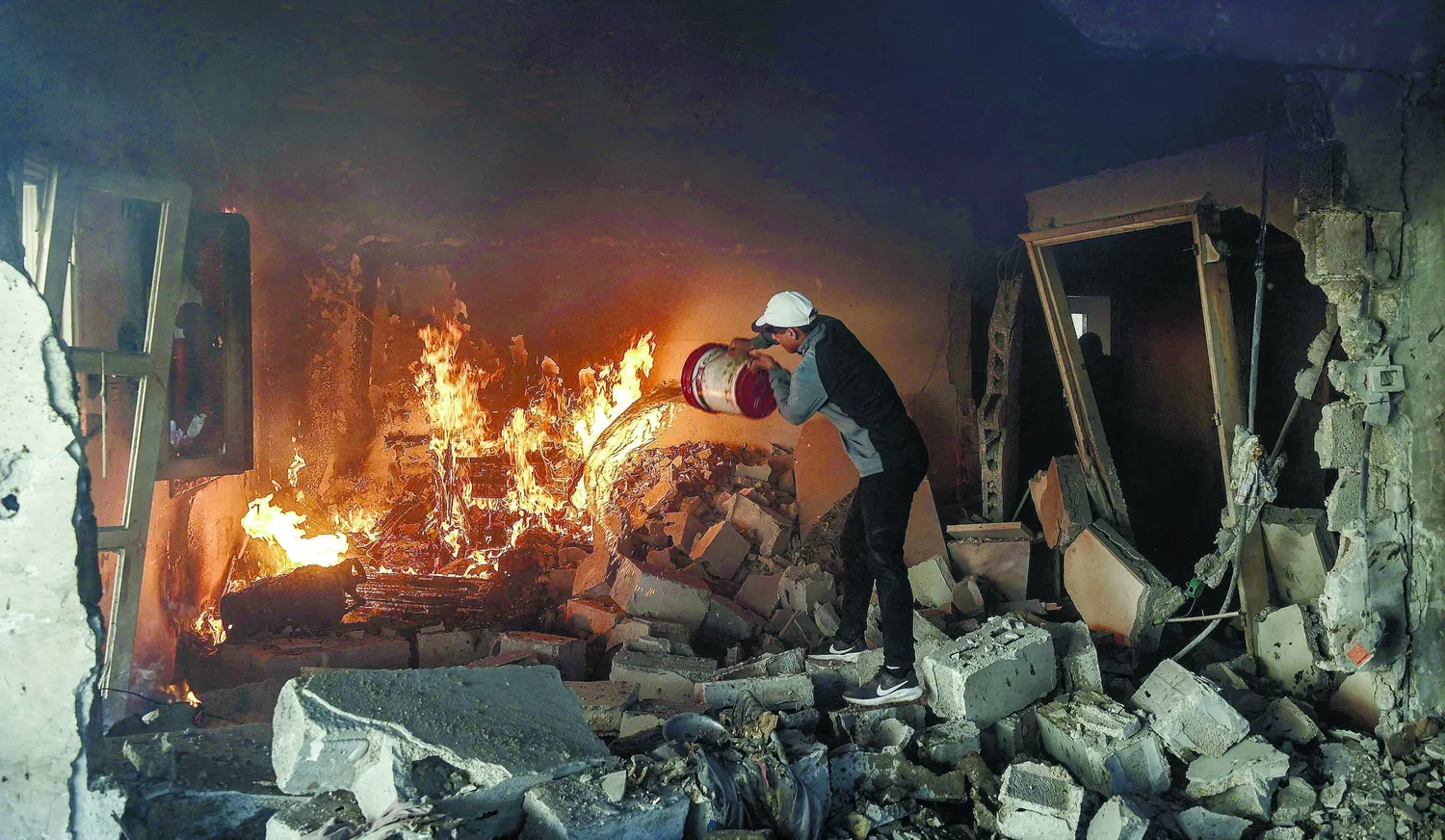
A Palestinian man trying to extinguish a fire after an Israeli strike in Gaza City's Rimal neighborhood this week. Credit: Omar Al-Qattaa/AFP
Amos Harel, September 11, 2026
The Jewish year that begins this weekend will be the fourth year of a regional war in the Middle East, and Israel remains at the center of it.
In its current incarnation, the war is being conducted at relatively low intensity. But all the fronts on which Israel is involved remain open, and the danger of renewed escalation looms over some of them (first and foremost Iran). Prime Minister Benjamin Netanyahu's frequent promises of imminent victory – at least he seems to have dispensed recently with the delusion of total victory – can't conceal the strategic mess we are trapped in, largely due to his decisions.
The longest war in Israel's history, waged in direct opposition to the principles of the defense doctrine formulated by the country's first prime minister, David Ben-Gurion, has created a security situation that will be difficult to deal with over time. But Netanyahu insists on turning this Achilles' heel of his policies into a source of pride.
In his view, this war without end has morphed from a bug into a feature. In recent interviews with sympathetic news outlets like his home television station, Channel 14, he has sent the message that he doesn't even want it to end.
After all, our situation, as described by Netanyahu in his election campaign, has never been better. Israel has killed most of its enemies' leaders and de facto annexed security zones outside its borders, and all its neighbors are trembling in fear of it.
In 2019, during one of that year's several successive elections, Netanyahu adopted the campaign slogan "A different league." It featured billboards with photographs of him alongside the leaders of several powerful countries: U.S. President Donald Trump, Russian President Vladimir Putin and Indian Prime Minister Narendra Modi. Today, those images have been replaced with two very different kinds: photographs of leaders Israel has assassinated or of their successors, with Netanyahu claiming that they are terrified that his Likud party will win October's election.
Benjamin Netanyahu in the Gaza Strip last week. Credit: Amos Ben Gershom/GPO
This column voiced – back in November 2023, little more than a month after Hamas committed its massacre in southern Israel on October 7 – the fear that Netanyahu planned to wage a long war, mainly for the sake of his own political survival. At the time, it was met by sweeping denials. Later, when U.S. President Joe Biden and his successor, Trump, pressured him to sign a hostage deal with Hamas and to seek to end the war in Gaza, Netanyahu told them that he could not do so because his far-right political partners, Itamar Ben-Gvir and Bezalel Smotrich, would quit the government.
In fact, both men stuck with him to the end, though they either voted against the hostage deals or abstained. Ben-Gvir did resign briefly in early 2025, but returned once the fighting in Gaza resumed. None of that has stopped either him or Smotrich from bragging about having brought the hostages back to Israel. (The government deliberately tends to obscure the difference between the return of living hostages and dead ones.) And when some 2,000 Palestinians were released in the final deal last October in exchange for the last hostages – 20 living and 28 dead – nor a single protest demonstration took place.
Netanyahu does seem to have prolonged the war out of political considerations, but not necessarily fear of Ben-Gvir and Smotrich. The continued fighting allowed him to present an appearance of persistent aggressiveness, keep the country in a constant state of emergency, reduce daily preoccupation with the causes of the massacre (while effectively shifting the blame to senior officers in the Israel Defense Forces and the Shin Bet security service) and allocate enormous sums to the Defense Ministry and for line items that served his political needs.
He now argues that his rivals within the governing coalition at the time – first and foremost Gadi Eisenkot and Benny Gantz, who joined the government after October 7 and left it in June 2024 – not only tried to shorten the war in Gaza but were afraid to fight Hezbollah. Eisenkot and others dispute that claim. They said they thought finalizing a hostage deal should be sped up precisely so that the military could focus on Lebanon.
Revealed: Netanyahu received an explicit warning days before Oct. 7. He didn't brief Israel's security chiefs
Click here to read the extensive investigation into the fateful warning delivered by UAE President Mohamed bin Zayed, which prompted Netanyahu to sent a warning letter ahead of a libel suit against Haaretz.
But Netanyahu also had partners on the other side who contributed to prolonging the war. Hamas and Hezbollah refused to capitulate despite the grave military blows they suffered. (Some members of the IDF General Staff think a de facto military victory was achieved on both fronts.) Iran became a front in the war as a result of a joint American-Israeli decision in June 2025; the war with Iran continues to this day, at varying levels of intensity.
Around once every two weeks, Netanyahu and Defense Minister Israel Katz, like Don Quixote and Sancho Panza, tour one of the borders and get photographed with soldiers at the front. Their preferred destinations are territory occupied over the last few years.
Having soldiers in the background is considered effective in campaign videos, and their use hasn't yet roused the Central Elections Committee from its relative slumber. Behind the scenes, arguments are taking place with the army over the rules of such photographs and what access journalists working for the Prime Minister's Office will be granted.
Perpetual war and imminent victory
During these tours, Netanyahu promises two contradictory things in the same breath: perpetual war, but also imminent victory. During his visit with Katz this week to "Keter Hahermon" (until recently known as the Syrian side of Mount Hermon), he predicted that the Iranian regime would soon fall.
Journalist Amit Segal wrote in a column in the Israel Hayom daily on Thursday that the Tehran regime's collapse is "very close," quoting a Mossad forecast of "the first quarter of 2027." The IDF is more skeptical in its assessments.
In general, Iran is now causing growing concern. The American effort to direct traffic in the Strait of Hormuz to the western route, alongside the coast of Oman, provides an economic opening for Iran's neighbors in the Persian Gulf at a time when the economic siege and the sanctions on Iran itself continue. IDF sources say they believe Tehran's leaders are increasingly frustrated and may soon act to intensify military friction with America and perhaps even to bring Israel back into the conflict. In the meantime, on Thursday the Iran-backed Houthi rebels in Yemen seized areas of the country near Bab al-Mandab Strait, potentially enabling Tehran to pose a threat to ships bound for the Suez Canal.
The military is aware of the costs of maintaining Israel's three security zones. It currently occupies 1,220 square kilometers (471 square miles) more than it did on the eve of October 7, on three fronts – Lebanon, Syria (on the Golan Heights and Mount Hermon) and Gaza. And that's without even mentioning the expansion of the territory in the West Bank that it has to protect.
This year alone, 26 new settlements are slated to be built (out of 104 decided on by the government). In addition, 95 settlement outposts and 42 farms have already been built this year. During the upcoming Jewish holidays, no fewer than 26 battalions will be deployed in the West Bank.
In the last two years, 63 army outposts have been built outside Israel's borders, most of them in Gaza. And the number of troops involved in protecting the borders, the West Bank and the security zones has risen by 300 percent compared to the number on the eve of the massacre.
Vessels near the Strait of Hormuz, as seen from Musandam, Oman, last Monday. Credit: Stringer/REUTERS
This situation has dictated 100 days of reserve duty a year for reservists. It also requires conscript soldiers to be involved in operational activity almost continuously, aside from short and insufficient breaks for training. To date, the state has spent 420 billion shekels ($138 billion) on the war, and in two years the annual defense aid from the United States may end entirely.
The General Staff is convinced that despite the complex circumstances, the time has come for diplomatic moves that will at least reduce the scope of the fronts on which the IDF is mired. With Netanyahu, there seems no point in talking about this, at least until after the October 27 election. But at the same time, Trump's attention also seems to be wandering to other fronts.
General Staff exercise
On Sunday the Israel Defense Forces held a large-scale, surprise exercise simulating a multifront escalation. Only a few officers besides IDF Chief of Staff Eyal Zamir were informed of the date in advance.
The scenarios practiced were extreme: a surprise attack from Gaza by Hamas, despite its limited military capabilities; horrific attacks on the home front; conflicts with Iran and with Hezbollah. The date was selected in the knowledge that the country and the military are entering a particularly sensitive period and that military tensions are likely to be negatively influenced by the internal tensions in Israel in the run-up to the election.
The IDF has traditionally considered September and October a particularly difficult period.
Israeli soldiers are deployed during an Israeli army raid in the occupied West Bank refugee camp of Askar, near Nablus, Friday, Sept. 4, 2026. (AP Photo/Majdi Mohammed) Credit: Majdi Mohammed/אי־פי
The best-known examples are the 1973 Yom Kippur War and the October 7 attack, which happened on Simhat Torah in 2023. The second intifada also erupted on Erev Rosh Hashanah in 2000, while a wave of Palestinian terror from the West Bank began in early October 2015 and continued for more than six months.
This year, in addition to the election, background events include the UN General Assembly in New York in late September (at which Netanyahu is scheduled to speak, as he usually does) and possible attempts to settle the Palestinian and/or Iranian accounts with Israel in advance of the third anniversary of the massacre in southern Israel and the war that followed it.
Zamir will have to maneuver amid complex political circumstances, with both the media and various political parties constantly talking about the possibility that Netanyahu will try to exploit some security pretext to influence the election or even postpone it. As Haaretz reported last week, there is already tension between Netanyahu and Zamir, mainly due to what is happening in the West Bank.
Zamir, who so far hasn't succeeded in budging the military from its practice of turning a blind eye to (and sometimes even demonstratively abetting) settler violence against Palestinians, has warned Netanyahu several times of a possible explosion in the West Bank. Netanyahu prefers talking about the danger of a scenario in which Palestinian Authority policemen open fire at IDF soldiers.
Two months ago, Haaretz reported on a letter sent to Netanyahu, Katz, other ministers and senior defense officials. It was signed by 99 former senior officials, including former Prime Ministers Ehud Barak and Ehud Olmert, three former IDF chiefs of staff and former senior officials in the defense and legal establishments. The lawyer representing them, Shmuel Berkovitz, said they planned to petition the Supreme Court over the government's disregard of settler violence against Palestinians in the West Bank.
Prime Minister Benjamin Netanyahu and Defense Minister Israel Katz visiting Gaza in November 2024. Credit: Itay Beit-On/GPO
Eight weeks have passed since then, and neither Netanyahu nor any of the other senior officials who received that letter has even bothered to respond. The letter detailed dozens of incidents of violent assault, some of which ended in Palestinian deaths.
Since then, there have been many other incidents, including a provocative tour by settlers in the village of Tell, south of Nablus, in July, which resulted in a gunfight in which four Palestinians and two IDF soldiers were killed. That was followed by the tension in the village of Qusra, east of Nablus, where settlers are still besieging Palestinian homes because the army and the police have proved hapless.
These latest incidents were mentioned in a new letter that Berkovitz sent to the same recipients. In it, he also noted the flood of condemnations of the incidents in Qusra by senior Israeli officials. But in practice, aside from those condemnations, there has been no significant change in the behavior of either the government or the security services.
There have also been dozens of other incidents, some of them detailed in the letter, of which the public is barely aware. Berkovitz, on behalf of the signatories, is demanding that real steps be taken to enforce the law, including confiscating guns and ATVs used in violent attacks on Palestinians. It's a pretty safe bet that this letter will simply be filed in the relevant drawer alongside his earlier letter.
West Bank woes
The Institute for National Security Studies at Tel Aviv University is releasing a poll Friday on the views of West Bank Palestinians. The participants were almost unanimous in their opinion of the severity of the West Bank's problems.
Here are their concerns, in order of severity: 97 percent of respondents were worried about unemployment, 96 percent about settler violence and 91 percent about IDF operations in the West Bank. A narrow majority, 52 percent, favored negotiating with Israel, while 13 percent favored unarmed popular resistance and 12 percent armed struggle. (Though it's possible the real numbers are higher.)
Credit: Jaafar Ashtiyeh / AFP
A majority, 57 percent, agreed with the claim that violence by the Palestinians has failed, so now they should focus on the international diplomatic arena. Still, none of the possible plans to this end won majority support.
Only 27 percent of respondents said they sought a two-state solution; 26 percent wanted a Palestinian state in all of what is now the West Bank, Gaza and Israel, with no Jewish presence, and 22 percent supported a binational state with equal rights. Only 41 percent recognized Israel's right to exist, while 46 percent rejected it.
Another survey, which would be harder to carry out, would be needed to learn the opinions of the people who have suffered the most during the war – the Palestinians in Gaza.
In recent weeks, two tours of IDF forces in Gaza's central sector have revealed a fairly static picture. The army has finished deploying a line of around 40 outposts along the hills of "Ridge 70" in Gaza, aiming to separate central Israel from the threat posed by Hamas.
The IDF, though, controls territory even a little beyond the Yellow Line – the boundary of the Israeli-controlled part of Gaza set by Trump's cease-fire plan last October. Israel controls about 60 percent of Gaza, either through a physical presence or firepower, while more than 2 million Palestinians – civilians as well as Hamas operatives – are crowded into tent camps or (partially destroyed) buildings in the area that remains.
Armed Palestinian militants from Hamas and Islamic Jihad gathering in Gaza City in March. Credit: Abdel Kareem Hana/AP
Despite the IDF's major exercise this week, the impression is that the current military threat from Hamas is fairly low. Military Intelligence believes that 98 percent of the rockets Hamas and Islamic Jihad possessed on the eve of the war have been destroyed, as have 80 percent of the tunnels and bunkers in Gaza.
After a minor tug of war with the U.S. administration and officers in the region from U.S. Central Command, Jerusalem and Washington seem to have reached understandings about the use of force in Gaza. Except in unusual cases, Trump isn't interfering with Israel's operations and isn't demanding that Netanyahu rein in the IDF.
Israel only draws the Americans' attention by incidents involving civilian deaths, usually due to planned assassinations of senior Hamas officials. After those, the administration asks Israel to show more restraint.
In the meantime, the IDF is trying to minimize airstrikes and preserve aerial munitions for the critical theaters – Iran and Lebanon. Instead, it's increasingly using smaller munitions dropped by drones. This has also helped reduce the ratio of civilian to terrorist deaths in airstrikes in recent months (which has recently been 0.6 civilians killed for every terrorist killed).
In the longer run, the General Staff faces a dilemma. Some officers are pinning their hopes on efforts by Trump and his Board of Peace to oversee the Gaza cease-fire, implement the next stages of his plan and reduce Hamas' freedom of action.
But the people monitoring Gaza from the Israeli side predict that the key effort, to disarm Hamas even of its light weapons, will fail. The question in that case will be whether to launch a new major military operation against Hamas despite the overcrowding and other woes in the territory remaining to the Palestinians.
Before then, the army faces two main problems: the possibility that Hamas will launch swarms of explosive drones, which Hezbollah has been using in the north, and the need to rebuild trust with residents of the south. Many families there only returned to their homes recently, for the start of the school year, and the massacre's emotional and physical scars are still very evident.
The Jewish year that begins this weekend will be the fourth year of a regional war in the Middle East, and Israel remains at the center of it.
In its current incarnation, the war is being conducted at relatively low intensity. But all the fronts on which Israel is involved remain open, and the danger of renewed escalation looms over some of them (first and foremost Iran). Prime Minister Benjamin Netanyahu's frequent promises of imminent victory – at least he seems to have dispensed recently with the delusion of total victory – can't conceal the strategic mess we are trapped in, largely due to his decisions.
The longest war in Israel's history, waged in direct opposition to the principles of the defense doctrine formulated by the country's first prime minister, David Ben-Gurion, has created a security situation that will be difficult to deal with over time. But Netanyahu insists on turning this Achilles' heel of his policies into a source of pride.
In his view, this war without end has morphed from a bug into a feature. In recent interviews with sympathetic news outlets like his home television station, Channel 14, he has sent the message that he doesn't even want it to end.
After all, our situation, as described by Netanyahu in his election campaign, has never been better. Israel has killed most of its enemies' leaders and de facto annexed security zones outside its borders, and all its neighbors are trembling in fear of it.
In 2019, during one of that year's several successive elections, Netanyahu adopted the campaign slogan "A different league." It featured billboards with photographs of him alongside the leaders of several powerful countries: U.S. President Donald Trump, Russian President Vladimir Putin and Indian Prime Minister Narendra Modi. Today, those images have been replaced with two very different kinds: photographs of leaders Israel has assassinated or of their successors, with Netanyahu claiming that they are terrified that his Likud party will win October's election.
Benjamin Netanyahu in the Gaza Strip last week. Credit: Amos Ben Gershom/GPO
This column voiced – back in November 2023, little more than a month after Hamas committed its massacre in southern Israel on October 7 – the fear that Netanyahu planned to wage a long war, mainly for the sake of his own political survival. At the time, it was met by sweeping denials. Later, when U.S. President Joe Biden and his successor, Trump, pressured him to sign a hostage deal with Hamas and to seek to end the war in Gaza, Netanyahu told them that he could not do so because his far-right political partners, Itamar Ben-Gvir and Bezalel Smotrich, would quit the government.
In fact, both men stuck with him to the end, though they either voted against the hostage deals or abstained. Ben-Gvir did resign briefly in early 2025, but returned once the fighting in Gaza resumed. None of that has stopped either him or Smotrich from bragging about having brought the hostages back to Israel. (The government deliberately tends to obscure the difference between the return of living hostages and dead ones.) And when some 2,000 Palestinians were released in the final deal last October in exchange for the last hostages – 20 living and 28 dead – nor a single protest demonstration took place.
Netanyahu does seem to have prolonged the war out of political considerations, but not necessarily fear of Ben-Gvir and Smotrich. The continued fighting allowed him to present an appearance of persistent aggressiveness, keep the country in a constant state of emergency, reduce daily preoccupation with the causes of the massacre (while effectively shifting the blame to senior officers in the Israel Defense Forces and the Shin Bet security service) and allocate enormous sums to the Defense Ministry and for line items that served his political needs.
He now argues that his rivals within the governing coalition at the time – first and foremost Gadi Eisenkot and Benny Gantz, who joined the government after October 7 and left it in June 2024 – not only tried to shorten the war in Gaza but were afraid to fight Hezbollah. Eisenkot and others dispute that claim. They said they thought finalizing a hostage deal should be sped up precisely so that the military could focus on Lebanon.
Revealed: Netanyahu received an explicit warning days before Oct. 7. He didn't brief Israel's security chiefs
Click here to read the extensive investigation into the fateful warning delivered by UAE President Mohamed bin Zayed, which prompted Netanyahu to sent a warning letter ahead of a libel suit against Haaretz.
But Netanyahu also had partners on the other side who contributed to prolonging the war. Hamas and Hezbollah refused to capitulate despite the grave military blows they suffered. (Some members of the IDF General Staff think a de facto military victory was achieved on both fronts.) Iran became a front in the war as a result of a joint American-Israeli decision in June 2025; the war with Iran continues to this day, at varying levels of intensity.
Around once every two weeks, Netanyahu and Defense Minister Israel Katz, like Don Quixote and Sancho Panza, tour one of the borders and get photographed with soldiers at the front. Their preferred destinations are territory occupied over the last few years.
Having soldiers in the background is considered effective in campaign videos, and their use hasn't yet roused the Central Elections Committee from its relative slumber. Behind the scenes, arguments are taking place with the army over the rules of such photographs and what access journalists working for the Prime Minister's Office will be granted.
Perpetual war and imminent victory
During these tours, Netanyahu promises two contradictory things in the same breath: perpetual war, but also imminent victory. During his visit with Katz this week to "Keter Hahermon" (until recently known as the Syrian side of Mount Hermon), he predicted that the Iranian regime would soon fall.
Journalist Amit Segal wrote in a column in the Israel Hayom daily on Thursday that the Tehran regime's collapse is "very close," quoting a Mossad forecast of "the first quarter of 2027." The IDF is more skeptical in its assessments.
In general, Iran is now causing growing concern. The American effort to direct traffic in the Strait of Hormuz to the western route, alongside the coast of Oman, provides an economic opening for Iran's neighbors in the Persian Gulf at a time when the economic siege and the sanctions on Iran itself continue. IDF sources say they believe Tehran's leaders are increasingly frustrated and may soon act to intensify military friction with America and perhaps even to bring Israel back into the conflict. In the meantime, on Thursday the Iran-backed Houthi rebels in Yemen seized areas of the country near Bab al-Mandab Strait, potentially enabling Tehran to pose a threat to ships bound for the Suez Canal.
The military is aware of the costs of maintaining Israel's three security zones. It currently occupies 1,220 square kilometers (471 square miles) more than it did on the eve of October 7, on three fronts – Lebanon, Syria (on the Golan Heights and Mount Hermon) and Gaza. And that's without even mentioning the expansion of the territory in the West Bank that it has to protect.
This year alone, 26 new settlements are slated to be built (out of 104 decided on by the government). In addition, 95 settlement outposts and 42 farms have already been built this year. During the upcoming Jewish holidays, no fewer than 26 battalions will be deployed in the West Bank.
In the last two years, 63 army outposts have been built outside Israel's borders, most of them in Gaza. And the number of troops involved in protecting the borders, the West Bank and the security zones has risen by 300 percent compared to the number on the eve of the massacre.
Vessels near the Strait of Hormuz, as seen from Musandam, Oman, last Monday. Credit: Stringer/REUTERS
This situation has dictated 100 days of reserve duty a year for reservists. It also requires conscript soldiers to be involved in operational activity almost continuously, aside from short and insufficient breaks for training. To date, the state has spent 420 billion shekels ($138 billion) on the war, and in two years the annual defense aid from the United States may end entirely.
The General Staff is convinced that despite the complex circumstances, the time has come for diplomatic moves that will at least reduce the scope of the fronts on which the IDF is mired. With Netanyahu, there seems no point in talking about this, at least until after the October 27 election. But at the same time, Trump's attention also seems to be wandering to other fronts.
General Staff exercise
On Sunday the Israel Defense Forces held a large-scale, surprise exercise simulating a multifront escalation. Only a few officers besides IDF Chief of Staff Eyal Zamir were informed of the date in advance.
The scenarios practiced were extreme: a surprise attack from Gaza by Hamas, despite its limited military capabilities; horrific attacks on the home front; conflicts with Iran and with Hezbollah. The date was selected in the knowledge that the country and the military are entering a particularly sensitive period and that military tensions are likely to be negatively influenced by the internal tensions in Israel in the run-up to the election.
The IDF has traditionally considered September and October a particularly difficult period.
Israeli soldiers are deployed during an Israeli army raid in the occupied West Bank refugee camp of Askar, near Nablus, Friday, Sept. 4, 2026. (AP Photo/Majdi Mohammed) Credit: Majdi Mohammed/אי־פי
The best-known examples are the 1973 Yom Kippur War and the October 7 attack, which happened on Simhat Torah in 2023. The second intifada also erupted on Erev Rosh Hashanah in 2000, while a wave of Palestinian terror from the West Bank began in early October 2015 and continued for more than six months.
This year, in addition to the election, background events include the UN General Assembly in New York in late September (at which Netanyahu is scheduled to speak, as he usually does) and possible attempts to settle the Palestinian and/or Iranian accounts with Israel in advance of the third anniversary of the massacre in southern Israel and the war that followed it.
Zamir will have to maneuver amid complex political circumstances, with both the media and various political parties constantly talking about the possibility that Netanyahu will try to exploit some security pretext to influence the election or even postpone it. As Haaretz reported last week, there is already tension between Netanyahu and Zamir, mainly due to what is happening in the West Bank.
Zamir, who so far hasn't succeeded in budging the military from its practice of turning a blind eye to (and sometimes even demonstratively abetting) settler violence against Palestinians, has warned Netanyahu several times of a possible explosion in the West Bank. Netanyahu prefers talking about the danger of a scenario in which Palestinian Authority policemen open fire at IDF soldiers.
Two months ago, Haaretz reported on a letter sent to Netanyahu, Katz, other ministers and senior defense officials. It was signed by 99 former senior officials, including former Prime Ministers Ehud Barak and Ehud Olmert, three former IDF chiefs of staff and former senior officials in the defense and legal establishments. The lawyer representing them, Shmuel Berkovitz, said they planned to petition the Supreme Court over the government's disregard of settler violence against Palestinians in the West Bank.
Prime Minister Benjamin Netanyahu and Defense Minister Israel Katz visiting Gaza in November 2024. Credit: Itay Beit-On/GPO
Eight weeks have passed since then, and neither Netanyahu nor any of the other senior officials who received that letter has even bothered to respond. The letter detailed dozens of incidents of violent assault, some of which ended in Palestinian deaths.
Since then, there have been many other incidents, including a provocative tour by settlers in the village of Tell, south of Nablus, in July, which resulted in a gunfight in which four Palestinians and two IDF soldiers were killed. That was followed by the tension in the village of Qusra, east of Nablus, where settlers are still besieging Palestinian homes because the army and the police have proved hapless.
These latest incidents were mentioned in a new letter that Berkovitz sent to the same recipients. In it, he also noted the flood of condemnations of the incidents in Qusra by senior Israeli officials. But in practice, aside from those condemnations, there has been no significant change in the behavior of either the government or the security services.
There have also been dozens of other incidents, some of them detailed in the letter, of which the public is barely aware. Berkovitz, on behalf of the signatories, is demanding that real steps be taken to enforce the law, including confiscating guns and ATVs used in violent attacks on Palestinians. It's a pretty safe bet that this letter will simply be filed in the relevant drawer alongside his earlier letter.
West Bank woes
The Institute for National Security Studies at Tel Aviv University is releasing a poll Friday on the views of West Bank Palestinians. The participants were almost unanimous in their opinion of the severity of the West Bank's problems.
Here are their concerns, in order of severity: 97 percent of respondents were worried about unemployment, 96 percent about settler violence and 91 percent about IDF operations in the West Bank. A narrow majority, 52 percent, favored negotiating with Israel, while 13 percent favored unarmed popular resistance and 12 percent armed struggle. (Though it's possible the real numbers are higher.)
Credit: Jaafar Ashtiyeh / AFP
A majority, 57 percent, agreed with the claim that violence by the Palestinians has failed, so now they should focus on the international diplomatic arena. Still, none of the possible plans to this end won majority support.
Only 27 percent of respondents said they sought a two-state solution; 26 percent wanted a Palestinian state in all of what is now the West Bank, Gaza and Israel, with no Jewish presence, and 22 percent supported a binational state with equal rights. Only 41 percent recognized Israel's right to exist, while 46 percent rejected it.
Another survey, which would be harder to carry out, would be needed to learn the opinions of the people who have suffered the most during the war – the Palestinians in Gaza.
In recent weeks, two tours of IDF forces in Gaza's central sector have revealed a fairly static picture. The army has finished deploying a line of around 40 outposts along the hills of "Ridge 70" in Gaza, aiming to separate central Israel from the threat posed by Hamas.
The IDF, though, controls territory even a little beyond the Yellow Line – the boundary of the Israeli-controlled part of Gaza set by Trump's cease-fire plan last October. Israel controls about 60 percent of Gaza, either through a physical presence or firepower, while more than 2 million Palestinians – civilians as well as Hamas operatives – are crowded into tent camps or (partially destroyed) buildings in the area that remains.
Armed Palestinian militants from Hamas and Islamic Jihad gathering in Gaza City in March. Credit: Abdel Kareem Hana/AP
Despite the IDF's major exercise this week, the impression is that the current military threat from Hamas is fairly low. Military Intelligence believes that 98 percent of the rockets Hamas and Islamic Jihad possessed on the eve of the war have been destroyed, as have 80 percent of the tunnels and bunkers in Gaza.
After a minor tug of war with the U.S. administration and officers in the region from U.S. Central Command, Jerusalem and Washington seem to have reached understandings about the use of force in Gaza. Except in unusual cases, Trump isn't interfering with Israel's operations and isn't demanding that Netanyahu rein in the IDF.
Israel only draws the Americans' attention by incidents involving civilian deaths, usually due to planned assassinations of senior Hamas officials. After those, the administration asks Israel to show more restraint.
In the meantime, the IDF is trying to minimize airstrikes and preserve aerial munitions for the critical theaters – Iran and Lebanon. Instead, it's increasingly using smaller munitions dropped by drones. This has also helped reduce the ratio of civilian to terrorist deaths in airstrikes in recent months (which has recently been 0.6 civilians killed for every terrorist killed).
In the longer run, the General Staff faces a dilemma. Some officers are pinning their hopes on efforts by Trump and his Board of Peace to oversee the Gaza cease-fire, implement the next stages of his plan and reduce Hamas' freedom of action.
But the people monitoring Gaza from the Israeli side predict that the key effort, to disarm Hamas even of its light weapons, will fail. The question in that case will be whether to launch a new major military operation against Hamas despite the overcrowding and other woes in the territory remaining to the Palestinians.
Before then, the army faces two main problems: the possibility that Hamas will launch swarms of explosive drones, which Hezbollah has been using in the north, and the need to rebuild trust with residents of the south. Many families there only returned to their homes recently, for the start of the school year, and the massacre's emotional and physical scars are still very evident.