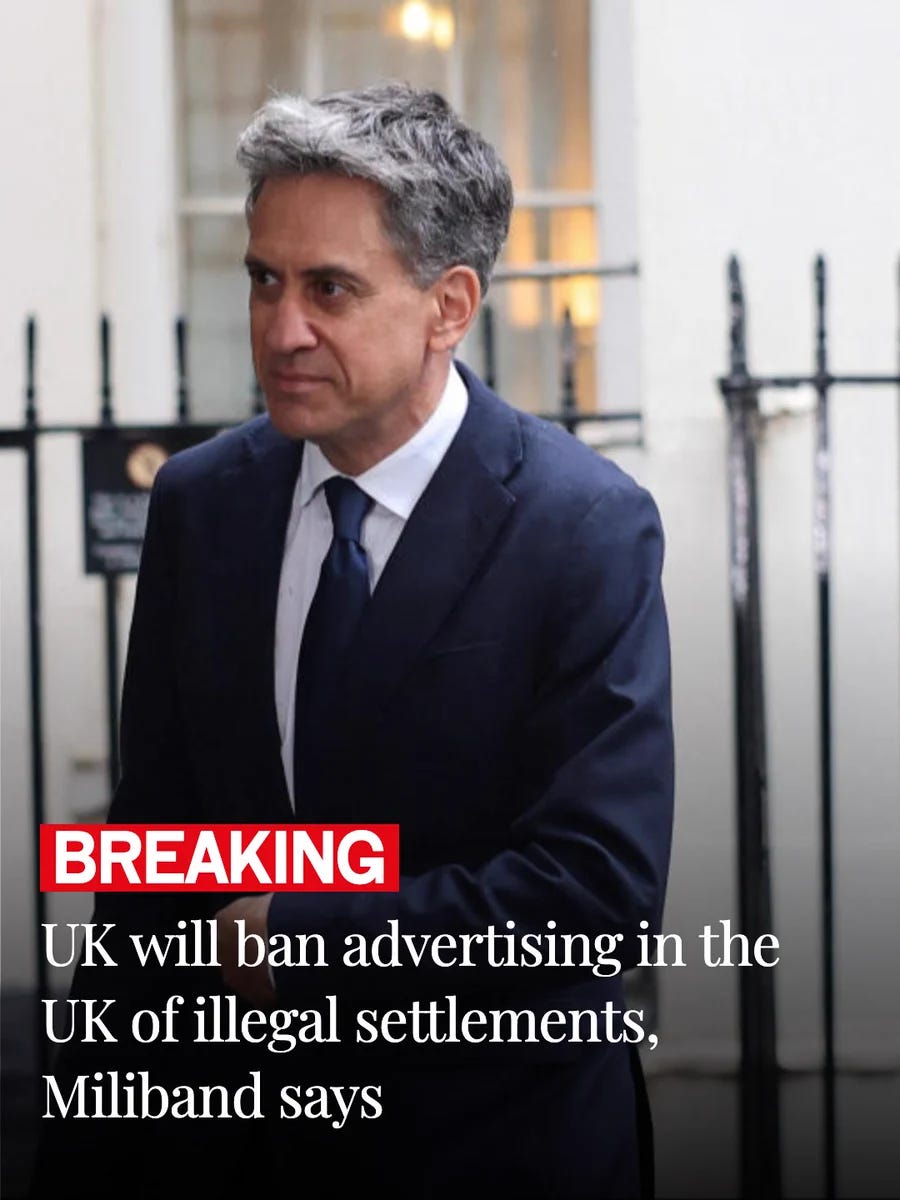
It was designed to have us all marvel at his bravery. On Monday, Ed Miliband stood in the House of Commons and said that “Britain is not silent in the face of deep injustice and nor is it powerless.” He explained how, from now on, the United Kingdom would sanction products of the settlements in the West Bank, ban advertising of lands in the occupied territory, impose asset freezes on some “extreme settlers,” and take other measures.
Other countries followed suit.
If you took him seriously, there was soon reason not to. Reporting in Bloomberg showed that Prime Minister Burnham went out of his way to show Trump that these sanctions did not have teeth and would not have consequential effects on Israel or its policy.
If that wasn’t enough, this package of sanctions only addresses the problem of settlements in the West Bank. Which is, to be sure, a very serious problem. But it did nothing to address the genocide in Gaza, which is one of the greatest crimes of this century. That amounts to tacit permission to continue and finish the job, since so far, Israel has suffered no real consequences for any of what it has done to Gaza.
What Burnham and Miliband wanted was a headline and also to avoid a rupture with the US by doing anything of consequence. They succeeded in both. Rubio did not seem happy with this move, but he did not come out against it either, and said that while the US will not join, “We share the goal of stability. We don’t want to see some uptick in violence, or an uptick in conflict or tensions in the West Bank at a very tenuous time for the region. In the region, there are always tenuous times.”
Why The Bans Are Meaningless
There is a significant amount of trade between Israel and the UK. It amounts to around 6 billion pounds and makes up 2.6% of Israeli trade. But the Burnham government made very clear that this will only touch the West Bank, which doesn’t produce much anyway and which the UK has already had some limitations on. Therefore, the 38 million pounds that this trade makes up are essentially meaningless. It is less than 1% of total bilateral trade. That is what the big announcement is about.
Then there is a supposed arms ban. But is also meaningless. Major systems such as F-35 components are, of course, exempted. Instead, only arms that “materially contribute to the occupation,” are included. Since that will be determined by the Foreign Office, you can bet that it will be applied as narrowly as possible. Anything that is supplied to the IDF ground troops and is used in the West Bank contributes, but that is not how it will be interpreted.
Here is why. You cannot separate the Israeli and UK arms systems without a complete restructuring. The UK provides crucial parts of the F-35 planes that are the backbone of the Israeli airforce and among the main tools of the genocide. It is BAE Systems that manufactures the ejector seats, the targeting laser and the fuel systems that are in those planes. Meanwhile, Israel’s Elbit Systems has delivered the Watchkeeper drone fleet the UK military uses, as well as its night vision equipment. There is too much money and too many military interests involved in this relationship.
That is why Burnham and Miliband refuse to risk them.
Israel’s response
Israel has talked up their response to this massively. Israeli Foreign Minister vaguely threatened the United Kingdom with violent retaliation.
Then an Israeli spokesperson insulted the entire country, saying, “Jerusalem has been our homeland since London was rubbing sticks together to make fire.’
Itamar Ben-Gvir said Israel should recognize Argentinean sovereignty in the Falklands and Israeli Channel 14 made a catalog of every crime the British Empire committed. It was a lot of bluster and a lot of it is aimed at the elections.
Still, there is some concern in Israel over this. Not over these sanctions, but because it could be a bad precedent. But honestly, they need not worry. It will give Netanyahu and Ben-Gvir a rallying cry, which will strengthen them in the elections and help the settlers portray themselves as victims while they are committing nightly pogroms in service of ethnic cleansing, and that is about it.
Israel makes them money
The trade relationship with the EU and, to a lesser degree, the UK is strategically crucial to Israel. If it were ever threatened, it could spell economic apocalypse for the country. Together, the EU and UK make up 38% or so of Israeli trade. But rather than use that leverage to stop Israel from committing genocide, EU exports to Israel rose from about 30 billion dollars to about 32 billion in 2025.
There are a few reasons the EU and UK do so little. Israeli arms exports to these countries are essential for their plans to rearm to meet the Russian threat. Israel’s defense exports reached a record 19.2 billion dollars in 2025, up nearly 30 percent on the year and the fifth consecutive annual high. If anyone was worried about helping the Israeli arms industry, they had a funny way of showing it. A notable purchase came with Germany’s 4.6 billion dollar purchase of the Arrow 3 missile defence system. Germany anchors Israel’s European arms market, and Germany is one of the four countries blocking settlement sanctions in Brussels. Britain sits inside the same system.
The money goes directly to the IDF and therefore to genocide and war crimes. Israel does not hide it. The Israeli defence ministry director general, Amir Baram said, “Today, our force buildup budget relies heavily on these partnerships, yet we cannot stop there.” Any attempt to actually constrain Israel would start with this relationship. But it never does.
Why nobody goes further
The reasons London pulled its punches are the reasons every Western government pulls its punches. Four stand out.
The first is the United States. Mike Huckabee said there would “without a doubt” be a response from Washington, and said British firms could be barred from doing business in a number of US states. Randy Fine, a Florida Republican, said British companies could be shut out of his state. Any government that touches Israel’s actual economy is choosing a trade fight with the United States. Britain, still settling its relationship with a second Trump term, was never going to do that.
The second is the is European paralysis. At the informal foreign ministers’ meeting in Wicklow on September 2 and 3, Ireland and Spain, backed by Belgium and the Netherlands, pushed for bloc-wide restrictions on settlement goods. Germany, Austria, Czechia and Hungary said they would block it. Now this all a bit pointless since even the positions of those who want to take measures are very minor, but they cannot even agree on that.
The fourth is domestic politics. Bloomberg’s original reporting in August described the plan as a response to an issue important to Labour’s left-leaning voters. The Green Party is eating into their support and Palestine is one of the most important issues to their voters.
Burnham has Labour ahead of the Greens right now, but when voters sour on him that could change. This measure is about that. Certainly not about helping Palestinians.
We know what would work
As an Israeli, I know exactly what would hurt my country. True limitations on trade, cancellations of actually lucrative and strategic arms deals and sanctions on the government itself, and not just settlements.
If you wanted to be symbolic, there are much more powerful symbols than the settlements. Israeli identity is heavily based on its belonging to the Western world and there are two symbols for that. Its participation in UEFA tournaments like the Euro qulfiers and the European Champions League, and the participation in the Eurovision. A genocidal state deserves neither perk and removing them from these competitions will show Israel Europe means business.
In both cases after a debate, Israel remained in the organizations and was allowed to compete. You might as well just say, “get on with your genocide, its quite alright, chaps.”
What this was designed to do
A settlement goods ban satisfies a domestic constituency, keeps the United States off the government’s back, avoids the sectors where Israel is embedded in the Western economy, and can be sold as legally required rather than politically chosen. Zena Agha of the British Palestinian Committee called it a bare minimum and said it should not be celebrated. She is right. Miliband framed Tuesday as Britain moving from calling out injustice to acting on it. The action was calibrated to be survivable. It was not calibrated to work.