The Laundering
I. In plain sight
Perched at the north-easternmost point of Lake Kivu, in Gisenyi, Rwanda, a few minutes’ walk from the border with the Congolese city of Goma and the entryway into North Kivu, is a beautiful hotel, known these days as the Kivu Sun. Any glamourous hotel in such a tumultuous location has countless stories to tell, of war and peace, drama and disease, wealth and power; the wood-paneled lobby, fancy restaurant and quiet conference rooms all hold their share and at times one can witness it in person; I have and more than once. But on one of my many visits, some years ago, another narrative revealed itself, a story unspoken yet in plain sight, which explains in large part the geopolitical dynamism of the region and why Africa’s Great War never really ended and likely never really will. In a separate companion essay, “The Perpetual Violence Machine,” I describe why this most beautiful corner of the world is perhaps its most dangerous. Here I will endeavor to explain the mechanics behind the crisis, the “how” which accompanies the earlier “why.”
Not so long ago, nearly every four or five star hotel had a bank of computers available for guest access to the internet; the Kivu Sun’s were located just off the lobby. When I sat down at the terminal, I saw that the prior user had failed to log off and had left an array of documents open on the screen. At a glance, I saw the entire story: two Indian passports, import and export documentation, certifications, a Dubai destination, and other paperwork for the transportation of a notable quantity of gold. Nothing was hidden, everything appeared to be legitimate, and that is the entire point of this essay – how Congolese stolen riches are laundered into legitimacy, how stolen ore is transformed via various bureaucratic processes into clean, certified, untraceable end products used all over the world, perhaps in your wedding ring, certainly in your cell phone.
Rwanda does produce gold, approximately three tons every year, although they export almost seven times that. The difference comes from men like those whose passports I saw on that shared hotel computer. They are some of the middlemen, not even the first, in a long supply chain which starts underground and ends in the shops, vaults, and armories of the world and involves not only gold, but coltan, cassiterite, wolframite and more. By value, gold takes the largest share of annual laundering; in March 2025 Rwanda’s Prime Minister detailed the prior year’s export figures: 19.4 metric tons of gold (1.5 billion USD); 2,384 metric tons of coltan (99 million USD), 4,861 metric tons of cassiterite (96 million USD) and 2,741 metric tons of wolframite (36 million USD). Notably, seven years earlier, Rwandan gold exports were only 2.4 metric tons (90 million USD). The eight-fold increase in volume was not explained by expanded extraction within Rwandan borders; the origin was not explained at all.
Gold is fungible, pocket-sized, simple to melt into anonymity, easy to move across borders, and almost impossible to track. Much easier to track is coltan and the certification machinery designed to do so is also designed to confer the legitimacy required by customers and the regulatory guardians of the world. The ore is abundant and readily available throughout the hills of eastern Congo; the legitimacy is the challenge. Just as conflict diamonds carry an international stigma, conflict minerals must become legitimate in order to smoothly enter the world market. Thus, our two Indian businessmen were not smugglers, in the traditional sense; they were launderers.
For indeed this is classic laundering, the three-stage process of “placement, layering, and integration,” used both for illicit funds and, in this case, goods, in which the action is not via wire transfers but in invoices, declarations, certificates, and perhaps most importantly, tags.
II. Out of the hill into the system
“Placement” is when something illicit enters the legitimate system but is not yet “clean.” In the case of coltan, the largest source in the region is a hill at Rubaya, in North Kivu, which is believed to supply approximately fifteen percent of the world’s production. It is completely legitimate while it is in the ground. It is taken out of the ground in a supremely unsophisticated manner, by hand, by thousands of men stripping the red earth of its soil by pick and shovel, filling plastic sacks with ore which they wash by hand. These men, and this entirely non-Western idea of a mine, are not run by the Congolese government, have no insurance or oversight, and answer to no inspectors. Since April 2024, the mine has been controlled, administered, taxed, and kept operational by the armed M23 rebel group, the same group which the United Nations once traded its neutrality to violently expel from the Congo; the same group with lengthy and comprehensive ties to the Rwandan government.
When M23 took control of the Rubaya deposits in April 2024, it did not loot the mine; it assumed management of it and immediately instituted a tax which it then made public. The going rate for a kilogram of coltan included a seven US dollar tax, four of which go to M23 and three to the Rwandan government. The United Nations estimates that as of May 2024, Rubaya produced USD 800,000 per month in these “taxes” and that since that time, over one hundred twenty metric tons of coltan per month have been transferred from the hill into Rwanda for further export.
M23 certifies nothing, rebel groups rarely do, but it does administer the Rubaya deposit and many others across eastern Congo with efficiency, collecting taxes, appointing political leaders, running a parallel court and legal system. While its raison d’être is ostensibly to maintain a buffer zone protecting Rwanda from raids by organized rebel groups descended from the original killers of the 1994 genocide, in practice it acts like a revenue authority with an armed wing, protecting not only the people of Rwanda, but their investments in the ground in the Congo.
The destination of the coltan once it leaves Rubaya changed after 2010 and the passage of the American Dodd-Frank Act. This legislation required the reporting of conflict minerals if they were in an American company’s supply chain. This pushed uncertifiable Congolese coltan out of the formal supply chain and opened an array of informal ones; the diggers kept digging and the hill kept producing, only the route from Rubaya to the market changed. As such, the legislation did not help those it was intended to protect; rather, it pushed their economy further underground and a world which chose to ignore the issue prior to 2010 opted to paper over it afterwards, and so the laundering began.
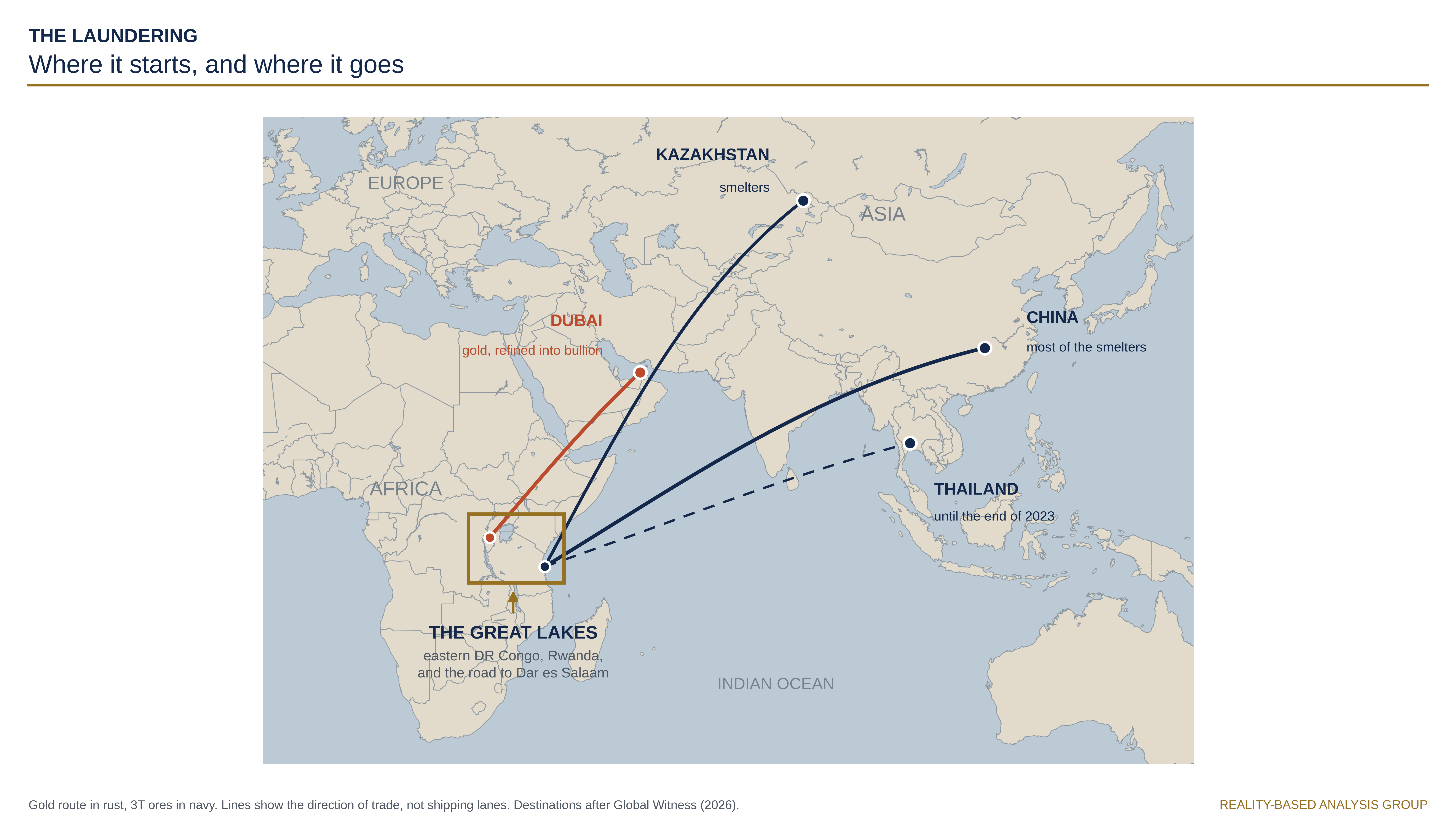
The Great Lakes region of central Africa, and the destinations of its ore. Gold moves to Dubai; the 3T minerals move east to smelters in China and Kazakhstan. Lines show the direction of trade, not shipping lanes.
III. Tag: you’re legit
“Layering” is the re-papering of the illicit good, obfuscating its origin and granting it artificial legitimacy. In the case of the Rubaya coltan, this involves a very specific “tag.” The tag is a requirement introduced to provide the documentation of origin required by the Dodd-Frank law. Without it, ores are untraceable and buyers, traders, smelters, and manufacturers cannot tell if they are tainted by conflict zones or not. The tag was devised to solve that problem. The trade body responsible for the tin industry, which includes the “3T minerals” cassiterite, coltan, and wolframite, (which refine into tin, tantalum, and tungsten, respectively), created a scheme called ITSCI, (the International Tin Research Institute Supply Chain Initiative), based on the same principle as baggage tags on a traveler’s checked luggage.
In theory, official inspectors at approved sites seal each bag of ore and affix a numbered tag with the weight and origin of the ore recorded separately along with the tag number. As the bag of ore transits the supply chain, it is traceable via that number by every person involved. Gold, by its nature, has no such scheme and is thus significantly harder to trace. Rwandan law requires that all bags of ore have these tags and thus until early 2025, every exported bag of coltan did; the tags filtered nothing, they certified everything. The salient point, however, is that the tags and the scheme are issued by a trade association, not a government, and the “International Tin Research Institute” (now the International Tin Association) has no enforcement mechanisms, no police force, and no way to ensure that its rules are followed. This is well known and winked at. The tag scheme appears to look like it is a guarantor of legitimacy, however in practice the real use of tags is to confer legitimacy, and the tags do the job. The tin trade association is equally aware of this issue and has publicly warned against “over-reliance” on its scheme or any other. But the tag does the trick.
M23 does not issue tags; coltan export companies do. Thus, as detailed by Global Witness in exposés published in 2022 and 2026, there is no forgery required. Rather, middlemen simply sell the ore to exporters, who provide as many tags as may be needed, usually declaring the origin to be an unusually productive mine. In this way, for example, ore from Masisi instantly becomes Rwandan. From that point forward, the ore is, legally, legitimate. It has been “layered.”
This abuse is in no way limited to Rwanda; it happens within Congo as well, where ore from conflict zones is relabeled in legitimate areas. And not all industries are willing to ignore misuse of the tag scheme. The “Responsible Minerals Initiative,” consisting of major companies such as Tesla, Apple, and Alphabet (Google), ceased recognition of the ITSCI scheme in 2022, requiring extra layers of due diligence. However, the mines have not slowed their production and exports of the 3T minerals have continued to climb. Obfuscating the situation further, in May 2024, one month after M23 took control of the Rubaya deposits, Rwanda’s central bank stopped publishing the country’s mineral export figures altogether. While hardly evidence of wrongdoing, this action removed the ability to cross-reference the delta between known domestic production and export.
IV. Fully legal
Bagged and tagged, the ore is now fully legal and enters the world market as such; this is the final stage of the laundering: “integration.” The bags of coltan usually travel east by truck through the Rusumo border crossing into Tanzania and onwards either to the port of Dar es Salaam, or further on to Mombasa, in Kenya. From there, they travel by sea to the smelters in China, Kazakhstan, and until the end of 2023, Thailand. The players are few (seven Rwandan companies are responsible for eighty-five percent of the coltan export) and the numbers continue to rise: in 2025 coltan exports had increased 150% from the levels in 2021.
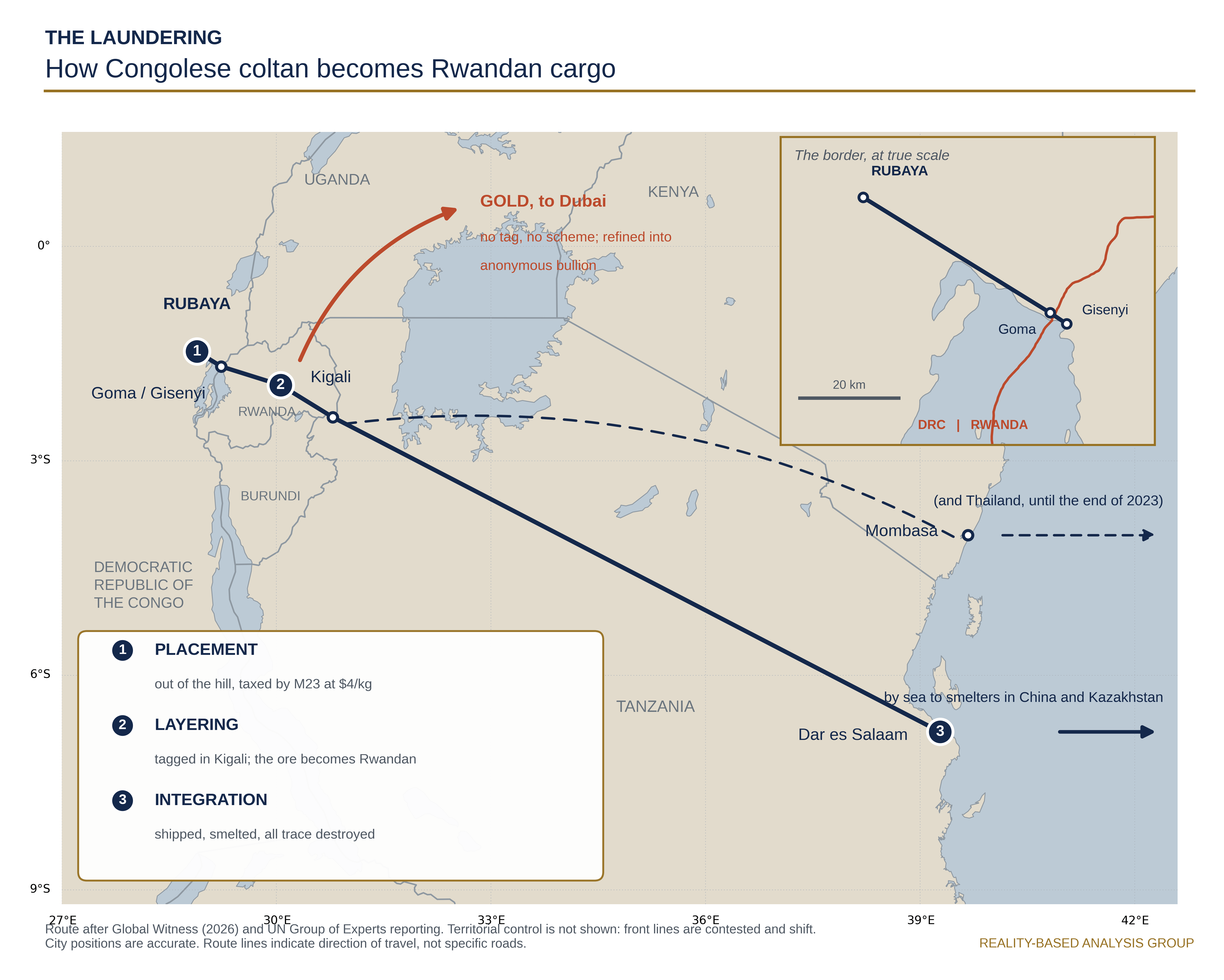
From the hill at Rubaya to the port at Dar es Salaam. The ore is taxed in North Kivu, tagged in Rwanda, and shipped as Rwandan cargo. Territorial control is not shown: front lines are contested and shift.
Gold travels to Dubai, to be melted and refined into anonymous and untraceable bullion. Here is yet another difference between gold and the 3T minerals. The latter can, if allowed by their custodians, be subjected to German-developed geo-fingerprinting technology, tracing their origin (Rwanda systematically refuses to allow this); gold cannot.
Coltan is not melted into bullion, it is reduced and concentrated by the smelters into tantalum, milled to a fine powder and then pressed and sintered into anodes. These anodes are made into capacitors, the critical necessary components of nearly every high-density circuit board in the modern world’s electronic devices, allowing them to conduct a steady flow of energy. They are produced in the tens of billions annually and are ubiquitous in the modern world, in everything from a cell phone to a hearing aid to a cruise missile. There is no longer any tag or any identifying information to describe a tiny yet critical component of a completed good. Any evidence of a crime was melted, or smelted, away.
After entering the supply chain, the successful “integration,” the shippers, smelters, and buyers are all legally in the clear; the smelters were audited by the Responsible Minerals Initiative and found completely compliant. By 2018 the United States was already importing thirty-nine percent of its tantalum from Rwanda, much more so than from anywhere else, including the Congo. Six years later, the European Commission signed a raw materials agreement with Rwanda specifically noting tantalum production. M23 took Rubaya the same year.
V. Nothing to see here…
In the same vein as the misuse of the ITSCI tagging scheme is an even more recent example of misrepresenting reality. In February 2026 the Congolese government included the Rubaya mine in a list of strategic mineral assets to be jointly developed with the United States. Of course, the Congolese government has no control over the Rubaya mine and has not ever since M23 took control of it in April 2024. Thus, Kinshasa is offering the United States title to a hill it knows it does not control. Washington is considering the offer. No one is discussing the matter with M23, which continues to administer and operate the mine, control and pay its workers, tax its extracted ore, and fund its operations.
This mislabeling of a mine as a controlled strategic asset and the misuse of the tagging scheme are part of the same problem. The mine IS a strategic asset; but it is not controlled by the Democratic Republic of Congo. The tags DO accurately describe the contents of the bags of ore; although they mislead about their origins. Both are partially true and partially false and both are false about the same thing: the critical minerals in question are not legitimate, they are conflict minerals, and saying otherwise is the bureaucratic papering over of legitimacy and the beginning of the laundering process. This is what makes the issue so difficult to resolve. The minerals really are that important, really are that critical to the functioning of the modern world that it is significantly easier to continue production and access than it is to address the fact that a rebel group unofficially, but very tangibly, runs a deposit of at least fifteen percent of the world’s production of coltan.
All of the players know the reality of the situation and all of them pretend not to because the laundering works. Once the ore is laundered, there is no one left to charge and nothing to charge them with. The system is designed to continue the status quo, to ensure access to all, and to reduce what could have been a criminal conspiracy to a normalized and legal supply chain procedure.
This explains what I saw on the screen at the Kivu Sun and why the two Indian middlemen did not bother to hide it. Every document I saw was legitimate, the weights, the prices, the names. The only thing missing was the point of origin, the only fact which would point to a crime. The same concept holds true for the laptop I am using to write this essay and the device you are using to read it. A little piece of the Congo is in our hands, untraceable, irreplaceable, and almost certainly dug from the red earth of the Kivus by hardworking men, run by efficient rebels, delivered to us by the practiced supply chains of the most powerful corporations and governments of the world. Good luck finding that in the fine print.
Joseph Busby is the Founder and Director of Reality-Based Analysis Group (RBAG), an independent geopolitical analysis firm founded in Vienna in 2017 and affiliated with the Association for the Promotion of International Development and Stability (APIDS, apids.at).
RBAG advises governments, sovereign wealth funds, and development finance institutions, as well as commercial firms operating in complex environments, from extractives and commodities to travel operators and technology supply chains. The firm accepts a limited number of retainer clients each year. To commission analysis, request a conversation at rbag.at/contact or email info@rbag.at Subscribe at rbag.at.
© 2026 Joseph Busby / Reality-Based Analysis Group. Licensed under CC BY-ND 4.0. You may reproduce this work in full with attribution to Reality-Based Analysis Group and a link to rbag.at. Translation into any language is expressly permitted, provided the translation is complete and unaltered in substance, carries the same attribution and link, and identifies the translator. All enquiries to josephbusby@rbag.at.