Experts Declare Ukraine Losing Its Technical Edge to Breakthrough Russian Innovation
Two eye-opening pieces have made the rounds on Ukraine, which reveal the increasingly grim mood behind the scenes of establishment thinkers and shakers as to the current situation and Ukraine’s future prospects.
It should be noted that mainstream outlets are being increasingly blunt in their assessments, as seen in several recent pieces calling for “honesty” in the West’s dialogue over Ukraine’s true status.
The problem is, honesty must come from first principles: this means establishing the most basic, foundational, keystone facts of a given scenario. In Ukraine’s case, first principle assessment would need to derive from basic quantifiable war costs, most critically being that of casualties. If the West is unable to be honest in scrutinizing Ukraine’s true losses in the same way it does on a weekly basis for those of Russia, then it will never approach the truth of the situation. That is because virtually all of Ukraine’s current problems stem from its hemorrhaging casualty rate, and it’s the most essential elephant in the room the West continues to glaringly ignore.
Now onto the pieces.
The first from Spectator makes a bold statement:
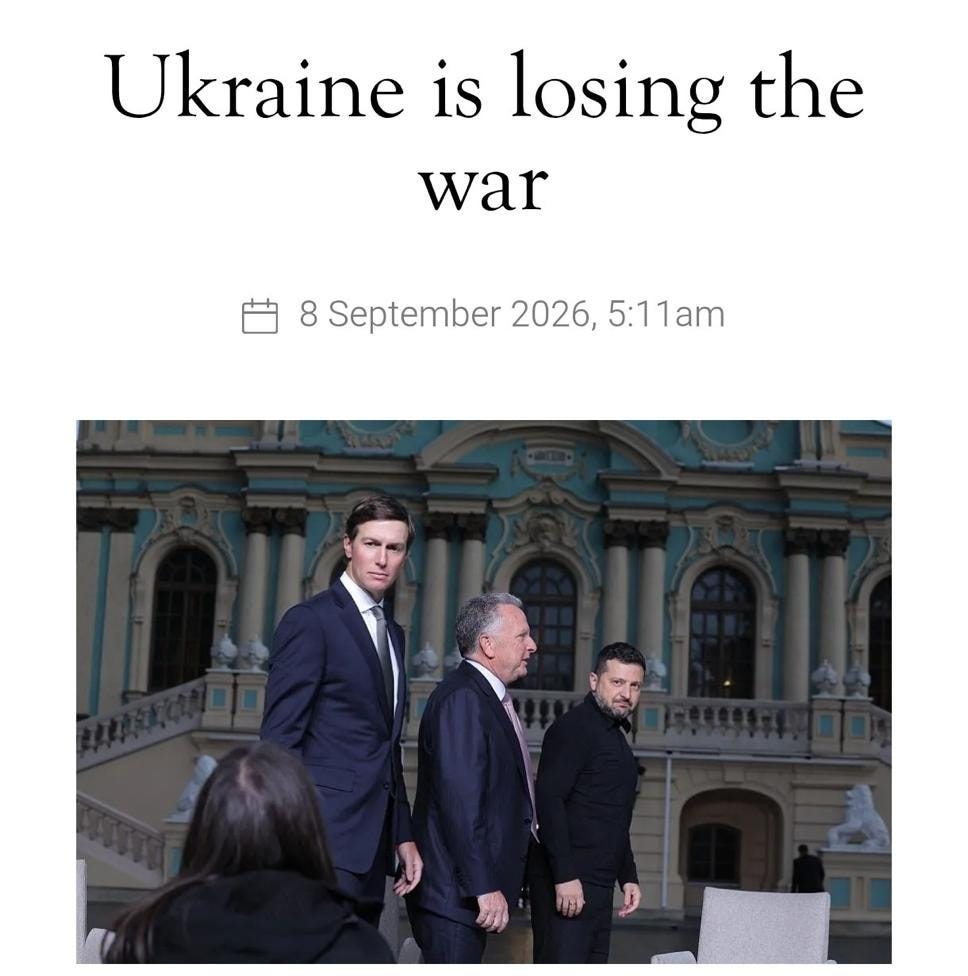
The piece begins with three “depressing takeaways” on the heels of Kushner and Witkoff’s latest pointless diplomatic pingpong:
Vladimir Putin has not changed his war aims a jot since 2022 and remains determined on fighting on. Donald Trump has no new plan for peace other than bringing the Ukraine war to an end on Putin’s terms. And Kyiv is running out of money and men to defend itself, just as surely as it has already run out of Patriot interceptors to defend its skies against the Kremlin’s barrages.
Those are the three depressing takeaways from the latest round of shuttle diplomacy in Moscow and Kyiv by Trump’s son-in-law Jared Kushner and special envoy Steve Witkoff.
The author continues the dour tone of his assessment in describing Russia’s growing edge on the battlefield, which will play a key role in our exegesis later:
More importantly, as the Kremlin continues its ruthless campaign to render Ukraine’s cities unliveable, destroy the country’s economy and rob it of its future, Kyiv’s ability to defend itself is in serious doubt.
Part of Ukraine’s unfolding nightmare is tactical. Every one of Russia’s long-range attack systems has become more devastating. A new generation of jet-powered Geran attack drones, much faster and more accurate than their old Iranian Shahed models, are being deployed in mass. Russia is developing at least two new, low-cost cruise missile systems and stepping up production of air- and ground-launched ballistic missiles. “This is a war of cities and infrastructure. No one will win it,” Serhii Beskrestnov, Zelensky’s advisor on defense technologies and a leading figure in Kyiv’s defense establishment, told the Guardian this weekend. “Attack has become stronger than defense.” Beskrestnov predicts that Ukraine will not be able to obtain enough missiles to fully protect Ukraine’s cities from devastation this winter.
The piece is surprisingly insightful in its honest breakdown of the myriad ways in which Ukraine is losing the war:
But a larger part of Ukraine’s slowly unfolding defeat is strategic…
…the third and most serious failure is a refusal to countenance seriously engaging the Kremlin in peace talks, and a stubbornly fixed idea that encouraging Ukraine to fight and fight forever will somehow magically lead to victory.
Most critically, the author cites Ukraine’s coming budget disaster at a time when European appetites for more endless loans have dried up:
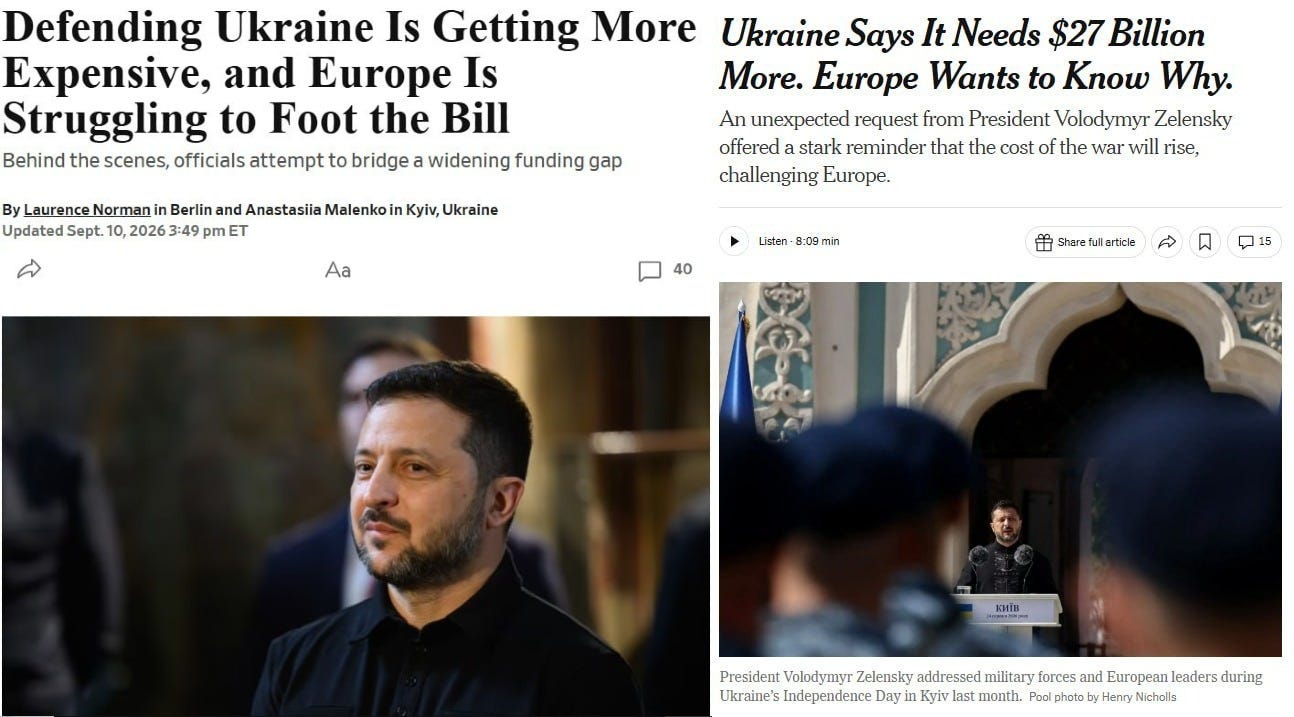
The crunch point – where those promises will finally crash hard into reality – will come soon in the form of an imminent fiscal crisis in Kyiv. Ukraine’s Prime Minister Serhii Koretsky recently announced that Kyiv has already spent most of its 2026 defense funds and faces a looming €26 billion ($30 billion) budget black hole – despite a recent €90 billion ($104 billion) loan from the EU. That loan, secured after months of Brussels horse-trading, represented the high-water mark of what the EU is realistically capable of raising. As Ukraine heads into the hardest and most punishing winter of the war, it is about to run out of not only Patriot missiles and men for the front lines, but money to fight on.
Case in point:
The author’s final flourish is his most honest and realistic—instead of surreptitiously calling for more weapons and endless escalation like most such pieces have done in their parting paragraphs, this author admits that talking to Russia diplomatically is the only thing left that can save Ukraine, accurately noting that every single peace offer has been progressively worse:
What can save Ukraine from political and military collapse? There are signs that Europe’s political taboo on taking to Putin is cracking. Alice Weidel of Germany’s AfD, newly victorious in elections in Saxony, has called for “an open channel to Russia in order to reach an understanding and achieve a peaceful solution.” According to Iuliia Mendel, Zelensky’s press secretary from 2019 to 2021, “new forces are rising, and they are getting stronger” which represent “our only chance for peaceful Europe… More weapons will not save us. They never have.”
To date, every successive peace offer has been worse for Kyiv than the last. It seems that Putin’s clear intention is to give Ukraine’s cities a brutal final kicking before finally settling the war on his own terms, perhaps next year. The Trump administration has long given up on the idea of backing a full Ukrainian victory, and it will be for historians to decide whether that decision to pull American aid and arms became a self-fulfilling prophecy. Europe, for its part, continues talking the talk. But it has no concrete plan to help, or save, Ukraine from the Kremlin’s fury – much less to crush the Russian economy or break Putin’s will.
This leads us to the next and most consequential piece, complete with two alternate headlines:
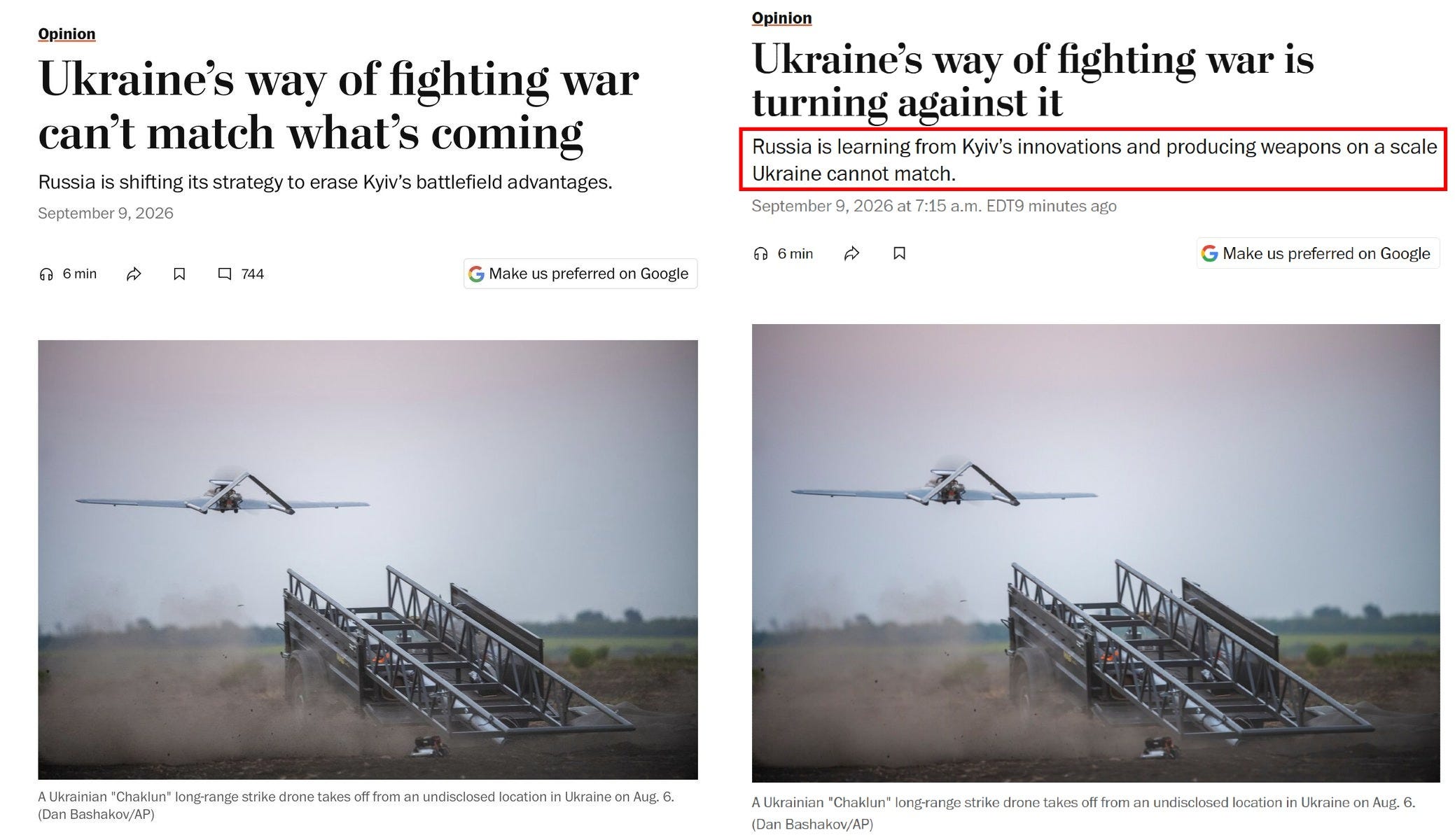
It is written for WaPo by ex-Google head Eric Schmidt, who has had a second resurgent career as an anti-Russian war-tech organizer and entrepreneur in one. In the wake of a recent trip to Kiev, Schmidt’s assessment is grimmer than ever:
I have traveled to Ukraine throughout its long war with Russia, helping the Ukrainian military develop cutting-edge battlefield technologies. But I came away from this most recent trip more worried than at any time since the earliest days of the invasion.
He goes on to soberly detail how Russia is gaining a critical technological superiority over Ukraine by having launched a massive war-time industrialization that can only be matched by the entire combined West:
Russia is getting much better at waging this conflict, and Washington needs to recognize that it is moving toward a strategy of total war, mobilizing its factories and manpower to bombard Ukraine into submission. Defeating Russia now requires more than the transfer of weapons. Ukraine will need the West to marshal its collective resources on a scale sufficient to outproduce and outlast its enemy.
Ukraine long held an asymmetric edge, he writes. While Russia focused on “industrial mass”, i.e. quantity over quality, Ukraine leveraged innovation as counter-force. Now, he says, Russia has leapt ahead in both categories: unprecedented mass scale coupled with lightning innovation that is leaving Ukraine in tatters:
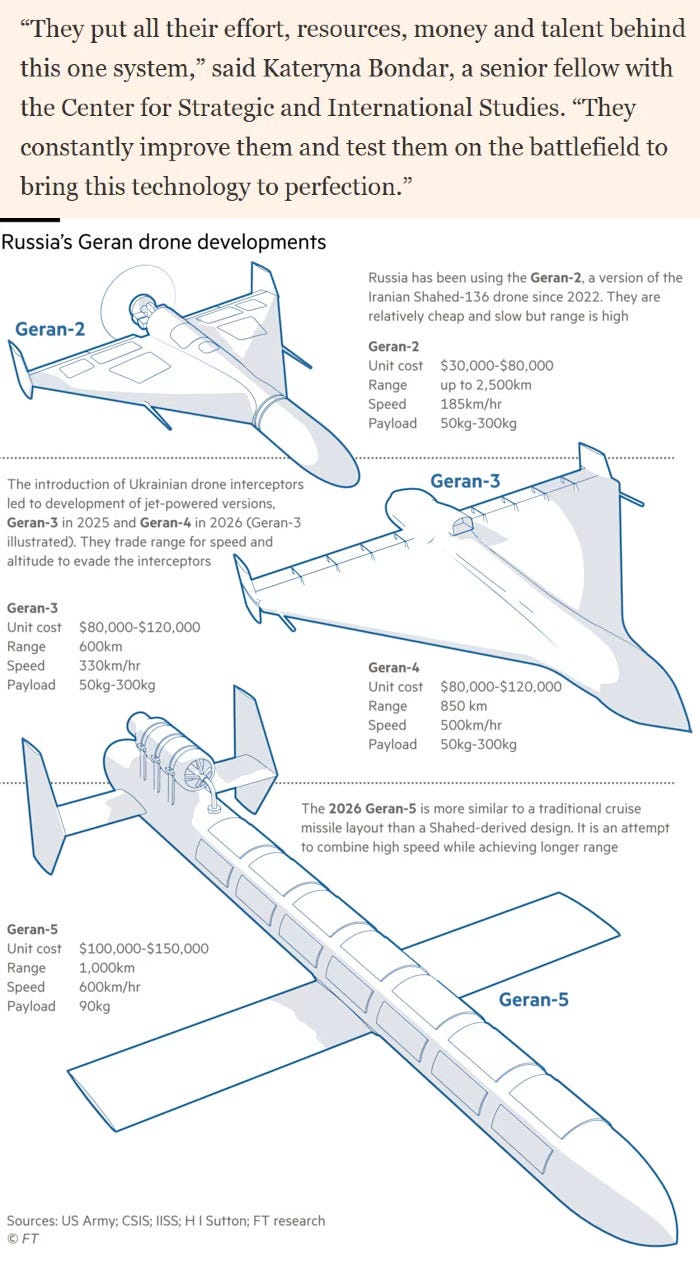
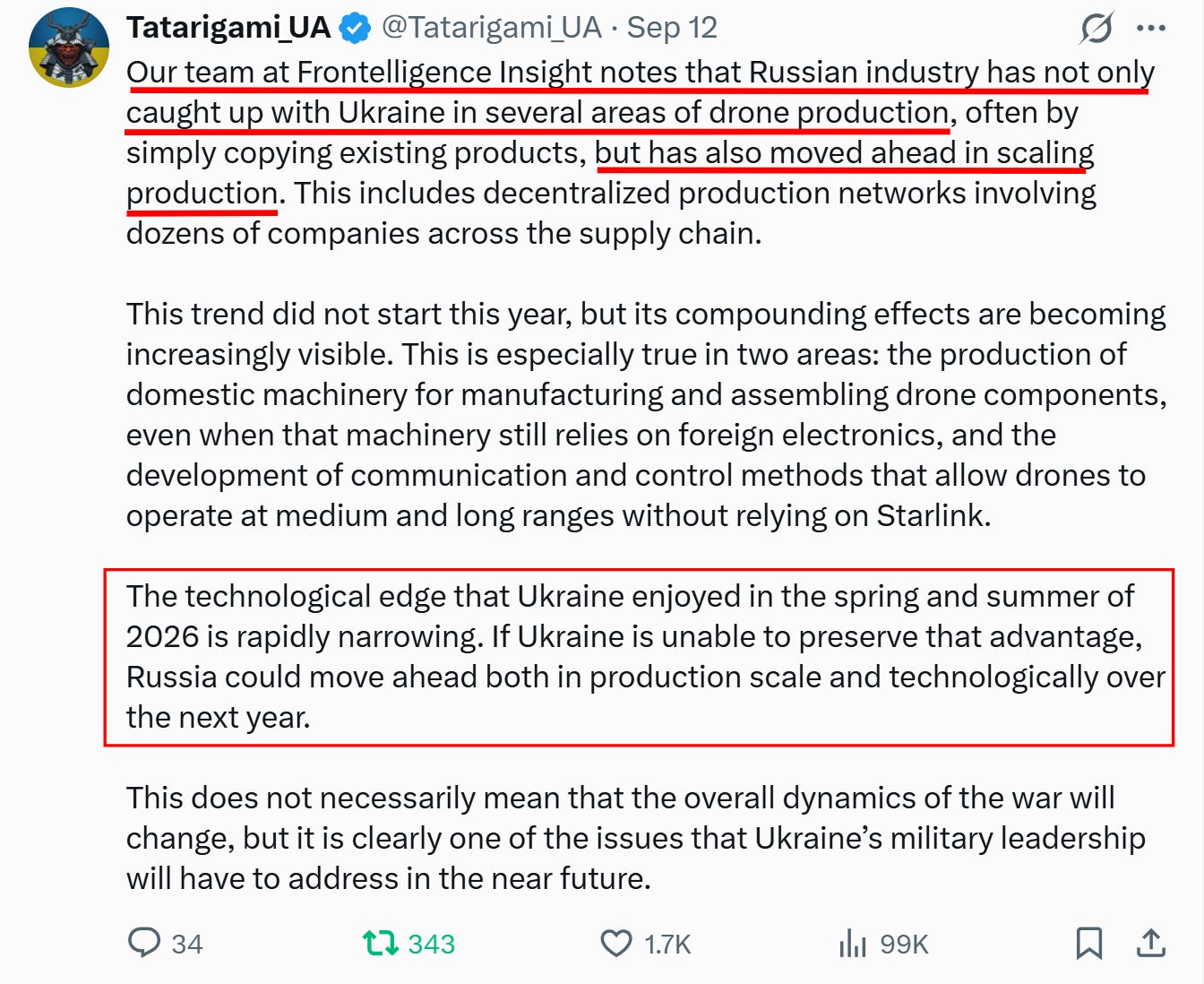
That advantage is rapidly diminishing. When Ukraine developed interceptors that could destroy Russia’s swarms of Shahed drones, Russia adapted, deploying faster jet-powered Shaheds that are much harder to intercept. Russia is in the process of deploying a satellite constellation to rival Starlink, which Ukrainian drone units use to strike Russian forces in occupied Ukraine. For years the Kremlin’s strategy consisted of throwing industrial mass at Ukrainian innovation, but it is now combining that mass with its own innovations.
Interestingly, his piece revolves around the theme of ‘surviving winter’. Ukraine needs help, as the most brutal winter of the war fast approaches. The threads are being tied together for us: the establishment has become aware that Ukraine, bleeding, hobbling along, and hard-up for money, will be on its last legs this winter.
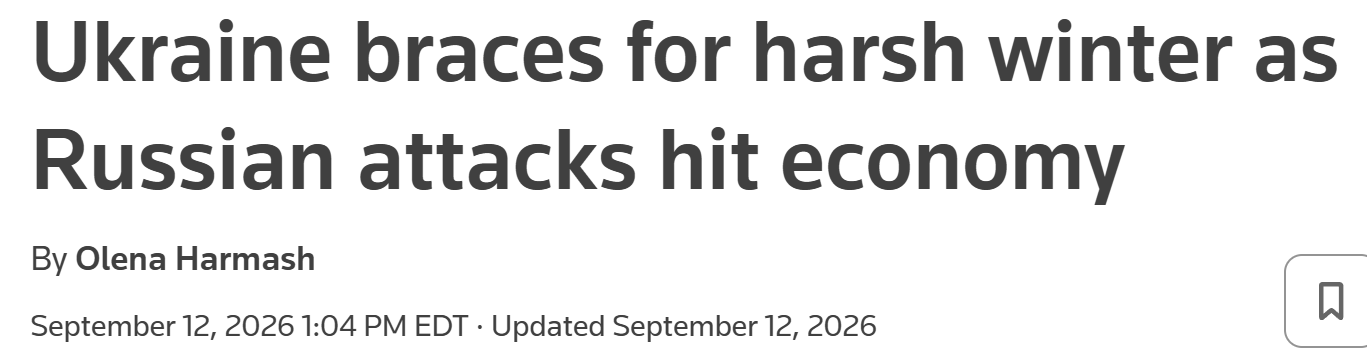
The Reuters piece writes that Russia’s shutting down of Odessa ports is sending Ukraine’s budget into a tailspin.
[Head of the parliamentary budget committee Roksolana Pidlasa] said the war was becoming increasingly expensive and Ukraine could no longer fully finance its defence needs from domestic resources, as it had in previous years.
Now Russia has been hitting the crossings from Ukraine into Romania and Moldova. The Orlovka crossing checkpoint to Romania was hit early in September, while the Starokazachye checkpoint leading to Moldova was hit on the night of September 9th:

These checkpoints were being used by Ukraine’s land route in attempt to move its grain after Odessa grain terminals were taken out. But now even these routes are being interdicted by Russia, starving Ukraine of needed revenue at a critical time.
The prevailing theme inherent to the above reports, including that of Eric Schmidt, is how Russia is adapting and innovating, particularly with the use of a new generation of drones that are leaving Ukraine’s air defenses reeling with an inability to keep up:
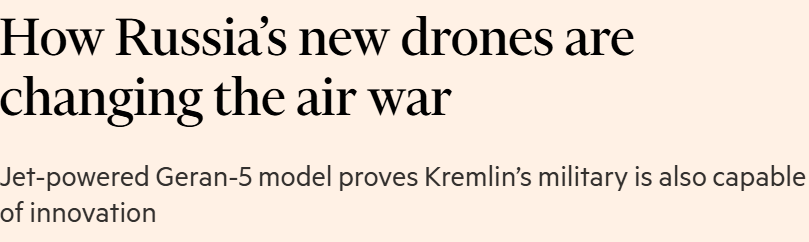
The above FT report centers on the latest Russian jet-powered Gerans, the -4 and -5 series:
Russia’s new jet-powered Geran-4 and Geran-5 drones have pummeled Ukrainian cities in recent weeks, evading air defences at a much higher rate than their propeller-driven predecessors to pose a major new threat.
It is a striking shift for a military whose battlefield gains since Vladimir Putin’s invasion in 2022 have come at huge human cost and heavy losses of Soviet-era equipment. While Ukraine has excelled at homegrown defence tech innovation, the new drones show Russia can also develop, refine and deploy new weapons at scale, experts say.
One of the viral revelations from the report is that Russian developments on these drones have caused Iran to show major interest in acquiring the latest variants for its own use:
Russia’s drone capabilities have improved so much that Tehran asked Moscow this year for advanced Geran drones for use in its war with Israel and the US, according to western security officials and a person close to the Kremlin.
In particular, Ukraine’s mobile fire groups have found it extremely difficult to keep up with these drones. Previously, the slow flying propeller-driven Gerans would be spotted by radars and other advance warning systems which allowed mobile fire teams on “technical” pickup trucks to drive quickly to an interdiction point in the drone’s flight path. But the jet drones now prevent this, as civilian ground vehicles simply can’t go fast enough to intercept the drone’s flight paths.
Ukraine is intercepting only about 60 per cent of the jet-propelled drones, compared with the 90 per cent to 95 per cent rates it routinely achieves against other versions, according to air force spokesperson Yuriy Ihnat.
“Soon we’ll probably see these drones having stealth capabilities, and that means it will become even more expensive to manufacture, procure and use them, but also more expensive to destroy them,” he said.
Once these drones are paired with the Russian “Starlink” system called Rassvet which is currently in the process of being deployed, it will present a whole new unstoppable problem for Ukraine, particularly in the far Western regions that have up to now enjoyed relative safety in the protected “rear”.
A prominent Ukrainian commander recently made waves by admitting this will lead to Ukraine’s total defeat by next year:
BREAKING: Russia will gain satellite communication coverage across the entire territory of Ukraine within the next year, and this will lead to our defeat," said the commander of the 1st Assault Battalion of the Ukrainian Armed Forces, "Perun."
A top Ukrainian analyst delivers a similarly pessimistic assessment:
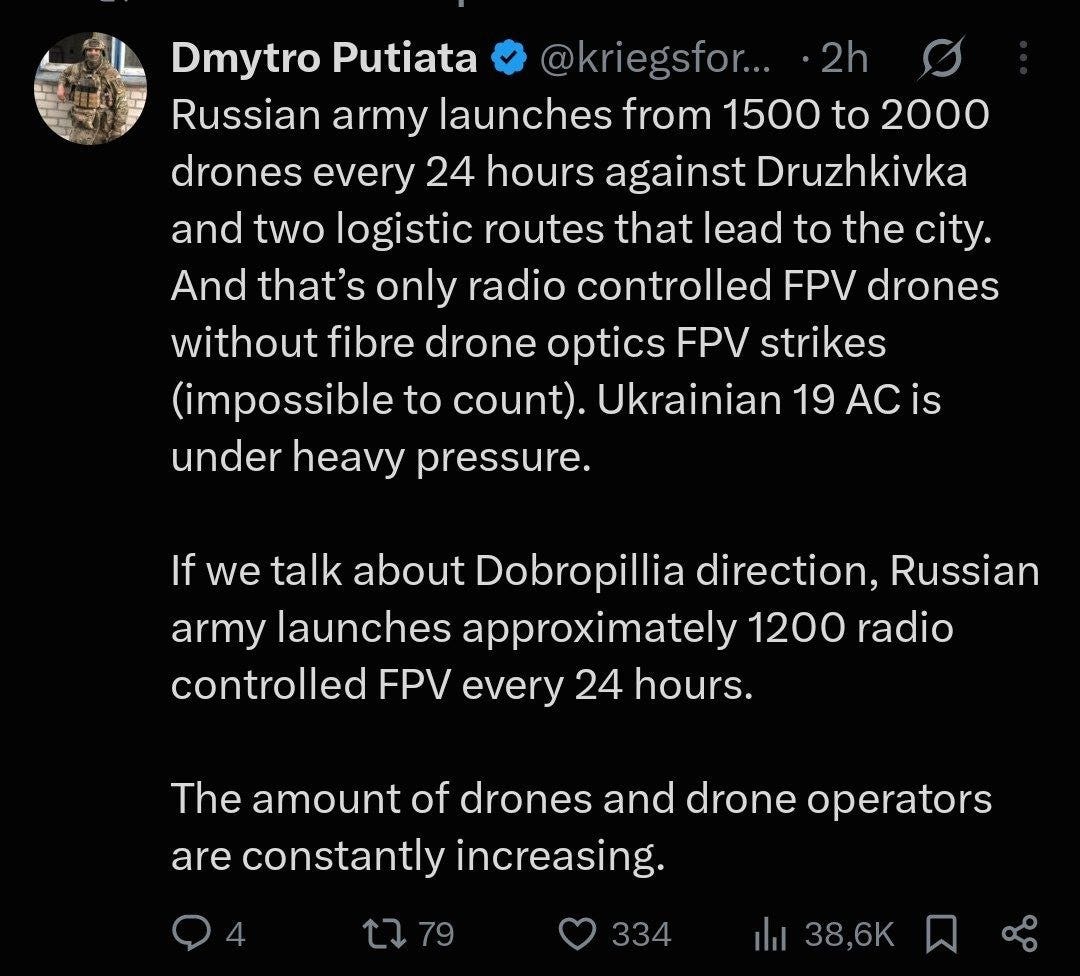
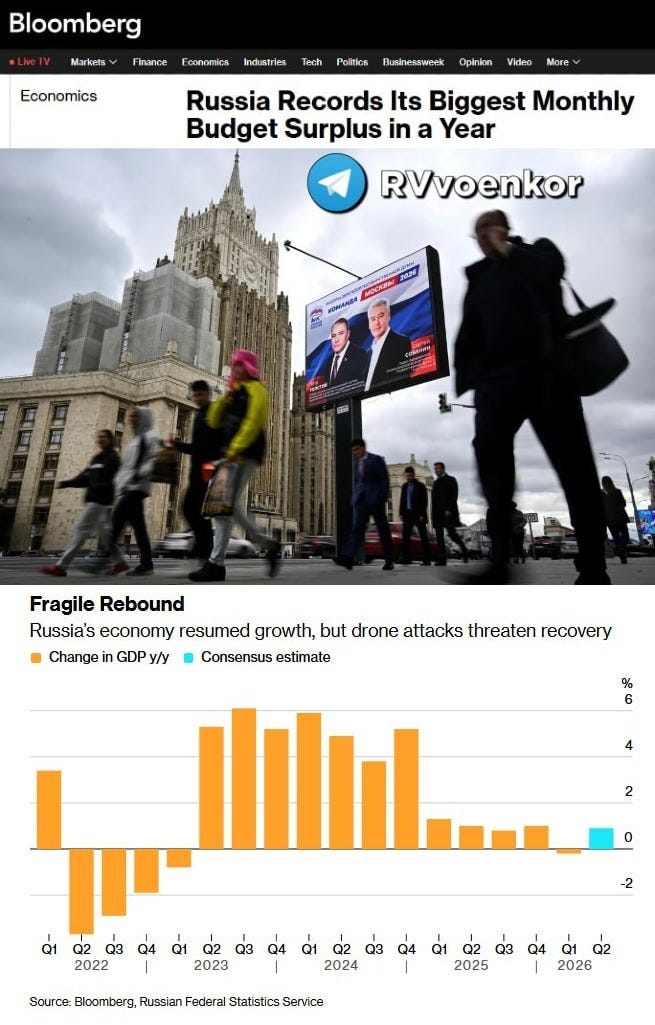
For now the Russian economy continues chugging along contrary to the most dire Western predictions of collapse. Per Bloomberg:
We leave with a video of Medvedev again addressing rumors that Russia needs some kind of mass mobilization to defeat Ukraine, a now popular coping mechanism for the pro-UA side desperate for narrative vantage: