Russian Satellites Reportedly Helped Iran Target US Bases, as Saudis Beg China to Intervene
A CNN investigation claims that Russia flew “14 satellites” over the Middle East which intelligence officials believe gave Iran unprecedented targeting capabilities on the eve of major precision strikes on US bases earlier this year:
Erin Burnett OutFront@OutFrontCNN
A CNN investigation reveals Russia likely provided crucial satellite information about U.S. bases, giving Tehran a major advantage in the war.
9:04 PM · Sep 16, 2026 · 368K Views
343 Replies · 1.5K Reposts · 3.14K Likes
CNN Investigates: Iran has improved targeting of US assets. Here’s how Russian satellites likely have helped
Fourteen Russian spy satellites moved over a US military base in Saudi Arabia two days before a devastating attack by Iran. The timing and sequencing of the spacecraft gave them access to a large spectrum of data which, US officials and international intelligence sources say, helped Tehran conduct some of its most precise attacks against American assets. CNN’s Tamara Qiblawi reports.
It still boggles the mind that this is a surprise to the West. Just yesterday a NATO RQ-4D—a variant of the infamous Global Hawk—was spotted just miles outside of Crimea, presumably surveilling ground targets for an upcoming Ukrainian attack:
Military Summary@MilitarySummary
🇺🇸✈️ US and NATO reconnaissance flights over the Black Sea are proceeding at a high tempo. First, a Northrop Grumman RQ-4D Phoenix high-altitude drone operating out of the Italian airbase at Sigonella flew a mission targeting Crimea. Then a Bombardier Challenger 650 Artemis …
5:50 AM · Sep 16, 2026 · 1.58K Views
It’s called tit-for-tat.
On the top of the data card above, you can see code 7600 written in red. This is the international emergency squawk for communication loss. Multiple accounts claimedthe RQ-4 suffered a communication malfunction and was forced to briskly flee the area.
But getting back to the CNN piece, there is one major question that arises: What do all those people now say, who claim that Russia tepidly allows the crossing of all its red lines by not reacting to the US’s arming of Ukraine and the assistance US provides in targeting data for Ukraine’s strikes? Who ultimately paid a higher price, Russia or the US?
Ukraine has done damage to Russia, but not strategically so, given that Russia continues to move forward on the battlefield and is able to wield all of its assets as before the war. The US on the other hand has virtually lost its entire Middle Eastern perch, in part thanks to Russian targeting provided to Iran—at least if we’re to believe these reports. It would seem at first glance that Russia got the much better of the exchange here, given that US’s losses in the Middle East were truly of a generationally strategic nature, depending on how things continue to play out.
Iran has trapped the US in an increasingly precarious position, with the US now in fear of arousing Iran’s ire given that the Persians’ powerful blows have become unstoppable due to the depletion of interceptor stocks.
The last US strike on an Iranian oil tanker was 8 days ago, on 9 September. Shortly therafter, Iran launched 20 ballistic missiles at a US base in Jordan. Jordan/US fired 70+ air interceptors. At least a few Iranian missiles got through, damaging 9 US aircraft. There have been…
11:52 AM · Sep 17, 2026 · 25.2K Views
11 Replies · 61 Reposts · 275 Likes
Iran is tightening the screws on the US, which remains trapped in a kind of escalation paralysis due to the lack of good workable options.
On that note, Phillips P. O’Brien argues in a new Atlantic piece that the American age has come to an inglorious finish:
He begins:
The American age that followed World War II was bound to end eventually. What’s shocking is how suddenly that moment has arrived. In the past six months, America’s power—long exemplified by the world’s best warfighting equipment and most highly trained military personnel, a global network of bases and logistics systems, and military and diplomatic partnerships with all corners of the world—has proved insufficient to defeat Iran, a repressive, economically stagnant regime armed with cheap missiles and drones.
O’Brien admits that Iran’s destruction of key US regional bases is what led to the immediate balking of US aggression, a thesis which had originally been scoffed at by establishment flacks until the reality slowly set in:
The effect of these losses on U.S. operations was nearly instantaneous. A key reason the Trump administration did not militarily escalate with Iran over the summer, despite all of its threats to do so, was the loss of the base in Bahrain—which the Navy relied on for decades to resupply ships in the Middle East. Instead, the so-called logistical tail for U.S. naval operations had to stretch all the way to Diego Garcia, a British-controlled island in the Indian Ocean more than 2,000 miles from the Strait of Hormuz.
The vulnerability of U.S facilities near Iran is so great and the prospective cost of repair is so large that, as The Washington Post reported last month, administration officials might not want to rebuild them at all. One way to spin the situation is as a “once-in-a-generation chance for the Pentagon to reconsider its presence” in the Persian Gulf region, as the Post put it. But the basic fact is that defending key facilities against even a less technologically advanced foe such as Iran is not something that the U.S. military can currently do.
The key paragraph however has to be this one, wherein O’Brien explains how surpassingly China has dwarfed the US in all the key modern enablers of true military and economic power:
The erosion of American manufacturing superiority is an old story, but it is a key element for understanding the end of the American age. The U.S. could once outbuild other powers by tapping into civilian production. During World War II, Americans retooled the automotive industry to build aircraft. Today, relative to the rest of the world, the United States does almost no civilian shipbuilding. China, in comparison, makes about 50 percent of the ships in the world and controls about 80 percent of the world’s drone manufacture. Having built its military to prevail in a burst of high-intensity fighting, the United States simply lacks the equipment, stockpiles, and rested forces to engage China for any extended period of time.
He concludes without the usual smarmy equivocating, which leaves the door open to some fantasy of American resurgence. His determination is final—America is done:
All of history’s previous superpowers have eventually declined. The emergence of East Asia as the center of the world’s economic output was always going to reduce American influence. The transition from one global age to the next is seldom evident in the moment. When Russia invaded Ukraine four and a half years ago, the potential of mass-produced drones had not yet become clear. As recently as February, few experts would have predicted that the United States—a global colossus for more than 80 years—would end up so hamstrung by Iran. But the conflict reveals something important: The American age has come to an end. U.S. global dominance cannot continue without the power sources that brought it about.
Interesting, that he notes “few experts would have predicted” Iran’s drubbing of the US. In fact, anyone with a brain predicted it easily, including our humble blog here, from the very start.
Here in a rare moment of self-aggrandizement, your humble author has beseeched the expert mode of Grok AI to read all our relevant Substack articles and determine what predictions were made of the Iran conflict from the very start:
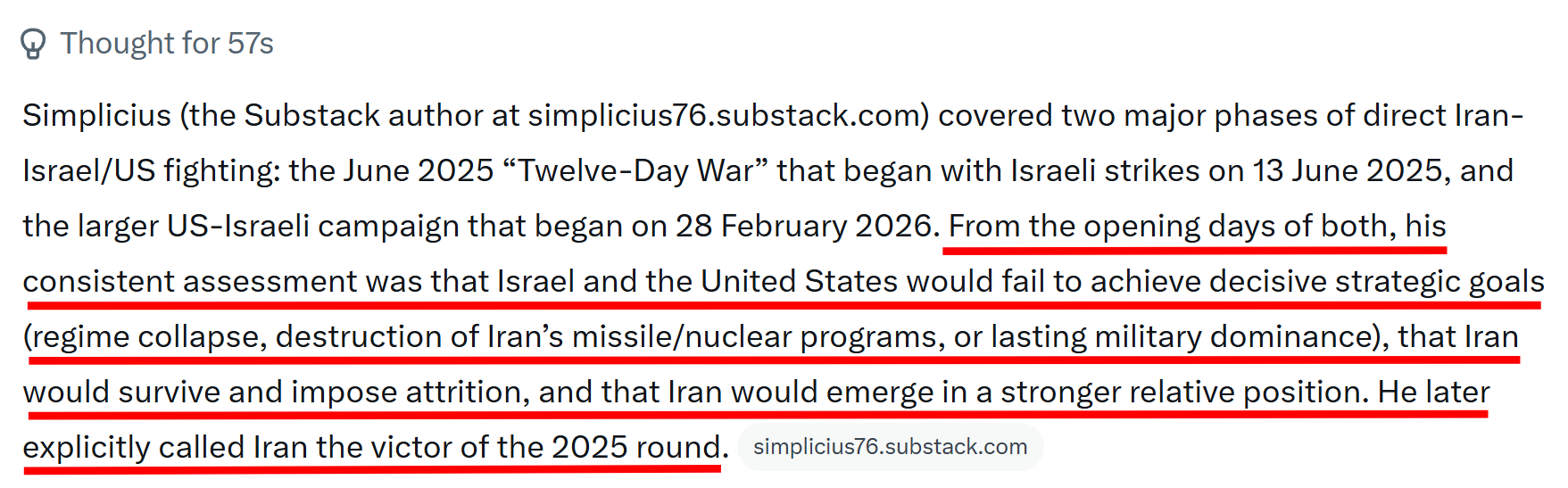
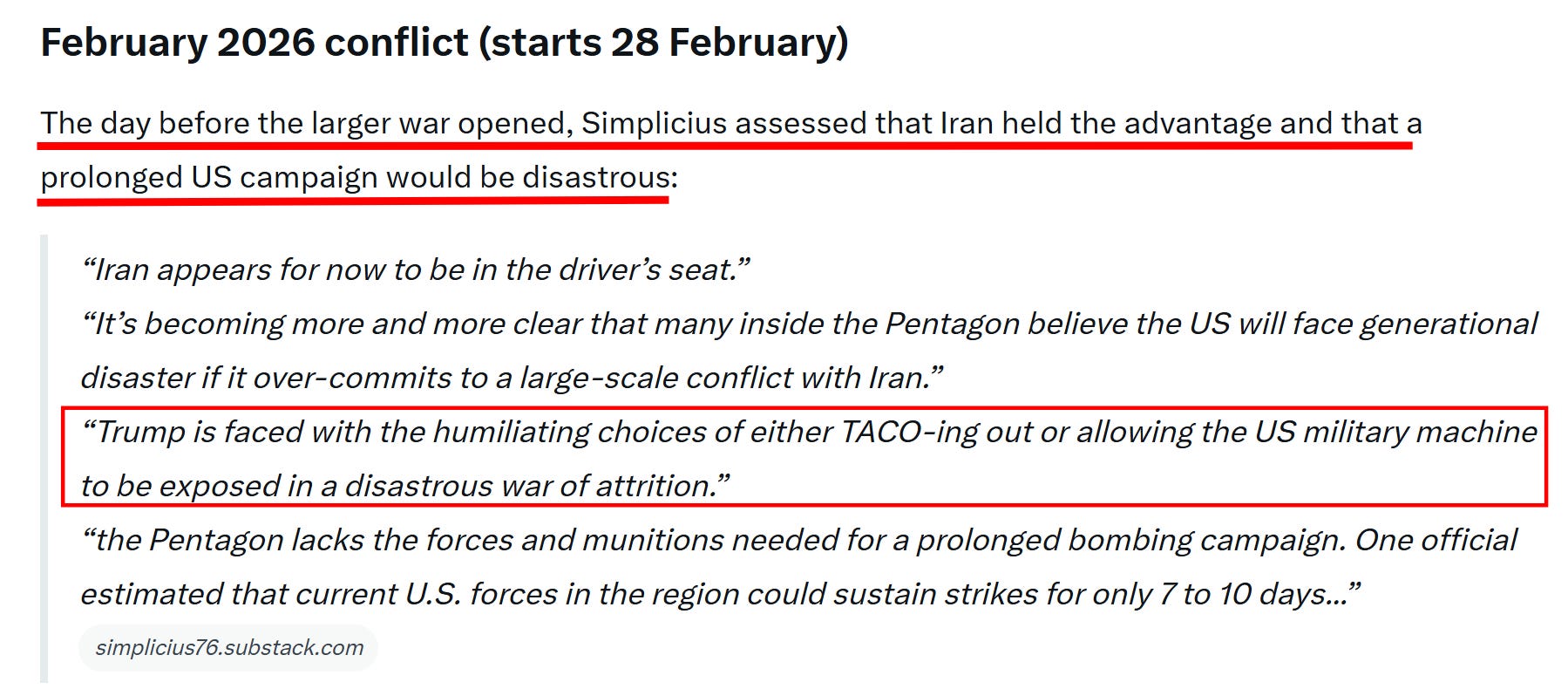
Specific citations of predictions from the very first days of the conflict:
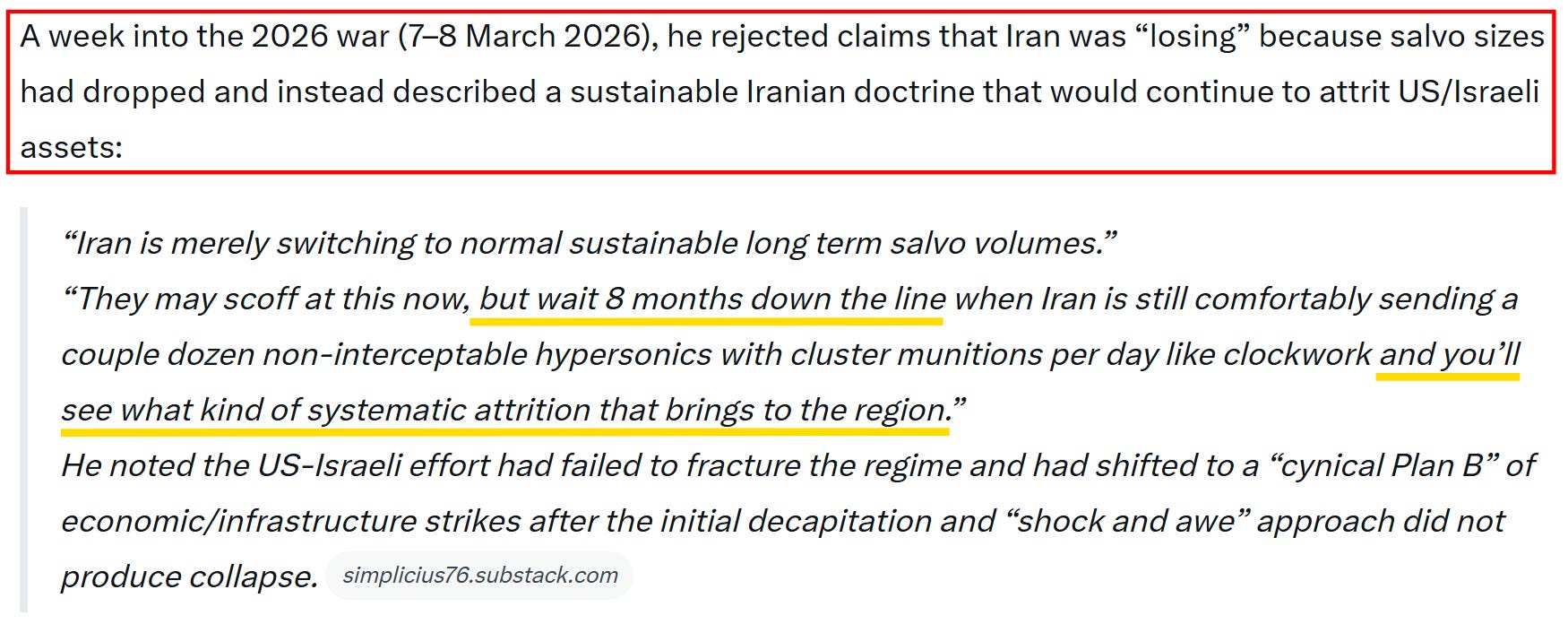
More importantly, as the entire world was foaming over the diminution of Iran’s “salvo sizes” in the first weeks of the war, we were amongst the only blog to confidently argue the opposite:
Well, what can we say? Maybe “analysts” like Phillips P. O’Brien would do well to stop listening to mainstream hacks and switch to sources with proven track records instead.
Now Trump has reportedly told Axios that he’s at a major inflection point with Iran:
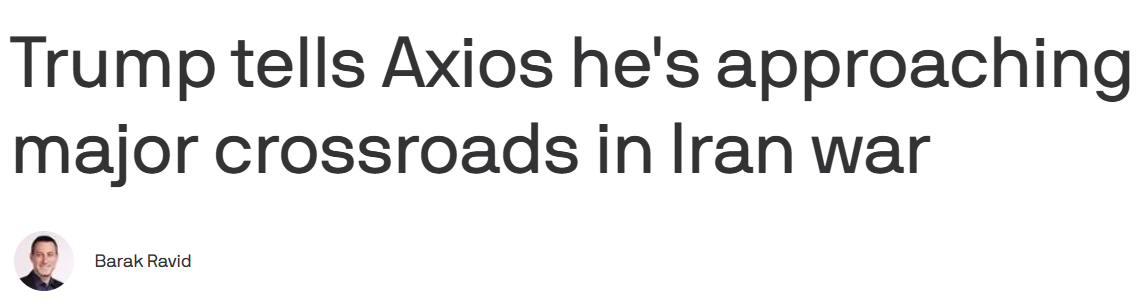
President Trump told Axios Thursday that he’s approaching a critical juncture in the Iran war over whether to restart massive attacks in an effort to bring the conflict to a close.
“I have a big decision coming up. Do I want to go in and annihilate them [the Iranian regime] or do I not? It’s a big decision. Anything could happen with me.”
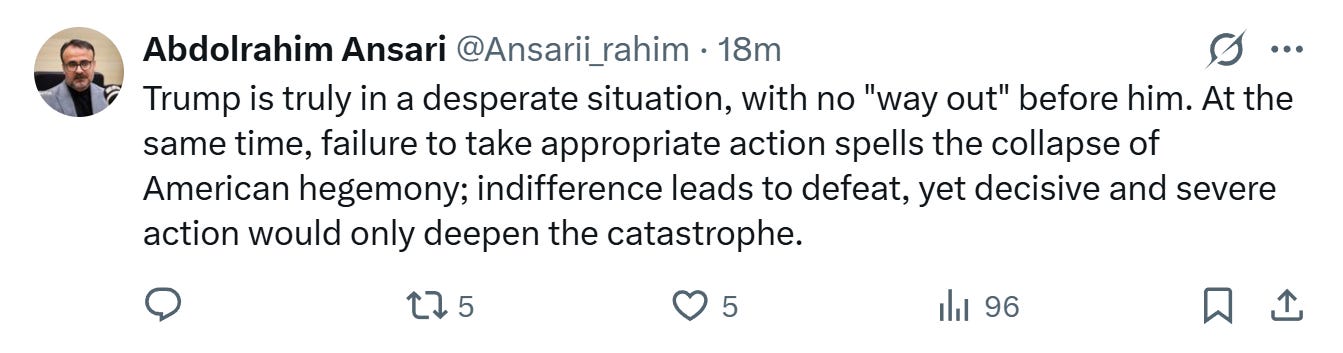
This is just more piffle from a vainglorious loser—an overcompensation for the lack of options by feigning power he never possessed. At this point the US can’t annihilate anything, and won’t; that day has long passed. As we had established in the last article, Iran is playing for keeps, and the US no longer has the morale to handle the pressure the regional superpower is now capable of doling out.
As a last update, new satellite images show the secret work being done at the Saudi East-West pipeline. Apparently, the Saudis are now trying to bypass the blown pumping stations with a re-directed emergency pipeline that literally goes around the station:
🇸🇦 SAUDI ARABIA | Emergency bypass work underway on East–West Pipeline New Vantor satellite imagery from September 16 appears to show Saudi crews rapidly constructing a temporary bypass around one of the pumping stations damaged in last week's attack. Workers can reportedly be …
1:47 PM · Sep 17, 2026 · 65.3K Views
New Vantor satellite imagery from September 16 appears to show Saudi crews rapidly constructing a temporary bypass around one of the pumping stations damaged in last week's attack.
Workers can reportedly be seen laying and welding two new pipeline sections, potentially allowing crude flows to bypass the damaged facility.
Reuters has separately confirmed that three pumping stations along the critical East–West Pipeline were hit and that Saudi Arabia is working to restore flows. Full repairs could take 5–6 weeks, although partial operations may resume earlier.
If completed successfully, the bypass could significantly shorten the disruption to one of the world's most important alternative oil export routes.
This obviously suggests the damage is far worse than previously thought, given that they chose to redirect around the stations rather than immediately restore the stations themselves.
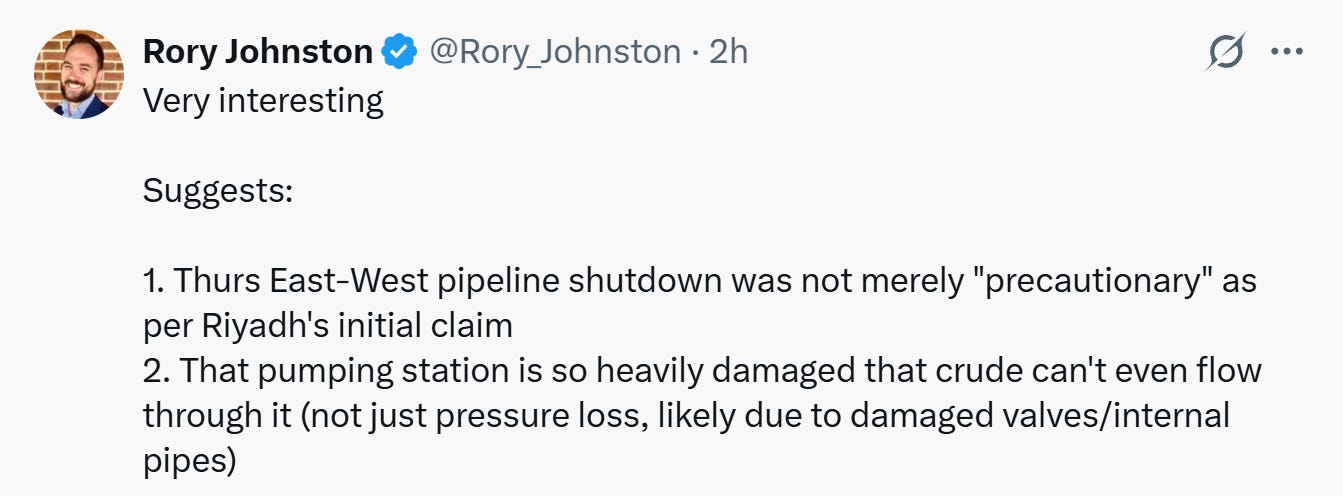
Experts will need to chime in, but theoretically and logically speaking, redirecting around the pumping station should mean the crude flows through the pipe would be much slower, given that the station is not adding its needed pressure boost. This would mean this ‘quick fix’ is not a complete solution.
The East-West line was said to be carrying 4-5% of the entire global oil supplyand a previous hit on just one pumping station earlier in the year was said to have slowed the supply by 700,000 daily barrels. This time three stations were hit.
We will have to see if the hit was only a warning for now, or the beginning of a systematic campaign to continue degrading the pipeline in perpetuity. Latest reports indicate KSA is begging China to intervene and force Iran to curtail its campaign against Saudi assets, but that China supposedly merely “passed the message” to Iran without asking any favors or issuing any direct guidance.
BIG: Saudi Arabia asked China to privately pressure Iran into restraining the Houthis after their seizure of Yemen's Red Sea coast and Bab al-Mandeb. Three Iranian sources say Beijing passed the message to Tehran — going beyond its public calls for restraint. Iran's response: …
8:27 AM · Sep 17, 2026 · 10.8K Views
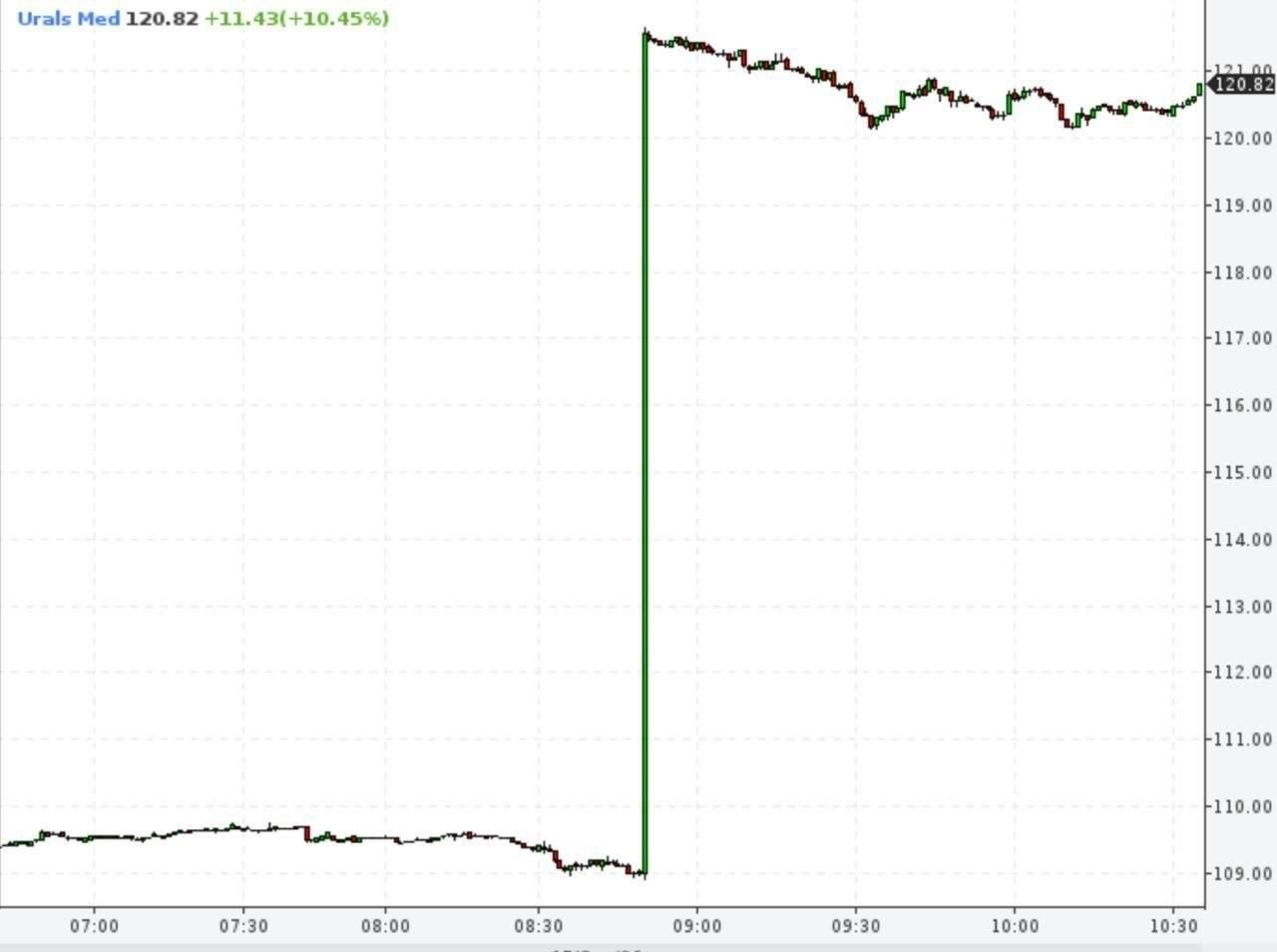
Now Bloomberg reports that Russia is boosting its oil flows:
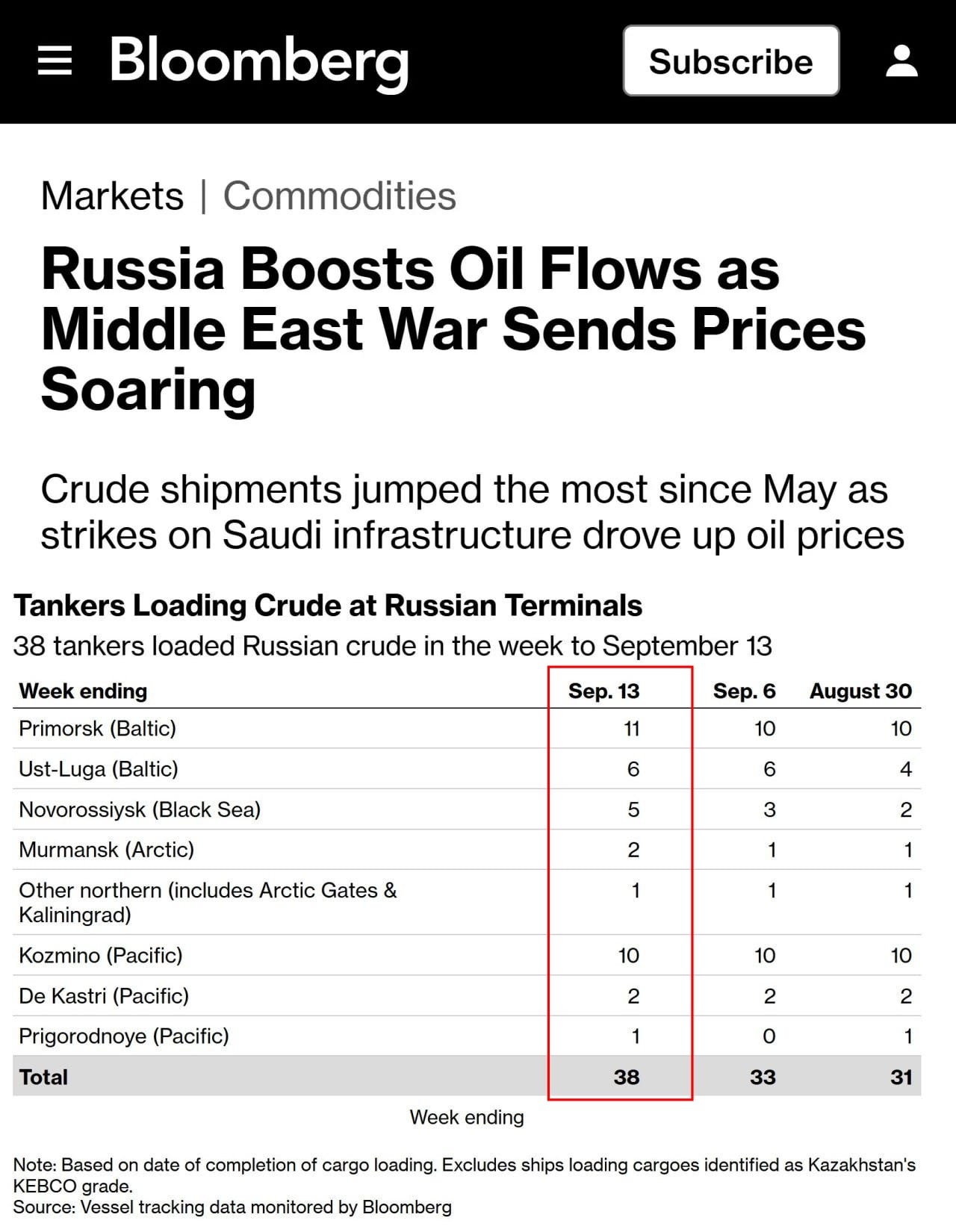
Russian Urals crude has jumped to $120 per barrel, higher than Brent in several assessments:
Where do you think the convergence of growing fuel and economic crises with the coming US midterms will go?
Your support is invaluable. If you enjoyed the read, I would greatly appreciate if you subscribed to a monthly/yearly pledge to support my work, so that I may continue providing you with detailed, incisive reports like this one.
Alternatively, you can tip here: buymeacoffee.com/Simplicius