The broad gains of Yemen’s Ansarullah, and their impact
Last week, I wrote this preliminary assessment of the importance of the gains that Yemen’s Ansarullah movement— often, wrongly, referred to as “Houthis”— had been making in their latest push against both the Saudi-backed fighters active in the southern portions of Yemen, and against Saudi Arabia itself.
The key gains that Ansarullah made were their capture of the whole western coast of Yemen down to the super-important Bab el-Mandeb strait and their capture along the way of the very strategic Perim Island (also called Mayun) which sits astride the 14-mile-wide Bab itself, and of two smaller but also strategically placed islands a little further north in the Red Sea.
Soon after those victories, forces in Iraq most likely allied with Ansarullah and Iran hit and very seriously disabled the pumping stations on the East-West pipeline through which Saudi Arabia had been hoping to get some of the oil from its (mostly eastern) oilfields delivered to the Red Sea and then exported to world markets.
Now, no longer. The pipeline will likely be offline for some months. And until now, the Strait of Hormuz is nearly totally closed to Saudi oil exports. Ansarullah’s advances and the attacks from their Iraqi allies have thus posed stark challenges not just to Saudi Arabia but also the whole global economy.
A little history
Saudi Arabia has, for 12 years or more now, been undertaking various forms of hostile action against the Ansarullah movement. The Saudi military has maintained a punishing blockade on the portions of Yemen that Ansarullah controls, and for several years after Muhammad Bin Salman (MBS) became Defense Minister (2015), then Crown Prince, he pursued a punishing— and largely U.S.-supported— campaign of air-strikes against Ansarullah-held areas.
He was doing this while he and the UAE (with which he more recently fell out some) were both backing a portion of Yemen’s political mosaic that until now has been graced with the title of the “official government of Yemen”. That, though the leaders of that “government” have been living in Saudi Arabia for many years, and though Ansaraullah has been in full control of the country’s capital, Sana’a from the beginning, and some two-thirds of the country’s 43 million peole live in Ansarullah-held areas…
In recent days several smart analysts have produced excellent accounts of the scale and impact of the latest developments. Among them, Indi Samarajiva (here), and as always, EI’s Jon Elmer (here).
The history of Yemen is extremely complex! An excellent resource to help you understand it is this post on Elijah Magnier’s blog. In it, he challenges the common framing of the Ansarullah-Saudi conflict as one framed wholly in sectarian terms. And he notes the following:
Approximately 57 per cent of Yemen’s territory is desert. Ansar Allah controls roughly 35 per cent of the country’s total land area, including much of the densely populated western highlands, and governs territory containing about two-thirds of Yemen’s population. The remaining 65 per cent of the land and one-third of the population are divided among government-aligned, southern, tribal and locally autonomous forces opposed to Ansar Allah. Much of this geographically larger territory consists of sparsely populated eastern and southern desert.
In this other post on his blog, Elijah provides a good picture of the extent not just of the Ansarullah gains but also of the stunning collapse of the Saudi-backed forces in Yemen.
He includes this:
Territory was not the only prize. Ansar Allah announced that it had captured advanced coastal-surveillance systems supplied by the United States, Israel, the United Arab Emirates and European manufacturers to the forces previously controlling the coastline. The inventory and operational condition of these systems have not been independently verified. Nevertheless, if genuine and serviceable—or capable of being repaired and integrated—they could significantly improve Sana’a’s maritime situational awareness.
That blog post provides a lot of detail about some of those coastal-surveillance systems. It also notes this:
The coalition opposing Ansar Allah has never represented a unified southern project. It contains separatists, unionists, Islamists, former Saleh loyalists, tribal forces and groups supported by competing foreign sponsors. Ansar Allah’s western offensive exploited those political and command divisions as much as it overcame military resistance.
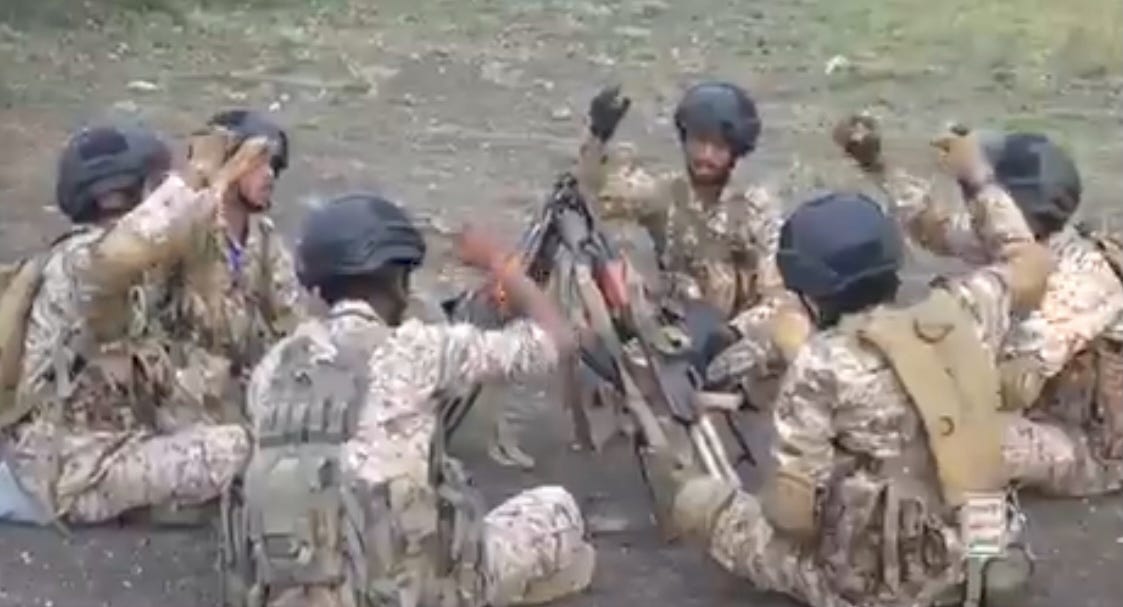
The accounts by Elijah, Indi, and others also make clear that the campaign Ansarullah launched earlier this month was broad, sophisticated, and very well prepared, most likely over the course of many months, or even years. These were not just a bunch of randos wandering around in flip-flops.
In this video from “Yemeni War Information” you can see many signs of the preps these units had undertaken before they launched the campaign. Here’s a screenshot from there, of a pre-battle briefing and pep/prayer session:
There has been a lot of intriguing diplomacy going on in the wake of Ansarulla’s latest gains. But the diplomacy I’d most love to see would be a concerted effort to find a sustainable end to the civil strife in which the country’s 43 million people have been trapped so very damagingly and for so long.
This would almost certainly have to involve the great powers of the world (including of the Arab world) giving formal recognition to Ansarullah’s political arm as constituting the official government of Yemen, since it already exercises control over— and clearly enjoys considerable support from— a majority of the country’s people, and it has also long been in control of the capital city, Sana’a.
Now, let’s head east, to Iran…
Iran’s resilience, smarts
Over the past six months, I have a number of times (e.g. here) reviewed the roots of Iran’s resilience in the different dimensions of human endeavor and geography. It is an exercise that’s worth repeating periodically. I haven’t myself visited Iran since 2004, but I’ve been lucky to be able to rely on the work of several long-time experts on the country whose work I admire. These include such analysts as Vali Nasr, Sina Toossi— and also, Elijah Magnier and Indi Samarajiva. (In the “Iran Crisis” project that I ran for Just World Ed earlier this year, Elijah Magnier was definitely a valued contributor.)
Here I just want to draw attention to two great recent contributions from Indi:
** Cannon and Fort: Iran, Yemen, and 500 Years Of Resistance (Sept 11)
This one is classic Indi. He starts with a notable quote and the grafs that follow then offer crucial insight:
“The West won the world not by the superiority of its ideas or values or religion […] but rather by its superiority in applying organized violence. Westerners often forget this fact; non-Westerners never do.”
– Samuel P. HuntingtonThe White Empire took Asia by taking and remaking its forts, using superior cannon and siege weaponry. The Portuguese took the Strait of Hormuz in 1515 and the British took Perim in Bab el Mandeb in 1799 and they are only now being wrested free. How? The same way they were tooken. With superior forts, cannon, and siege weaponry.
Iran and the Axis of Resistance have redefined forts as being underground. Under entire mountains, as in Iran and Yemen, or even under a concentration camp as in Palestine, these have proven to be superior. We had forts before, but the colonizer always wrested them. Now the modern underground fort has been tested in war, and bested them.
The Axis of Resistance has also redefined cannon. While the Empire drifted away from land-based cannon, because they were always bombing people far from home, the people of the land innovated on them. Now Iran and Yemen have ‘cannon’ that can be fired from its mountain fortresses and quickly withdrawn, and the ‘cannonball’ can find their targets from across continents. It’s a brave new day and the cowardly colonizers have little or nothing to do with it…
The whole of that post is an excellent, informative read. It’s paywalled, but definitely worth it. His wordplay is just the icing on the cake of his analysis…
** Rates Vs. Straits (Sept. 17)
This is another bracing piece that explores the important topic of the effects the Iranians’ control of Hormuz is having on financial markets in the West. Indi is not only someone who (like me) likes to look at current events across the Global South in the context of the 500-plus years of White Empire. He’s also a well-informed skeptic of many of the claims made by classic and neoliberal Western thinkers.
One of the topics in this recent Indi piece is this intriguing post that the Speaker of Iran’s Parliament, Mohammad Bagher Ghalibaf put onto X Sept. 16.
For those of you not on X, here’s what MBG had posted:
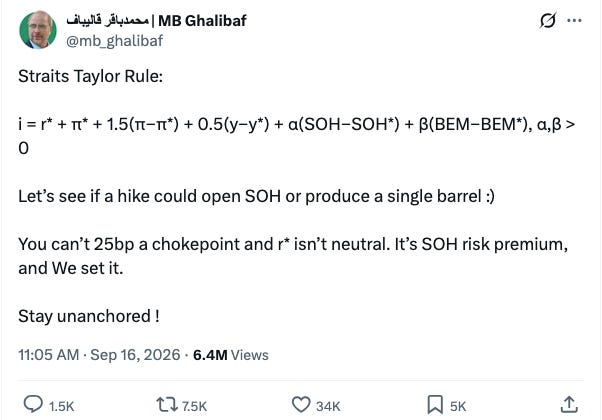
That was Ghalibaf’s adaptation of something that economists call the “Taylor Rule”, which is designed to help policymakers set central bank interest rates. (Yes, a timely topic right now.)
So a first thing to note here is just how erudite and intellectually wide-ranging Speaker Ghalibaf is. He’d first made his name as a commander of the IRGC in the Iran-Iraq war of the 1980s, and he’s had an interesting career ever since. Since 2007, he’s authored or co-authored the following five books:
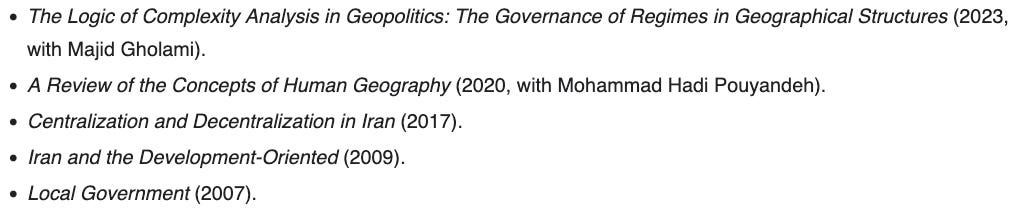
I confess I did not know any of this about MBG until Indi drew my attention to MBG’s “Straits” version of the Taylor Rule, so then I delved into his c.v. a bit more. Honestly, can you identify any member of Washington’s current political elite with anything like the erudition of M. B. Ghalibaf? … And he is is very far from the only person in Iran’s leadership who has this degree of culture and policy smarts.
I can’t easily speak to the accuracy/helpfulness of the “Straits Taylor Rule” that he offered. But the self-confidence and political defiance in that X post was unmistakeable:
Let’s see if a hike could open SOH [Straits of Hormuz] or produce a single barrel :) You can’t 25bp a chokepoint and r* isn’t neutral.
It’s SOH risk premium, and We set it.
And a great footnote…
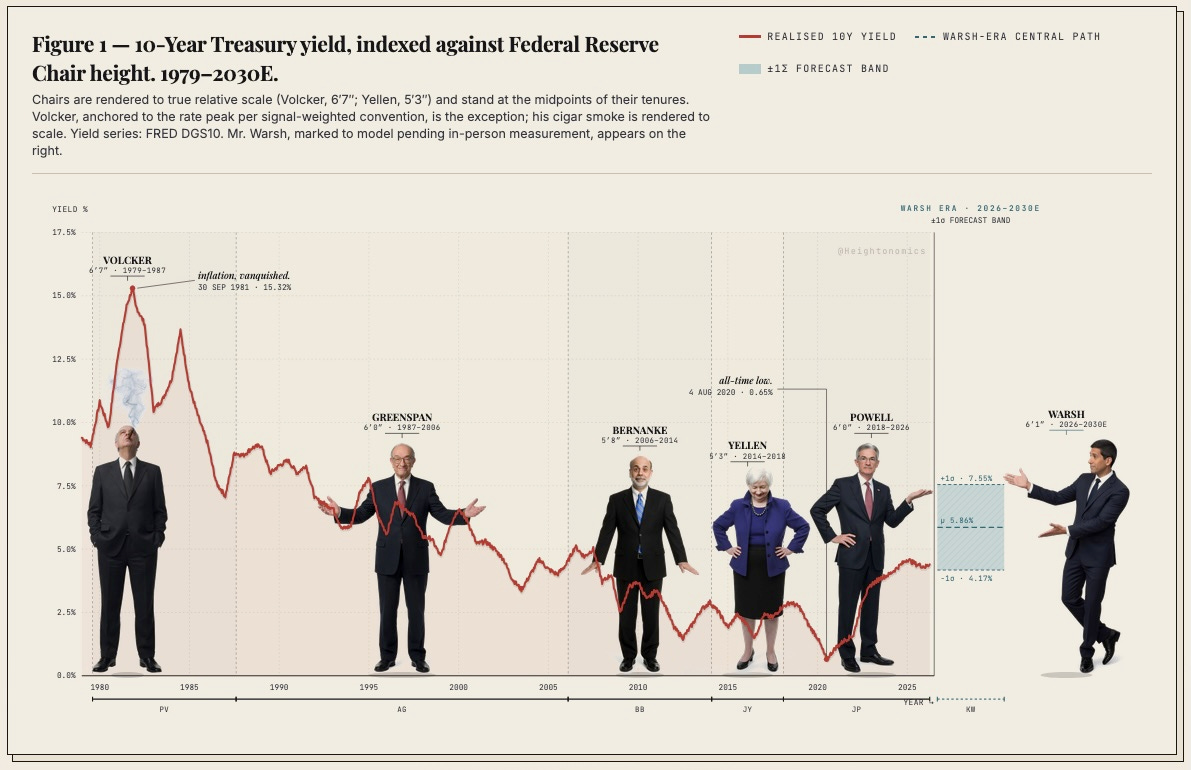
One footnote before I leave that great essay from Indi. Throughout the essay, he seriously questions the entire, super-”quantitative” and allegedly scientific basis on which Western economic/financial thinking is based. And he notes this:
since 1980, you could also predict whether rates would go up or down based on the height of the human being sitting in the Federal Reserve Chair. This heightonomics is unbeaten, indeed, Warsh is just a little bit taller than Powell, and raised rates a little bit above.
As he noted, he is not the only person to have made this observation. He included this great graphic, which he took from this website:
I’ll leave you with that…