I recently spoke with Ambassador Chas Freeman, the principal American interpreter during President Nixon’s path-breaking visit to China in 1972, and a former ambassador to the Kingdom of Saudi Arabia, during operations Desert Shield and Desert Storm, on the contours of the post American middle east, after the Iran war.
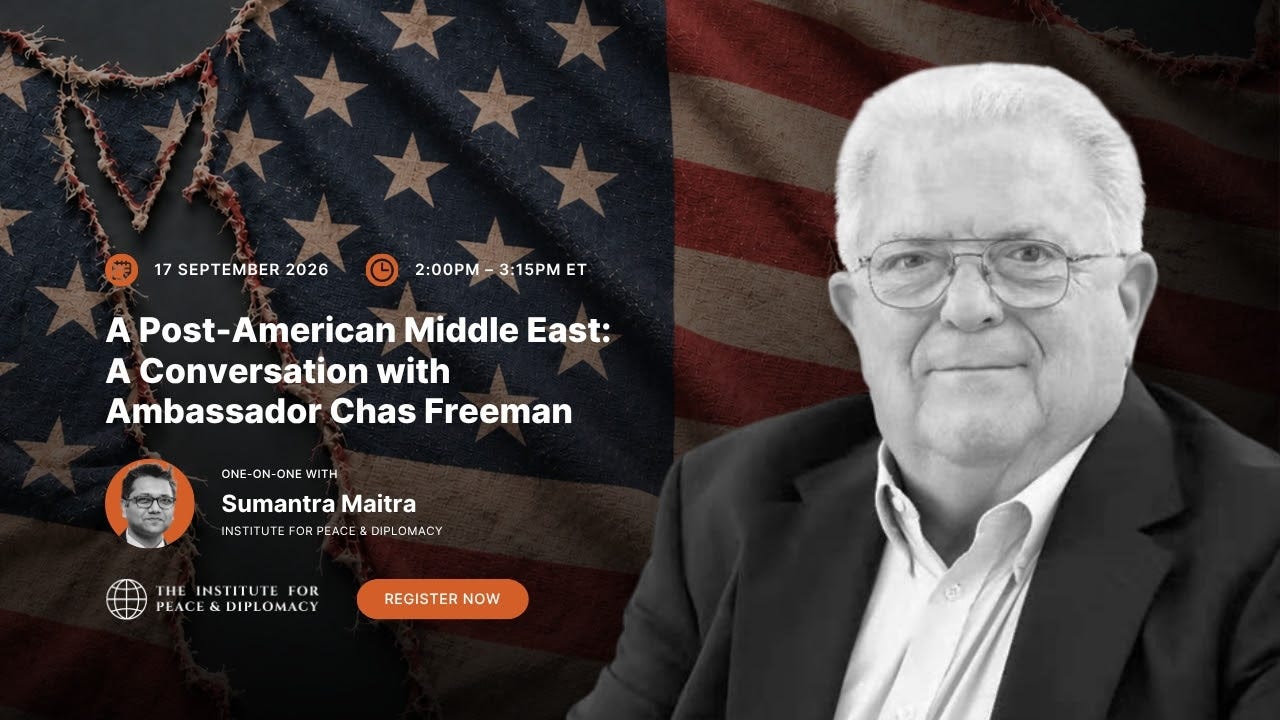
While I cannot transcribe the whole conversation, for obvious reasons, here are a few select and thought provoking quotes from Ambassador Freeman. Opinions are strictly his own.
Iran was the first country in the region to cast off foreign tutelage. It did that in the Islamic Revolution. It ceased to be the play thing of any foreign patron. That is a forerunner of what is now happening with others in the region including as I mentioned Israel which has discovered the limitations of its relationship with the United States. Iran has undergone a major change in strategy as a result of this war. Prior to the war, it was dominated by theologians who issued fatwa during the Iran Iraq war, which they then proceeded to reaffirm occasionally against the development of weapons of mass destruction. The Iranian Revolutionary Guard petitioned the Ayatollah, the dead leader, to match Iraqi chemical weapons with their own and was refused on grounds on religious grounds. Religion was the guideline of the state in that earlier period.
I would not describe Hezbollah or Hamas or even Syria as proxies. I think they were clients. They had their own interests which compelled them to cooperate with Iran. That was mutually beneficial from the Iranian point of view. It gave them a foreign deterrent, a foreign a forward deterrent against Israel. If Israel were to attack Iran, the supposition was that Hezbollah would attack Israel and so forth. Support for Hamas despite the fact that Hamas is an offshoot of the Sunni Muslim Brotherhood. Iran was on the defensive. It was passive. Israel carried out innumerable, several thousand actually assassinations in Iran or of Iranians abroad. Iran did virtually nothing to respond. It addressed the question of its nuclear program in the JCPOA accepting an unprecedented level of foreign supervision of its nuclear activities. All that is now gone. Iran in this round following the June attack on it by Israel and the United States last year adopted what I would call the Muhammad Ali style rope a dope strategy. Let the enemy hit you as hard as it can expend its best shot, only then should you respond.
I think the basic point on sea power is 500 years ago Christopher Columbus u in search of Indians, not American Indians but the real kind, stumbled on America and Vasco Da Gama around the same time rounded the Cape of Good good hope and emerged in the Indian Ocean that brought in the age of sea power and it culminated in a way at the end of the 19th century with Alfred Mahan's book on sea power. But there was a three-mile limit. You could not sail within three miles of the land because that was sovereign territory of whoever owned the land. That the range of a cannonball in the 18th century. In the 19th century with the ability of projectiles to hit ships at sea steadily expanded. We now have a different situation. So in the law of the sea treaty, we all compromised on a 12 mile limit but that is essentially arbitrary and meaningless. The Chinese now can hit aircraft carriers at almost 2,000 miles. Iran forced the aircraft carriers arrayed against it to stay 600 miles, a thousand kilometers away from its shore batteries, and it like the Houthies has demonstrated that it from the land it can control sea passages. So what do we do about this? There are lots of implications to this. It's not limited to the straight of Hormuz. What about Gibralter? Could someone close that? How about the Dardanelles? They're under a treaty, but why should the Turks respect that? What about the St. Lawrence Seaway? How about more exhorbitant fees for the Panama and US canals? What about the Taiwan strait? What about the Strait of Malacca? So, you know, I think the Iranians have set a very unfortunate precedent, but we're not resisting it on legal grounds.
The American arsenal has been depleted to the extent that we can no longer sell items to the Europeans for onward transfer to Ukraine. That is having its effects on the Ukrainian defense against the Russian invasion. We have no ability according to the regional commanders responsible for our war plans to meet contingencies not just in Europe but in Pacific especifically with China and Taiwan and the South China Sea. We have galvanized the world we saw in the Shanghai Cooperation Organization meeting in Bishkek in Kyrgystan a rare unity between non-western great powers, Russia, India, China, all signing on to various things that Mr. Modi had previously not signed on to. There is a grouping in the global south coming together as a balancer of a declining west.
It is the end of the 500 years of Atlantic supremacy. It is the end of the century of American supremacy. It is the beginning of what I call a multinodal framework of global affairs. I prefer that to multipolar because a pole is simply the end of a line. So you have if you have a bipolar relationship between Moscow and Washington that adequately describes their interaction. But now we have um nodes. So India for example has relations with Iran, with Russia, with the United States, with China, all of differing natures with differing thicknesses of the relationship economically, politically, militarily, and culturally.