A Realistic View of the US Position in the Asia-Pacific?
Jennifer Kavanaugh wrote the peace “A Second Island Chain Strategy For China” for the journal Defense Priorities. It takes a realistic view of the inability of the US to defend the “first island chain” in any war with China and proposes a retreat to the much more defensible “second island chain”.
Below is the first island chain (from Wikipedia)
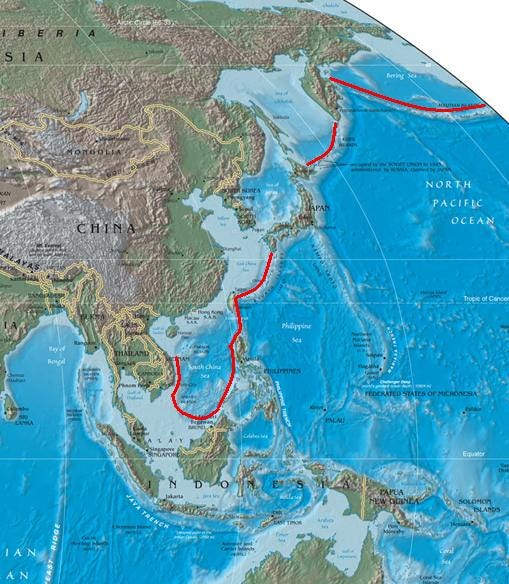
From Japan, through Okinawa to Taiwan, the Philippines and then the coast of the island of Borneo, (Malaysia and Indonesia), then Vietnam. The closeness to the Chinese mainland, let alone China’s military build up and modern drone, missile and submarine technologies, should have made it obvious to anyone that this is a completely indefensible line. Even more with Vietnam, Malaysia and Indonesia being neutral parties. Taiwan would be quickly overwhelmed, and any bases in South Korea, Japan and the Philippines that allowed usage by the US forces rapidly destroyed.
Kavanaugh states that:
The United States has two core interests in Asia worth protecting with military power: defending the U.S. homeland and safeguarding access to key economic markets and trade routes. The first priority requires little in the way of a forward military presence while the second benefits from a modest air and naval presence to hedge against outcomes that would threaten U.S. interests.
A strategy that shifts U.S. military commitments and presence from the vulnerable “first island chain” toward a more defensible “second island chain” would reduce U.S. military requirements and the risk of a war with China while still protecting U.S. interests.
The United States should narrow its defense commitments in the region, shifting to a clear non-intervention position on Taiwan, ending mutual defense alliances with South Korea, Australia, the Philippines, and Japan, and negotiating narrower and flexible security partnerships in their place. U.S. military posture should change accordingly.
The United States should remove most Army and Marine Corps deployments from Asia and cut air and naval power significantly. The remaining U.S. forces should be consolidated at more survivable bases farther from China’s coast and tasked with securing U.S. economic interests and signaling continued U.S. involvement in the Pacific region.
The United States should provide a clear plan of its intentions and communicate carefully with its allies and China. Changes should be phased over a period of three to eight years, with most changes complete by 2030 and all finalized by 2035.
Kavanaugh’s points follow a defensive realist logic, but that logic is not what drives US foreign policy. What drives it is the US capitalist oligarchy’s ability to exploit other nations for its own profiteering while keeping any challenger to that ability at bay. A retreat from the first island chain would signal that China is indeed the dominant regional player, directly affecting US relations with ASEAN, South Korea, Japan and even Australia and New Zealand. She accepts that China is now the geopolitical equivalent of the US, but also spews the nonsense that the Chinese economy is still smaller than the US (on a PPP basis the Chinese economy became bigger than that of the US in 2013).
It is interesting that she states that “from the perspective of the United States, no country can be allowed to dictate the terms of U.S. economic engagement in Asia.” Imagine a Chinese scholar stating that “no country should be allowed to dictate the terms of Chinese economic engagement in the Americas.” Even though Kavanaugh is being much more realistic than many US analysts, she still suffers from the socio-centrism that pervades the Western academies. Kavanaugh has been attacked for her article from across the spectrum of the US foreign policy field as she has inadvertently raised a possibility that is inimical to the current US oligarch orientation.
But what of the second island chain, is it really a defensible position?
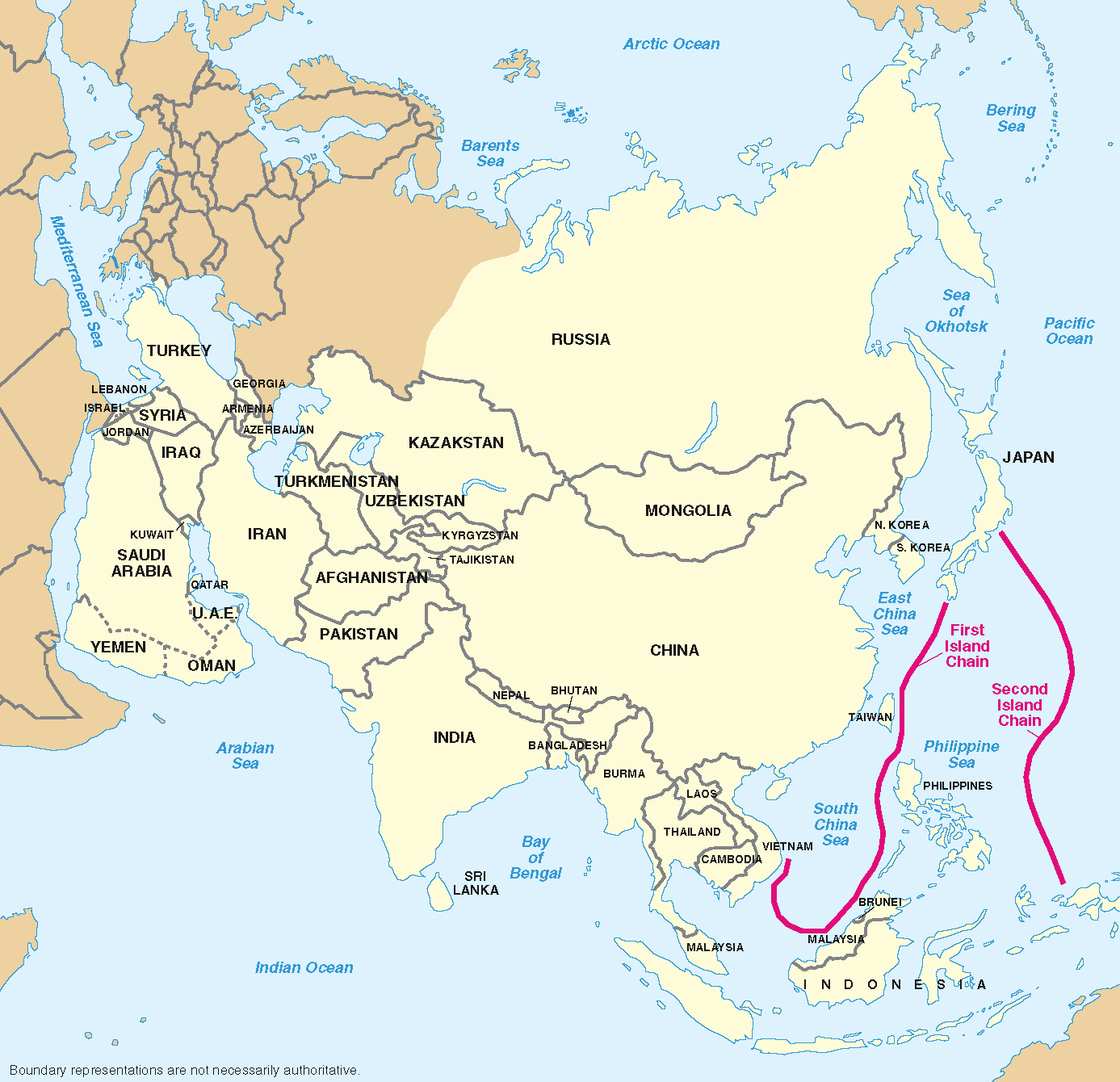
Running from the Japanese mainland (near Tokyo) through the Japanese Mikurajima and Iwo Jima islands, the Northern Marianas and Guam, then to West Papua. The US bases are located in the Northern Marianas and Guam, both US territories. The reality is that these islands are well within the range of Chinese ballistic missiles (2,890 miles) and are also remote islands which could be easily cut off from their logistics hubs in the Hawaii Islands (3,800 miles away) by Chinese submarines. The reality is that the US will simply not be able to fight a war on the other side of the Pacific in China’s “backyard”. With quite possibly South Korea and Japan opting out of a war that would lead to so much destruction upon their own territories.
A piece written for US Naval Institute accepts an actually realistic position that the US should rely upon a third island chain.
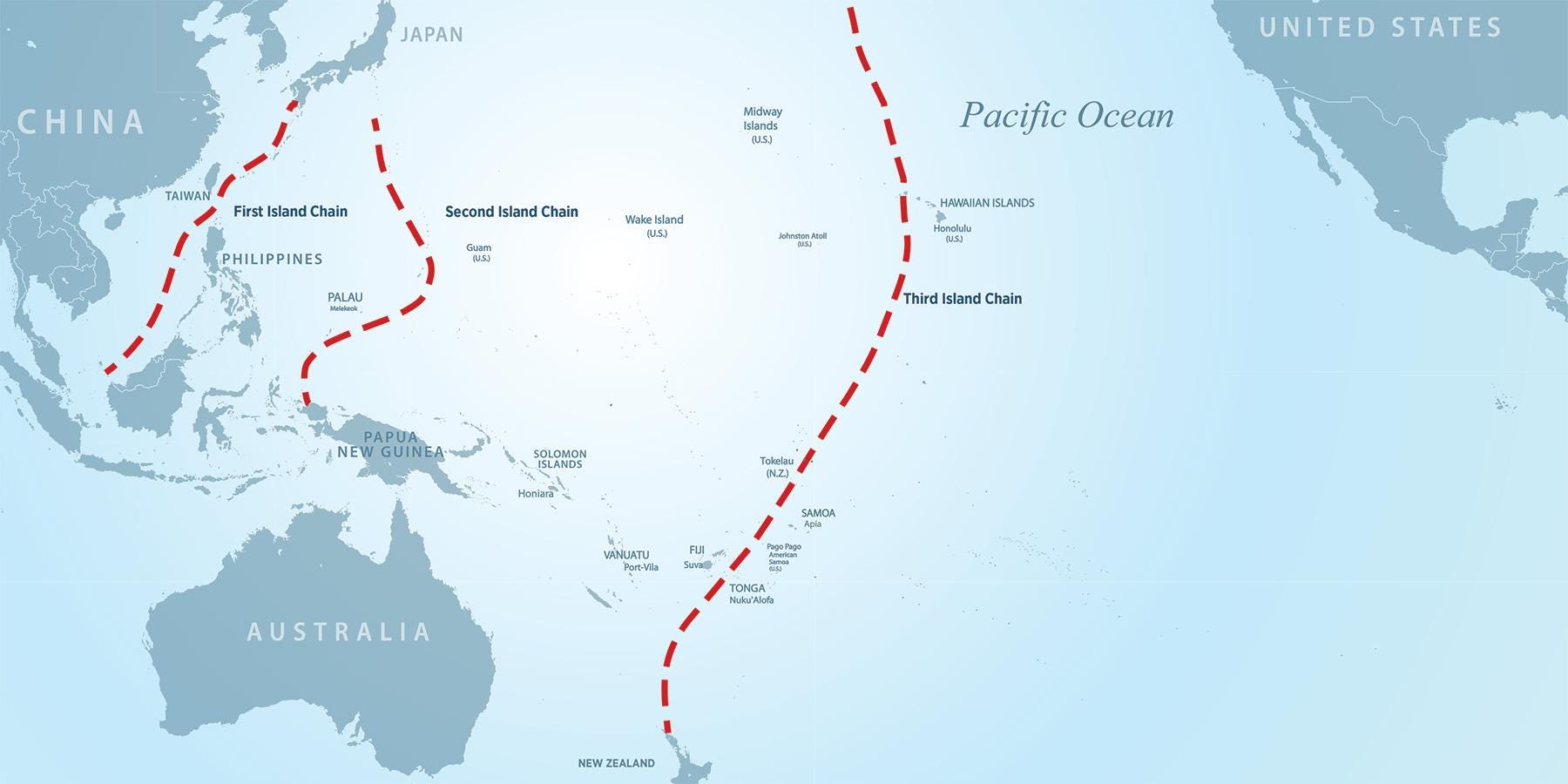
From the western tip of Alaska, running through the Hawaii Islands, then Samoa, Tonga and Fiji. This would be a truly defensible line, closer to the US than to China. It would also signal the US retreat from Asia, even signalling to Australia that it cannot rely upon the US. Japan, South Korea, ASEAN and Australia would take note, accepting China as the regional hegemon. Such a strategy makes sense for a declining debt-ridden power, whose military has been shown to be an expensive paper tiger by both Iran and Yemen, that needs to consolidate into its own hemisphere. But such a retreat is anathema to the US oligarchy, that still pines after the 1990s unipolar moment. Unless absolutely forced to by financial necessity, the US oligarchy will take a while to come to terms with such retrenchment. For the UK and France it took the Suez Crisis (and the Algerian Crisis for France) to get the point across.