An Ever-Expanding Gulag of Concentration Camps for Immigrants: The US Under Stephen Miller
12.2.26
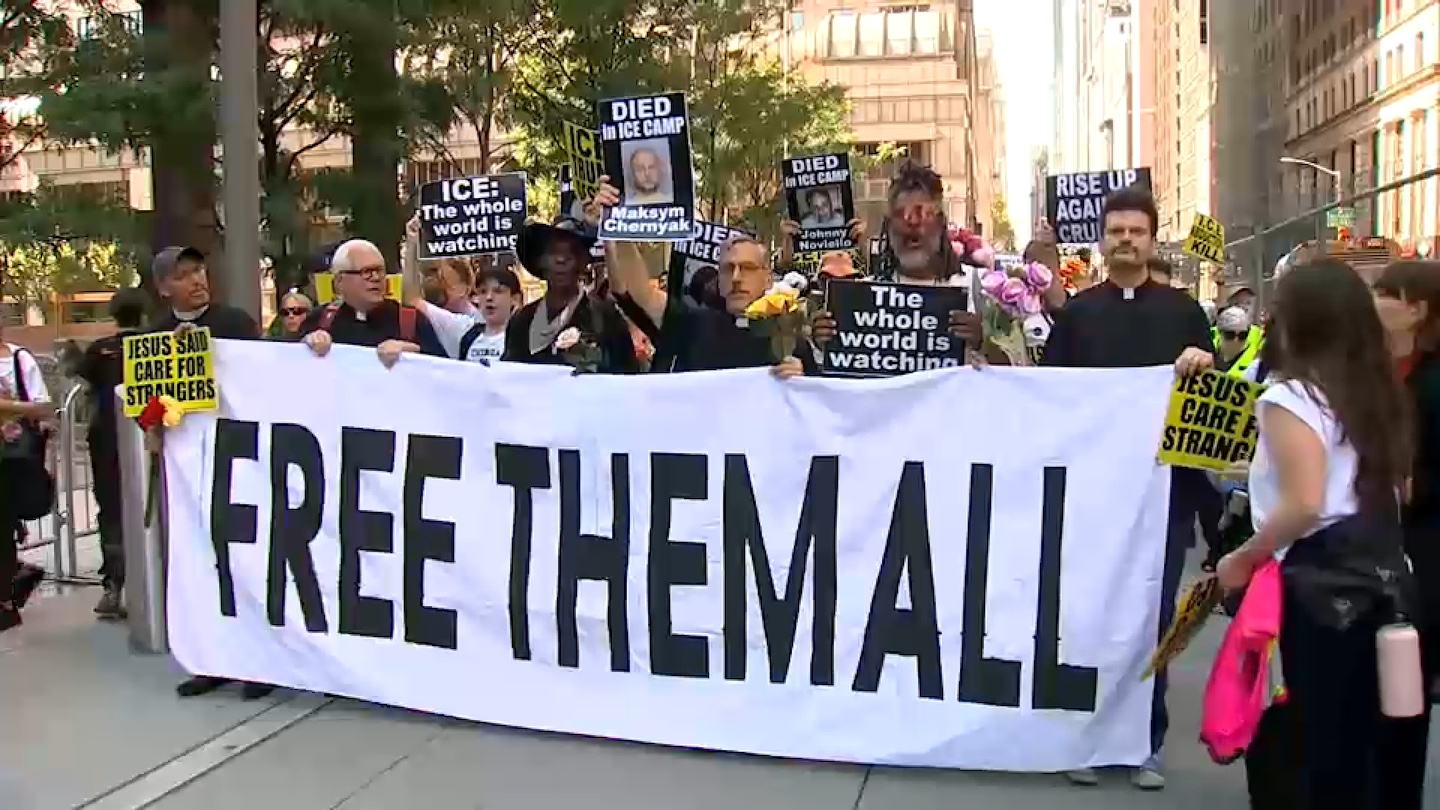 A screenshot from a video of a protest against ICE in New York City in August 2025.
When Donald Trump promised, on the campaign trail, to “carry out the largest domestic deportation operation in American history”, even the most observant critics would have been hard-pressed to realize quite what that would actually entail.
In the last year, however, we’ve come to see what it is, and the reality is truly horrific, as it involves nothing less than a concerted effort to turn the entire landmass of the United States into a hunting ground for masked and heavily-armed unaccountable thugs to terrorize entire cities, to abduct anyone who isn’t white, on the merest suspicion that they might be undocumented migrants, and to “disappear” them into increasingly overcrowded detention facilities where even the most basic human requirements — decent food and water, and adequate medical treatment — are routinely denied, where strenuous efforts are made to deny them access to lawyers, despite that being their legal right, and where institutionalized cruelty and violence are rampant.
When Trump’s second presidency began, ICE was holding around 40,000 people in 107 facilities. In just twelve months, those figures have both nearly doubled, with over 70,000 people held in 212 facilities. Most pertinently, despite the administration’s claims that it is only seizing and removing “criminal illegal aliens”, three-quarters of those held — 52,504 out of the 70,766 held as of January 25 — have no criminal record whatsoever, while many of those with convictions “committed only minor offenses, including traffic violations.”
The contrast with Trump’s claims, in a TruthSocial post on January 25 — that, “During the four years of Crooked Joe Biden and Democrat failed leadership, Tens of Millions of Illegal Alien Criminals poured into our Country, including Hundreds of Thousands of Convicted Murderers, Rapists, Kidnappers, Drug Dealers, and Terrorists” — could hardly be starker.
Widespread revulsion at the horrors of ICE’s brutal detention facilities
The remorseless expansion of these facilities has, fortunately, attracted significant attention in the mainstream media, from numerous dedicated NGOs, and amongst many concerned members of Congress, backed by judges who, repeatedly, are pushing back against the administration’s brutality and lawlessness.
When Liam Conejo Ramos, a five-year old Ecuadorian immigrant, was seized in Minnesota with his father and flown to an ICE detention facility for families in Dilley, Texas, a photo of him taken at the time he was seized, in a blue bunny hat and a Spider-Man backpack, tugged at the nation’s heartstrings.
 The photo of Liam Conejo Ramos that melted hearts.
The father and son were freed after a campaign led by Rep. Joaquin Castro, and a memorable court order by District Judge Fred Biery, who condemned the administration’s “perfidious lust for unbridled power” and its “ill-conceived and incompetently-implemented government pursuit of daily deportation quotas, apparently even if it requires traumatizing children”, and on February 1 the New York Times published an article by Elora Mukherjee, the director of the immigrants’ rights clinic at Columbia University, in which she recounted the horrific conditions at Dilley, where she has been representing some of those held for the last seven months.
After explaining that at least 3,800 children under the age of 18, including 20 infants, were arrested and detained by the immigration authorities throughout the country between January and October 2025, she provided the following analysis of the situation at Dilley:
The children at Dilley with whom I’ve worked over the past year range in age from 2 to 16 years old. They are citizens of Afghanistan, Azerbaijan, Colombia, Honduras and Russia. A 2-year-old boy was breastfeeding in detention. One 6-year-old boy had leukemia. An 8-year-old girl began wetting the bed. A 14-year-old girl engaged in self-harm. All of these children and their parents were detained despite being eligible for release — ICE has the authority to release these families, who are not flight risks, on parole — and while seeking asylum and other humanitarian protections in the United States. None of these children or their parents had a criminal history anywhere in the world.
The family detention facility at Dilley is a hellhole. Children and parents consistently report not having access to sufficient potable water, palatable food (both children and parents have told me they found worms in their meals), adequate medical care or meaningful educational opportunities. Lights are left on 24 hours a day, making it difficult to sleep. Officers have repeatedly threatened to separate families, including those I represent.
Another devastating article about Dilley was published by ProPublica on February 9, featuring numerous harrowing accounts from the children themselves, speaking via video calls with reporter Mica Rosenberg, while other media outlets focused on the story of 18-month old Amalia, held with her parents, who got so ill that she was hospitalized, but, on her return to Dilley, had the medication that doctors prescribed for her withheld.
 Children in the Dilley detention center, filmed on a video call with ProPublica’s reporter Mica Rosenberg.
Other facilities that have attracted significant media attention, and which I wrote about in a recent article, Fascism in the US, as the Trump Administration Defends Death Squad Executions of US Citizens, are Krome and “Alligator Alcatraz” in Florida, condemned by Amnesty International for the systematic use of “torture and enforced disappearances” at both locations, and Camp East Montana, on the Fort Bliss military base in El Paso, Texas, a new $1.2 billion facility intended to hold up to 5,000 “detainees”, which is located on the site of a former WWII Japanese-American internment camp, where, as I described it, based on reporting by the ACLU and other NGOs, “As with the facilities in Florida, food is inadequate (or worse), outbreaks of raw sewage are widespread, conditions are cramped, with, often, no opportunities for outside recreation, the provision of medical care is alarmingly poor, and arbitrary and often severe violence is widespread.”
However, it’s apparent that chronic inhumane conditions in these facilities are the norm, rather than the exception.
In a search for other stories for this article, I came across a recent report by Sen. Jon Ossoff, identifying “Over 1,000 Credible Reports of Human Rights Abuses in US Immigration Detention”, and I also came across similar accounts of abuse at the privately owned California City Detention Facility, the largest ICE facility in California, where detainees described “severe medical neglect” and “harrowing conditions”, and where one man, Fernando Viera Reyes, has “continuously been denied medication and urgent treatment” for what, in all likelihood, is prostate cancer.
The re-opening of Angola Prison’s notorious solitary confinement block for migrants
Another shocking story emerged via the Vera Institute of Justice, which reported on January 30 about the reopening of a notorious solitary confinement block in Louisiana’s Angola Prison to hold migrants, via “a new partnership between Louisiana Governor Jeff Landry and the Trump administration.” As the article explained, those held are “Detained for 23 hours per day in a dirty prison cell. Held without access to medical care or necessary prescription medications. Locked up, far from home, with limited ability to communicate with lawyers or family members.” In September, one detainee wrote about his experiences in an article entitled, “I won protection from torture in El Salvador. Now I face torture by the US government.”
The grim significance of using the Angola Prison to hold migrants was explained as follows in the Vera Institute for Justice’s article:
Angola’s name comes from the plantation that previously occupied the land on which the prison now sits. Enslaved Africans were forced to labor on this land, and after emancipation, Louisiana quickly replaced slavery with convict leasing and prison labor, ensuring that Black labor could still be extracted through the criminal legal system. Today, it remains the largest maximum-security prison in the United States, housing more than 5,000 people—nearly all of them Black men and many of whom labor in the prison’s fields under harsh conditions that echo its plantation past. Human rights observers, journalists, and federal courts have long condemned Angola for its brutality, rampant medical neglect, and reliance on forced labor, yet the prison remains a central pillar of Louisiana’s punishment infrastructure.
The prison’s solitary confinement block, Camp J, was eventually closed in 2018 due to safety and security concerns, but, given its history, its re-use makes rivetingly clear how Trump’s mass immigrant detention and deportation program is deliberately echoing the horrors of America’s history of slavery, just as the Fort Bliss facility, on a former WWII Japanese-American internment camp, is deliberately echoing that reviled period when the US previously embraced lawless detention camps.
These echoes are not accidental.
Worse to come, as ICE buys up warehouses across the country for a gulag of vast new detention facilities
Even this, however, is not the worst of it. Having secured the most bloated budgetary increase imaginable over the summer — $75 billion over four years, a more than sevenfold increase on its previous budget of $10 billion — ICE (Immigration and Customs Enforcement), the main government agency responsible for detention and deportation, which was established in 2003, as part of the newly-created Department of Homeland Security, is massively expanding its detention operations.
Of the $75 billion allocated to ICE in what Donald Trump sickeningly called his “One Big Beautiful Bill”, $45 billion is allocated for the expansion of detention capacity, the aim being to hold over 100,000 people annually, as part of an openly-stated target to deport a million people a year, while the other $30 billion is allocated for enforcement, tracking, and hiring 10,000 new unaccountable thugs to act as deportation officers.
As the Washington Post reported on December 24, a “draft solicitation” seen by the Post revealed that the Trump administration was “seeking contractors” for “a plan that includes renovating industrial warehouses to hold more than 80,000 immigrant detainees at a time.” The plans envisaged that “newly arrested detainees would be booked into processing sites for a few weeks before being funneled into one of seven large-scale warehouses holding 5,000 to 10,000 people each, where they would be staged for deportation.”
The Washington Post‘s map of the planned expansion of ICE facilities.As the Post added, “The large warehouses would be located close to major logistics hubs in Virginia, Texas, Louisiana, Arizona, Georgia and Missouri”, while “sixteen smaller warehouses would hold up to 1,500 people each.”
In just the last month, as Aaron Reichlin-Melnick of the American Immigration Council posted on X on February 9, ICE has bought seven vacant warehouses to convert into detention facilities — three of the planned “large-scale” facilities, and four of the smaller feeder facilities, at a total cost of well over $500 million.
The large-scale facilities are in Tremont, PA ($120 million, 7,500 capacity), El Paso, TX ($123 million, 8,500 capacity) and Social Circle, GA (price unknown, 10,000 capacity), while the smaller facilities are in Hagerstown, MD ($102 million, planned 1.500 capacity), Surprise, AZ ($70 million, planned 1,500 capacity), Hamburg, PA ($87 million, 1,500 capacity), and San Antonio, TX ($82 million, 1,500 capacity).
Contempt for the local communities affected
Typically, however, the administration has such contempt for those affected by its deportation obsession that many of these purchases have taken place without any consultation with the communities that will bear the brunt of having vast prison warehouses in their neighborhoods.
Thankfully, the racism that Trump relies on has largely failed to play a part in these complaints, with many communities recognizing that the “war on migrants” that they were sold has actually turned into something much more sinister, and showing sympathy for those detained.
Instead, what they are complaining about, primarily, is the economic and logistical stress these facilities will impose. Because the sites have been purchased by the federal government, these communities will be deprived of the often substantial local tax revenues that would be raised if they were bought or leased by private sector companies, while, at the same time, the establishment of new detention facilities will place demands on already stretched budgets to cope with the many impacts on local infrastructure.
And in addition, of course, after seeing how shamefully unable — or unwilling — the managers of the existing ICE facilities have been when it comes to providing adequate food, water, bathing and toilet facilities and medical treatment in existing facilities subjected to target-driven overcrowding, why would anyone expect that they — or, particularly, the corporate private prison contractors running most of these facilities — would suddenly manage to become either competent or caring when fitting out vast empty warehouses to hold thousands of people?
I never normally have any time for Sen. John Fetterman, the right-wing Democrat and fanatical supporter of Israel’s genocide in Gaza, but, on ICE’s purchase of two warehouses in Pennsylvania, with plans to them to be used to hold 7,500 and 1,500 detainees, he was appropriately scathing of the administration’s contempt for the local communities.
On February 7, in a letter to DHS director Kristi Noem, he wrote, “While I have been clear in my support for the enforcement of federal immigration law, this decision will do significant damage to these local tax bases, set back decades-long efforts to boost economic development, and place undue burdens on limited existing infrastructure in these communities.”
He pointedly noted that the proposed conversion of these facilities was taking place “without input from local or state officials”, and stressed that neither of the two townships involved “have the capacity to meet the demands of these detention centers, with Tremont Township officials specifically stating the proposed 7,500-bed detention facility would quadruple the existing burden on their public infrastructure system.”
As he added, “Detention facilities impose unique and substantial demands, particularly adequate access to existing water and sewage systems, an increased demand on local electrical grids, the capacity of local law enforcement and EMS [Emergency Medical Services], and proximity to appropriate medical facilities.”
Regarding the economic cost of the facilities being removed from the private sector, he also pointed out that it “represents a combined loss of over $1.6M in local tax revenue per year”, which “compounds concerns over the ability of these municipalities to meet the infrastructure needs of these facilities and would place undue strain upon the budgets of local governments and school districts in the region.”
The baleful role of Stephen Miller
As some states begin to mobilize to try to find legal ways to prevent ICE from blighting their own communities with further warehouse purchases, it’s important to remember that none of this would be happening without the driving influence exerted by one man and one man alone — Stephen Miller, the White House Deputy Chief of Staff for Policy, who is also Trump’s Homeland Security Advisor.
 Stephen Miller, the driver of Donald Trump’s mass detention and deportation program.
Although Donald Trump himself can be counted on to relentlessly indulge in shameful racist slurs against everyone in the United States who isn’t white, it is Miller, an unelected bureaucrat, who is obsessively pushing and micro-managing the deportation program.
Unlike Trump, whose racism, like so much of what passes for his intellectual activity, is visceral, Miller fancies himself as an intellectual, and has long pored over US immigration history to formulate what Greg Sargent of The New Republic described, in a detailed article in December, as “his disdain for multiculturalism, his hatred of mass migration [and] his affinity with white nationalists.”
Despite being a descendant of of Ashkenazi Jews who arrived in the US from Belarus in the first two decades of the 20th century, Miller is a supporter of the Immigration Act of 1924, which endorsed ethnic quotas for immigration, and whose primary aim, as Sargent explained, “was to slam the brakes on immigration by people like Miller’s ancestors” — part of the 20 million or so immigrants who arrived in the US, mostly from Southern and Eastern Europe, between the 1880s and the 1910s, and whose reasons for doing so were to “escape economic hardships and religious persecution”, and to build a “better life for themselves and their children.”
The 1924 Act, however, was driven by virulent opposition to these new arrivals by those who identified with the “pioneers” from Northern and Western Europe, who were regarded as superior. Sargent cited the sociologist Edward Alsworth Ross, who, as he described it, “declared in a 1914 broadside [that] these new immigrants were inferior to Americans who descended from the ‘pioneer breed’ who’d given birth to the American nation.” The new arrivals, he said, had “submerged” that ancestral connection to the “pioneer breed,” setting the nation on a path to the “extinction that surely awaits it.”
As Sargent proceeded to explain, the diatribes of 100 years ago are “very similar to claims Miller makes today about the threat to ‘civilization’ supposedly posed by those emigrating from Africa, Latin America, Asia, and elsewhere.”
Miller’s other obsession is the 1965 Immigration and Nationality Act, which brought to an end the ethnic quotas for immigration created in 1924, and his opposition to it is, as Sargent described it, “an effort to destroy the entire architecture of immigration and humanitarian resettlement put in place in the post-World War II era”, which, crucially, has, until now, largely been a bi-partisan project.
As Sargent described it, “Miller is feverishly stamping out every single avenue for those fleeing horrific conditions to come here legally that he possibly can” — seeking to reduce to zero the numbers of refugees allowed into the US, in dangerous defiance of the post-war consensus in the 1951 Refugee Convention, and also seeking to end Temporary Protected Status (TPS), first introduced under George H. W. Bush, which provides routes to safety and productive lives for over 1.5 million people “fleeing some of the most horrific conditions on the planet: armed conflicts, natural and environmental disasters, large-scale civic breakdown.” As Sargent added, “These are not undocumented immigrants. They are here lawfully, have work permits, and are integrating into US communities.”
Crucially, Miller’s obsessive, racist, white supremacist ideology is indifferent to the economic reality that immigration is essential for the US economy. Driven solely by a malignant ideology, “Miller’s obsession with sheer numbers — the amounts of various categories of immigrants who are either in the United States or trying to get here — borders on pathological”, as Sargent described it.
Regarding undocumented migrants, Sargent also noted how Miller rages incessantly at ICE officials to step up their arrests to meet his arbitrary target of a million deportations a year. However, this, of necessity, “requires arresting people who are not criminals or gang members — people who have jobs and have become integrated into US communities — because there’s no other way to get the removals up.”
As Sargent proceeded to explain, Miller’s target-driven “deportation machinery” is already so out of control that ICE and Border Control agents are “arresting people faster than they are being removed”; hence the new network of vast warehouses”, which he accurately described as creating “a massively expanded immigrant carceral state at an enormous cost to all of us”, both economically and morally.
Detaining many more people than can be deported
Since Greg Sargent wrote his article, the moral cost of Miller’s obsessive racism has become apparent on the streets of Minneapolis, through the public executions of Renee Nicole Good and Alex Pretti, two white US citizens whose only crime was either to have got in the way of ICE’s brutal, blundering, heavily-armed operations, or to have been observers seeking to provide some measure of safety to its victims.
These killings have precipitated an unprecedented backlash against the deportation program, but outrage alone cannot stop its continuing expansion. Greg Sargent correctly identified a system so out of control that the rate of detentions is far outstripping the ability of the authorities to deport those detained.
There are many factors involved in this, but one key example is the decision, taken in July, that “immigrants who arrived in the United States illegally are no longer eligible for a bond hearing as they fight deportation proceedings in court”, as the Washington Post described it.
As the Post proceeded to explain, in a memo on July 8, Todd Lyons, ICE’s acting director, “told officers that such immigrants should be detained ‘for the duration of their removal proceedings’, which can take months or years.” Lawyers said that the policy would “apply to millions of immigrants who crossed the US-Mexico border over the past few decades.”
This decision, backed by the Board of Immigration Appeals on September 5, has created havoc in the court system, not least because of the possibility that what it will lead to is an unacceptably punitive detention apparatus that condemns untold numbers of people to mandatory, and potentially indefinite detention.
To date, it has been condemned by at least 360 judges in over 3,000 cases, and has been supported by just 27 judges, but further chaos ensued on February 6, when a divided three-judge panel in the 5th Circuit Court of Appeals backed the policy, with only the dissenting judge, Dana Douglas, pointing out that the ruling would, as Politico described it, “require the detention of as many as two million immigrants residing in the United States without bond” — “some of them the spouses, mothers, fathers, and grandparents of American citizens”, as Judge Douglas explained.
“Straining at a gnat, the majority swallows a camel,” she added, also declaring, “The government’s proposed reading of the statute would mean that, for purposes of immigration detention, the border is now everywhere. That is not the law Congress passed, and if it had, it would have spoken much more clearly.”
As law professor Steve Vladeck described the ruling, the court “adopted the extreme minority view — that the government can detain without bond millions of non-citizens who have been here for decades; who have never committed a crime; and who pose neither a risk of flight nor any threat to public safety.”
The ruling will, of course, be challenged, but it is just part of a legal landscape in which immigrants in the US — workers without criminal records — are being targeted relentlessly for deportation almost entirely because of Stephen Miller’s obsession with the wholesale ethnic cleansing of the US.
Other battles, as mentioned briefly above, involve the various Temporary Protected Status (TPS) programs, affecting over 1.5 million people, with the largest numbers, by far, being nearly 800,000 Venezuelans, 474,000 Haitians and 232,000 Haitians.
For further information, check out “ICE is detaining indiscriminately. And releasing almost no one”, a succinct overview of the various ways in which ICE is increasing the detention population, published by the National Immigration Law Center in September.
The administration seeks to gloss over its deportation problems
As the numbers of the detained and detainable inexorably increase under the whip of Stephen Miller’s obsession, a final problem that doesn’t seem to have been adequately covered in the mainstream media is the question of how many of these hundreds of thousands of detainees can actually be deported — or can be persuaded to “self-deport.”
In December, in a vile press release, the DHS “announced historic progress in securing the homeland”, claiming that over 2.5 million “illegal aliens” had left the US since Trump took office in January, declaring that 605,000 of these departures were via deportation, with an additional 1.9 million people choosing to self-deport. “We encourage all illegal aliens to use the CBP Home app to get a free flight home for Christmas and $1,000”, the press release added.
Experts have poured scorn on the 1.9 million figure, with Edward Kissam of the Center for Migration Studies concluding, in a detailed analysis on January 12, that the true figure was no higher than 200,000. He explained that the DHS figures “seem to be based on a flawed analysis of the Census Bureau’s monthly Current Population Survey”, which ignores quite how many immigrants are actually “hunkering down in fear and are unlikely to provide any information about themselves to any strangers, especially government interviewers.”
As he also explained, “The DHS allegations of high rates of self-deportation are crafted to incorrectly suggest that the administration’s aggressive campaign of deportation is successfully convincing millions of immigrants to ‘go home’, when, in fact, many, such as Temporary Protected Status beneficiaries and asylum seekers, cannot go home. Many other immigrants who are long-time settlers similarly do not want to leave, or are unable to.”
He added that, “Despite the high priority given by the Trump Administration to removing immigrants from the US through aggressive ICE detention and weaponization of administrative datasets to persuade immigrants to self-deport, the campaign is not achieving its objectives. This self-deportation component of the Miller-Trump strategy, despite being touted as a cost-effective and rapid way to get rid of immigrants, has failed spectacularly.”
As for the 605,000 deportations, these may be correct figures, with what limited statistics I’ve been able to find suggesting that nearly all of these deportations have been to countries in Central and South America, but I’ve found it frustratingly difficult to establish which countries have been accepting deported migrants, and which countries haven’t. This is hugely important, because the US cannot simply force countries to comply. Vast diplomatic efforts have been involved, over the last year, in persuading countries to do just that, but some countries clearly remain unwilling.
In an attempt to overcome these obstacles, the Trump administration spent much of last year trying to negotiate third country deportations for people that they either couldn’t repatriate, or didn’t want to repatriate, which I reported with alarm at the time, because the US is obliged, under the UN Convention Against Torture, not to send anyone to any country where they may face the risk of torture, ill-treatment, disappearance or death, a prohibition known as non-refoulement.
According to Third Country Deportation Watch, “To date, the Trump administration has used these deals to send third country nationals to at least 15 countries (Cameroon, Costa Rica, El Salvador, Eswatini, Equatorial Guinea, Ghana, Guatemala, Honduras, Kosovo, Mexico, Panama, Poland, Rwanda, South Sudan, and Uzbekistan)”, with the “vast majority” of these transfers involving Mexico.
Despite this, the diplomatic effort involved — and, presumably, the cost involved in paying countries to oblige — makes this an impracticable method of dealing with significant numbers of unwanted immigrants.
It’s also worth remembering that, however much the administration may pour scorn on international treaties, the ban on non-refoulement is the kind of red line that, although it can occasionally be ignored, cannot be done away with on an industrial scale without attracting significant condemnation.
It does, however, seem reasonable to assume that many of those held by ICE either cannot safely be returned to their home countries, or cannot be returned because their home governments won’t comply.
“A sprawling detention system in which deportation is largely a mirage”
It also seems reasonable to assume that, when the extraordinary cost of flying hundreds of thousands of people to other countries is factored in, as well as all the legal challenges that cannot simply be wished away (however much the administration hopes otherwise), what Stephen Miller has been creating over the last year is not so much a detention and deportation system, as a sprawling detention system in which deportation is largely a mirage, and the United States will end up holding vast numbers of people, never convicted of a crime, in a gulag of brutal and lawless prisons for years, if not indefinitely, at a cost that is almost unimaginable both economically and morally.
Before it is too late, Miller needs to be removed, and the entire detention and deportation system overhauled to resemble something that meaningfully recognizes that, while there may be problems with a small number of undocumented migrants with violent criminal records, most immigrants are, unreservedly, not the enemy, and have as much of a right to work and live unmolested in the United States as US citizens.
* * * * *
Andy Worthington is a freelance investigative journalist, activist, author, photographer (of a photo-journalism project, ‘The State of London’, which ran from 2012 to 2023), film-maker and singer-songwriter (the lead singer and main songwriter for the London-based band The Four Fathers, whose music is available via Bandcamp). He is the co-founder of the Close Guantánamo campaign (see the ongoing photo campaign here) and the successful We Stand With Shaker campaign of 2014-15, and the author of The Guantánamo Files: The Stories of the 774 Detainees in America’s Illegal Prison and of two other books: Stonehenge: Celebration and Subversion and The Battle of the Beanfield. He is also the co-director (with Polly Nash) of the documentary film, “Outside the Law: Stories from Guantánamo”, which you can watch on YouTube here.
In 2017, Andy became very involved in housing issues. He is the narrator of the documentary film, ‘Concrete Soldiers UK’, about the destruction of council estates, and the inspiring resistance of residents, he wrote a song ‘Grenfell’, in the aftermath of the entirely preventable fire in June 2017 that killed over 70 people, and, in 2018, he was part of the occupation of the Old Tidemill Wildlife Garden in Deptford, to try to prevent its destruction — and that of 16 structurally sound council flats next door — by Lewisham Council and Peabody.
Since 2019, Andy has become increasingly involved in environmental activism, recognizing that climate change poses an unprecedented threat to life on earth, and that the window for change — requiring a severe reduction in the emission of all greenhouse gases, and the dismantling of our suicidal global capitalist system — is rapidly shrinking, as tipping points are reached that are occurring much quicker than even pessimistic climate scientists expected. You can read his articles about the climate crisis here. He has also, since, October 2023, been sickened and appalled by Israel’s genocide in Gaza, and you can read his detailed coverage here.