The Didi from the airport
The traffic in Beijing was the lightest I have ever seen in the dozens of trips I’ve made over the past decade while working at DCM.
In Beijing, congestion is a decent real-time proxy for economic activity, and the ride from the airport took a fraction of the time it had any right to during rush hour. I kept seeing the same picture all week. More young men driving Didi (Chinese version of Uber) than I have ever seen, because Didi is the only job young people can get. Graduates from the best universities in the country, unable to find work and moving home to the smaller cities they grew up in after fighting their whole lives to get to Beijing/Shanghai. Youth unemployment at 17.9% as of July. July retail sales up 0.6% year over year against an expected 1.5%. Consumer consumption after COVID never really recovered, and the real estate crash continues to weigh on everything else.
This is the backdrop for everything else in this essay, and it is the part that goes missing in the American version of the story. We talk about Chinese AI as though it were emerging from a uniform position of strength. However, the people building AI in China see it as the one sector the state has decided must work, propped up with abundant state-subsidized electricity, fast-tracked IPOs, and open encouragement of price wars with little regard for who survives. Perhaps a more true perspective is that it is the only engine of the Chinese economy that is working.
No analogies
My earliest memories were in Beijing and it feels like my other home besides the Bay Area.My parents were born and raised in Beijing. They lived through the Cultural Revolution and barely made the age cutoff to sit for the Gaokao/高考 (University Entrance Exam) when it was reinstated in 1977 after an 11-year suspension. Later, they emigrated to the US for graduate school and I was born in San Jose, CA. Since they were in different states at the time, they sent me back to live with my grandparents in Beijing shortly after I was born.
I spent the first years of my life in Beijing’s Xicheng district, the capital’s administrative and traditional financial hub. Like most people in the neighborhood, my grandpa had been assigned the apartment through his work in the railway ministry. Years later, my parents brought me back to our new lives in San Francisco’s Balboa Park neighborhood.
Growing up, I had dreams of becoming a diplomat because I believed the US–China relationship was going to be the largest and most interesting surface area of the next hundred years. Though I’m not a diplomat (yet), I did spend a decade as an investor at a firm with one foot in the US and one in Asia. For most of that decade it was an advantage. Then Thomas Friedman’s McDonald’s Peace Theory fell apart and the two halves stopped being complementary. This was my first trip back since the thing I organized my career around became the thing that made that career structurally impossible.
I really don’t like analogies. In venture they are a crutch — you say “X for Y” to get your investment committee up to speed, and in the process you launder away the specific, idiosyncratic thing the company actually is. I have used analogies in my own memos and regretted it. The American conversation about Chinese AI runs almost entirely on analogy and generalization. Sputnik. The Cold War. Japan in the eighties. Depending on whose newsletter you read, Chinese AI is the existential threat to every American AI company or the great liberating force that will commoditize the frontier and hand value to the application layer. Bogeyman or savior. Both stories are told by people who have mostly never been in the room and never intend to set foot in China.
So I spent a week in the room with the model labs, robotics companies, academics, tech media, and I hosted dinners with local VCs and founders. I also took a few days to explore the inland cities and visited 张家界/Zhang Jia Jie, the UNESCO site whose floating sandstone mountains inspired the mountains in the Avatar movies. I would highly recommend it. Once you finish the climb, there’s a McDonald’s at the top waiting for you. I’m still holding out hope Friedman was right in that a middle class prefers to wait in line for burgers rather than fight wars.
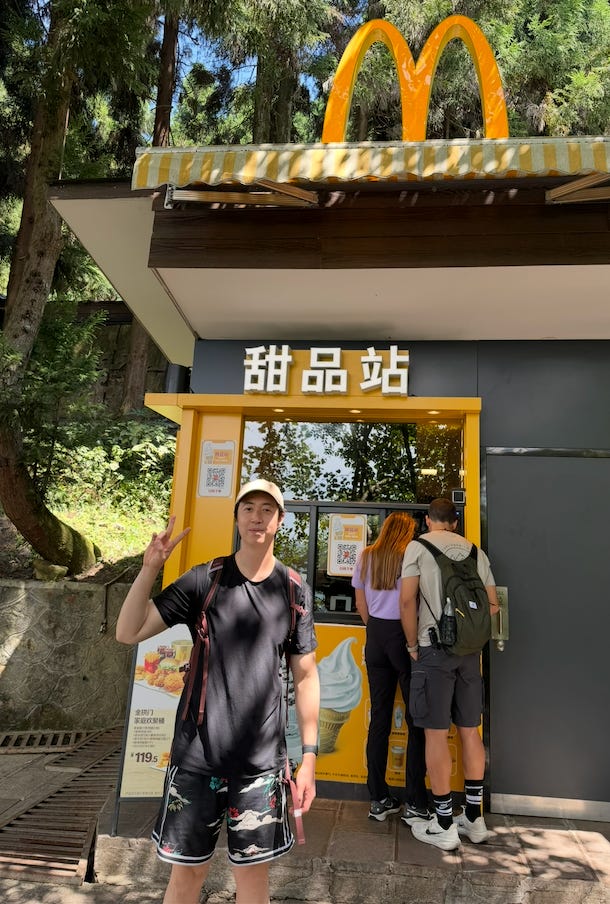

内卷/Involution
One phrase that is the through line of the entire trip: 内卷, involution.
It started as an academic term for effort that increases without producing gains. Everyone escalates, nobody advances. Chinese tech adopted it a few years ago as shorthand for exactly what I saw everywhere: hundreds of labs undercutting each other on price, poaching each other’s researchers, shipping monthly, running a treadmill that produces genuine engineering excellence and almost no profit.
A line I heard put it better than I can: 如果不出海就白卷了 — if you don’t go overseas, all that grinding was for nothing. Involution without export is wasted effort.
Involution at home; export as the only mechanism that converts effort into anything. Nearly every strange or alarming behavior I’m about to describe (open weights, the price collapse, the distillation, the desperate courtship of American developers) falls out of those two facts sitting on top of each other.
Efficiency is not a choice
The best estimate I heard is that US effective compute is more than 10x all Chinese labs combined. The American read on Chinese labs is that scarcity and constraint were somehow choices that made the Chinese labs evolve in the way that they did. That there was some strategic choice here. While likely true in some respects, this is not really a story the Chinese tell about themselves.
A senior researcher at one of the major labs put it flatly: their post-training-driven gains exist because “we don’t have access to high performing chips.” Domestic silicon still can’t do efficient large-scale training. Inference is a somewhat better story — Alibaba claims its in-house PPU, their TPU equivalent, beats H20, though those benchmarks were run on 20B–100B models, and the claim attached to it is that with US-level compute they’d be “a huge step ahead.” But even at inference the constraint bites. Moonshot recently gated access to Kimi K3 because they didn’t have the capacity to serve it.
Compute scarcity doesn’t just make training slower. It starves experimentation. You cannot run the speculative pre-training sweep that doesn’t work, which means you cannot run the one that does. The phrase I heard over and over, in a dozen different rooms, was “那怎么办呢?” — what choice do we have?
There is a real and widely held anxiety, which I did not expect and which I heard unprompted from multiple people: that the entire Chinese AI industry is built on 1-to-10 excellence with little 0-to-1 capability. From the outside, it reads as remarkable efficiency. From the inside it feels like a series of trade offs whose consequences arrive later.
Some labs are so starved for compute they are building roads and bridges into remote parts of Southeast Asia so they can drop in prefab modular data centers. These are not the actions of an ecosystem that believes efficiency is a strategy.
Which brings us to open source, which is also not a choice.
Open-sourcing an inferior model is the only viable distribution wedge when there is a clear capability gap. You can watch the rule operate by looking at the exceptions.
ByteDance/Doubao is the only major lab keeping its flagship closed, because it is the only one that already owns distribution — Doubao, their ChatGPT-style super app, has over 300 million users. Alibaba sits in between: a family of open models, with the flagship 2–5T kept closed and API-only. Qwen Max has always been closed.
A university researcher said something that I’ve thought a lot about since, because of what it implies about US labs:
“When you trail the frontier, openness maximizes reputation per unit of capability. The moment you lead, you close.”
Open source is a phase and a tier. There is evidence that this is already starting to change for some. Zhipu/Z.ai delayed the release of the GLM 5.3 weights. Kimi and MiniMax have both started attaching revenue thresholds to their licenses.
Benchmarkmaxxxing
Everybody in China knows this.
When a benchmark shows parity with a US frontier model, the reflexive response from their own researchers is that the benchmark is probably broken, or that somebody is benchmark-maxing. Few people I met treated leaderboard parity as evidence of anything. The gap they all pointed to is long-horizon agentic work: multi-step tasks with tool use and real state. Several researchers put the best Chinese models at 10–20% completion on long-horizon tasks without significant post-training and harness development.
On the labs currently claiming self-improvement or continuous learning, one researcher-founder was blunt:
“It’s just talking. Everyone is waiting for the American labs to release something.”
No RL Environment
A pre-training researcher at a Shanghai lab gave me the most original explanation I’ve encountered for why the agentic gap exists: China lacks a sufficient RL environment.
American companies interoperate by default. Open APIs, MCP, webhooks, a hundred SaaS products that assume they will be called by other software. That means American agents train against real-world surfaces. When you teach a model to call tools and chain multi-step work, the tools exist, they are documented, and touching them is normal.
The Chinese tech ecosystem is closed, for two compounding reasons. First, B2B SaaS never worked in China, so there is very little shared surface for work in the first place. Second, every company competes with every other company, and there is a real fear that if any company touches another’s data it will be “eaten.” The consequence is that there is nothing for an agent to practice on.
This is a much better theory than “they’re behind on post-training,” because it explains things the simpler theory doesn’t. It potentially explains why ByteDance’s UI-TARS native-GUI-agent bet exists. That is an architectural workaround for a closed ecosystem, not a bet on GUI agents being the superior paradigm. It also explains the absence that I kept noticing and couldn’t account for in the ecosystem. There is no interoperable infrastructure layer of note, because there is no interoperation. Alibaba does cloud, then chips, then models, then apps, all in-house, all the way down.
This matters to anyone building here: the American interoperability we treat as a convenience is actually a training asset. Open APIs made integrations easier; they also create the environment for agents to learn in. That is not a gap that closes by spending more on post-training. It closes only if the underlying ecosystem opens, and the underlying ecosystem is closed for reasons that are competitive and structural rather than technical.
If you are building an American application company, your integration surfaces and data loops are your moat. Own and nurture the delivery of your product to your end customers as much as you can.
How the tokens flow
I also got to see the third-party inference providers (Fireworks, Together, Baseten) from the supply side for the first time.
Many of the Chinese labs’ North America workloads flow through Fireworks and Bedrock, because a US company cannot contract with an Entity-Listed lab directly or don’t choose to for cosmetic reasons. These providers are, in effect, a compliance airlock between Chinese labs and US enterprises. MiniMax/Zhipu/Qwen all route through US providers so that customer data never leaves the country. And in most cases the labs do not earn anything from it. When I raised this with one of them, the response was: “temporary — it can’t always be like this.”
The chokepoint was created by regulatory fear. And as geopolitics worsens, regulation gets denser, which means the chokepoint gets stronger. Somehow compliance forced value to accrue elsewhere.
The second thing these providers are selling is scarcer than compliance: post-training talent. Harvey’s Tenet was post-trained with Fireworks on roughly 150 B300s. Baseten just shipped a post-training platform.
American frontier labs train SOTA models. Chinese labs distill them. American inference providers serve them and make the revenue on inference by serving American AI applications companies.
The structural point for anyone building on Chinese weights through a provider: your architecture rests on two keystones, the regulatory airlock and the weights staying open. The one thing you as a founder can completely own is deployment into your customers.
Sovereign AI is happening in China
Chinese labs are world-class at on-prem and on-device deployment, and it is worth understanding why. Chinese cloud B2B SaaS never took off. The domestic software market, where it exists, largely serves state-owned enterprises. Think Sinopec or Bank of China. Those buyers only buy on-prem software. In the AI era they will buy on-prem deployed models. So Chinese labs have spent years doing the unglamorous work of shipping models into someone else’s data center because there was no other business available.
Meanwhile, a growing number of US enterprise buyers now want some version of sovereign AI, which in regulated industries means on-premise, self-hosted. And after twenty years of B2B SaaS, the number of people at American startups with real on-prem deployment experience is vanishingly small. These labs are actively building service layers for US deployment. They have a decade of reps in the thing we forgot how to do.
The device story is further along than I think most people in the US realize:
Phones and consumer devices. Qwen ships every size from 1B up and has pre-install and integration deals with OPPO, Xiaomi, vivo, and Honor.
Cars. StepFun’s stated differentiation is deployment surfaces — cars and phones, plus an unreleased robotics company. ByteDance/Doubao sells into banks and autos through Volcano. Qwen is in vehicles. The Chinese auto industry is a volume buyer of embedded model deployments.
Device distribution produces a data loop that selling software alone does not provide. This matters enormously in a market where consumers and businesses don’t like paying subscriptions for standalone software.
Two things I’d take from this. First, hardware done right is a distribution and data advantage. Second, a diligence question for me worth standardizing for any applied AI company: “What’s your smallest model that hits your quality bar, and who owns your post-training pipeline?”
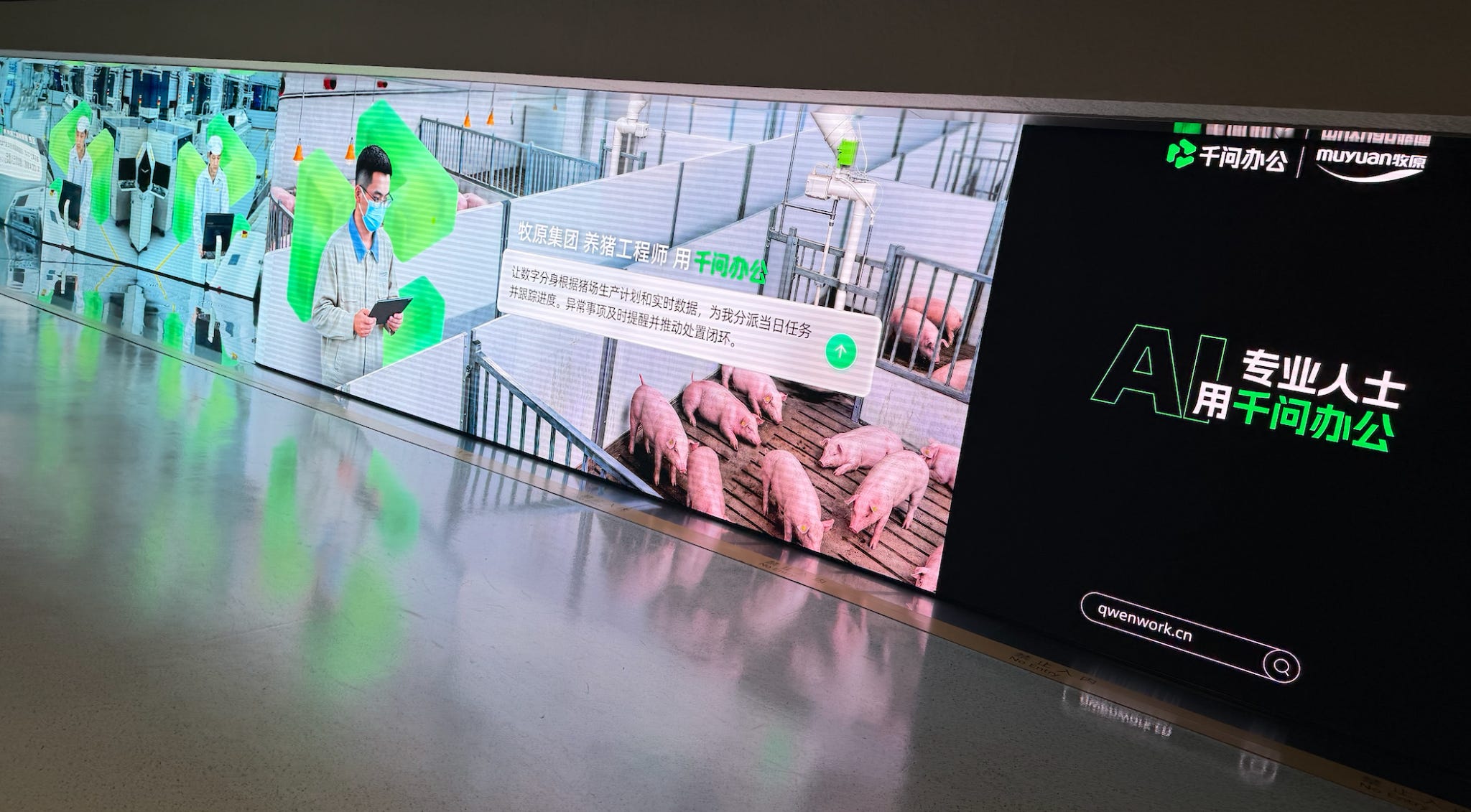
Subway Alibaba Qwen ad showcasing their work with Muyuan foods, one of the largest pork producers in China
The monolith is the myth
If there is one thing I’d want to delete from the American discourse, it’s the phrase “China’s AI strategy.”
Every single meeting, be it labs, investors, media, all independently, without my prompting, described domestic competition as more brutal than competing with American labs. When I described the US framing of Chinese AI as a coordinated bloc moving at the direction of the state, people laughed. Not defensively. They found it funny. I was called a stupid ABC (American-born Chinese) more than once because of this.
These labs are actually far less coordinated than US labs are, which should have been obvious to anyone who watched the previous cycles of Chinese tech. I said no analogies, but I’ll allow one because it’s theirs. The last cycle had a name: 百团大战, the War of a Hundred Groupons (it was actually 5000). Hundreds of group-buying companies raised money, undercut each other into oblivion, and Meituan emerged as the victor. This cycle already has one too: 百模大战, the War of a Hundred Models.
What actually exists is an ecosystem of labs relentlessly undercutting each other on price, stealing each other’s researchers, raising against each other, and trying to win a local arms race. Hundreds of labs and neolabs have raised, died, and been replaced, continuously.
The things we experience in the US as hostile acts are mostly the exhaust of that domestic fight. The distillation attacks and the collapsing token prices are not a strategy aimed at American incumbents. They are what a hundred companies do to each other when none of them can win and none of them can stop.
That doesn’t make the effects benign. Distillation is still distillation. A security problem doesn’t become less real because it was incidental. But the response you design for an adversary with a plan is different from the one you design for a hundred exhausted competitors racing a treadmill, and we are currently designing for the first one.
出海 or going overseas
The irony of involution is that everyone knows the answer is somewhere else. I heard 出海 — go overseas — as the primary go-to-market strategy so often it stopped registering as a strategy and started sounding like a prayer.
MiniMax. The H1 2026 filing shows international at more than 60% of revenue, on $116.6M total, with enterprise/platform at 63.4% of the mix.
Zhipu. Predominantly domestic today, selling to state-owned enterprises, but building sovereign AI overseas and growing overseas GTM fast.
Qwen. The largest overseas adoption of anyone — 1B+ downloads, but does not monetize as all weights are released under Apache 2.0. Domestic consumption is monetized via Alibaba Cloud pull-through.
A16z estimates 80% of OSS model use for startups are Chinese models. The most widely adopted family in that stack is Qwen, and it generates no revenue from any of them.
Domestic willingness to pay is the unsolved problem. Which is why every one of these labs’ most attentive audience is now American developers. This should inform how you read every announcement, every price cut, and every license that comes out of them.
Broken capital markets plumbing
There are two parallel venture systems that do not mix: RMB and USD. The USD funds that built the entire Chinese internet sector of the last generation have been frozen out of sensitive sectors, and many have retreated over CFIUS and reverse-CFIUS exposure. RMB funds raise domestically, which usually means government-affiliated money with strings. RMB terms routinely include buyback rights with personal founder guarantees — sometimes unlimited, with individual recourse. The capital is impatient, and often carries Qualified IPO terms that require a company to go public inside a fixed window or trigger ratchets.
Then there’s Manus, which came up in nearly every investor conversation.
The team started in Beijing and raised USD from Chinese investors including ZhenFund, HongShan, and Tencent. It grew quickly, mostly on overseas revenue. It took money from Benchmark and relocated to Singapore. In December 2025, Meta acquired it for roughly $2B and began integrating the team. Then on April 27, China’s National Development and Reform Commission ordered the transaction unwound on national-security grounds — after some investors had already distributed proceeds. In August, Manus announced it would return to operating as an independent company.
Beijing has since tightened outbound rules on cross-border deals, giving the state what one analyst described to me as “a retroactive and forward-looking chokehold” on any deal that ever touched Chinese capital. The explanation I got from investors on the ground was blunter: the government found it embarrassing that a high-profile Chinese AI company could redomicile mid-journey and be sold to a foreign acquirer while still being run by Chinese nationals. They wanted to be sure nobody tried it again.
Meanwhile valuations are wilder than in the US, because there are only so many investable companies and capital concentrates into a handful: Moonshot is at roughly 115x, against something like 20–30x for US frontier labs.
I believe in a future where many more Chinese founders will decide that they should start their companies in the US day one because it is the best place in the world to build a company. That is because the capital markets genuinely feel broken relative to past cycles, and this is a large part of why the scarcity mindset is so pervasive.
China builds the bodies of embodied AI
Embodied AI is the hardware mirror of the open-weights story: American intelligence running on Chinese substrate.
One Shanghai arm maker I visited is doing tens of millions in revenue, doubling, at premium pricing, selling into several of the largest US technology companies and into US embodied-AI startups that use its arms as their physical layer while they build the intelligence on top. The Shenzhen data-collection shops selling egocentric training data to American robotics companies are the same pattern one layer down.
The instructive comparison is Unitree, which just listed in Shanghai at roughly $6B after a profitable 2025 on about $257M of revenue. Roughly three-quarters of its humanoid revenue comes from research and education buyers, and under 10% from industrial deployment.
Around the most minute parts of a robot — actuators, reducers, force sensors, dexterous hands — thousands of component startups have emerged. Those supply chains are being stood up at a speed and cost the US cannot currently match. The dependency sits awkwardly next to the FCC’s July addition of foreign advanced robots to its Covered List.
The bear case, from a Chinese builder
The most bearish person I met on Chinese AI is someone who built one of China’s largest AI apps.
His argument: Chinese model gains lean heavily on distilling American frontier models, so the gap is structural rather than temporary. As US labs increasingly withhold their best models from public access, the distillation source dries up and American companies compound the edge. Chinese capital markets demand early monetization, so nobody is funded for long-horizon foundational R&D. And the chip performance gap is insurmountable in the near term.
China’s counter, in his view, is brute force: abundant power plus a command economy stacking enormous volumes of inferior chips until per-chip efficiency stops mattering.
He conceded two strengths: Chinese labs are world-class at post-training, and world-class at on-prem deployment because that was the only way software was ever bought.
His conclusion was that China’s AI sector is built on a poor foundation and, on its current trajectory, has no way of catching the frontier US labs.
What China is getting right
There were four things I saw that I think are real advantages.
Energy. “China has all the energy in the world but no chips. The US has chips but no energy.” I heard versions of that line all week. There are two slogans behind it: 西电东送 (xī diàn dōng sòng), West-to-East Power Transmission, and 东数西算 (dōng shù xī suàn), Eastern Data, Western Computing. Local governments in western China are effectively saying: bring chips, and we will supply the electricity free or heavily subsidized.
Shipping cadence, and trusting junior people. Monthly releases, and first-year researchers on core-model work. The generous read is that this is a retention hack forced by a treadmill. But I’d note something from my own career: the most valuable thing anyone ever gave me professionally was freedom before I’d earned it. Firms that hand real work to people who aren’t obviously ready yet tend to produce people who become ready fast.
Institutionalized criticism. Alibaba does a “worst product” award every year at all hands. It is easy to dismiss as theater but it is legitimately hard to build an organization where product leaders can stand up in front of everyone and survive criticism.
They study us far more than we study them. This was the observation that stayed with me. The volume of niche American startup references that came up in casual conversation was remarkable — at one point someone told me, unprompted, “we took inspiration from the US company The Browser Company, which made Arc.” No shade to the Browser Company but, I cannot imagine that sentence running in the other direction from San Francisco. That asymmetry should worry us more than it does.
And then there is the thing that was less an advantage than a mirror, which is their societal view on AI. Two questions I got asked, both sincerely, both of which I struggled to answer well:
“What does permanent underclass mean? Why do you guys keep repeating this?”
“It’s strange that so many people in the US seem to hate AI. To us, it’s clearly something that’s inevitable, so you might as well learn to live with it.”
The first question has stuck with me in the week that I’ve been back. My initial instinct was the obvious answer — America believes in upward mobility, China has been sorting people with exams for thousands of years, of course “permanent underclass” lands differently. But the more I sat with it the less that held up. The Gaokao my parents took exists because a test score can rewrite a family’s story in a single generation.
I think the actual difference is what each side assumes about disruption. My parents watched the exam system get switched off for eleven years, then switched back on simply because Mao died. When you live in a society so arbitrary, the only option is to make yourself adaptable. So when someone in Beijing tells me AI is inevitable and you might as well learn to live with it, I hear their parents’ lives in that sentence. Americans grow up assuming change is something you get a vote on. It doesn’t just “happen to you”, rather you get to decide if it even happens or not.
I don’t think the second one is straightforwardly correct but I came home thinking about the differences between a society arguing about how to build something versus a society arguing about whether to.
What this means if you’re building here
If your thesis rests on Chinese open weights, it rests on two keystones — the regulatory airlock and the weights staying open. Both are somebody else’s decision. Download the weights, post-train, and own the deployment as a rule.
Any thesis that hinges on OSS adoption requires serious post-training and harness investment to reach frontier capability in terms of cost-per-task.
Providers’ post-training services are a real near-term option for companies without the talent in-house. Fireworks’ Training API, Baseten’s platform. The model companies themselves are also all happy to consult. I can intro!
Integration surfaces and data loops are your moat. Your training and RL environment is a real asset and possibly the most durable.
Hardware, done right, is distribution plus data
Expect cheap Chinese tokens to keep coming, and expect them to lag on true long-horizon agentic work. Price your product against the second fact
If you’re building on open weights, or trying to decide whether to, I’d genuinely like to compare notes — david@costanoa.vc. I came home with more context than I can fit in an essay.
The frontier is here (in the US)
We have more than 10x the effective compute of every Chinese lab combined. We have the frontier models. The gap on long-horizon agentic work — the part that actually matters for the next generation of products — is wide and, if the RL environment theory is right, structural rather than temporal. We have functioning capital markets, an M&A exit path, and private capital patient enough to fund research with a 5+ year horizon. We have an ecosystem that interoperates by default and we have application companies that treat security as a product requirement.
Our deficits are real and I’d name two. Energy is the first, and it is a physical, permitting, five-to-ten-year problem that no amount of software cleverness solves. The second is attention. They study us far more closely and objectively than we study them, and most of our ignorance is chosen.
The last thing I’d say is that I went looking for a monolith and found a thousand exhausted competitors “just trying to survive”, in the one sector of a struggling economy that is permitted to look like it’s working. That should make us less afraid and considerably more urgent. Less afraid, because a hundred companies undercutting each other into oblivion is suddenly a less scary bogeyman. More urgent, because involution produces genuinely excellent engineers, and the moment the compute constraint eases, everything I described as a consequence of weakness stops being one. The open weights will probably close.
“When you trail the frontier, openness maximizes reputation per unit of capability; the moment you lead, you close.”
One last thing. Most investors, founders, and engineers I met who travel to the US have experience with what they call the “little black rooms” at US customs. One investor told me that roughly one time in three he gets taken to the back and has his devices taken. I don’t have a policy recommendation here. But I spent this whole essay arguing that our advantage is openness — open APIs, open markets, an ecosystem anyone can build on. The people building Chinese AI want to engage with that system; many of them are trying to move here. The version of this competition where we win by being the more open system requires us to actually be the more open system.

(It has since been removed but up until 9/16/26, the US Government Federal Register was using Alibaba Qwen models)