Holocaust and madness in Tel Aviv-Jaffa
He wrote that there is a Holocaust in Gaza on the walls of Jerusalem. His journey continued in Tel Aviv-Jaffa and ended in prison. Despite his mental challenges, the messenger with the can of paint and the lighter represented a kind of sanity.
6 HOURS AGO
He wrote slogans about a “holocaust in Gaza” on walls in Jerusalem, so the judge sent him for a psychiatric evaluation and lamented, “A sad case.” The man himself said he did it because there was no protest, because he wanted to raise awareness about the starvation, and to introduce the word “holocaust” into the discourse, but he was a “person coping with mental health challenges,” and the experts said he did it “because of his illness,” that it was impossible to have a rational conversation with “such a person.” His journey continued in Tel Aviv-Jaffa and ended in prison. Despite his mental challenges, the man with the can of paint and the lighter represented a kind of sanity.
Wednesday, September 30, 2026
Our story began in the summer of 2025 in Jerusalem and ended in the winter of 2026 in Tel Aviv-Jaffa. If we have a reason to tell it again, it’s because not everyone has heard it, and because it offers a vivid way to think about the Israeli experience over the past three years. Those who are already familiar with it, please excuse me.
The messenger
On October 7, 2023, Prime Minister Benjamin Netanyahu declared the Heaps of Ruins policy: “All the places where Hamas has prepared, in this city of evil…”—that is, all the places in Gaza—“we will turn them into heaps of ruins.” In the three years that have passed since then, the military forces have implemented this policy in both spirit and letter. In the spring of 2024, a brigade commander, Lieutenant Colonel David Bar Kalifa , said that “in Gaza, we were like a herd of elephants that left behind heaps of ruins.”
In the summer of 2025, almost two years into the crushing operation, nearly ninety percent of the Strip’s residents remained displaced. The number of casualties in August included approximately 62,000 dead, 11,000 missing, and 155,000 wounded. These are only the residents who were directly affected, by bombs and gunfire. The number of those who lost their lives indirectly, as a cumulative result of hunger, infections, and a lack of basic living conditions, is unknown but is estimated to be much higher. The healthcare system in the Strip had already been almost completely destroyed. Malnutrition reached catastrophic levels, and international organizations, including the UN, declared a state of famine. Attempts to distribute humanitarian aid at designated centers were met with Israeli fire and ended in mass casualty events.
In July 2025, the Beit Lessin Theater in Tel Aviv-Yafo staged Rhinoceros, the famous play written by Eugène Ionesco a few years after World War II. The theater:
A mysterious herd of rhinoceroses is attacking a peaceful town. The surprised residents initially try to ignore the threat, but their fear for their fate intensifies, causing them to voluntarily transform into rhinoceroses. The protagonist of the play, a young man named Bérenger, tries his best to protect his close friends and his beloved from joining the herd of rhinoceroses, but is it possible to remain human in the face of such an extreme threat? And at what cost?
During that summer, the number of children killed in the Gaza Strip since October 7, 2023 exceeded 20,000. The number of children with amputated limbs reached approximately 4,000, making the Gaza Strip the place with the highest percentage of children with amputated limbs in the world. An officer in the Air Force told Haaretzthat he “feels that the Air Force has lost its professionalism. Its professionalism is not to harm innocent people, unless there is no other choice. I feel that what is happening is disproportionate, that the number of casualties is astronomical, and that it is a stain on the Air Force and on the State of Israel,” and added: “We, the pilots, are champions at repression.” Adam Raz and Asaf Bondi comment on this in their Lexicon of Brutality, under the entry “Denial”: “This is how one can continue to go to theater plays while the pile of children’s bodies in Gaza is higher than the Habima Theater building.” Beit Lessin Theater:
Ionesco’s well-known parable takes on a relevant and breathtaking meaning in light of today’s reality.
To explain the event, none other than the newspaper “Haaretz” published an article under a title that promises self-reflection (“We are all comfortable being part of the herd”). The article makes interesting points and even mentions “Palestinian creators” who “were constantly in dialogue with the Theater of the Absurd,” but not the Palestinians being massacred in Gaza or the army that is massacring them. After the interviews and interpretations, the reader is still unclear about the moral of the story. The overall impression is that this is an internal struggle within Israeli Jewish society, perhaps between those who regularly come to demonstrate in the Democracy Square (playing the role of Bérenger) and everyone else (playing the role of the Rhinos).
~
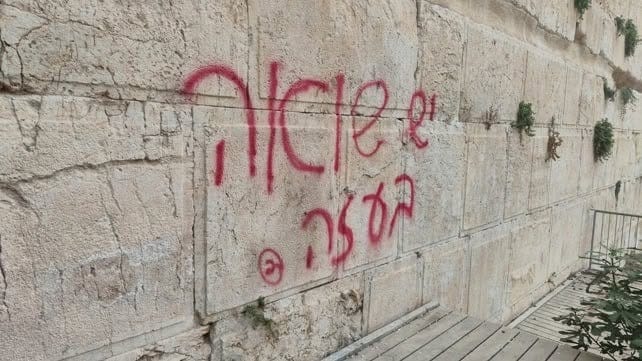
In August 2025, Israeli media outlets reported that an unidentified person defaced the Western Wall in the Jewish Quarter of the Old City of Jerusalem. He sprayed a three-word message in crimson paint on the stones:
There is a holocaust [shoah] in Gaza.
The graffiti artist, who believes in equal opportunities, chose “Ezrat Yisrael,” the southern section of the Western Wall plaza, where men and women pray together.
On a nearby structure (perhaps an elevator), the brazen delivery person sprayed another three-word sentence:
Children are dying of hunger.
The Western Wall is not exactly a remnant of the ancient Temple in Jerusalem—the Holy of Holies, the Ark of the Covenant, which was considered the dwelling place of the Divine Presence—but it is still a remnant of the Temple Mount complex, which included the Temple. Some Jews would reclaim the entire Temple Mount complex, but the area is occupied by the Al-Aqsa Mosque and the Dome of the Rock. As long as this is the case, the Jewish world regards the Western Wall as the holiest place. In the eyes of many believers, the Wall is the navel of the earth or the “axis mundi,” a point where heaven and earth meet. Since the conquest (“liberation”) of the Old City of Jerusalem in 1967, the Wall has also served as a symbol of Israeli sovereignty, including in the Palestinian territories beyond the country’s borders. The site attracts millions of visitors, and the encounter with the large limestone blocks evokes a profound spiritual experience for many of them.
Armed with a 12-ounce can of Rust-Oleum Painter’s Touch 2X UltraCover spray paint, he stepped into the center of the world at 5:30 a.m. and wrote “Holocaust” in front of the security cameras.
The condemnation was immediate and widespread. Everyone expressed outrage—whether genuine or feigned—over the crime, with some pointing fingers at the left wing, foreign organizations, and Iran. Many called for the swift apprehension of the perpetrators and severe punishment.
The police had no trouble identifying the perpetrator, who was caught with a can of spray paint. The man was known to the authorities: a young man in his twenties, “a resident of Jerusalem from a religious household, who participated in protests against the government and expressed left-wing views on social media.” He immediately confessed to spraying the message on the Western Wall, as well as spraying the same message earlier that day in green at the entrance to his synagogue—the Jerusalem Great Synagogue—and another message:
Everything that is published is a lie.
The answers he gave at the police station after his arrest were straightforward and direct.
Do you understand that this is a violation of the law?
Yes.
So why are you doing this?
I feel like there isn’t enough protest, and we need more.
After the investigation concluded, the police announced that the suspect had been released, as his actions did not indicate a danger and there was no fear that he would obstruct the investigation. However, later that same morning, they changed their minds and decided to keep him in custody and ask the court to extend his detention. The reason for the change was not a mystery. The Minister of National Security, Itamar Ben-Gvir, who is responsible for overseeing the police, signaled his expectations to them in amessage to the general public: “I was shocked to see the harm and disrespect shown to the holiest place for the Jewish people—the Western Wall. The Israel Police will act with lightning speed to arrest the perpetrator and bring him to justice.” One news site reached the obvious conclusion: “The Israel Police has fully internalized the instruction… and reversed their decision.”
Ben-Gvir’s sensitivity to the accusation of a Holocaust in Gaza is understandable. As early as October 2023, he stated that “as long as Hamas does not release the hostages in its custody, the only thing that should be brought into Gaza is hundreds of tons of explosives from the Air Force, not a gram of humanitarian aid.”
It soon became clear that the young man had a documented history of severe mental illness, including, as his family members noted, periods of psychiatric hospitalization. The judicial system in Jerusalem responded to the desecrator’s act with restraint, considering the pressure from the government and the public to take harsh measures. There was room to distinguish between the perpetrator and the act. There was no doubt that spraying graffiti on a holy site constituted a violation of the law—a clear case of “vandalism” and “insulting religion”—but in light of the psychiatric assessments, there was doubt as to whether he was responsible for his actions and whether there was any reason to keep him in custody.
“It appears that the respondent’s medical condition, which requires treatment, is highly relevant to the circumstances that led to the incident,” stated Judge Meir Jonathan Troper of the Magistrate’s Court. “I have reviewed the medical records and believe that there is no danger in this case.” He released the man and sent him to the psychiatric emergency room at “Eitanim” Hospital to determine appropriate treatment. The judge barred the man from the Great Synagogue for two weeks but rejected the state’s request to prohibit him from returning to the main crime scene: “I will not bar Jews from the Western Wall.” He added,
This is a sad case.
There was no need to explain exactly what was sad about the case. Obviously, it had nothing to do with the Holocaust that the man proclaimed from the Western Wall, the children dying of hunger, or anything else that was happening in Gaza at that very moment.
His public defender, Erez Ben Zvi, welcomed the judge’s decision. “This is a young man coping with mental health challenges who likely committed the acts due to his mental state.” He added: “Who brings a person like this to court?” and revealed that, in the police’s opinion as well, “the young man should not have been brought to court in the first place.”
~
Two weeks later, the eccentric protester struck again in the Old City, this time in the Christian Quarter; he reprinted his flagship message in green on The Stone of Anointing, the reddish stone slab inside the Church of the Holy Sepulcher—the very sacred stone slab on which (or rather, on the rock beneath it) the body of Jesus was prepared for burial after the crucifixion, according to Christian tradition. This time, too, the inscription read:
There is a holocaust in Gaza.
Old wine in new bottles.
The police interrogators asked him what he meant by that, without specifying which part of the short sentence they didn’t understand.
Because children in Gaza are dying of hunger, and people there are being starved—in my opinion, this is a Holocaust.
Why are you doing this?
I need the word “holocaust” (shoah) to be included in public and international discourse.
It was reported that “the police know that this is not the end of the story and are trying to restrict the suspect’s movements.” Jerusalem is, of course, sacred “to the three religions.” After the Western Wall and the Church of the Holy Sepulchre, the police feared that his next target would be the Al-Aqsa Mosque on the Temple Mount, but the Oracle of Jerusalem chose an easier target: the light rail station opposite the central bus station in Jerusalem. He was caught red-handed, holding a large, red-on-white sign and spraying in red on the sidewalk:
There is a holocaust in Gaza.
He was brought before the Jerusalem Magistrate’s Court again. Judge Orna Sandler-Eitan described him as a person with “psychological complexity who wishes to undergo a marijuana detoxification process” and ruled that detention on the basis of “dangerousness” is not justified. This time, the court ordered him to stay outside the city limits for a month.
No charges have been filed against him yet. Ultimately, it must be said that the Jerusalem justice system treated the man with reason and humanity. The prosecution and the judges recognized that there was no justifiable reason to punish a person who would not have committed the offense if he had not suffered from a severe mental illness, or to remove from society a person who does not pose a real danger to others.
~
Although the actor received lenient treatment, the act he committed was condemned as a despicable crime against his own people. The Rabbi of the Western Wall and Holy Sites, Shmuel Rabinowitz, and the Mayor, Moshe Lion, strongly condemned the act. Defense Minister Israel Katz called it a “despicable act and a crossing of a red line.” Katz had reason to take the writing on the wall to heart. Just a few days after October 7, while serving as Minister of Energy and Infrastructure, he declared: “The entire civilian population in Gaza must leave immediately. We will win. They will not receive a drop of water or a single battery until they leave the world.”
Another person with reason to take things personally is Yoav Gallant. As Minister of Defense on October 7, he declared a “complete siege” on the Gaza Strip, blocking the supply of food and water to its residents, and told soldiers that he was removing “all restrictions” on their operations there, stating that Israel was fighting “human animals” and would treat them “accordingly.” Since November 2024, he has been the subject of an arrest warrant, issued by the International Criminal Court for crimes committed in Gaza during his tenure, including starvation as a method of warfare. Now, in response to the news, the former secular general posted a picture of himself praying at the Western Wall, wearing a tallit and tefillin, and demanded that the desecrator be brought to justice as soon as possible.
“Whoever wrote this,” declared the chairman of the Knesset’s Foreign Affairs and Defense Committee, Boaz Bismuth, “has no place here. He is not part of me, and he is not part of you.”
Most of those who condemned felt no need to deny what was written on the wall, to tell us that there is no holocaust in Gaza and that no children are dying of hunger. The underlying assumption was that the graffiti artist from Jerusalem was a false prophet with a false, offensive, and baseless message that did not deserve serious consideration. There is no need to explain why we don’t talk about a holocaust in Gaza; we don’t talk about it, and that’s it.
One notable exception was Ariel Kallner, a Member of Knesset from the Likud party, who screamed on social media that “despicable Nazi supporters desecrated the sacred stones of the Western Wall and accused the victims of the Nazis of carrying out a Holocaust,” and hinted that the “perpetrators of this abomination” were incited by left-wingers, artists with a troubled conscience, or organizations that “spread blood libels of starvation and genocide against our soldiers.” (This hysterical reaction brought him publicity, as will be seen later).
Kallner’s sensitivity to the accusation is understandable. Immediately after October 7, he called on the people to unite around “one goal: Nakba! A Nakba that will overshadow the Nakba of 1948. A Nakba in Gaza and a Nakba for anyone who dares to join.”
Nevertheless, the chorus of critics crossed party lines. Yair Lapid, the opposition leader, dismissed the political nature of the act: “This isn’t protest, it’s desecration.” Benny Gantz, leader of National Unity—who boasted once in a campaign video, insensitively, perhaps, but accurately, that the IDF under his command had destroyed thousands of targets in Gaza in the summer of 2014 and returned parts of it to “the Stone Age”—called the graffiti “a crime against all the people of Israel.” Labor Party lawmaker Gilad Kariv described the inscription on the Western Wall as “the most terrible and contemptible way to raise awareness of the need to end the war.”
“Families who came in the morning to celebrate a bar mitzvah or bat mitzvah in the egalitarian plaza were horrified to see the graffiti,” said Rakefet Ginsberg from the Reform movement. “We are appalled by this despicable act and call on the authorities to respond with severity.”
The media functioned as a stenographer of official sources. It simply published their condemnations in their entirety, without errors or omissions.
Many of those who left comments on the various news sites joined in the condemnations, calls for punishment, and accusations: “Indeed, there is a genocide in Gaza; Israeli citizens are being held in horrific conditions, subjected to daily starvation and abuse” (“Ynet”). “They should release him and let him go to the Temple Mount, and the Muslims there will take care of him as they should… not like the judges who use compassion in the wrong place” (“Kan”). “There is no genocide. This has been introduced into the global discourse in order to harm Israel and the real memory of the Holocaust, the one that took place on European soil eighty years ago. ‘Haaretz’ is cooperating with this because it is a newspaper with a globalist agenda” (“Haaretz”). “The real crime is abandoning Jews to die underground, refusing to serve in the army during wartime. Stop blinding us; keep your eyes on the ball” (“Maariv”). “A direct result of the wild incitement from the deranged left, led by Yair Golan and Yair Lapid. If you continue like this, the entire Right will go en masse to the polls, and the Left will never be in power” (“Walla”).
One of the more disheartening reactions came from the defendant’s father. “My son is in a difficult psychiatric state, and under normal circumstances, he would not do such a thing. He is a good and kind person, and we love him at home.” Nevertheless, the father felt obligated to distance himself from his son’s actions: “I completely disavow his actions—it is a shame and disgrace.”
His crime
“Shame and disgrace”? The graffiti wasn’t exactly a serious crime. It had no victims, and it didn’t cause any irreparable damage to the structures; the inscription was reportedly carefully removed by the Israel Antiquities Authority’s conservation experts, using water-based materials that left no mark on the ancient limestone. What aroused such great anger was not the desecration of the Wall, but its use as a billboard for a particularly offensive message. The real crime was not an offense against God or religion, but an offense against more earthly, political entities that Israelis hold just as sacred. The inscription on the Wall cast aspersions on the state, the army, and ultimately, the people. What struck a nerve was probably the reversal of the national Holocaust narrative, with the Palestinians in Gaza playing the role of Holocaust victims and the Israeli Jews playing the role of their perpetrators. Taking a leaf out of Elias Khoury’s depiction of the Nakba in one of his novels, “The Palestinians have become the Jews of the Jews.”
Finance Minister Bezalel Smotrich made sure to put the Holocaust back in its rightful, singular place in the discourse. He declared that those who are capable of “tainting” the Western Wall’s stones with “sickly antisemitic blood libels” have forgotten “what it means to be Jewish.” The Western Wall’s stones “are imbued with the long history of our people—destruction, blood, persecution, and the Holocaust, and again, building and revival.” Like some of the others who were shocked by the graffiti on the wall, Smotrich was also personally involved in its issue. Together with his partner in the government’s far-right wing, Minister Ben-Gvir, Minister Smotrich repeatedly called for the “voluntary emigration” of Gaza residents to any country that would agree to accept them, and demanded “that the Gaza Strip should no longer be a breeding ground where two million people are raised on hatred and a desire to destroy the State of Israel. If there were 100,000 or 200,000 Arabs in Gaza instead of two million, the entire discussion about the day after would be different.”
The medical-legal diagnosis revealed following the arrest provided a reassuring sign for a frightened society. It confirmed the assumption that this was not an ordinary citizen, a level-headed member of the community seeking to express a political opinion in a time of crisis, but rather a person whose judgment and functioning were so impaired that the law enforcement system refrained from prosecuting him.
The media blurred the political context of the act and presented it as a bizarre act by some Einzelgänger, a lone wolf who acted out of a twisted motive. For example, the “Kan” broadcasting corporation gave the article the absurd headline, “In order to defile the Jewish heritage,” as if that were the man’s goal.
In the summer of 2025, for anyone who had been following the nearly two years of images, testimonies, and reports from Gaza, the repeated spraying of the phrase “There is a holocaust in Gaza” in public places in Jerusalem could easily have seemed like a spontaneous reaction from someone who could no longer keep their feelings to themselves, could no longer maintain silence, someone who was simply responding to an urge to protest against a situation in which a population is being starved and children are dying of hunger, a situation that, in their eyes, is a holocaust fair and square, and to briefly disrupt the daily routine of people so that they would turn their attention to Gaza. But the lawyers and the media jumped on the news about the mental-medical state of the perpetrator as if they had found a treasure. As soon as his illness was revealed, the possibility that those responsible for the act, however “radical” they may be, were sincere actors who were acting out of principle or moral feeling, mysteriously disappeared, and it was presented as a detail that explains everything that needs to be explained. The graffiti artist’s belief that there is a holocaust in Gaza and his urge to protest against it were erased from the record.
The medical-legal diagnosis served as a kind of alibi—not so much for the individual himself, but for society. It provided a familiar and easy explanation for deviant behavior, which otherwise would have required a completely different explanation, one rooted in an apocalyptic event unfolding right under our noses but that must not be mentioned. Here we have a “sad case,” but one that is understandable and unrelated to anything happening around it: a person suffering from mental distress did something that people don’t do. Who can know what is going on in the mind of a “person coping with mental health challenges”? Perhaps he was subject to hallucinations and convinced himself, contrary to the evidence, that Israel was perpetrating a holocaust in Gaza. Perhaps he is easily influenced and fell victim to false information from Hamas, Iran, or the New Israel Fund? Perhaps he didn’t even believe his own message and acted out of an uncontrollable urge to stand out or provoke. Either way, once the graffiti artist was labeled as mentally unstable, the message itself ceased to require a response. You don’t argue with madmen.
~
After being expelled from the ancient holy city, the lone wolf shifted his area of operation to the secular capital, Tel Aviv-Jaffa, “a city ablaze with clubs and acts of debauchery.” One autumn night, he arrived in Florentin, a vibrant neighborhood in the south of the city, teeming with cafes and nightlife, and set fire to piles of cardboard in several locations, causing a minor commotion before the firefighters completed their work. He told the police that “he had decided to launch a rebellion, a kind of protest, to raise awareness of the starvation in Gaza and stop it.” He explained it this way:
Given the slim chance that anyone will show up to the demonstration, we need to inject some motivation, and to inject motivation, we need to burn down Florentin.
He also told the investigators about an even more ambitious goal: “I plan to burn down the [Azrieli] Center, and I hope no one will die. I assume I will be in jail for a long time.” He was not wrong: this time, the prosecution filed an indictment with the District Court, which found its way to the media—with his full name—and he was arrested until the end of his trial. Mental illness was once again at the center of the case, although he chose to stand trial (instead of claiming insanity), and the prosecution agreed to replace the arson charge with a much lighter charge.
In January 2026, District Court Judge Oded Maor convicted him of causing “malicious damage” and sentenced him to five months in prison. Attorney Elad Rat, who represented him on behalf of the Public Defender’s Office, stated:
This is a clear case of a person acting under the influence of mental health issues—the details of which I cannot disclose out of respect for his privacy. In my assessment, there was no ideological component to his actions. Evidence of this is the fact that no indictment was filed for the incidents attributed to him in Jerusalem, and the indictment that was eventually filed in Tel Aviv did not include any element of ideological motivation. Ultimately, the lenient sentence agreed upon with the prosecution speaks for itself.
The defense attorney was not impressed by the political explanation that his client himself gave to the investigators—the urge to protest against the holocaust, which he claimed was taking place at that time in Gaza. “We are dealing with a person who is not mentally stable. It was his illness that motivated him to act, not his ideology. In my opinion, he did not do it out of protest. I do not analyze an irrational person in rational terms.”
This suggests the assumption that mental illness and a principled motive are incompatible, but why is it unreasonable to think that the man acted as a result of both of these factors? Perhaps his mental state helped him to freely express his principled opposition to the holocaust, which, in his view, was raging in Gaza?
A fable
Judging by the reactions of the general public to the unfolding story, not everyone bought into that premise. A significant number expressed empathy with the man, agreement with his message, and support for his actions.
There is no more fitting place for this graffiti than the Western Wall! A brave child with his finger in the dam, also shouting that the king is naked (״Ynet״).
It sounds like he’s more sane than most of Israeli society. | What does psychiatric hospitalization have to do with it, haha. It’s a pretty legitimate opinion considering the images coming out of the Strip (“Kan”).
The Western Wall has spoken (“Maariv”).
God sent us a true prophet (“Walla”).
Classic. Whoever shouts the truth is portrayed as a madman and unfit. | It is those who are perpetrating a holocaust, refusing and starving the hostages, and starving and killing tens of thousands in Gaza who should be sent for psychiatric evaluation! | The person who wrote the graffiti “There is a holocaust in Gaza” is a brave person who deserves appreciation. He can be compared to Sophie Scholl from the “White Rose” movement, who distributed leaflets against the Nazis at the University of Munich. In the end, the Nazis executed her at the age of 17. | All told, the young man said the truth. There is a holocaust in Gaza. It is indeed sad!(“Haaretz,” 8/11).
Take this from the Indians (Jiddu Krishnamurti): “It is not a sign of mental health to be well-adjusted to a profoundly sick society” (“Haaretz,” 8/14).
The story of the Jerusalem messenger, who sprays on the walls, evokes the ancient, worn-out motif of the madman who speaks the truth—a figure who is himself part of a family of archetypes that includes the court jester, the village idiot, the impudent child, the prophet of wrath, the holy fool, and the blind seer. In each of its incarnations, the marginal, eccentric, and ridiculous figure loudly proclaims what everyone else thinks in silence – a truth that he knows as a fact but that respectable society considers both terrible and forbidden, and therefore condemns to denial.
“The young person coping with mental health challenges” embodied the parable well. In the summer of 2025, as he wandered among the holy sites of Jerusalem, a 2X Ultra Cover spray paint can in hand, his message about the “holocaust” in Gaza was deemed unacceptable in public discourse. In Israel, there is only one holocaust, the Holocaust, the one that led to the establishment of the state and has never ceased to cast a shadow over life there, the holocaust of “Never Again,” of “the world knew and remained silent,” of “from holocaust to revival.” To use the language of the Holocaust to describe a disastrous event affecting any other people is to diminish our own, immeasurably worse, historical disaster, a violation of the biblical commandment, “Do not compare.” But the claim that Israel’s actions toward the Palestinians are on the same moral plane as the Holocaust perpetrated by the Nazis against our ancestors—even if on a significantly smaller scale—is seen by Israelis as an intolerable perversion of reality that can only be explained by a combination of antisemitism and ignorance.
When the President of Brazil, Luiz Inácio (Lula) da Silva, said for example, that what is happening in Gaza “is not a war, it is a genocide” and compared it to the Nazi Holocaust, Israel declared him a “persona non grata.” Prime Minister Netanyahu, who since October 7 has not stopped comparing Hamas to the Nazis, accused da Silva of “trivializing the Holocaust” and stated that “the comparison between Israel and the Nazi Holocaust and Hitler is crossing a red line.” The then-Foreign Minister of Israel, Israel Katz, summoned the Brazilian ambassador to the campus of the Holocaust Remembrance Center Yad Vashem to reprimand him. “The comparison between Israel’s just war against Hamas and the atrocities of Hitler and the Nazis is a disgrace and a scandal and a serious antisemitic attack,” he said. The condemnation was joined by Israel’s Holocaust Education tzar, the Chairman of Yad Vashem, Dani Dayan, who declared that da Silva’s words were “a shocking combination of hatred and ignorance” and “a clear antisemitic statement.”
The omertà that was in effect did not completely prohibit the use of terms related to the Holocaust, and some news consumers who responded to a story about spraying graffiti on the wall stated that there was indeed a holocaust worth mentioning in Gaza, namely the one perpetrated by Hamas against the residents of the Gaza envelope on October 7 and subsequently against the Israeli hostages. For the vast majority of Israeli Jews, Israel’s actions in Gaza were perceived as military operations (“Operation Swords of Iron,” “Operation Gideon’s Chariots”) against Hamas. The idea that these should be seen as genocide, and especially as a genocide that constitutes a Palestinian holocaust—not just another Nakba, but a veritable holocaust—was unthinkable and unspeakable.
As in every story about a madman imparting knowledge, the madness of our graffiti artist played a complex role. It gave the man a license to tell the government and the patriotic public the harsh truth to their faces without being severely punished, to turn the canonical Holocaust narrative on its head, all while using the wall as a mere billboard. On the other hand, that same madness gave society a license to ignore the content of what he said without public debate, to dismiss his message without explaining what was wrong with it.
The focus of his family, lawyers, courts, and the media on his mental challenges allowed everyone to maintain a professional, progressive, and apolitical image, and provided the public with a scientific, objective explanation for what appeared to be a clear political act by a conscientious citizen protesting against his government’s real-time commission of a holocaustic genocide against another people.
Like every story of this kind, the story of our emissary on a sacred mission to the holy places points to the fluidity of the divide between sanity and madness and calls into question the initial assignment of these labels between the herald of forbidden knowledge and the silent society. Even when it is wrapped in a clean code word like “person coping with mental challenges,” labeling someone mad is telling us that their mental faculties are impaired, that they cannot rely on them to properly guide their thoughts, feelings, and actions. On the other hand, the very fact that this person sees the ugly truth, understands its importance, and is driven to awaken the herd-like public from its sleep shows that their mental faculties guide them well, after all. The clearer his perception of reality seems, the sharper his moral response to events, the more delusional the society around him appears, sunk ever deeper in rhynoseritis, the collective psychosis.
Without questioning the psychiatric opinion, when looking at what truly matters, the young person with “psychological complexity” appears to be the sane person in the story. The system, the gatekeepers, and the patriotic public are portrayed as the madmen who have taken over the asylum.
The taboo
One sign of the taboo that enveloped all attempts to characterize what the state was doing in Gaza in the summer of 2025 in holocaust/shoah terms is the way in which Israeli public opinion was measured—or not measured—that summer. While our complex-minded correspondent was on his little crusade, a number of Israeli organizations surveyed the attitudes of Israeli Jews regarding the war, the humanitarian situation in Gaza,the army’s conduct , and the media coverage. The results generally indicated broad support for the Israeli military operation and little concern for the plight of the Palestinians. However, none of the polls presented its sample of citizens with the elephantine question, the question that was not raised but hung in the air from the first moment, from the moment the outlines of the Israeli response to October 7 became clear enough to be undeniable. You can search the polls in vain for a question like,
To what extent do you agree with the statement “Israel is committing genocide in Gaza,” or “Palestinians are experiencing a Holocaust in Gaza”? (1 = strongly disagree, 5 = strongly agree).
At that point in time, the question had already been at the center of a global controversy for a year and a half. South Africa had already presented its historic genocide claim to the International Court of Justice in a live broadcast from the “Peace Palace” in The Hague. The court itself had already ruled, by a large majority, that the claim was “plausible.” Countless human rights organizations, legal experts, and historians around the world had already presented their views on the matter. The question was not ambiguous, and many answered it in the affirmative—da Silva and South Africa were by no means isolated cases—Israel was forced to answer the accusation in the international community again and again, and to demand that more and more fair-minded people decide whether they preferred to be called anti-Semites or simply ignorant fools. Israeli citizens are not known for their tendency to live under a rock; they were exposed to this accusation in the media and on the internet, during their frequent trips abroad—if only from the graffiti throughout Athens—and through local expressions of protest that the government did not completely silence.
Even a handful of Israeli citizens with a public platform have adopted the accusation. Palestinian researcher Nadira Shalhoub-Kiborkian did so as early as October 2023, as did Stockton University researcher Raz Segal. In January 2024, the late Palestinian actor Muhammad Bakri rhetorically asked the readers of Haaretz whether what the IDF was doing in Gaza should not be called a “holocaust.” Starting in February 2024, Hebrew University historian Lee Mordechai repeatedly argued in his online documentation project that these activities constituted genocide. His colleague, Amos Goldberg, published the same conclusion in April 2024 and again in October. In January 2025, Daniel Blatman, another Hebrew University historian, joined them. Brown University historian Omer Bartov did so in July 2025. By mid-2025, the Israeli human rights organizations B’Tselem and Physicians for Human Rights Israel had reached the same conclusion. These arguments were disseminated in both Hebrew and English.
However, it was not only the bleak view, but also the evidence supporting it, that was accessible to anyone with a smartphone. It included official statements from political and military leaders, videos from the field, satellite images, testimonies from doctors, reports from local journalists that were not censored in time, reports from human rights organizations, and discussions around the world about things that widened people’s eyes, such as the voice of Hind Rajab, the girl, the voice of Rifat Radwan, the paramedic, incendiary bombs, the destruction of hospitals, mass expulsion orders, houses being burned, the “flour massacre,” artificial intelligence systems for mass target incrimination, double taps, sniper drones, a Star of David carved into the rubble using tanks and bulldozers, large enough to be seen from space.
If this doesn’t look like high-tech genocide—designed to render an entire region uninhabitable and gradually empty it of all its inhabitants—then nothing ever will.
Public opinion polls do not only measure opinions; they also reveal which questions are considered legitimate. Omitting the question from the polls revealed as much about Israeli society as the answers that would have been received had it been asked—or the answers given to the questions that were actually asked. It demonstrated how the perception of reality by the Jerusalem grafitti messenger was considered blasphemy, a taboo, verboten in the Israeli public discourse in the summer and fall of 2025. To talk about a holocaust of Israel’s own making in Gaza during that summer and fall meant shattering the binding collective denial. Anyone who broke the omertà declared themselves an infame, a scoundrel, a collaborator.
Enforcement
The media has its own ways of enforcing omertà, even when it’s wearing the hat of a democratic watchdog. Remember MK Ariel Kallner’s attack on the Western Wall desecrators, whom he accused of “blaming the victims of the Nazis for carrying out a holocaust.” The exchange of words took place the moment the identity and mental state of the perpetrator were revealed, when Nir Gontarz, a journalist for Haaretz, called Kallner in one of his typical “ambush” interviews. The reader was presented with a heated exchange between representatives of the government and the media, with hostile questions and answers, by the book. You would think that the journalist would press the coalition member on the truth of the dark message in red. After all, isn’t that the central question that the act raises? Which aspect of the news is of greater public interest?
Judging by the responses to the interview, some of the readers would have appreciated such a discussion. Here are a few examples:
The main problem with the graffiti incident at the Western Wall is the headline stating that a person wrote “There is a Holocaust in Gaza” and was subsequently sent for psychiatric treatment. This connection creates a fixed perception in the Israeli public, according to which any comparison between what is happening in Gaza and the Holocaust—whether one agrees with it or not—is necessarily perceived as a sign of a “mental defect.”
In a country that is mentally unstable, the mentally unstable person is the normal one.
Soon, we will see a “Gaza Holocaust” museum in the world; it’s in the works, and there is a huge amount of material!
It seems that such readers would be interested to hear what Kallner has to say about this huge amount of material. But right from the start, the interviewer sets aside the message and focuses on the messenger. “Let’s leave aside ideology,” he suggests, “and even the content of the graffiti, ‘There is a Holocaust in Gaza.’” Instead of defending the specific claim written throughout the capital against Kallner’s attack, the journalist mocks his initial assumptions about the graffiti artist’s identity, political affiliation, and mental health. “When you tweeted, you thought the sprayer was some leftist, and in the end it turned out that it was a son of a religious family… someone with a history of mental problems, who wrote the inscription.” It is implied that Kallner’s anger was unjustified, as it was based on the assumption that the man was secular, a leftist, and mentally healthy. Now that this assumption has been proven wrong, Kallner should swallow his pride and retract his statement.
Do you still think he supports Nazis?
It doesn’t really matter… Tell me, why didn’t a mentally unstable person write that Israel is destroying penguins? After all, he’s mentally unstable… Why didn’t he write that we are slaughtering polar bears?
Are you asking seriously?
Yes, I’m asking a rhetorical question [to show that the man wrote “holocaust in Gaza”] because someone introduced that into the conversation! He went and did it on the Western Wall because he… is at the point where he is mentally. But someone introduced… that despicable antisemitic blood libel into the conversation!
I tried to understand why you didn’t delete the [condemnation].
Because the whole [event] wasn’t about that person. That person doesn’t interest me!
You wrote against that person. You probably imagined someone on the far left, a reader of “Haaretz,” a protester at the demonstrations. That’s what you imagined. You can admit it, honestly.
I’m not interested in the person at the end [of the chain of events]… I’m interested in who prepares people’s hearts for these things!
Kallner has no particular difficulty in dealing with this line of inquiry. His parody of penguins and bears nicely shows that even if the messenger’s mental state helps us understand why he felt free to break the law, desecrate holy places, and provoke the public and tempt fate, it cannot explain the content of the message he sent, why he declared that a holocaust was taking place in Gaza. In this, Kallner is exactly right: the graffiti artist’s illness does not strip his graffiti of its political power.
As for the media figure, he is not asking the government official to retract his condemnation of the graffiti as a false and baseless accusation against the state of “carrying out a holocaust,” as a “blood libel of starvation and genocide against our soldiers.” Instead, he is only asking him to retract the absurd suggestion that the graffiti was the work of “Nazi supporters,” as if we needed information about the perpetrator’s mental state to dismiss it. So, those who wrote the message weren’t Nazi supporters. What is much more important is whether the message written was indeed a “libel” or whether it represented reality as it was. If there was a holocaust in Gaza, it is clear that Israel was not the victim. If the message were true, Israel was inflicting a holocaust on the Palestinians, nothing less. From the perspective of the Zionist project, the state, and Israeli society, this is an apocalyptic vision. The tense exchange about the perpetrator’s mental state and his connection to “Nazis,” on the one hand, and “Haaretz,” on the other, does not help us to clarify the answer.
Far from defending the troubling yet credible and well-founded message, the journalist distances himself and his newspaper from the entire embarrassing incident, from the inflammatory indictment, as well as from the undignified way in which some person coping with mental challenges chose to disseminate it to the public—instead of waving it in Tel Aviv’s Democracy Square with a blue and white flag, or in Jerusalem’s Paris Square with a black flag, or perhaps in a polite letter to the editor.
Together, the questions and answers reveal that the thing that most concerned the government and its gatekeepers was not the reality in Gaza. What preoccupied them more was their ability to control and monitor the boundaries of public discourse, and specifically the fear that the public was already feeling free to think and talk about all of the military’s actions in Gaza as a war of annihilation against the Palestinians, one aimed at the complete destruction of Palestinian life in the Strip and the displacement of the population southward, westward, and ultimately, out of the Strip. Nevertheless, Kallner attributes a degree of seriousness to the messenger and his act that Gontarz is not willing to attribute. Kallner is bothered by what the message itself says about the state and the military and how it is seeping into legitimate public discourse. True, given the amount of information available online, his insinuation that the act stemmed from incitement, conspiracy, or a disinformation campaign was far-fetched—but his general concern is understandable: what was written on the stones throughout Jerusalem was indeed an accusation of unusual severity against the state and the military that had already seeped into public discourse. Kallner was right in his thinking that if these views were given free rein to be discussed, they could gain legitimacy and even eventually become a consensus. In this way, the representative of the coalition party gave appropriate _expression_ to the public anxiety aroused by the graffiti campaign of his messenger.
~
Only when Kallner tries to steer the discussion away from the messenger and toward his own message—and rhetorically asks where else this terrible idea could have come from—does the conversation finally turn serious. Even here, the interviewer doesn’t completely let go of his focus on the actor’s personality. “It’s possible that this person is more sensitive than others,” he suggests. “And it’s possible,” he suggests again, with the same level of interest, “that the State of Israel is actually committing crimes in Gaza. That’s not an illogical thing.” The use of a double negative is interesting. Despite the tsunami of well-documented opinions that Israel has committed genocide in Gaza—the crime of crimes against humanity—the journalist is not willing to call the claim that Israel is committing any crimes in Gaza “logical.” He almost admits to Kallner that we have a tie: both those who accuse Israel of crimes and those who reject the accusation “have difficulty substantiating their claim.” It is impossible to know who is right. “But,” he says correctly, “reality proves that claiming that Israel is committing serious crimes in Gaza—that is not just a claim.” As expected, even this highly qualified claim doesn’t satisfy Kallner.
One could also accuse the Jews of committing crimes against the Germans.
Come on, Knesset Member Kallner.
No, no, that’s exactly it!
The killing of thousands of children raises questions.
Some people don’t understand what kind of world they live in and what kind of enemy is here!
Doesn’t that make you feel like… things need to be investigated?
Not even a little! … What needs to happen is for the State of Israel to defeat its own demonic evil. And those who need to be investigated are people who live among us, surrounded by billions of jihadists who want to slaughter them, and yet they are still preoccupied with a morbid obsession, an auto-antisemitism, searching for the Nazi within the Jews instead of among their enemies… Anyone who does this abroad, in my opinion, is engaging in an antisemitic conspiracy, and anyone who does it here in Israel should undergo a psychiatric evaluation.
It sounds like you’re excited about this conversation… I don’t care about the morality of my enemies. I care about our morality. That’s all. But maybe I really do need a psychiatric evaluation. I don’t know.
Somehow, the person in power, who completely rejects the writing on the wall, is the one who continues to treat it with the utmost seriousness. His panicked reaction, a Molotov cocktail of hatred, contempt, and above all, fear of those Israelis who cast themselves and Palestinians in the roles of holocaust perpetrators and victims, respectively, reveals his awareness of the true intention of the graffiti poet, whether he is coping with mental challenges or not, as well as of the severity of the accusation and the unprecedented consequences it has for the state and society, if it is—heaven forbid—true. Furthermore, Kallner protests too vehemently. His excessive aggression creates the impression that he is aware of the evidence he is up against and knows, deep down, that he is unable to refute it.
You could say that the nationalist legislator and the graffiti artist he denounced were interested in the same picture of reality, but from opposite directions. Kallner fears that the public and the world will learn about the holocaust in Gaza. The artist hopes that it will happen. The journalist, on the other hand, doesn’t understand what all the fuss is about and volunteers to undergo a psychiatric evaluation.
~
“For a stone shall cry out of the wall, and the beam out of the timber shall answer it,” but the outcry from the wall about the atrocities in Gaza fades in the interview, diluted into an almost imperceptible lament about the “not entirely illogical” possibility of war crimes, a possibility that, of course, exists in every war.
Here is a subtle technique of policing discourse. Someone accuses the state and the people’s army of causing a holocaust for a defenseless people, of starving children to death. What do you do with something like that? How do you prevent a discussion about the unbearable possibility that this is indeed the case? The first part of the interview achieves its goal by ignoring the message and focusing on the messenger—a kind of shooting the messenger. In the second part of the interview, after the messenger’s biography has been exhausted and there is no escape from addressing the content of the message, the specific, serious accusation leveled is ignored and diluted to the point where it no longer threatens the self-perception of the state and society, their sense of righteousness and purity of intentions. An accusation that could be considered a Nuremberg-level crime, which turns the Holocaust narrative on its head and places the Palestinian disaster in Gaza on the same moral plane as the Jewish holocaust, is replaced with a weak warning about the possibility of crimes in Gaza.
This technique allows liberal gatekeepers to gently banish the forbidden opinion from the conversation, without condemning it but also without supporting it. It allows them to have their cake and eat it too: to play the role of gatekeepers who hold the government’s feet to the fire but without touching the radioactive position. In this way, they help the government enforce the ban on discussing this position, because despite the heated disagreements, the gatekeepers silently agree to keep the forbidden opinion out of the public sphere.
Holocaust flipped
Spraying “holocaust in Gaza” on the Western Wall in red just hours before the proud Bar and Bat Mitzvah children arrive at the egalitarian plaza—what a magnificent gesture! Not only is it a desecration of a holy place, not only is it a defilement of the secular totems that are the army and the state itself, but it is also an insult hurled at the silent Jewish Israeli society, intentionally aimed at offending their conscience. Those who took it personally can be understood. They were peed on from the diving board.
As the exaggerated condemnations demonstrated, the graffiti artist’s choice of words for the sacred sites was particularly effective. His outcry touched upon a raw nerve that the usual protest cries surrounding the “war” kept at arm’s length. He chose the single word that would ensure that no one would miss his intention to slam the State of Israel’s official Holocaust narrative onto the table and turn it upside down, with a vengeance. Not “war,” not “humanitarian disaster,” not “crimes.” He decided to call a spade a spade, “holocaust”—”shoah,” in his language—the single word that the state has adopted for the formative national disaster, the holocaust of “Holocaust and Heroism Remembrance Day,” “From Holocaust to Renewal,” “Holocaust Martyrs,” “Holocaust Survivors,” “We Are All Holocaust Survivors,” “Second Holocaust.” He chose the word that evokes the most horrific images, the most severe moral judgment, the existential fear, but at the same time also the feeling of self-assurance and pride in the “renewal” (tekumah), which is none other than the State of Israel, the necessary response to that holocaust and the constant threat of a new holocaust at the hands of the enemies of the hour, the reassuring feeling that the holocaust threatening to repeat itself is conclusive proof of the need for a Jewish nation-state that relies on overwhelming military force and uses it without hesitation, “for it is a people that shall dwell alone and not be accounted among the nations,” and “if someone comes to kill you, rise up and kill him first.”
He did not write “Nakba,” the term Palestinians use to describe the ethnic cleansing of Mandatory Palestine during the 1948 War of Independence—the violent expulsion of approximately 750,000 residents from their homes, the destruction of about 500 Palestinian settlements. Israel itself, and the vast majority of its Jewish citizens, do not recognize the Nakba, and most of those who do recognize it reject both its description as a crime of the highest order and the right of the Palestinian refugees and their descendants to return to their homeland. They see it as a regrettable but inevitable disaster, the justified price of establishing a Jewish state in the Land of Israel. To shout “There is a Nakba in Gaza” would not necessarily move anyone—especially in a climate where a new Nakba in Gaza is precisely what figures in power, such as the Minister of Agriculture Avi Dichter and MK Ariel Kallner, have explicitly called for.
He didn’t even write “genocide” or “extermination”—terms that are central to the international discourse surrounding Gaza. Genocide is the crime of crimes in international law, but in Israel, the word “holocaust” carries an even heavier emotional and moral weight, encompassing not only the genocide committed by the Nazis but also the idea that the Holocaust was a unique event in history, a crime and a loss that no other people have experienced or will experience, and all the correct educational lessons regarding the righteousness of the state and its path. And indeed, even the few citizens who publicly claimed that the state was committing genocide were often hesitant to describe the whole thing as a “holocaust.” Take, for example, the Haaretz article by historians Amos Goldberg and Daniel Blatman, “While what is happening in Gaza is not Auschwitz, it is the same family—the crime of genocide.” The article concludes with the words: “What is happening in Gaza is not the Holocaust. There is no Auschwitz or Treblinka here. However, it is a crime of the same family. The crime of genocide.” As with the title, so too does the concluding sentence soften the harsh message before delivering it, reassuring the audience that the horrors of Gaza, however shocking, do not equal the evil of our holocaust. They certainly belong to the family of genocides, but not necessarily to the family of holocausts, with all due respect to the Palestinians. (See also the English version of the article).
Not our graffiti artist. A product of the Israeli education system, he chose the one word that pushes all the buttons, including the red button that, when pressed, evokes in the target audience the imagery of Auschwitz and Treblinka, and unequivocally places the destruction of the Palestinian people as a member of the family of holocausts:
There is a holocaust in Gaza.
As emerged from the audience’s reactions, the outcry resonated and even aroused empathy; this is how a commenter in the newspaper “Haaretz” (8/14) put it:
Religious and ethnic persecution, ethnic cleansing, concentration camps, bombing of population centers, sniper fire at children’s heads, indiscriminate firing at population centers, intentional starvation, deliberate targeting of healthcare facilities and water sources, indiscriminate destruction of homes, sieges, prevention of foreign media coverage, and deliberate targeting of journalists. When this is accompanied by statements from the Prime Minister, ministers, senior military officials, and the President of the State that there are no innocent people and that the intention is to exterminate the Amalekites, it becomes a full-scale Holocaust.
~
Along with his main message about the Holocaust in Gaza, the Einzelgänger, using a spray-paint can, sent a secondary message to the Israeli public about the denial of that very same holocaust. By blatantly breaking the silence surrounding the horrors of Gaza and its holocaust-like nature, it highlighted one of the most well-known moral lessons of Holocaust education in Israel, only to subvert it. “The world knew and remained silent,” Israelis are raised on this lament. Countless good people in Europe could not have been unaware of the systematic destruction of their defenseless Jewish neighbors by their own countries, their soldiers, their people; the evidence was before their eyes, but they remained silent, as the regime and its gatekeepers demanded. The lament expresses a moral condemnation of the individuals and nations who knew and kept silent. Even today, 80 years later, the world’s indifference is still remembered with disbelief and resentment. Somehow, the awareness we have gained since then of our remarkable ability to conform our opinions to the prevailing view, to obey authority, to become rhinos in groups, does not make us forgive the world for its silence while knowing.
By breaking his silence around the Gaza holocaust in full public view, the eccentric graffiti messenger from Jerusalem recited this well-known lament but directed it inward, toward his own country and society. Just as a holocaust that we did not grow up with is still a holocaust, so too is the denial of a holocaust that we did not grow up with still a case of holocaust denial.
Sanity
You won’t find a good story about a madman spreading knowledge that doesn’t grant its protagonist a redemptive sanity, and our case is no exception. The answers the Jerusalem madman gave to the Jerusalem police sounded remarkably sane. Whatever role his mental illness played in his actions, he did not bring it up during questioning as an excuse or as grounds for leniency. His simple explanation gave his behavior perfect political logic and sounded exactly like the explanation we would expect to hear from someone who opposes genocide on principle and decides to break the law in order to protest the government’s perpetration of it and spur others to join the resistance—someone like Hans Scholl, Sophie’s brother, who in the winter of 1943 wrote “Hitler is a mass murderer” in black tar at the entrance to the University of Munich.
Or, to take a less heroic example closer to home: Izzy Lapidus, Sarah Borus, and Leah Salim, Jewish students who, in the spring of 2024, took part in the “Gaza Solidarity Encampment” at Columbia University in New York, protesting the massacre Israel carried out there and the unqualified American support for carrying it out. They were arrested, suspended from their studies, evicted from their dorms, and publicly denounced as terrorist supporters, kapos, and Judenräte.
When his investigators asked him why he sprayed the wall, he replied:
I tried to come up with an idea for how I could bring the issue of the holocaust (shoah) in Gaza to the attention of the public.
So, what did you do?
I arrived at the Western Wall and sprayed it.
Do you understand that this is a violation of the law?
Yes.
So why are you doing this?
I feel like there isn’t enough protest and that we need more.
But why are you harming sacred places?
In order to point out that it is a matter of Jewish honor and to defile Jewish heritage.
This latest, rather confusing, response gave the “Kan” broadcasting company the headline for their report, stating that the man sprayed graffiti on the Western Wall “in order to defile Jewish heritage.” However, his answers to the investigator’s subsequent questions indicate a completely different picture. In his view, what defiled Jewish heritage was not his act, but the massacre in Gaza. He decided to show a slight disrespect towards the Wall in order to protest the far greater defilement of Jewish heritage by the Jewish state.
But you wrote that there was a holocaust in Gaza, so explain the logic to me.
True, it is shameful that Jews behave in this way.
Don’t you think you can express what you’re thinking in a different way?
I have no patience, and I want something very big to happen, and for my actions to have a very big impact.
~
The answers he gave to the investigators two weeks later only reinforce the impression that his motive was of a principled, moral nature. When asked why he chose the Church of the Holy Sepulchre as the location for his paint spraying, he explained that the church—the site of Jesus’ crucifixion, burial, and resurrection, according to tradition—was “the most sacred place I could think of” and a place that might attract “international attention.” When asked what he meant by “there is a holocaust in Gaza,” he simply replied:
Because children in Gaza are dying of hunger, and the population there is being starved—in my opinion, this is a holocaust.
Why are you doing this?
I need the word “Holocaust” to be included in public and international discourse.
Who committed the holocaust?
Hamas and the IDF are cooperating, just as they cooperated on October 7th. This is a betrayal.
Far from complaining about ignorance or illness, the young soul, in an unreserved and open manner, admits that all his offensive actions were calculated to cause the harm they caused. All this offense to feelings, he tells the skeptical investigator, all this disruption was essential to what he was trying to do: to raise awareness of the horrors in Gaza, of their scope and exceptional nature, especially by describing them as a holocaust and evoking the disturbing images and moral condemnation that the target audience associates with its own national holocaust.
He wanted to introduce the word “holocaust” into the public discourse about Gaza, which is exactly the scenario that sent Knesset member Kallner into a state of hysteria.
His plan of action was the opposite of crazy. If he had chosen to protest in conventional ways, if he had, for example, presented his simple, sharp message at the weekly demonstrations at the Kaplan intersection in Tel Aviv (Democracy Square), the message would have been absorbed into the complex and bland messages—those that ignored the genocide in Gaza, did not mention the Palestinians being slaughtered there en masse, and did not even demand an end to the “war,” but only insisted that it not be ended—God forbid—before the last of the hostages returned home. And if he had insisted on desecrating holy places but chosen a general, sufficiently moderate critical message such as “There is a famine in Gaza,” or perhaps “Stop the war,” he probably would not have succeeded in frightening the establishment or touching the public. Such a message would not have violated the commandment of “do not compare” or made a parody of Holocaust education in Israel.
Several citizens who responded to the news story aptly compared our messenger to that little boy in Hans Christian Andersen’s tale. Our messenger also loudly said what everyone saw. But there is also a difference: the legendary boy was innocent; he did not try to embarrass the adults who knew and remained silent. In contrast, the Oracle of Jerusalem certainly tried to do so. His “psychological complexity” did not prevent him from understanding that he was breaking the law and shattering the silence; he broke and shattered intentionally in order to be caught, arrested, and subjected to condemnation. The uproar he created—”vandalism,” “insult to religion,” “malicious damage,” the widely publicized arrest procession, the public condemnations, the court appearances, the imprisonment—all served his purpose of forcing the public to drop everything and focus on Gaza, to finally confront the avalanche of unambiguous evidence, to realize that there is a holocaust there, not the largest holocaust in history but a full-fledged holocaust, the most documented holocaust in history, the first holocaust that the world knew about in real time from the very beginning. All the uproar was intended to evoke in the public at least some of the feelings reserved for that one genocide that it knows so well.
Our pathetic street protester, all alone, with a 12-ounce can of spray paint and a lighter, achieved in a matter of weeks something significant, something that a couple of hundred thousand patriotic citizen-soldiers wrapped in Israeli flags, pilots, intelligence officers, lawyers, high-tech workers, and journalists failed to achieve in months of demonstrations in front of the Kirya in Tel Aviv. He managed to draw public attention, even if for short periods, to Gaza and to warn of a man-made holocaust taking place there.
~
“The prophet is a fool, the man of spirit is mad.” One cannot argue with the clinical diagnosis, but despite his mental challenges, there is no doubt that our messenger represents a kind of sanity—cognitive, emotional, moral. From the city center to the Old City, from the Jewish Quarter to the Christian Quarter, from the Old City to the central station, from the holy city to the profane city, the man with his “psychological complexity,” his can of spray paint, and his lighter, demonstrated clarity of thought and intellectual integrity. He followed the evidence with wide-open eyes and attentive ears, until he reached the conclusion to which it led him, a conclusion that he did not desire and did not enjoy reaching; a conclusion that the authorities saw as a malicious blood libel against the state, and the people saw as a treacherous defamation of its army, the people’s army. He allowed the ugly facts to spoil the picture of the world that he would have preferred to adopt—and what is intellectual integrity if not that?
Adam Raz and Asaf Bondi note in their Lexicon of Brutality, under the entry “Heaps of Ruins,” that “the policy of ‘Heaps of Ruins’ has been legitimized by the vast majority of the Israeli public,’ including the opposition and the left.” Thus, “Israelis have become partners in the crime of destroying Gaza.” At the heart of our messenger’s message was the prosaic realization that, in addition to the “Heaps of Ruins,” there were also people in Gaza with desires, interests, lives to live—some two million of them. Their lives were destroyed before his eyes and ears—before the eyes and ears of the world—countless were killed or wounded, lost a parent or child, lost a home, a livelihood, a neighborhood. They were marked for disappearance, and since then they have been gradually but steadily pushed out of the Palestinian coastal strip to make way for Jewish Israeli settlers, a Riviera, cyber parks, an ecological city, a center for peace studies named after Yitzhak Rabin. This killed him, so he took a can of paint and began to spray graffiti on the walls of Jerusalem. He took a lighter and set fire to cardboard boxes in Tel Aviv-Jaffa.
He demonstrated moral integrity, a commitment to the most basic universal moral principle, the principle that no one is more important than anyone else, the principle that, after October 7, 2023, Aida Touma-Suleiman, a member of the Knesset for the Arab-Jewish party “Hadash,” beautifully summarized from the Knesset podium.
A child is a child.
The graffiti artist took this principle for granted. He never imagined for a moment that the life of some child “there” in Gaza could be less—or more—important than the life of some child “here” in Israel. What is surprising about this story is not his basic fairness, but the fact that most Israelis around him were not willing to accept even this simple principle. Most Israelis believed that the children of Gaza were not “innocent.” Knesset member Meirav Ben-Ari from the liberal “Yesh Atid” party interrupted Touma-Suleiman’s words, shouting: “There is no symmetry!” Regarding the killing of Palestinian children in Israeli bombings, Ben-Ari said:
The children of Gaza brought this upon themselves.
In response, Touma-Suleiman reiterated,
A child is a child, this child.
He wasn’t a war hero, but he wasn’t a coward either. He didn’t need to be a soldier to know that you don’t drop a one-ton bomb on an apartment building. He wrote about a holocaust in Gaza and about children dying of hunger there, but he could just as easily have written about
Come on, lions and lionesses, pick on someone your size.
He wasn’t a saint, he didn’t pay for his protest with his life like Sophie Scholl and her brother Hans, and thanks to the certificate of insanity he carries, he also didn’t spend years in prison. But he bore the consequences of breaking the code of silence with dignity: public condemnation, arrest, expulsion from the city, conviction, a prison sentence, a few months inside. (Everyone said it was a “good deal,” that without the illness he would have rotted in prison. No one asked why a mentally ill person who hadn’t harmed a fly was sentenced to prison). His name was leaked to the media, and his personal details were dragged through the internet, and he took in good spirits the Jerusalem mix grill that the courts and the media served him, a combination of understanding and condescension: “due to his mental state,” “a sad case,” “shame and a disgrace”—opinions of professionals and family members with good intentions that reduced his actions to his illness, disconnected them from the horrors that were happening just a few dozen kilometers away, and denied him the recognition he deserved for his persistent and courageous protest against a war of annihilation.
His behavior served as an upright model of the kind that cannot enjoy social recognition in real time, as it requires going against the current. Perhaps one day he will receive recognition, perhaps from that “Gaza Holocaust Museum” that, according to one of Haaretz’s readers, is already in the works, perhaps in South Africa. One day, perhaps even his society will understand that he was ahead of his time and will acknowledge the righteousness of his actions. And perhaps not; for our messenger, it certainly wouldn’t have made any difference.
Where there are no people, strive to be a person. In a society that thought of the children of Gaza as “human shields,” he saw them as, well—children.
~
The other side of his sanity is, of course, the madness of society. One of the readers’ responses in “Haaretz” to the initial publication of the story expressed the idea in a humorous but not entirely inaccurate way:
“There is a holocaust in Gaza.” This should be written everywhere, even on the Western Wall. You’d have to be crazy to think otherwise.
The story of the wall sprayer from Jerusalem raises the possibility of a collective psychosis. In the summer and autumn of 2025, Israel was a country in the midst of carrying out a high-tech genocide against a defenseless people in broad daylight. In this sense, Israel was in the throes of a psychosis. At the same time, Israeli national society—that is, the Jewish society—was fully committed to the mission, either through service in the people’s army or through unwavering support for its actions. In this sense, Israeli society was a society in a state of temporary insanity.
Well done, the Messenger of a Mitzvah from Jerusalem, Yehuda Powitz!
Notes
The messenger
“The number of those who lost their lives indirectly… is estimated to be much higher”: See, for example, various articles in the medical journal The Lancet. 2024, 2025, 2026.
“In July 2025, the Beit Lessin Theater in Tel Aviv-Jaffa staged Rhinoceros”: Eugène Ionesco, Rhinoceros: A play in three acts and four scenes (1959).
“In August 2025, Israeli media reported… desecrated the Western Wall”: The initial reports were published on August 11, 2025. Haaretz, Ynet, Kan, Maariv, Walla, Hayom, HaMakom, Makor Rishon, Chabad Online. On August 14, an interview with Nir Gontarz with MK Ariel Kallner on the subject was published. Haaretz.
“Everything that is published is a lie”: in fact, the man wrote on the entrance to the Great Synagogue, “Everything that is published is of lies.” We omitted the preposition “of” without changing the meaning of the sentence.
“He reprinted his flagship message…inside the Church of the Holy Sepulchre”: Reports about the spraying inside the Church of the Holy Sepulchre were published between August 25 and August 27, 2025. Ynet, Kan, Walla, Kan.
“But the Oracle from Jerusalem chose a target… opposite the central bus station in Jerusalem”: Reports of the spraying near the central bus station were published between August 31 and September 1, 2025. Ynet, Kan, Kol Ha’ir.
“The media functioned as a stenographer of official sources”: Examples of articles that implicitly confirmed the condemnations include the news site Ynet, for example, which covered the event under a “Judaism” label and emphasized in the headline that it was a “sad case.” Although the article quotes various condemnations by political figures of the man’s actions, it avoids mentioning the natural possibility that he acted out of political and moral motives in order to protest against the horrors in Gaza—which, in his eyes, were nothing less than a holocaust. The headline of the original article describes the case as “shocking.” The headline of the article in “Kan” implies that the man committed the act “in order to defile the Jewish heritage.”
“Finance Minister Bezalel Smotrich … singular place in the discourse”: Other ministers who condemned the act—in addition to the Minister of National Security Ben Gvir, Minister of Defense Katz, and Finance Minister Smotrich, who are mentioned in the text—include Minister of Education Yoav Kisch, who stated that “there is no limit to the absurdity. The Western Wall is the place where generations of Jews stood in prayer and tears. It is a symbol of the unity and eternity of the Jewish people. An attack on it is an attack on all of us,” and Justice Minister Yariv Levin, who expressed deep shock: “This is a most despicable desecration of a remnant of our Temple.” Both called on law enforcement authorities to make the investigation a top priority and to prosecute the perpetrator to the fullest extent of the law.
His crime
“It was reported that the inscription was carefully removed … conservation experts”: This report reminded one commenter of Bertolt Brecht’s 1934 poem, “An Unconquerable Inscription.”
“Taking a leaf out of Elias Khoury’s depiction … ‘The Palestinians have become the Jews of the Jews’”: The novel in question is Children of the Ghetto—My Name Is Adam (2026), where Khoury uses terms from the Nazi Holocaust (”ghetto,” “survivor,” “death convoy”) to characterize the ethnic cleansing of Palestinians during the 1948 “Nakba War,” focusing on the massacre and expulsion from the city of al-Lid (Lod).
“The media… presented it as a bizarre act by some Einzelgänger”: This is how the German court also referred to the members of the “White Rose” in the winter of 1943.
“Tel Aviv-Jaffa, ‘a city ablaze with clubs and acts of debauchery.’”: This description of the city is taken from the first line of the song “After Us, the Flood” by Nurit Galron:
There is a country of stones and Molotov cocktails, and there is Tel Aviv a city ablaze with clubs and acts of debauchery.
“One autumn night, he arrived in Florentin, in the south of the city”: Reports about the indictment filed against the man for setting a fire in the Florentin neighborhood were published on September 15, 2025. Kan, Kol Rega, i24news, B’Chadrei Charedim.
“In January 2026, District Court Judge Oded Maor convicted him…”: On January 20, 2026, the District Court in Tel Aviv-Jaffa convicted the man of four incidents of “malicious damage,” after an amended indictment was filed against him as part of a plea bargain, and sentenced him to five months in prison. Case No. 40322-09-25.
“Attorney Elad Rat… stated”: He made the statement in a personal telephone conversation with the author on July 14, 2026.
A fable
“When the President of Brazil, Luiz Inácio (Lula) da Silva, said …”: Da Silva went further than these claims, and his additional claims that “what is happening in the Gaza Strip with the Palestinian people has almost never happened at any other time in history” and that “in fact, it has only happened once when Hitler decided to kill the Jews” are untrue—genocides occurred both before and after Hitler. However, the Israeli condemnation was not limited to this false claim but focused on da Silva’s claim that Israel was committing genocide against the Palestinians in Gaza and the legitimacy of the comparison to the Nazi Holocaust.
The taboo
“Several Israeli organizations examined the attitudes of Israeli Jews”: Surveys conducted by Israeli organizations in the summer of 2025 that did not ask the prohibited question included the following four surveys:
(1) A public opinion poll conducted by the “aChord” center at the Hebrew University at the end of May 2025. The poll found that an overwhelming majority of the public (64 percent) believes that the coverage in the Israeli media regarding Gaza is balanced and that there is no need to present a broader picture of the situation of the civilians there. The same majority agree with the claim that “there are no innocent people in Gaza.”
(2) A survey conducted by the Institute for National Security Studies at Tel Aviv University in July 2025. According to the survey, a vast majority of the Jewish public in Israel (92.5 percent) believe that the IDF is a moral army. Less than a quarter expressed concern about the humanitarian situation in Gaza.
(3) A survey conducted by the Viterbi Center for Public Opinion and Policy Research at the Israel Democracy Institute at the end of August 2025. The survey found that support among the Jewish public in Israel for the cabinet’s decision to expand the war in Gaza was higher than opposition to it (49 percent versus 42.5 percent).
(4) A survey by the Jewish People Policy Institute from August 2025. According to the survey, about a third of Israelis agree with Israel’s official position that reports of famine in Gaza are “an absolute lie.”
“However, none of the polls presented its sample of citizens with the elephantine question”: This was true for surveys conducted in the summer of 2025 by Israeli research institutions. There were other surveys that did ask elephantine questions. A particularly prominent example is the survey conducted in the spring of 2025 at the request of Pennsylvania State University in the United States. (See also here). The authors of the survey, the Israeli researchers Shay Hazkani and Tamir Sorek, sought to “examine a series of ‘impolite’ questions that would not be found in surveys conducted regularly in Israel.” The survey asked, for example:
Do you support the claim that the IDF, when conquering an enemy city, should act in a similar manner to how the Israelites acted when they conquered Jericho under the leadership of Joshua, meaning to kill all its inhabitants?
Almost half of the Jewish Israelis responded positively. 82% of that population answered positively to the question of whether the residents of the Gaza Strip should be forcibly expelled, and more than half supported the forced expulsion of Arab citizens of Israel.
“Israeli citizens … were exposed to this accusation… if only from the graffiti throughout Athens”: When the Israeli ambassador to Greece, Noam Katz, complained in the summer of 2025 about “antisemitic” graffiti throughout the city, the mayor of Athens, Haris Doukas responded: “As a municipal authority, we have demonstrated our firm opposition to violence and racism, and we will not learn lessons in democracy from those who kill citizens. Athens is the capital of a democratic country that fully respects its visitors and supports the right of its citizens to freedom of _expression_. This is what the ambassador is concerned about—only the graffiti that was erased, while there is genocide in Gaza.”
“things that widened people’s eyes, such as the voice of Hind Rajab”: For key terms related to the genocide in Gaza, see The Lexicon of Brutality by Adam Raz and Asaf Bondy. For detailed documentation, see Lee Mordechai’s website, Bearing Witness—Gaza.
Enforcement
“Remember MK Ariel Kallner’s attack on the Western Wall desecrators”: MK Ariel Kallner’s full response to the story was given through his X account.
“when Nir Gontarz… called Kallner in one of his typical ‘ambush’ interviews”: The interview was published on August 14, 2025 in the weekend supplement of “Haaretz”.
Holocaust flipped
“a new Nakba in Gaza is precisely what figures in power … have explicitly called for”: In November 2023, Minister of Agriculture Avi Dichter said, “We are rolling out the ‘Nakba of Gaza’ (in Arabic). This is the Nakba of Gaza. From an operational point of view, it is impossible to conduct a war as the IDF wants to conduct it, when the masses are among the tanks and the soldiers.” As we’ve seen, MK Kallner called for a “Nakba that will overshadow the Nakba of 1948.”
“He didn’t even write ‘genocide’ or ‘extermination’”: One response to the “Haaretz” interview with Knesset member Kallner illustrates the difference between the terms “genocide” and “holocaust” (shoah) in Israeli discourse:
“Genocide” is a precise enough term to legally describe what is happening in Gaza. The term “Holocaust” does not provide a legal description and evokes so many emotions in Israel. We can put that aside and say without a doubt that genocide is being committed in Gaza by us.
“The Haaretz article by historians Amos Goldberg and Daniel Blatman”: The two published their article in January 2025, under the title
While what is happening in Gaza is not Auschwitz, it is the same family—the crime of genocide.
They published the article in English under the title
There is no Auschwitz in Gaza. But it is still genocide.
Sanity
“Izi Lapidus, Sarah Boros, and Leah Salim, Jewish students who, in the spring of 2024, participated in the ‘Solidarity Tent with Gaza’”: See Ariel Engel’s interview with the three students in an “On the Nose” podcast of the American magazine Jewish Currents. The interview was published on April 25, 2024, under the title
“When his investigators asked him why he sprayed the wall, he replied”: Selected excerpts from the interrogation of the man by the police after his arrests in Jerusalem were published on August 27, 2025 in a news report by Chaim Golditch of the “Kan” Broadcasting Corporation under the headline
“In order to defile the heritage”: The suspect in the graffiti incident explains.
“the first holocaust that the world knew about in real time”: In her appearance before the International Court of Justice in December 2023, one of South Africa’s lawyers, Blinne Ní Ghrálaigh, argued:
the genocide against the Palestinian people [is] being live-streamed from Gaza to our mobile phones, computers, and television screens—the first genocide in history where its victims are broadcasting their own destruction in real time, in a desperate—but so far vein—hope that the world will do something.
“In this sense, Israel was in the throes of a psychosis”: Jewish political scientist Ian Lustick argued in the fall of 2025 that Israel is a “crazy state,” a term coined by the late Israeli political scientist Yitzhak Daror in his 1973 book of that name. See also Chapter 3 of the book:
Eli Clifton and Ian Lustick, Israel’s Lobby (2026)
“Israeli national society… was fully committed to the mission”: Regarding the claim that the genocide in Gaza was a “national project” and that Jewish Israeli society is a “genocidal,” see Nathan Robinson’s interview with Jewish political scientist Norman Finkelstein in Current Affairs, June 2026, and Finkelstein’s book:
Norman Finkelstein, Gaza’s Gravediggers (2026)